
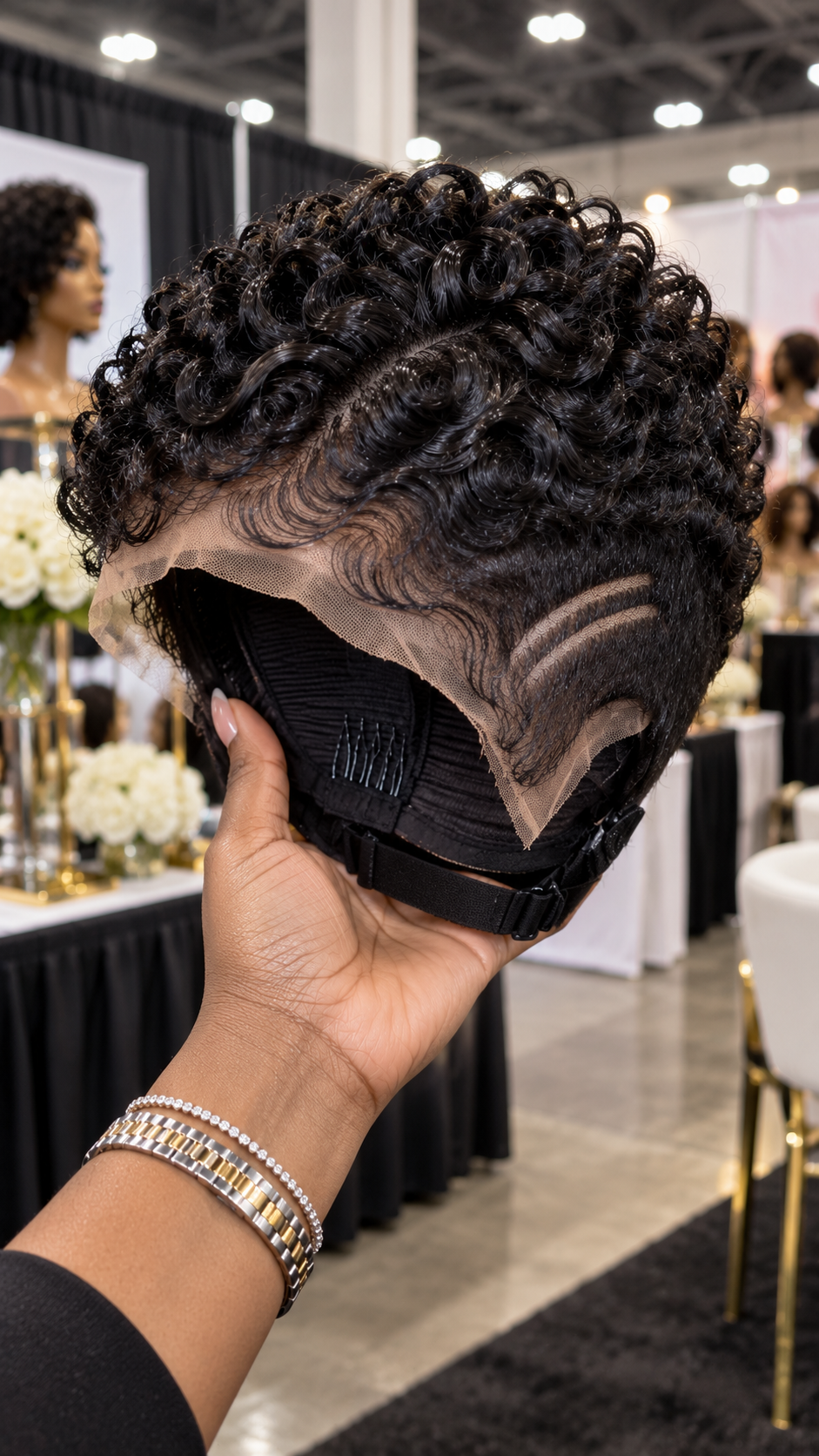
A wig can be styled beautifully from the front and still fail a customer’s expectations once it is worn. The crown may sit too far forward, the temple artwork may fall below its intended position, or the cap may not provide the security the wearer needs. This onyx-black sculpted spiral wig is an excellent reference for examining those decisions together because its exterior styling and part of its interior construction are visible in the same photograph.
The hairpiece is held upright at what appears to be a beauty exhibition or professional hair display. Its crown contains glossy, open spiral curls arranged around an asymmetric parting. Fine, elongated strands form sweeping waves across the front, while the visible side carries two narrow curved channels above a compact dark section. Untrimmed beige-toned lace extends beyond the front and temple, and the underside reveals black cap fabric, interior comb teeth and an adjustable fastening strap.
The most useful way to evaluate this unit is to consider the finished hairstyle and the unfinished installation work separately. The spirals, front waves and carved side pattern have already been arranged. Cap fitting, lace trimming and confirmation of the intended attachment method remain individual purchasing or installation considerations. The visible hardware provides helpful evidence, but it does not independently establish the hair fiber, lace grade or adhesive-free suitability.
The Interior Construction Is the First Buying Decision
Before focusing on the glossy curls, examine the black cap visible beneath the lace. The photograph shows a structured foundation with stitched sections, comb-style teeth and a dark adjustable fastening strap near the lower opening.


These components matter because a wig’s security depends on more than the attractiveness of its exterior. A buyer needs a cap that fits the head correctly and accommodates the preferred installation method.
The adjustable strap appears capable of changing the tension within its designed range. However, an adjustment mechanism cannot compensate for every sizing difference. A significantly unsuitable cap may remain uncomfortable or unstable even after tightening.
The visible comb teeth also require consideration. Their placement should be compatible with the wearer’s hair and attachment preferences. Customers should confirm the complete hardware arrangement with the seller before purchasing.
Why the Adjustable Band Deserves a Separate Inspection
The lower interior strap is clearly visible across the open cap. Its dark material and fastening hardware suggest a system intended to provide some degree of adjustment.
For everyday use, the important questions concern the available adjustment range, how the strap is attached to the cap and whether replacement or repair is possible if the hardware becomes damaged.
The photograph does not establish those specifications, so they should be requested from the supplier rather than assumed.
A customer planning regular wear may also want to understand how the strap should be positioned during fitting. Excessive tension is not a substitute for correct sizing.
Visible Combs Do Not Prove Adhesive-Free Suitability
The interior includes comb-style attachment teeth. These can be useful components, but their presence alone does not establish that the unit is intended for glueless installation.
Whether adhesive-free wear is appropriate depends on the complete cap design, adjustment system, fit and the manufacturer’s instructions.
Some wearers may prefer not to use internal combs, depending on their hair condition or personal comfort. For made-to-order work, ask whether attachment options can be discussed before production.
Any glueless claim should be verified directly with the supplier. The photograph supports describing visible combs and a fastening strap, not guaranteeing a specific wearing method.
The Crown Contains Broad Spiral Formations Rather Than Tiny Coils
Across the upper hair, numerous circular and partially open spiral curls overlap in a rounded arrangement. Several have wide centers, while smaller formations fill the spaces between them.
The strands appear gathered into glossy ribbons that turn inward, creating circular openings instead of hanging loosely downward.
Compared with a wig constructed entirely from narrow corkscrew columns, these curls look broader and more sculptural. Their changing sizes contribute to a crown that appears full without relying on excessively long hair.
A professional recreation should preserve the mixture of large and medium circular sections. Replacing them with uniformly tiny coils would change the crown’s visual character.
The Crown’s Asymmetry Comes From a Visible Division
A parting travels diagonally through the upper styling, separating groups of curls and influencing the direction of the surrounding hair.
This division is not centered across the crown. Its angled position creates an asymmetric arrangement, with the curls distributed differently on either side.
The part also contributes to the shape of the front waves. Several strands follow the direction established by the division rather than falling randomly across the hairline.
For custom production, the maker should establish the parting before completing the spiral placement. Moving it significantly afterward may require rebuilding nearby curls.
Onyx Black Creates Depth Through Reflection
The hairstyle appears consistently deep black, with narrow reflective highlights along the raised spiral surfaces. Some strands show charcoal or warm black reflections under the exhibition lighting, but there is no clearly established second hair color.
The dark palette makes the spiral openings particularly important. Recessed sections remain nearly black while the raised outer strands reflect enough light to remain distinguishable.
A buyer requesting an accurate version should prioritize the styling rather than adding contrasting highlights. Blonde, copper or burgundy streaks would introduce a different color arrangement.
For shade confirmation, a neutral-light photograph of the actual available hair can help distinguish natural black from strongly blue-black fiber.
Large Front Spirals Give the Hairpiece a Rounded Crest
Near the forward crown, several open curls sit above the finer hairline strands. Their circular forms rise enough to create noticeable height without becoming extremely tall.
The curls do not all face the same direction. Some openings turn outward, while others sit at an angle that reveals more of their glossy outer surfaces.
This variation makes the crown appear deliberately arranged without resembling a rigid sequence of identical circles.
A custom stylist should preserve the relationship between these larger forward spirals and the smaller surrounding curls. Adding excessive hair around the front could obscure their individual shapes.
The Front Hairline Uses Feathered Curved Strands
Beneath the raised spirals, finer black strands travel across the front in elongated curves. These sections occupy less volume than the crown and create a gradual transition toward the lace.
Several strands bend in coordinated directions, producing a layered finger-wave appearance. Their shape helps connect the upper curls to the decorated temple.
These finer pieces should not automatically be removed during fitting. They form part of the visible front styling and may contribute to the intended appearance once the wig is positioned on the wearer.
A professional should evaluate them before deciding whether any trimming or repositioning is necessary.
The Temple Artwork Uses Two Sweeping Arches
The visible side contains two narrow exposed curved pathways arranged beneath the crown. The upper line travels through the compact hair before the lower line follows a related curve closer to the temple.
The channels are not ordinary straight barber stripes. Their shape follows the rounded contour of the hairpiece and creates a layered arch arrangement.
Dark hair remains between the exposed paths, allowing both curves to remain individually recognizable.
For a custom order, provide a direct side photograph and specify the curvature and relative spacing. A generic request for two shaved lines may not communicate the actual shape.
The Hair Between the Arches Is Essential
The exposed temple channels create contrast only because substantial dark hair remains around them. The retained sections form the visible boundaries of the design.
If the channels are widened unnecessarily, the separating panel may become too narrow. The two arches could begin merging into one exposed area.
This is particularly important with a wig because removed strands cannot naturally grow back.
A professional should preserve the existing carving rather than deepening it automatically during every maintenance appointment.
The Lower Side Has a Compact Curled Surface
Beneath the exposed arches, the hair becomes finer and lies close to the foundation. The lower section remains visibly populated instead of appearing completely bare.
This compact surface allows the crown’s larger spirals to remain dominant while providing a dark background for the temple design.
A custom maker should avoid extending the upper curl size throughout the side, which could hide the arches and make the hairstyle excessively full.
The correct transition moves from raised crown spirals into flatter front waves, then into closely arranged lower hair.
The Lace Perimeter Has Not Yet Been Customized
The photograph shows beige-toned mesh extending beyond the front and side hair-bearing edges. The lace has not been trimmed to a specific wearer’s outline.
This gives the installer flexibility to position the unit before determining the final cut.
The temple area requires particular attention because the curved channels are fixed to the cap. Moving the wig forward or backward changes where the arches sit relative to the wearer’s face.
The lace appears fine, but its exact material and commercial grade cannot be confirmed from the photograph. Buyers should request verified specifications instead of assuming HD lace.
Cap Measurements Affect the Position of the Artwork
The crown parting, front waves and temple arches are fixed to the wig foundation. Their placement changes when the cap moves.
For someone commissioning this exact hairstyle, correct measurements can be as important as curl accuracy.
Follow the maker’s sizing instructions. Depending on the construction, circumference, front-to-nape and ear-to-ear measurements may be relevant.
A professional wig stylist can help establish the appropriate size before an expensive custom order is placed.
Inspect the Complete Underside Before Purchasing
Although the photograph reveals useful cap details, the entire interior is not visible. A separate underside photograph should show the full construction, including all attachments and adjustment components.
The buyer should confirm whether the actual unit being sold uses the same hardware as the example.
For a custom commission, attachment preferences should be discussed before production.
This avoids discovering after delivery that the interior construction differs from the buyer’s intended installation method.
Where to Find a Specialist for This Design
Custom lace-wig studios, sculpted-wig makers and salons experienced with finger coils and precision temple styling are practical places to begin.
The maker should be comfortable arranging broad open spirals, creating a diagonal crown part and preparing curved side channels without unnecessarily removing surrounding hair.
Experience with ordinary loose curls does not automatically demonstrate the required skills.
Ask for portfolio photographs showing the crown from above and the decorated side from a direct profile.
Ready-Made Stock Versus Custom Construction
A ready-made unit can be convenient if its crown, side geometry and cap measurements already match the buyer’s needs.
A custom commission may be preferable when specific adjustments are required to the curl placement, temple arches or interior attachment system.
Before ordering, clarify whether the seller supplies the hairstyle fully completed or expects local salon work after delivery.
The final cost should account for any remaining styling, fitting and lace preparation.
Build a Detailed Production Brief
Begin with the crown: deep black open spiral curls with varying diameters, arranged around an asymmetric diagonal part.
Specify elongated feathered front waves beneath the upper curls.
The side should include two curved exposed temple channels surrounded by compact dark hair.
The cap requirements should then identify measurements, lace options, preferred attachments and any adjustment system.
This provides a much clearer instruction than asking for a black curly wig with shaved lines.
Approval Photographs Should Cover Both Exterior and Interior
An elevated crown photograph should reveal spiral size, opening direction and part placement.
A direct side image should document both temple arches and the retained hair between them.
A frontal photograph can show the feathered hairline and the first row of curls.
A rear photograph should confirm that the crown remains consistent around the back, while a complete underside image should document the cap construction.
Pricing Depends on Both Styling and Cap Preparation
This hairstyle may require several kinds of professional work. The crown contains individually arranged spirals, the front uses precise directional waves, and the temple design requires careful cutting.
The adjustable cap, lace preparation and any custom attachment preferences may contribute to the quotation.
Estimated Pricing for Sculpted Black Spiral Wigs With Temple Arches
| Category | Illustrative Price Range | Potential Scope |
|---|---|---|
| Premium Custom | $330–$600+ | Higher-grade hair, personalized cap measurements, hand-arranged black spiral crown, diagonal parting, feathered hairline waves, curved temple artwork and selected cap preparation. |
| Standard Custom | $200–$355 | Prepared spiral crown, double-arch temple design and standardized adjustable cap options. |
| Basic Human Hair | $115–$215 | A human-hair foundation requiring spiral setting, temple customization and professional fitting. |
| Premium Synthetic | $80–$160 | A quality pre-set alternative that may preserve the spiral crown with relatively limited professional restyling. |
| Basic Synthetic | $40–$95 | A budget interpretation where curl separation, side precision or cap construction may be simpler. |
These are illustrative budgeting estimates rather than verified quotations for the photographed wig. Actual prices depend on material, seller, location, customization labor, cap construction, shipping and installation.
Before comparing suppliers, ask whether the completed crown, temple artwork and intended interior hardware are included in the price. A cheaper foundation requiring substantial additional work may ultimately cost more.
Human Hair Can Offer Greater Restyling Flexibility
A human-hair version may allow selected spirals to be reset when they lose their shape, depending on the condition of the strands.
The directional hairline waves can potentially be maintained separately from the circular crown.
Heat should be chosen according to the actual hair quality and processing history rather than assuming unlimited tolerance.
Premium Synthetic Can Help Retain Pre-Set Spirals
A quality synthetic version may preserve the circular crown with comparatively little daily intervention.
This can be useful for buyers who prefer to retain the original hairstyle rather than frequently change it.
However, heat tolerance and future modification options vary. The actual fiber should be confirmed before styling tools or chemical products are used.
Check the Interior Before Each Installation
Because the wig contains visible attachment hardware, regular inspection should include the cap as well as the hair.
Check whether the adjustment strap remains securely attached and whether the visible comb teeth are in good condition.
Inspect the lace for signs of damage near areas that may experience tension during fitting.
These checks should follow the manufacturer’s guidance and should not involve excessive tightening of the cap.
Protect the Spiral Crown During Washing
Before washing, photograph the crown from above. This records the original placement and diameter of the curls.
Avoid aggressive rubbing that could intertwine neighboring spirals or collapse their openings.
Use care methods appropriate for the confirmed human-hair or synthetic material.
After drying, restore only the sections that have moved rather than rebuilding the entire hairstyle unnecessarily.
The Forehead Waves Need Separate Maintenance
The fine front strands should retain their elongated curved direction rather than being rolled into additional circular coils.
If one wave becomes displaced, guide it back along the original route using material-appropriate styling methods.
Excessive holding product may cause neighboring strands to adhere together and reduce the delicate detail.
Preserve the Temple Arches Without Enlarging Them
The exposed side channels are permanent design elements. They do not need to be widened automatically during routine maintenance.
If fine hairs shift across an opening, careful repositioning may restore visibility without cutting.
When professional refinement becomes necessary, use the original side photograph to preserve the channel widths and curvature.
Repeated aggressive cutting can reduce the dark hair separating the arches.
Storage Should Protect the Crown and Fastening Hardware
A suitable wig stand or mannequin head can help maintain the raised spirals between wears.
The decorated side should remain clear of pressure that could shift fine strands across the carved channels.
Make sure the cap and lace are fully dry before storage.
Position the adjustment strap and comb attachments so they do not snag the lace or neighboring curls during transportation.
The Best Purchase Combines Styling Accuracy With a Suitable Foundation
This onyx-black wig demonstrates how an intricate sculpted hairstyle can remain monochromatic while using several distinct construction techniques. Large open spirals create the crown, an asymmetric part organizes the upper sections, feathered waves frame the front and two curved temple channels decorate the compact lower side.
For buyers, the essential quality checks are spiral diameter, open curl centers, parting direction, forehead-wave placement, temple-channel geometry, lace condition, cap measurements and visible adjustment hardware.
For wig businesses, exterior photographs alone cannot answer every purchasing question. Showing the crown, side and interior foundation allows customers to understand the hairstyle and practical construction separately.
A faithful recreation should preserve the original shapes without adding unrelated highlights, exaggerated crown volume or additional carved lines. The strongest result will combine accurate spiral styling with a properly specified cap and installation method suited to the wearer’s needs.
Search Terms
onyx black sculpted spiral wig · asymmetric crown part lace wig · twin curved temple arches · feathered forehead wave hairpiece · black open circular coil crown · adjustable strap spiral wig · internal comb lace cap wig · untrimmed lace black curls