
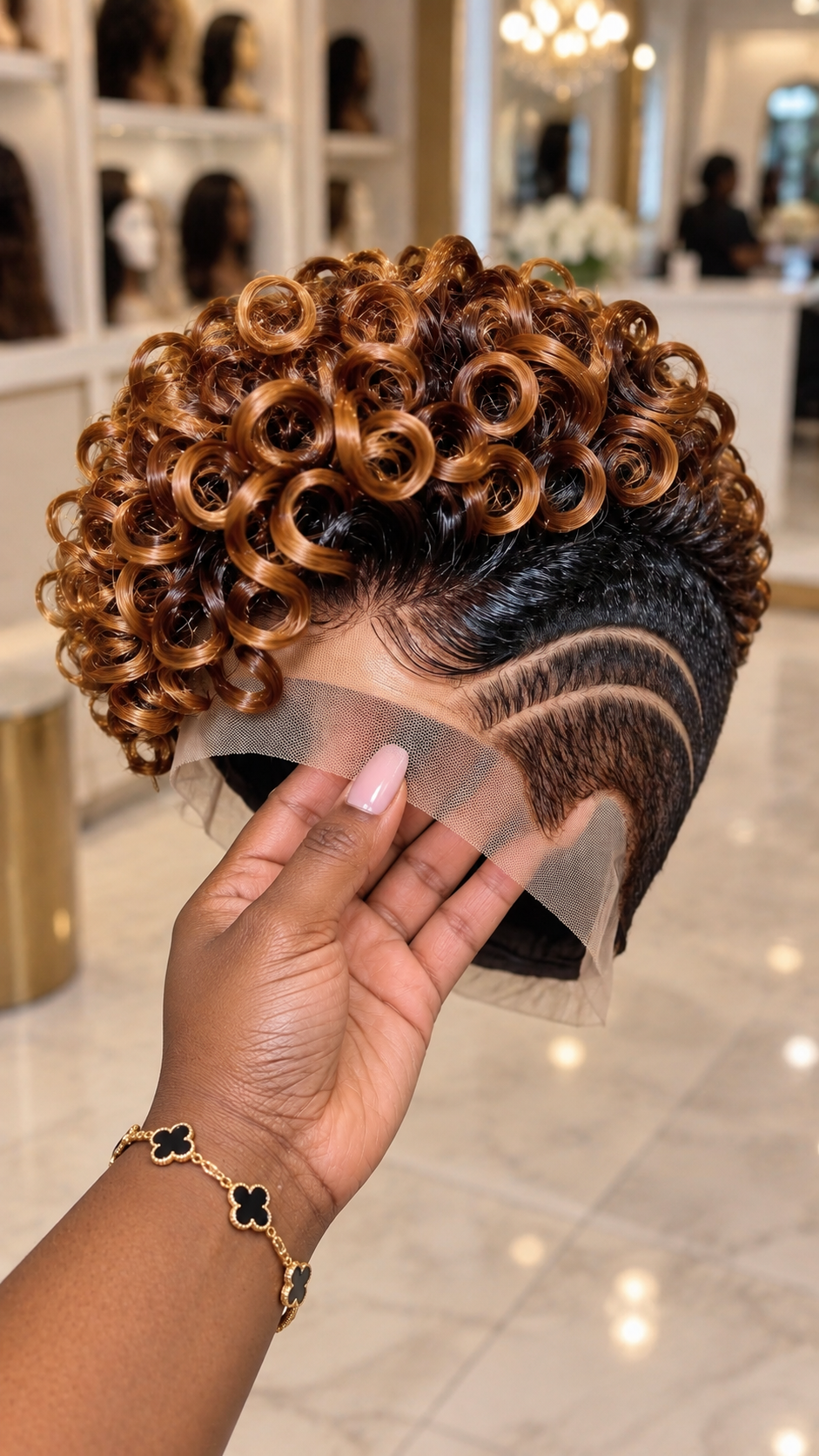
What makes a curly pixie wig memorable when hundreds of similar styles are available? In this photograph, the answer is a striking combination of golden caramel ringlets, a dark sculpted side, and two flowing temple separations. The curls create a rounded, lively crown, while the closely arranged black hair beneath them provides a contrasting foundation that gives the hairstyle its distinctive personality.
The wig is being presented by hand inside an elegant hair salon, with its frontal lace extending beyond the hairline. This pre-installation view reveals details that are often concealed in photographs of finished hairstyles. Buyers can examine the circular curls, the color transition, the sculpted side arrangement, and part of the cap before deciding whether a similar wig is suitable for them.
The crown contains numerous open-centered ringlets in warm golden caramel and deeper brown tones. Several curls face forward, making their circular openings particularly noticeable. Others overlap or turn diagonally, creating a dense arrangement without losing the individual character of the loops. Beneath the crown, dark hair follows a sweeping direction toward the side, where two prominent curved channels form a decorative temple pattern.


This hairstyle is best approached as a carefully arranged curly pixie lace wig rather than a generic brown curly hairpiece. Its successful reproduction depends on maintaining the rounded crown, the warm color placement, and the distinctive temple geometry.
Golden Caramel Curls That Dominate the Upper Silhouette
The most visually prominent element is the crown, which is filled with rounded spiral ringlets. The curls have visible openings and relatively broad circular surfaces, allowing the golden caramel color to catch the light.
The front contains several particularly noticeable curls that extend toward the hairline. These ringlets are arranged at slightly different angles, creating movement and depth without requiring long hair.
Across the central crown, the curls remain closely grouped. Some loops overlap neighboring sections, while others face outward and reveal their hollow centers. The arrangement produces a rounded silhouette that sits above the compact dark side.
The ringlets are not loose waves or tightly packed natural coils. They resemble individually formed circular curls with a glossy, ribbon-like appearance.
This distinction is important for buyers because many products advertised as curly pixie wigs use different curl structures. A wig with small spring-shaped coils may have a similar length but will not reproduce the broad circular appearance shown here.
Why the Front Ringlets Need Special Attention
The frontal curls contribute significantly to the hairstyle’s overall balance. Several golden loops sit close to the hairline, creating a rounded edge above the dark frontal styling.
If these curls are positioned too far backward, the hairstyle may appear flatter from the front. If they extend excessively forward, they could obscure the hairline or interfere with the intended temple arrangement.
A custom wig maker should therefore consider the placement of the frontal ringlets separately from the rest of the crown.
Customers should request photographs from the front and upper three-quarter angle before approving a completed custom unit. These perspectives help establish whether the curls frame the face appropriately.
Understanding the Golden Caramel and Dark Brown Combination
The crown displays a warm golden caramel color with honey-brown and deeper chestnut reflections. Some curls appear lighter where the salon lighting strikes their curved surfaces, while others retain a richer brown appearance.
The darker foundation is particularly noticeable beneath the curls and throughout the temple area. This creates a pronounced contrast between the upper styling and the closely arranged side hair.
Unlike a uniform golden blonde wig, the color here includes substantial brown depth. The ringlets are not all identical in tone, and darker strands remain visible between many of the lighter curls.
The photograph does not show a clear silver, burgundy, or bright copper-red treatment. Its palette is primarily warm caramel, golden brown, chestnut, and black.
Buyers seeking an accurate color match should avoid relying solely on a manufacturer’s shade name. Terms such as caramel blonde, honey brown, and golden chestnut can refer to noticeably different colors.
Evaluating the Shade Under Different Lighting
The salon environment contains warm lighting and pale interior surfaces that can influence how the hair appears in photographs.
Golden brown strands may look brighter under warm lights than they do outdoors. For this reason, customers should request additional images under daylight or neutral indoor illumination.
It is also useful to compare the lighter curls against the dark root color. The contrast between these areas contributes to the hairstyle’s appearance.
A custom order should specify that the temple remains predominantly dark while the crown carries the golden caramel color.
The Twin Temple Curves Create a Decorative Side Profile
Beneath the crown, the visible side contains two prominent curved parting channels. These exposed lines follow a sweeping direction across the temple, creating a layered appearance within the dark hair.
The upper channel begins near the frontal region and travels backward along the side. A second curved separation sits beneath it, following a similar path before turning toward the lower temple.
The dark hair between these channels forms a distinct band, contributing to the sculpted appearance.
Unlike hairstyles with multiple straight razor lines, this design relies on broad curves that follow the contour of the head. The lines are not perfectly parallel because their spacing and direction change along the temple.
The exposed areas appear scalp-toned, but the photograph does not establish the exact technique used to create them. They should be described as visible curved separations rather than assumed to be razor cuts into natural hair.
Keeping the Two Curves Proportional
The spacing between the channels is essential to the finished appearance. If the dark band becomes too narrow, the pattern may appear crowded. If it becomes excessively wide, the curves may lose their visual connection.
The reference shows a broad upper sweep and a lower curve that follows the temple’s contour.
Customers commissioning a similar wig should provide a clear side photograph and ask the stylist to preserve the relative placement of both channels.
Adding extra decorative lines would change the original design and could make the temple appear busier than intended.
The Dark Frontal Waves Provide a Visual Transition
Between the circular crown and the curved temple channels, the hair is arranged into elongated dark waves. These strands sweep backward from the frontal region and follow the upper side of the wig.
The frontal styling is comparatively flat, creating a transition between the raised ringlets and the compact temple panel.
Fine strands are visible near the hairline, where the dark hair meets the exposed lace. Their placement contributes to the intended frontal appearance.
This transitional area is important because the crown curls do not simply begin at the lace edge. The dark waves create a boundary that helps separate the ornamental upper section from the frontal hairline.
Customers should ask their wig maker to preserve this relationship rather than allowing the golden curls to cover the entire frontal region.
What the Untrimmed Lace Reveals About Installation
The wig is held with a substantial section of beige lace extending beyond the frontal hairline. The mesh hangs across the front and toward the visible side, indicating that it has not yet been trimmed for an individual wearer.
The lace appears fine in the photograph, but its exact grade cannot be confirmed visually. It should not automatically be described as HD lace or another specialized material.
The photograph also shows part of the dark interior cap beneath the mesh. However, the complete underside is not visible, so the number of attachment combs, adjustable straps, and other hardware cannot be established.
Buyers should request additional photographs showing the frontal lace lying flat and the complete interior construction.
These images can help determine whether the wig is suitable for the customer’s measurements and preferred installation method.
Why Lace Trimming Should Wait Until Fitting
The position of the frontal lace affects the appearance of the temple curves and the nearby ringlets. If the wig sits too far forward or backward, the decorative side pattern may not align naturally with the wearer’s face.
A professional installer should first check the cap fit and position the wig correctly.
Only after confirming the hairline should the excess lace be trimmed.
Removing too much mesh can compromise the frontal edge and may be difficult to repair.
The lace color should also be assessed against the wearer’s complexion rather than judged exclusively from the photograph.
Choosing a Wig Maker for This Curl and Temple Combination
Customers searching for this hairstyle should look for specialists experienced in decorative pixie wigs, circular curl styling, and sculpted temple arrangements.
Custom wig studios, specialist lace wig salons, and independent hairpiece makers may offer suitable services.
When reviewing previous work, look for examples of open-centered ringlets and curved side partings. A stylist experienced only with ordinary loose curls may not necessarily be able to reproduce the detailed crown arrangement.
Send the reference photograph and explain that the desired design contains golden caramel circular curls, a dark frontal wave section, and two curved temple channels.
Ask whether the proposed hair material can maintain the circular shapes and whether the side pattern can be incorporated into the wig without exposing unwanted construction details.
What to Request Before Placing an Online Order
Ask the seller to confirm the fiber type, cap measurements, lace specifications, and available attachment options.
Request actual photographs of the product being shipped rather than relying entirely on promotional images.
For a custom commission, establish the expected production time, payment terms, revision policy, and whether the completed styling is included in the price.
It is also useful to request a brief video showing the crown from multiple angles. This can reveal whether the circular curls remain visible throughout the upper hairstyle.
Customers should avoid assuming that a similar color automatically means the curl construction is equivalent.
Ready-Made Versus Custom Styling
A ready-made wig may be convenient if it already contains the correct circular curls and decorative temple arrangement.
However, many golden brown pixie wigs contain ordinary spirals or loosely curled hair without sculpted side channels.
Custom production may offer greater control over curl diameter, color placement, temple geometry, and cap fit.
Before purchasing a basic wig for customization, consult a specialist to determine whether the existing hair density and construction can support the intended design.
Attempting to create exposed channels in an unsuitable wig may reveal underlying materials or produce unwanted gaps.
Estimated Prices for Golden Caramel Ringlet Pixie Wigs
The cost of this hairstyle may be influenced by the number of individually arranged ringlets, the golden caramel color placement, the sculpted temple channels, and the lace construction.
The following USD figures are illustrative planning ranges, not verified current retail prices or quotations for the photographed wig.
| Wig Category | Illustrative USD Range | Potential Purchasing Considerations |
|---|---|---|
| Premium Custom | $340–$770+ | Individually arranged golden caramel ringlets, specialist temple styling, personalized color placement, and possible lace fitting services. |
| Standard Custom | $185–$400 | Customized circular curls and twin temple channels with selected cap and frontal adjustments. |
| Basic Human Hair | $105–$255 | A possible human-hair foundation that may require separate coloring, curl shaping, and decorative side work. |
| Premium Synthetic | $80–$190 | A potential pre-styled alternative if the manufacturer offers comparable circular ringlets and curved temple detailing. |
| Basic Synthetic | $35–$95 | Budget options may resemble the general caramel curly silhouette without reproducing the intricate styling. |
These categories describe possible purchasing options rather than the confirmed material of the photographed wig. The image does not establish whether its strands are human hair, synthetic fiber, or a blend.
Before accepting a quotation, confirm whether the price includes the finished curls, color work, lace preparation, and cap adjustments.
Shipping, professional installation, and future maintenance may be charged separately.
For this design, the quality of the circular curls and the accuracy of the temple pattern should be considered alongside the initial price.
Maintaining the Ringlets Without Losing Their Open Shape
The crown depends on the circular openings remaining visible. Repeated brushing, pulling, or compression may disturb the ringlets and reduce their individual character.
Customers should avoid separating the curls unnecessarily.
Before washing or applying styling products, confirm the fiber type and obtain appropriate care instructions from the seller.
If the wig is synthetic, heat styling should only be attempted when the manufacturer confirms suitable temperature limits. If it contains human hair, previous coloring and processing may influence its response to further treatment.
The golden caramel shade may also require material-specific care to preserve its appearance.
Keeping the Temple Waves in Position
The dark temple styling depends on closely directed strands surrounding the curved channels.
Excessive product buildup or aggressive manipulation may interfere with the clarity of these separations.
Ask the original stylist which products and maintenance techniques are appropriate for the side arrangement.
Avoid attempting to deepen or widen the channels without professional guidance. Removing hair from a wig can be irreversible and may expose the underlying construction.
When storing the unit, support the cap without compressing the crown or stretching the frontal lace.
Choosing This Hairstyle for Its Balanced Detail
This golden caramel pixie wig combines a rounded crown of open circular ringlets with a dark temple decorated by two sweeping curved channels.
The frontal waves connect these sections, creating a coordinated appearance rather than two unrelated styling elements.
For customers seeking a similar wig, accurate curl placement and temple geometry should take priority over generic color descriptions.
Request actual product photographs, confirm the cap and lace specifications, and discuss the intended styling before commissioning custom work.
The strongest reproduction will preserve the golden caramel ringlets, dark foundation, proportional crown height, and carefully positioned temple curves without introducing unnecessary additional details.
With appropriate construction and professional fitting, this design offers a distinctive example of ornamental pixie wig styling in which color, circular curls, and sculpted side waves contribute equally to the finished appearance.
Search Terms
Golden caramel circular ringlet pixie wig · Twin curved temple wave lace hairpiece · Honey brown open spiral crown wig · Black side golden caramel curly pixie · Beige untrimmed frontal lace ringlets · Sculpted dark temple golden curl wig · Warm chestnut circular crown hairstyle · Caramel blonde ringlets with sweeping side channels