
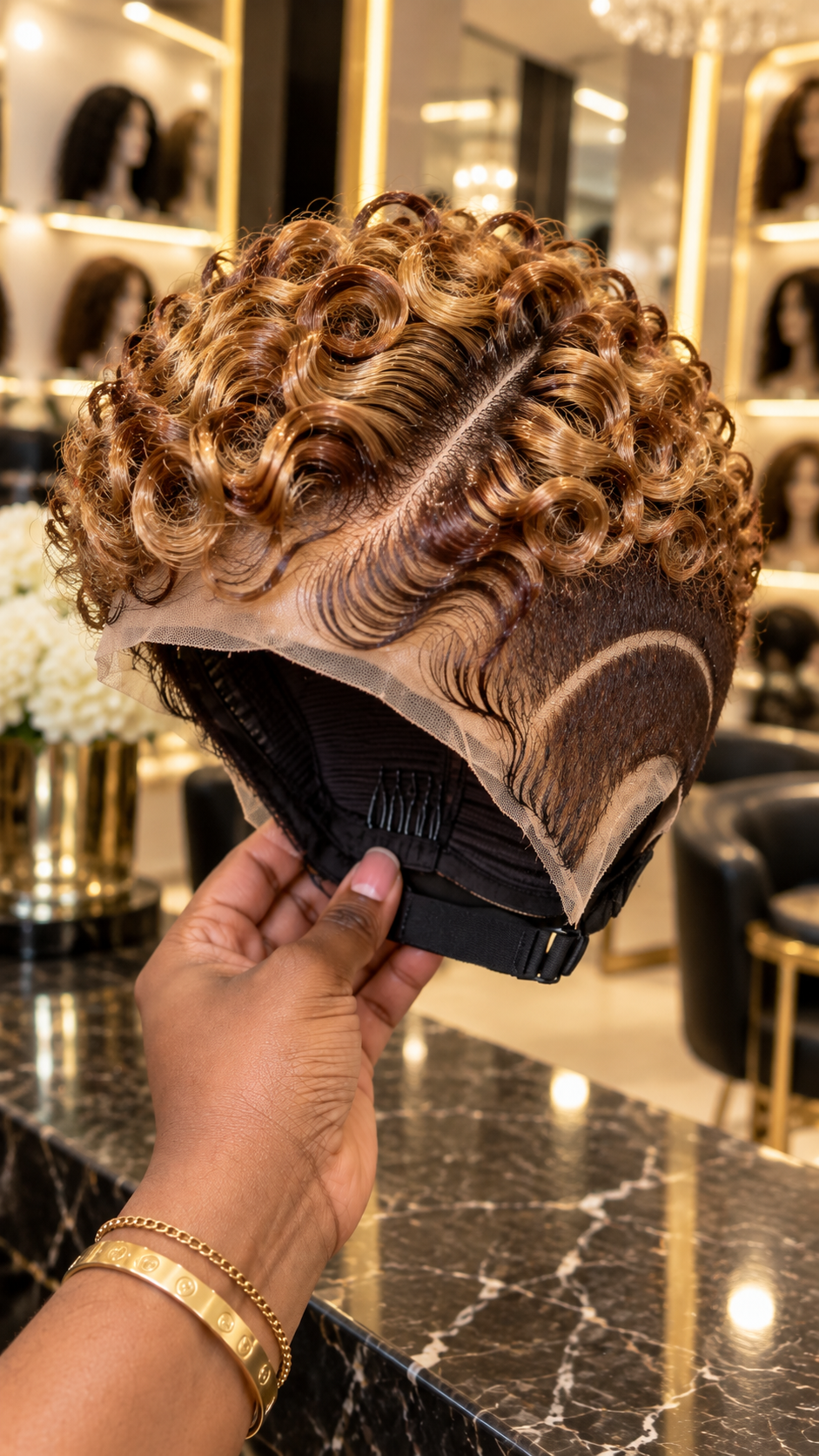
Not every curly pixie wig is designed to look the same from every angle. This caramel bronze lace wig introduces an unexpected detail through a diagonal parting that travels into the raised spiral arrangement, dividing the upper curls into two visually distinct sections. Beneath that separation, glossy finger-wave styling flows toward a darker temple panel, where a broad curved channel creates an additional decorative accent. The result is a hairstyle whose strongest appeal comes from the relationship between its curl placement, directional parting, and closely arranged side hair.
The photograph captures the wig before installation, held by one hand inside an elegant hair salon. Warm lighting reflects across the copper-brown and caramel strands, emphasizing the circular shapes of the upper curls. Beige lace remains untrimmed around the visible hairline, while the underside reveals a black fabric cap, an interior comb, and an adjustable strap with a buckle. These construction details provide useful information for buyers evaluating the unit before committing to an installation.
Unlike wigs built around a completely continuous crown of identical curls, this design includes a visible diagonal separation through the upper styling. That distinction changes the direction of the surrounding hair and makes the crown arrangement an important consideration when requesting a similar custom wig.


The Diagonal Crown Division Changes the Entire Composition
The most unusual detail appears near the upper center of the hairstyle. A narrow exposed parting travels diagonally from the front-side region toward the upper rearward curls. Hair on either side follows different directions, creating two adjoining arrangements rather than one uninterrupted mass of ringlets.
On one side of the division, broad spiral sections rise and curl backward. Several circular openings are visible among the glossy strands. On the opposite side, smaller rings and directional curls gather closely around the parting, producing a more compact arrangement.
The separation is not simply a conventional straight middle part. Its diagonal orientation follows the sculpted shape of the hairstyle, helping guide the eye from the front hairline toward the upper curls.
This detail should be treated as an essential design element during customization. A wig maker who fills the entire upper section with curls may reproduce the color and general silhouette but lose the distinctive directional structure.
Where the Hair Changes Direction
The strands immediately beside the parting are closely arranged before rising into larger curls. This creates a transition between the exposed channel and the elevated spiral shapes.
Some curls appear to turn inward toward the separation, while others project outward and backward. Their different orientations make the upper surface more intricate than a uniform ringlet arrangement.
The photograph does not establish the exact technique used to construct the parting or secure the surrounding curls. A customer should ask the wig maker whether the proposed styling method can maintain this arrangement during normal wear.
When reviewing a custom sample, the buyer should examine the diagonal channel from the same angle as the reference. A frontal photograph alone may not reveal whether the division has been positioned correctly.
Caramel Bronze Coloring With a Darker Understructure
The visible upper hair contains a warm mixture of caramel brown, bronze, and copper-toned reflections. Certain curls appear golden where the salon lighting strikes their outer surfaces, while deeper brown strands remain visible within the overlapping rings.
The overall impression is a rich warm brown rather than a pale blonde or bright orange hairstyle. The color has considerable visual depth because the circular curls expose both reflective outer strands and darker interiors.
The lower temple hair appears noticeably darker than the elevated upper curls. This difference helps separate the decorative side arrangement from the more voluminous crown.
Although several shades are visible, the photograph cannot establish whether they result from deliberate highlights, blended hair colors, or lighting effects. The exact dye formula and commercial shade numbers remain unknown.
Matching the Shade for a Custom Order
A buyer should describe the desired color as caramel bronze with warm copper-brown reflections and a darker brown temple section. This communicates the general appearance without inventing a specific color code.
Request photographs of the proposed hair under daylight and ordinary indoor lighting. Warm salon illumination can intensify golden reflections, making a shade appear brighter than it would in a different environment.
If the seller proposes a uniform caramel color, ask whether enough darker strands will remain visible to preserve the contrast around the diagonal parting and lower wave panel.
The goal should be to reproduce the observed balance of warm upper curls and darker closely arranged hair, rather than simply selecting the brightest available copper shade.
Open Spiral Rings With Different Degrees of Elevation
The upper curls are arranged into numerous rounded loops, many with clearly visible circular openings. Some resemble compact barrel curls, while others form elongated spiral shapes that curve across neighboring sections.
The central area contains several prominent rings positioned above the diagonal parting. Around the outer edges, smaller curls fill the spaces between larger sections, producing a layered appearance.
The curls do not all rise to the same height. Some stand noticeably above the surrounding hair, while others sit closer to the crown. This variation contributes to the hairstyle’s irregular yet coordinated silhouette.
Near the front, several spiral sections extend toward the lace hairline. Their placement provides a transition between the raised curls and the flatter finger-wave styling below.
The exact diameter of each ring cannot be measured reliably from the photograph, but the visible variation is clear enough to guide a custom stylist.
Why Ordinary Loose Curls Would Produce a Different Result
A standard curly pixie typically allows individual curls to fall or spring naturally according to their length and setting. This wig instead displays curls that appear deliberately arranged into circular forms.
The open centers are particularly important. They create small areas of shadow within the crown, making the loops appear more dimensional.
If the maker uses curls that are too narrow, the result may resemble tightly coiled hair rather than the visible barrel-like rings. If the curls are excessively broad, the crown may lose its compact appearance.
A suitable stylist should understand how to balance curl size, placement, and overall height without relying solely on increased hair density.
The Front Finger Waves Connect the Crown to the Temple
Below the diagonal upper parting, the hair transitions into a glossy finger-wave arrangement. Several closely aligned strands curve across the front-side section, following a controlled directional pattern.
The waves are especially noticeable near the lace hairline, where individual strands form repeated curved paths. Their appearance contrasts with the larger circular curls above.
This transition is important because it prevents the hairstyle from consisting of two unrelated sections. The finger waves guide the eye downward from the upper curls toward the temple design.
The visible wave arrangement includes dark brown and warm bronze reflections, depending on the direction of the strands and the lighting.
For a custom order, the stylist should be asked to preserve the relationship between the diagonal parting, the front waves, and the lower side panel. Styling each area independently without considering the transitions could change the overall appearance.
A Broad Curved Channel Frames the Lower Temple
The lower side contains a prominent curved separation that follows the contour of the temple area. Its exposed foundation appears lighter than the surrounding dark hair, creating a clear contrast.
The channel bends across the side and descends toward the lower hairline, outlining a substantial section of closely arranged hair. Its shape is more expansive than a small decorative stripe.
The hair inside the curved boundary remains comparatively flat and dark. This provides a visual counterweight to the elevated curls above.
The photograph shows one dominant lower curved channel rather than a series of evenly spaced parallel lines. The upper diagonal parting and the front wave arrangement are separate components of the overall design.
Because this is a wig, the visible channel should not automatically be described as a shaved line on natural skin. Its exact construction method requires confirmation from the maker.
Keeping the Curve in the Correct Position
The lower channel approaches the ear-side region, making cap placement especially important. A wig that sits too high or too low could change the apparent position of the curve.
Customers should provide accurate head measurements and confirm which side should display the decorative pattern.
Before any permanent trimming, the stylist should check whether the curve remains visible when the wig is positioned on the wearer’s head.
Cutting into the side panel or changing the channel’s depth without a clear plan could permanently alter the design.
Visible Cap Hardware and What It Does Not Prove
The photograph offers a useful view of the underside. A black fabric cap is visible beneath the lace, with stitched sections and an interior comb positioned along one area.
An adjustable black strap and buckle can also be seen near the lower edge. These components suggest that the unit includes hardware intended to assist with fitting and attachment.
However, the presence of a strap and comb does not establish that the wig is suitable for adhesive-free wear in every situation. Security depends on the complete cap construction, the wearer’s measurements, and the intended installation method.
The beige lace extends beyond the visible front and side hairline. Its mesh appearance is clear, but the photograph does not establish its exact grade or commercial classification.
A buyer should not assume that the lace is HD lace without independent confirmation from the seller.
Inspecting the Interior Before Purchase
Ask the seller for a complete underside photograph showing all combs, straps, stitching, and the lace perimeter.
Confirm the cap circumference and other relevant measurements. A custom wig maker may also request front-to-nape and ear-to-ear dimensions.
Once the unit arrives, inspect the hardware for loose stitching or damage before installation.
The lace should remain untrimmed until the wig has been fitted and the correct hairline position established.
Finding a Specialist for Diagonal Parting and Spiral Styling
This design requires experience in several areas of wig customization. The stylist must understand elevated spiral curls, directional crown parting, finger-wave arrangement, and precision temple styling.
Begin by searching for wig makers who specialize in sculpted pixie hairstyles and detailed lace-front customization. Their portfolios should contain close-up photographs of finished work rather than only general curly wig examples.
When contacting a salon, send the reference image and identify the diagonal crown division as the primary requirement. This helps distinguish the hairstyle from other caramel curly pixie designs.
Next, explain the desired front finger waves and the broad curved temple channel. The stylist should confirm whether these details can be reproduced on the proposed cap.
For online custom orders, request photographs of previous work showing comparable spiral arrangements and exposed parting designs.
Booking the Right Type of Appointment
A consultation is useful before ordering because the hairstyle combines several techniques that may require different preparation stages.
Ask whether the salon provides the wig itself or expects the customer to supply a suitable base unit.
If the customer supplies the wig, the stylist should assess whether the existing hair length, density, and cap construction can support the desired arrangement.
Confirm whether the quoted service includes curl setting, finger-wave styling, temple customization, lace preparation, and installation.
A completed custom wig should ideally be reviewed before shipping or before the final installation appointment.
Comparing a Ready-Made Alternative With a Fully Custom Unit
A ready-made caramel curly pixie may provide a similar warm color and compact silhouette. However, the diagonal crown parting and lower curved channel make this reference more specialized than an ordinary curly wig.
Ready-made options may be suitable for buyers who are flexible about the exact parting structure. A custom order is more appropriate when the diagonal separation and finger-wave transition are essential.
Before choosing, compare the total cost of purchasing a base wig and paying for additional styling against the price of a completed custom unit.
Some base wigs may not have enough suitable hair in the correct areas to reproduce the crown arrangement. Others may require extensive restyling that increases the final expense.
The maker should explain these limitations before the customer commits to a purchase.
Illustrative Pricing for Caramel Bronze Sculpted Lace Wigs
The potential cost of this hairstyle depends on the selected hair material, cap construction, warm color arrangement, spiral setting, diagonal parting work, and detailed temple styling.
The following USD amounts are illustrative planning ranges only. They are not verified live retail prices or quotations for the photographed wig.
| Wig Category | Illustrative USD Range | Possible Inclusions or Limitations |
|---|---|---|
| Premium Custom | $390–$880+ | May include individualized spiral placement, diagonal crown construction, detailed finger waves, custom temple geometry, and cap fitting. |
| Standard Custom | $195–$450 | Could cover the main caramel spiral arrangement and directional side styling on a prepared wig foundation. |
| Basic Human Hair | $110–$280 | A potential starting unit that may require additional coloring, curl setting, and decorative customization. |
| Premium Synthetic | $80–$205 | May offer a pre-styled warm brown curly alternative if the fiber and construction support the required arrangement. |
| Basic Synthetic | $30–$100 | A lower-budget option for a similar color and silhouette, potentially without the diagonal parting or detailed temple styling. |
The photograph does not establish whether the wig contains human hair, synthetic fiber, or a blend. These categories describe possible purchasing options rather than verified properties of the displayed product.
Additional charges may include shipping, lace trimming, cap alterations, professional installation, and future styling restoration.
When comparing quotations, ask whether the price includes the completed diagonal parting and finger-wave arrangement. A generic curly base wig should not be compared directly with a fully customized sculpted unit.
Maintaining the Crown Division and Circular Curls
The diagonal parting is one of the hairstyle’s most recognizable details, so maintenance should preserve the direction of the surrounding hair.
Repeatedly brushing across the separation could disturb the closely arranged strands and reduce the clarity of the parting.
The upper spiral rings also require careful handling. Pulling individual curls apart may change their circular openings and alter the crown’s appearance.
Ask the stylist whether the curls were set using a technique that can be refreshed at home or whether professional restyling is recommended after washing.
If the wig contains human hair, cleansing should account for any coloring and styling products used during preparation.
If synthetic fiber is used, heat tools should not be applied unless the manufacturer confirms the material’s temperature tolerance.
Preserving the Finger-Wave Transition
The front wave section contains closely aligned strands that form repeated curves. Its appearance depends on the hair remaining in the intended direction.
Heavy brushing or excessive product application could disturb this arrangement. The stylist should explain how to refresh the waves without flattening the upper curls.
The lower curved temple channel also needs protection from repeated friction or unnecessary trimming.
Any permanent adjustment to the side pattern should be performed only after evaluating how the wig fits the wearer.
Evaluating the Wig From Multiple Angles
The photograph provides a detailed view of the upper curls, diagonal parting, front waves, lower temple channel, and part of the interior cap. However, it does not show the complete rear surface or the opposite side.
A buyer seeking a faithful reproduction should request additional photographs before approving a custom order.
The frontal view should show how the curls frame the face. The opposite-side photograph should clarify whether the diagonal parting continues across the crown or remains concentrated on the visible side.
A rear view is necessary to evaluate the continuation of the spiral arrangement. An underside photograph should show the complete cap and attachment hardware.
These additional views can help prevent misunderstandings about the intended silhouette and construction.
Who Might Prefer This Directional Spiral Design?
This hairstyle is particularly suitable for customers who enjoy sculpted salon artistry and want a compact wig with considerable visual detail.
The warm caramel bronze coloring offers a rich appearance, while the diagonal parting introduces a distinctive structural element.
The combination can work well for portrait photography, celebrations, fashion-focused occasions, and customers who appreciate carefully arranged curls.
For everyday wear, the buyer should consider the maintenance required to preserve the circular rings and front waves. A hairstyle with several sculpted sections may require more careful handling than a conventional curly wig.
Neutral clothing, warm brown accessories, and simple jewelry can complement the bronze coloring without competing with the intricate hair arrangement.
The Detail That Should Guide the Final Choice
The most valuable aspect of this wig is its directional construction. The diagonal crown division creates movement through the upper curls, while the finger waves and curved temple channel establish a coordinated lower arrangement.
Warm caramel and bronze reflections make the hairstyle visually striking, but color alone does not explain its distinctive appearance.
Customers should prioritize a maker who can reproduce the relationship between the exposed crown parting, circular spirals, and closely arranged temple hair.
The visible cap hardware and untrimmed lace also make accurate measurements and professional fitting important considerations.
A successful custom order should preserve the hairstyle’s directional structure while providing a comfortable, appropriately constructed wig that meets the customer’s expectations for wear and maintenance.
Search Terms
Caramel bronze diagonal parting wig · Copper brown open spiral crown · Sculpted front finger wave lace pixie · Black cap adjustable strap curly wig · Bronze ringlet wig with curved temple channel · Warm caramel barrel curls side design · Beige lace diagonal crown separation · Dark brown temple wave copper spiral wig