
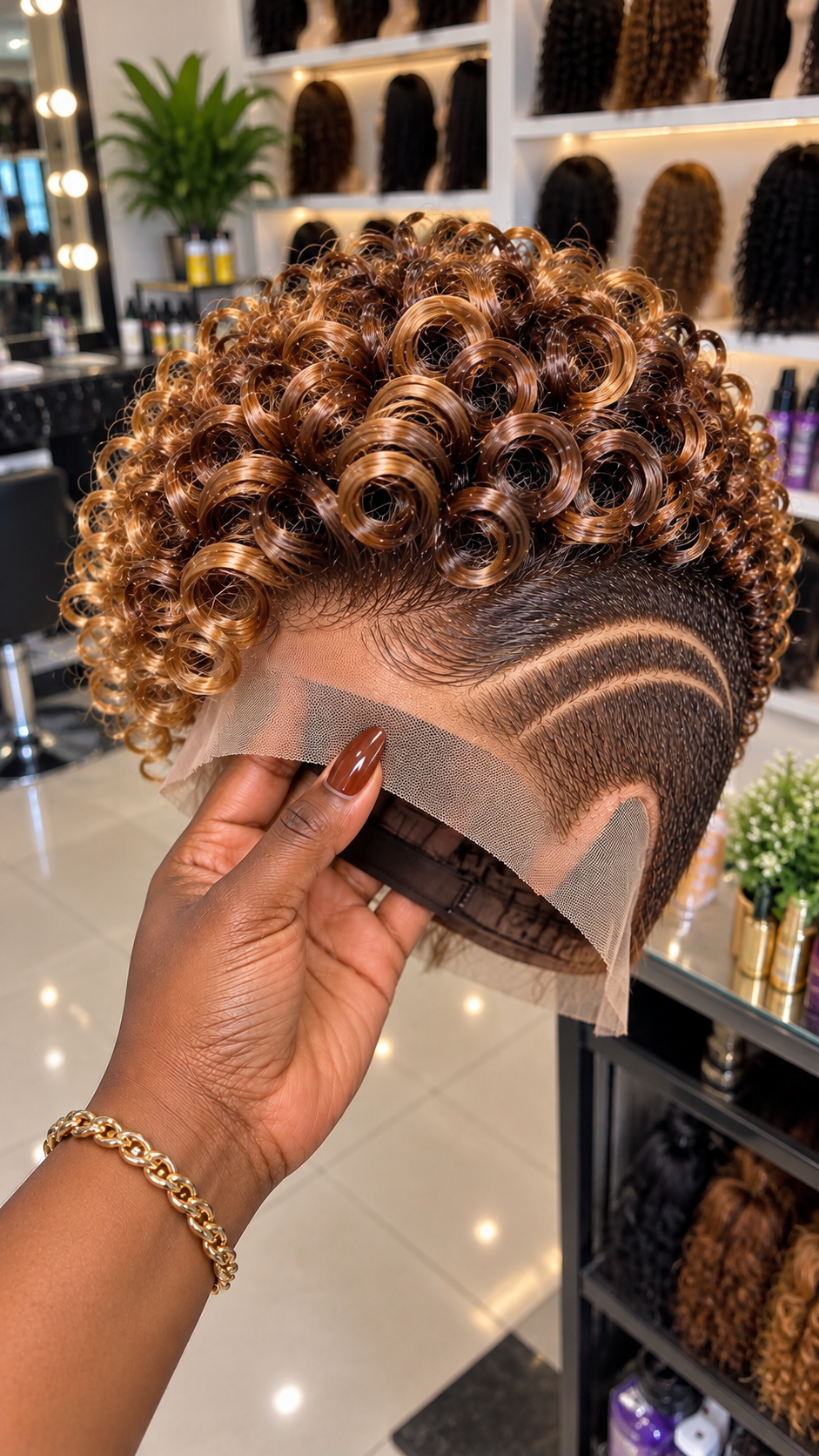
The first thing that makes this wig worth examining is the contrast between its circular upper curls and the two graceful crescent-shaped channels running through the dark temple hair. From a distance, the warm amber and caramel ringlets command attention. At closer range, the precisely arranged side panel reveals a second layer of craftsmanship. This combination gives the hairstyle a distinctive identity that cannot be reproduced simply by purchasing an ordinary curly pixie in a similar color.
Photographed inside a beauty salon, the wig is held in one hand with its front and side lace still extending beyond the hairline. The elevated crown contains dozens of glossy barrel-like rings, many with clearly visible circular openings. Their coloring moves between rich caramel brown, golden amber, and deeper chestnut reflections. Beneath the curls, the closely laid temple section appears dark brown, almost black in its deepest areas, and is interrupted by two sweeping curved parting channels.
The photograph also provides a partial view of the dark brown interior cap. However, it does not establish the hair’s fiber composition, the exact lace grade, or the complete attachment system. Those details should be verified before purchase rather than inferred from the appearance.


For customers interested in a sculpted caramel ringlet lace wig, the most important buying consideration is the balance between the elevated curls and the close-fitting side arrangement. The upper portion needs enough structure to maintain its circular appearance, while the temple pattern must remain visible without being overwhelmed by the surrounding hair.
Why the Circular Openings Matter More Than Curl Quantity
The upper section is composed of tightly arranged ringlets that resemble miniature barrels. Many face outward, revealing dark circular openings surrounded by glossy strands. Others are tilted or partially overlapped, creating a layered arrangement across the upper head.
The curls are not simply hanging downward. They are positioned close together to form a rounded, elevated surface. The central rings appear comparatively large and prominent, while smaller curls fill portions of the front edge and outer perimeter.
This variation is important because the hairstyle relies on visible circular structure. If a wig maker replaces the barrel rings with ordinary corkscrew curls, the resulting silhouette may have a similar overall volume but a substantially different appearance.
The photograph shows a particularly noticeable cluster of open rings above the temple. These curls create a strong visual boundary between the elevated crown and the dark, closely arranged side panel.
Near the front, several smaller caramel curls descend toward the lace hairline. Their placement softens the transition from the larger upper rings to the exposed front perimeter.
Spacing Is Part of the Design
Although the curls are densely packed, individual circular openings remain visible. The darker interiors of the rings create contrast against their reflective outer surfaces.
A custom stylist should therefore consider the distance between neighboring loops. Excessive compression could cause the openings to disappear, while widely separated curls might make the crown appear sparse.
The desired result is a compact arrangement where the ringlets overlap naturally but retain their recognizable circular forms.
The exact setting technique cannot be established from the photograph. Buyers should ask the wig maker how the rings will be created and whether the chosen method is suitable for the proposed hair material.
Amber and Chestnut Reflections Across the Upper Hair
The coloring is one of the hairstyle’s strongest visual qualities. Warm amber, caramel brown, and chestnut tones appear across the raised curls, producing a rich appearance under the salon lighting.
Some rings look distinctly golden, especially where light strikes their upper surfaces. Others appear deeper brown, particularly within the circular openings and overlapping sections.
The photograph does not clearly establish whether these variations come from separate hair colors, intentional highlights, lighting reflections, or a combination of those factors. A buyer should avoid assuming that every bright streak represents an individually colored highlight.
The lower temple section is visibly darker than the upper curls. This contrast makes the crescent-shaped channels easier to distinguish and provides a visual foundation beneath the brighter crown.
When requesting a similar wig, a useful color description would be warm amber caramel curls over a deep brown temple section. The seller should then provide actual color samples or photographs of the proposed hair.
Choosing Between Caramel and Copper Undertones
Warm brown hair can look noticeably different depending on the lighting. In this photograph, some reflections approach golden copper, while the deeper portions retain a chestnut-brown character.
A customer seeking the same general appearance should compare caramel, amber brown, and warm chestnut samples rather than selecting a shade based on a single product name.
The dark temple section should also be included in the color discussion. Making the entire wig uniformly golden would reduce the contrast that currently emphasizes the side pattern.
For online orders, request photographs taken under ordinary daylight and indoor lighting. This can help establish whether the proposed color is genuinely close to the reference.
The Twin Crescent Channels Create a Distinctive Side Profile
The temple design is visually different from a straight-line fade or a conventional single curved part. Two exposed channels sweep backward through the closely arranged dark hair, following the contour of the side.
The upper channel begins near the front side hairline and travels in a broad arc beneath the crown. A second curved separation follows below it, producing a layered crescent arrangement.
The channels are not perfectly identical. Their spacing and curvature change as they move toward the rearward visible edge, giving the pattern a natural directional rhythm.
Between the exposed channels, a narrow band of dark hair follows the same general curve. Beneath the lower channel, the remaining temple hair continues downward toward the ear area.
The exposed foundation appears lighter than the surrounding strands, making the two arcs stand out clearly. However, the image does not prove that these are shaved lines on natural skin. They belong to the visible styling of the wig, and their exact construction method should be confirmed with the maker.
The Role of the Ear-Side Contour
The lower temple hair is arranged closely around the visible ear-side region. The dark strands follow the head-shaped form beneath the decorative channels.
This matters because the pattern needs to remain recognizable when the wig is installed. If the cap sits too low or the hairline is positioned incorrectly, part of the lower arc may become less visible.
A custom maker should assess the customer’s measurements before deciding exactly where the crescent channels will sit.
The customer should also specify which side of the head should display the pattern. The orientation of a wig in a product photograph should not be treated as a substitute for clear left-or-right placement instructions.
What Can Be Learned From the Pre-Installation Presentation
The wig is shown before the visible lace has been trimmed. Beige mesh extends across the front and side perimeter, including a noticeable section beneath the temple styling.
The hand holding the unit supports it near the lower front edge, leaving the raised curls and side channels unobstructed.
Part of the dark brown interior cap is visible through the opening beneath the hair. The cap appears to contain stitched fabric sections, but the photograph does not provide a complete view of its construction.
No reliable conclusion can be drawn about the full number of attachment combs, the available adjustment hardware, or the exact lace dimensions.
The mesh is visible enough to confirm the presence of lace, but not enough to establish a specialized commercial classification. Claims about HD lace or a particular lace technology would require independent product information.
Questions to Resolve Before Installation
Before purchasing, ask the seller for a full underside photograph, the cap measurements, and the dimensions of the lace area.
Confirm whether the wig is supplied with adjustment straps or combs and whether the seller recommends adhesive, an alternative attachment method, or professional installation.
Once the wig arrives, the first fitting should take place before trimming the lace. The stylist needs to establish the correct front hairline position and check the alignment of the crescent channels.
Permanent trimming should be conservative because removing too much lace can complicate later adjustments.
Commissioning the Barrel Ringlets From a Specialist
This hairstyle requires a maker who understands sculpted curls rather than only conventional curly wig styling. The circular openings are central to the design, and their appearance depends on the arrangement of individual sections.
Look for salons or wig makers whose portfolios include barrel curls, sculpted pixie hairstyles, compact ringlet arrangements, and decorative temple work.
When contacting a potential supplier, send the reference photograph and explain that the upper curls should retain their open circular appearance.
Ask whether the maker can reproduce the dark temple panel with two sweeping crescent channels. The side pattern should be discussed separately from the upper curl arrangement because the two sections require different styling approaches.
It is also useful to ask for photographs of previous custom orders taken from multiple angles. A stylist may create an attractive frontal appearance without reproducing the intended side profile.
Planning the Order Around the Finished Silhouette
The buyer should specify the desired crown height, approximate curl size, preferred color distribution, and location of the decorative channels.
Cap measurements should be provided according to the maker’s instructions. A properly sized unit is important for both comfort and the placement of the side design.
The seller should confirm whether the wig will arrive fully styled or require additional work at a local salon.
For custom orders, request written confirmation of the agreed design, material category, expected completion time, and revision policy before paying a deposit.
If the maker proposes a ready-made alternative, compare its actual photographs with the reference. Similar coloring alone is not enough to establish a close match.
Why the Cost Depends on More Than the Hair Material
The visible design contains two labor-intensive areas: the densely arranged barrel ringlets and the closely aligned crescent channels.
The upper curls may require individual positioning and careful setting, while the side pattern demands consistent separation and controlled strand direction.
Hair material and cap construction also influence cost, but neither automatically guarantees the appearance shown in the photograph.
A premium base wig with ordinary curls may be less faithful to the reference than a more affordable unit styled by a specialist who understands the circular arrangement.
Illustrative USD Price Ranges for Sculpted Ringlet Wigs
The following figures are illustrative planning estimates, not verified live retail prices or quotations for the photographed product. Actual costs may vary considerably according to supplier, material, styling labor, and included services.
| Wig Category | Illustrative USD Range | Possible Cost Factors |
|---|---|---|
| Premium Custom | $370–$850+ | Individually arranged barrel ringlets, custom cap fitting, carefully placed warm brown tones, and detailed crescent temple styling. |
| Standard Custom | $190–$430 | Specialized ringlet setting and two curved side channels on a prepared wig foundation. |
| Basic Human Hair | $105–$270 | A possible starting unit that may require substantial additional styling and color matching. |
| Premium Synthetic | $75–$195 | Potentially suitable for a pre-styled circular curl arrangement if the fiber and construction support the design. |
| Basic Synthetic | $30–$95 | A lower-budget option for a similar warm brown curly silhouette, potentially without the exact crescent pattern. |
The photograph does not confirm whether the displayed wig contains human hair, synthetic fiber, or a blend. These categories describe purchasing possibilities rather than verified properties of the photographed unit.
Additional charges may include lace trimming, cap adjustment, professional installation, shipping, and later curl restoration.
Before comparing quotations, ask each seller whether the price includes the completed circular styling and decorative temple channels. A base wig price should not be compared directly with a fully customized package.
Keeping the Barrel Rings From Losing Their Shape
The most important maintenance concern is preserving the circular openings of the upper curls. The rings appear deliberately arranged, and repeated brushing could disturb their structure.
Customers should avoid pulling individual curls apart merely to increase volume. The compact arrangement is part of the intended design, and excessive separation could change the silhouette.
The maker should explain whether the ringlets can be refreshed at home or whether they require professional restyling after washing.
If the wig contains human hair, care should account for any coloring and setting products used during construction. Washing may affect the arrangement, even if the hair itself remains in good condition.
If synthetic fiber is used, the manufacturer’s instructions should determine whether heat styling is permitted. A glossy appearance does not establish heat resistance.
Maintaining the Dark Temple Panel
The closely arranged side hair needs a different approach from the upper ringlets. Its appearance depends on the strands remaining aligned around the two exposed channels.
Repeated rubbing or combing across the arcs may shift hair into the separations and reduce their visibility.
Ask the stylist how to restore the side arrangement without altering the shape of the channels. Avoid cutting or deepening the pattern without professional guidance.
The crescent design is a prominent part of the wig’s identity, and careless alteration could permanently change its appearance.
Checking the Wig Before Approving a Custom Order
A completed custom wig should be inspected from the front, side, and rear before shipment whenever possible.
From the front, evaluate the height and arrangement of the barrel ringlets. The curls should retain visible openings rather than forming an indistinct mass.
From the side, examine the two crescent channels and the darker hair between them. Their relative spacing should resemble the approved reference.
The rear photograph is important because the supplied image does not show the complete back. It should help establish how the circular curls continue around the head.
An underside photograph should confirm the cap construction, lace extent, and any attachment hardware.
After delivery, inspect the unit before cutting the lace or making permanent styling changes. Any concerns about the custom design should be raised with the seller while the wig remains in its original condition.
Who Will Appreciate This Particular Pixie Design?
This hairstyle is well suited to customers who enjoy detailed salon artistry and a compact silhouette with considerable visual impact.
The amber caramel coloring provides warmth, while the dark temple section adds contrast. The circular ringlets make the crown highly decorative, and the crescent channels give the side a recognizable identity.
It may be especially appealing for portrait photography, celebrations, fashion events, and occasions where the hairstyle is intended to attract attention.
For everyday wear, the buyer should consider comfort, cap security, and the maintenance required to preserve the sculpted curls.
The warm brown tones can coordinate with cream, black, chocolate, beige, and other neutral clothing colors. Because the hairstyle already contains considerable detail, relatively simple accessories may allow the hair to remain the focal point.
The Value of Getting the Geometry Right
The appeal of this wig lies in its deliberate contrast. Large amber caramel rings create an elevated crown, while the darker temple hair follows the head closely. Two sweeping crescent channels establish a clear boundary and introduce a distinctive decorative rhythm.
A successful reproduction requires attention to the circular openings, the warm color distribution, the height of the upper section, and the placement of the side pattern.
The exposed lace and partially visible cap also make fitting an essential consideration. Buyers should confirm construction details and measurements before choosing an installation method.
Rather than purchasing solely on the basis of color or a general pixie description, customers should evaluate whether the maker can reproduce the hairstyle’s defining geometry.
When the ringlets, dark side panel, and twin crescent channels are executed with care, the result captures the distinctive character of this sculpted amber caramel lace wig.
Search Terms
Amber caramel barrel ringlet lace wig · Twin crescent temple parting pixie · Chestnut brown open circular curls · Golden amber sculpted crown wig · Dark brown double curved side channels · Beige lace caramel ringlet hairstyle · Compact barrel curl pixie with side arcs · Warm caramel lace wig with crescent temple design