
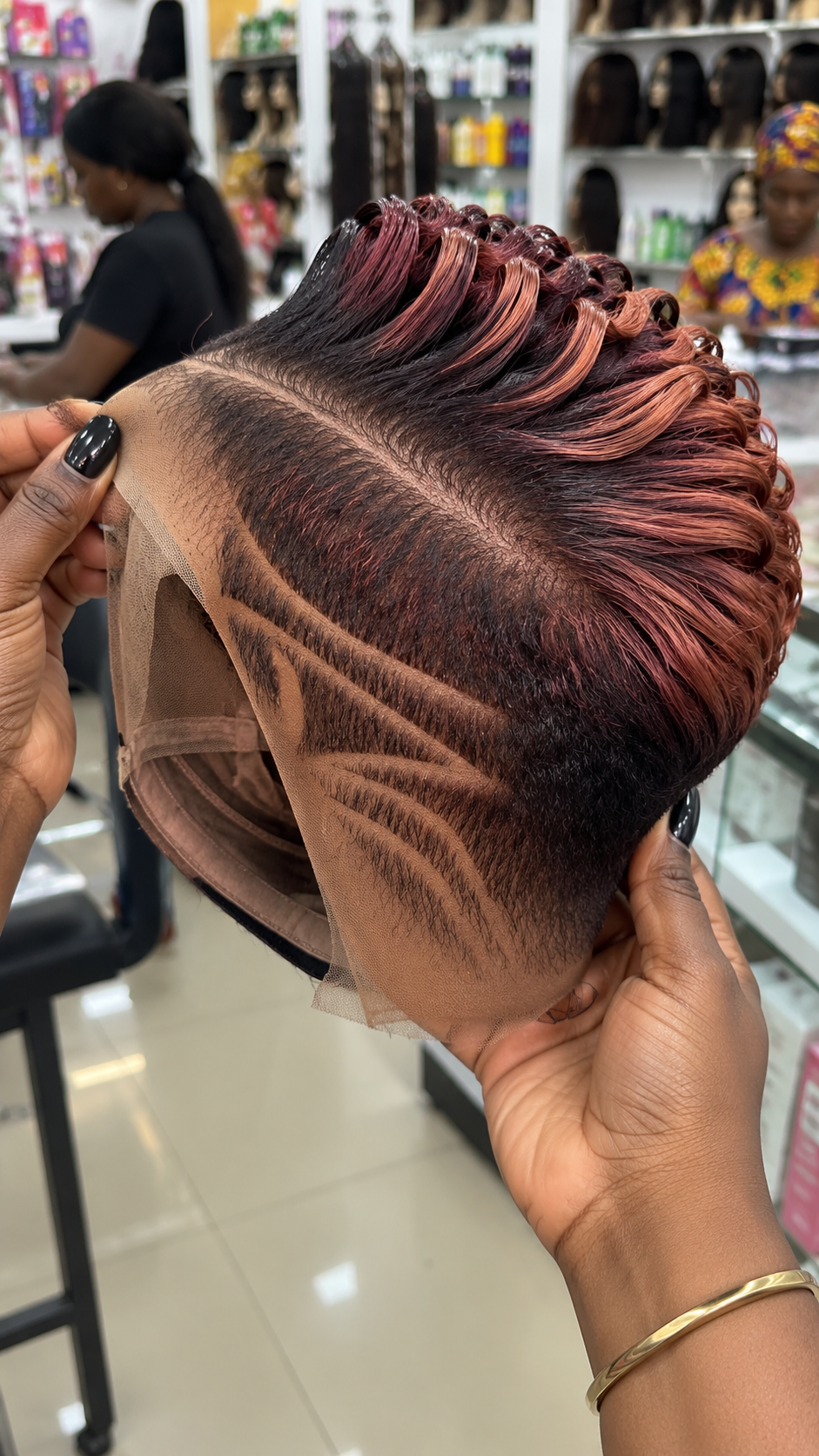
Color placement becomes especially important when a pixie wig combines a dramatic upper hairstyle with precision work along the side. In this salon photograph, deep burgundy roots transition into rose copper and warm reddish highlights, creating a striking contrast against a closely fitted dark side panel. The upper strands sweep backward in glossy ribbon-like sections before forming curled loops near the crown and rear edge. Three carved lines cut through the lower side area, adding another distinctive element to the overall composition.
This is not simply a copper curly wig or a conventional tapered pixie. Its appeal comes from the relationship between directional styling, contrasting hair lengths, and carefully positioned color. The photograph also reveals an extended lace area and part of the interior cap, making it particularly useful for customers researching custom wig construction before purchasing.
The unit is being displayed by hand inside a wig retail shop, with its side facing the camera. Because it has not yet been installed, the image provides an opportunity to examine the design without confusing it with the wearer’s natural hair. It also raises practical questions about how the carved side pattern is produced, how the color is maintained, and what a buyer should request when ordering a similar wig.
Rose Copper Color Placement Across the Swept Crown
The upper hairstyle displays a mixture of dark wine-colored roots, reddish-brown midsections, and brighter rose copper strands. The colors are not distributed as a uniform single shade. Instead, the brighter tones follow individual sections of hair, emphasizing their backward movement and curved arrangement.
Near the front, the hair appears considerably darker. This darker foundation continues beneath the highlighted strands, creating visual depth between the upper styling and the lower side panel.
The brighter copper-pink reflections become more noticeable through the middle and rear portions of the hairstyle. Several prominent strands carry warm rose-gold highlights, while neighboring sections remain deeper burgundy. The resulting contrast makes the direction of the hair visible even where individual strands overlap.
Although the photograph contains strong reflections, the color should not be described as bright orange or platinum rose gold. The visible palette is more accurately characterized as burgundy, muted copper, reddish rose, and dark brown-black undertones.
Understanding the Difference Between Surface Highlights and Full-Head Coloring
A wig with this appearance does not necessarily require every strand to be colored copper. In fact, preserving a darker foundation can help maintain the contrast that gives the upper styling its character.
For a custom order, the buyer should specify whether the brighter color should follow selected upper strands or cover the entire crown. These approaches produce different results.
Selective highlighting can emphasize the swept sections while allowing the darker hair beneath to remain visible. Full coloring creates a more uniform appearance and may reduce the contrast between the crown and the closely fitted side.
Ask the supplier for photographs taken under ordinary indoor lighting as well as daylight. Copper and burgundy shades can appear substantially different depending on white balance, salon lighting, and photographic processing.
It is also important to establish whether the color is manufactured into the fiber or applied through a coloring process. The photograph alone cannot establish the fiber type or its processing history.
The Backward Sweep Gives the Hairstyle Its Direction
Unlike a crown made entirely from small circular coils, this design uses longer-looking, ribbon-shaped sections that travel from the front toward the rear. Their orientation creates an impression of movement while keeping the hairstyle relatively compact.
The front strands rise from a darker foundation and bend backward. As they approach the crown, several sections curve into raised loops. Farther toward the visible rear edge, the curls become more clustered and irregular, forming a rounded continuation of the upper silhouette.
This progression matters because it prevents the hairstyle from looking like a uniform collection of identical ringlets. The front has a stronger directional flow, while the upper rear introduces more circular movement.
The glossy surface emphasizes the separation between neighboring strands. Fine lines are visible along several copper-colored sections, creating a ribbon effect that is especially noticeable where the hair bends.
Reproducing the Front-to-Rear Movement
A stylist recreating this hairstyle should begin by examining the direction of the front strands rather than focusing only on the curls near the back.
If the front is styled into forward-facing ringlets, the overall appearance will differ considerably from the reference. The intended design depends on the hair being guided backward before the loops become prominent.
Buyers should ask whether the hairstyle is permanently formed, set with styling products, or designed to be reshaped after washing. Different materials and construction methods can affect how reliably the backward sweep can be restored.
Request a close-up photograph from above before approving a custom unit. This angle will reveal whether the highlighted sections maintain their intended direction across the crown rather than changing abruptly near the center.
Three Carved Side Lines Change the Entire Profile
The most distinctive structural detail appears along the closely fitted side. Three diagonal carved channels create a striking geometric pattern beneath the upper hair.
These are not finger waves or colored stripes. They appear as deliberate separations through the dark, closely cropped hair, revealing a lighter underlying surface.
The upper channel begins near the front side and extends backward in a slightly curved direction. Beneath it, another diagonal channel follows a related angle. A third, lower line completes the layered arrangement.
The spacing between the channels creates dark bands of hair, giving the side pattern its recognizable shape. The channels do not appear perfectly parallel from beginning to end; their angles and lengths contribute to a more dynamic design.
The darker side hair is closely fitted to the cap, providing a strong contrast with the longer highlighted sections above. This difference in length is as important as the carved lines themselves.
Why a Barber Reference Should Include the Entire Side
Customers often describe hairstyles like this by requesting three razor lines. That instruction alone is insufficient because the direction, width, and spacing of the channels determine the final result.
A professional barber or wig stylist needs to see the complete side profile. The reference should include the front starting points, the relationship between the channels, and the way the pattern ends toward the rear.
Before commissioning the design, confirm whether the side is constructed from cut hair attached to the wig or uses another manufacturing technique. The photograph shows the appearance of closely cropped hair and carved channels, but it does not reveal the exact production method.
Any cutting should be approached carefully. Removing hair from a finished wig can expose the cap or create gaps that cannot be concealed easily. A barber experienced with natural hair may not automatically have the same expertise with lace wigs and their underlying structures.
The Lace Front Is Still in Its Pre-Installation Condition
The photograph shows a broad beige lace extension around the front and side. The lace remains untrimmed, extending beyond the visible hairline and lower side area.
Fine hair strands are visible near the front, where the dark hair meets the lace. The lower side pattern also appears against the light-colored lace surface, making the carved channels especially noticeable before installation.
This presentation helps buyers inspect the hair placement, but it does not establish how the lace will look once fitted against a particular complexion.
Although the mesh appears fine in the photograph, its exact grade cannot be confirmed. A seller should provide the lace specification rather than relying on photographs or generic marketing terminology.
Part of the dark interior cap is visible through the open lower area. There appears to be a fabric band or seam along the inner circumference. The image does not provide a complete view of the attachment hardware, so it would be inappropriate to claim that the wig includes particular combs, clips, or an adjustable strap without additional evidence.
Finding a Supplier Capable of Producing This Design
Searching for an ordinary copper pixie wig may produce products with similar colors but entirely different silhouettes. A more productive approach is to search for sellers specializing in custom pixie lace wigs, sculpted curls, and barber-inspired side patterns.
Independent wig makers, professional wig boutiques, and salons offering custom units are potential starting points. Online marketplaces may also carry comparable products, but buyers should evaluate actual product photographs rather than relying entirely on listing titles.
The supplier should be able to explain whether the color, upper styling, and side carving are included in the advertised price. A low-cost base wig may require substantial additional work to resemble this reference.
Information to Send Before Requesting a Quote
Provide the original side photograph and identify the details that matter most: the burgundy-to-rose-copper color relationship, backward-swept upper strands, raised curl loops, closely fitted dark side, and three diagonal carved channels.
Next, supply the head circumference and any other measurements requested by the wig maker. Cap sizing should be established before customization because a poor fit can affect where the side pattern sits relative to the wearer’s temple.
Ask the supplier whether the completed wig will be shipped already styled. If it will arrive unfinished, request an explanation of the additional salon services needed to achieve the photographed appearance.
Before making payment, clarify the production timeline, revision policy, shipping costs, and whether the finished unit can be inspected through photographs or video.
A custom wig should ideally be approved from more than one angle. The current photograph provides a strong side reference, but it does not fully establish the rear styling or the appearance of the opposite side.
Custom Wig Versus Ready-Made Pixie: Which Is More Practical?
A ready-made wig may be the better choice for someone primarily interested in the copper color and compact curly silhouette. Similar color combinations can sometimes be found without commissioning every styling detail.
However, buyers seeking the precise relationship between the swept upper hair and triple carved side pattern may find that custom work offers greater control.
With a ready-made unit, the main question is whether the existing hair placement allows the desired design to be created safely. Cutting a pattern into an unsuitable cap can expose construction materials or weaken the appearance.
A custom unit allows the side design to be considered during production, potentially reducing the need for extensive modification afterward. Nevertheless, the result depends on the wig maker’s skill and the construction method selected.
For customers who frequently change hairstyles, a simpler ready-made wig may offer more flexibility. A highly customized side pattern is less adaptable because its carved channels are part of the visual identity of the unit.
Rose Copper Pixie Wig Price Estimates and Styling Costs
The following prices are illustrative USD budgeting ranges, not verified offers for the photographed wig. They represent possible purchasing categories and should not be interpreted as evidence of the displayed unit’s fiber or construction.
| Purchase Category | Illustrative USD Range | Relevant Cost Factors |
|---|---|---|
| Premium Custom | $320–$720+ | Personalized cap construction, multi-tone color placement, hand-arranged upper curls, and detailed triple-line side work. |
| Standard Custom | $175–$360 | Selected cap options, coordinated burgundy and copper coloring, and moderate customization of the side pattern. |
| Basic Human Hair | $100–$250 | A human-hair starting unit that may require separate coloring, cutting, and specialist curl styling. |
| Premium Synthetic | $70–$170 | A manufactured multi-tone pixie with prearranged curls, provided the required side design is available. |
| Basic Synthetic | $30–$85 | A lower-cost alternative that may approximate the color and silhouette without matching the detailed carving. |
The complexity of the color placement may influence the total cost. Multiple warm tones can require additional work compared with a single-color black or copper unit, particularly when the highlights must follow selected strands.
The carved side pattern may also increase the labor component. A wig maker must account for the available hair density, underlying cap, and risk of exposing the construction when creating closely spaced channels.
Salon fitting, lace trimming, shipping, taxes, and future restyling may be charged separately. Request an itemized quotation to understand which services are included.
When comparing suppliers, a higher price is not proof of better quality. Clear construction information, genuine photographs, consistent craftsmanship, and realistic revision terms are more useful indicators than price alone.
Installing the Wig Without Distorting the Side Design
Installation should begin with positioning the cap correctly. The upper sweep and carved side lines are designed to sit at particular angles, so shifting the wig too far forward or backward may change the appearance.
A professional wig stylist can assess the hairline position, cap tension, and the relationship between the side pattern and the wearer’s natural temple area.
Once the position is confirmed, the stylist can determine whether the excess lace requires trimming. Because the carved channels appear close to the lace surface, unnecessary cutting or pulling could damage the surrounding hair placement.
The photograph does not establish whether the wig is suitable for adhesive-free installation. Anyone wanting a glueless option should ask the supplier for explicit confirmation and details about the cap’s security system.
After fitting, the upper curls should be checked for compression or displacement. A well-positioned cap should allow the crown to retain its intended height without forcing the highlighted strands into a different direction.
Maintaining the Burgundy and Copper Contrast
Multi-tone hair requires attention to color appearance as well as physical styling. The darker foundation and brighter copper sections should remain visually distinct for the original design to retain its character.
If the wig contains human hair, color longevity may depend on the processing history, washing products, water temperature, and exposure to sunlight. Previously lightened or colored strands can respond differently from untreated hair.
If the wig is synthetic, conventional hair dyes may not be appropriate. Buyers should not attempt to recolor synthetic fibers without reliable manufacturer guidance.
Regardless of material, avoid using excessive heavy products that collect between the swept sections. Product buildup may reduce the visible separation between the highlighted strands and make the upper hairstyle appear less organized.
Preserving the Carved Channels
The side pattern should be handled differently from the upper curls. Brushing across the carved channels can move nearby hair into the exposed spaces, reducing their visibility.
If the pattern becomes irregular, consult a stylist familiar with the wig’s construction before attempting corrective cutting. Removing additional hair may enlarge the channels beyond the original design.
When storing the wig, support the cap so that the side panel is not crushed. Avoid placing heavy objects against the carved area or pressing the raised curls flat.
For long-term use, ask the supplier whether the hairstyle is intended to retain its shape after washing or whether professional resetting will be necessary. This information can be more valuable than a general claim that the wig is easy to maintain.
Who Will Appreciate This Particular Pixie Design?
This wig is suited to customers who want a compact hairstyle with noticeable artistic detail rather than a conventional all-over curl pattern. Its combination of warm metallic-looking color reflections, directional upper styling, and geometric side carving gives it a distinctive identity.
The darker roots help separate the brighter upper sections visually, while the closely fitted side keeps the hairstyle from appearing excessively full. The carved channels introduce a barber-inspired element without requiring the entire crown to be cropped close.
It may appeal to someone selecting a statement hairstyle for celebrations, professional photographs, social events, or regular personal styling. The most suitable use will depend on cap comfort, installation requirements, and the owner’s willingness to maintain the sculpted sections.
The photograph provides a compelling side view but should not be treated as complete evidence of the product. A careful buyer will still request the opposite side, rear, crown, and full cap interior before ordering.
Ultimately, the success of a reproduction depends on preserving the design’s relationships rather than copying only its color. The rose copper strands must follow the backward movement, the darker foundation must remain visible, and the three carved side channels must retain their intended spacing. Those specific choices are what distinguish this hairstyle from a standard curly pixie wig.
Search Terms
Rose copper pixie lace wig · Burgundy root swept ribbon curl wig · Triple razor line side design wig · Copper pink highlighted crown curls · Dark tapered side with diagonal carvings · Untrimmed beige lace pixie unit · Reddish copper backward swept hairstyle · Burgundy and rose gold sculpted curl wig