
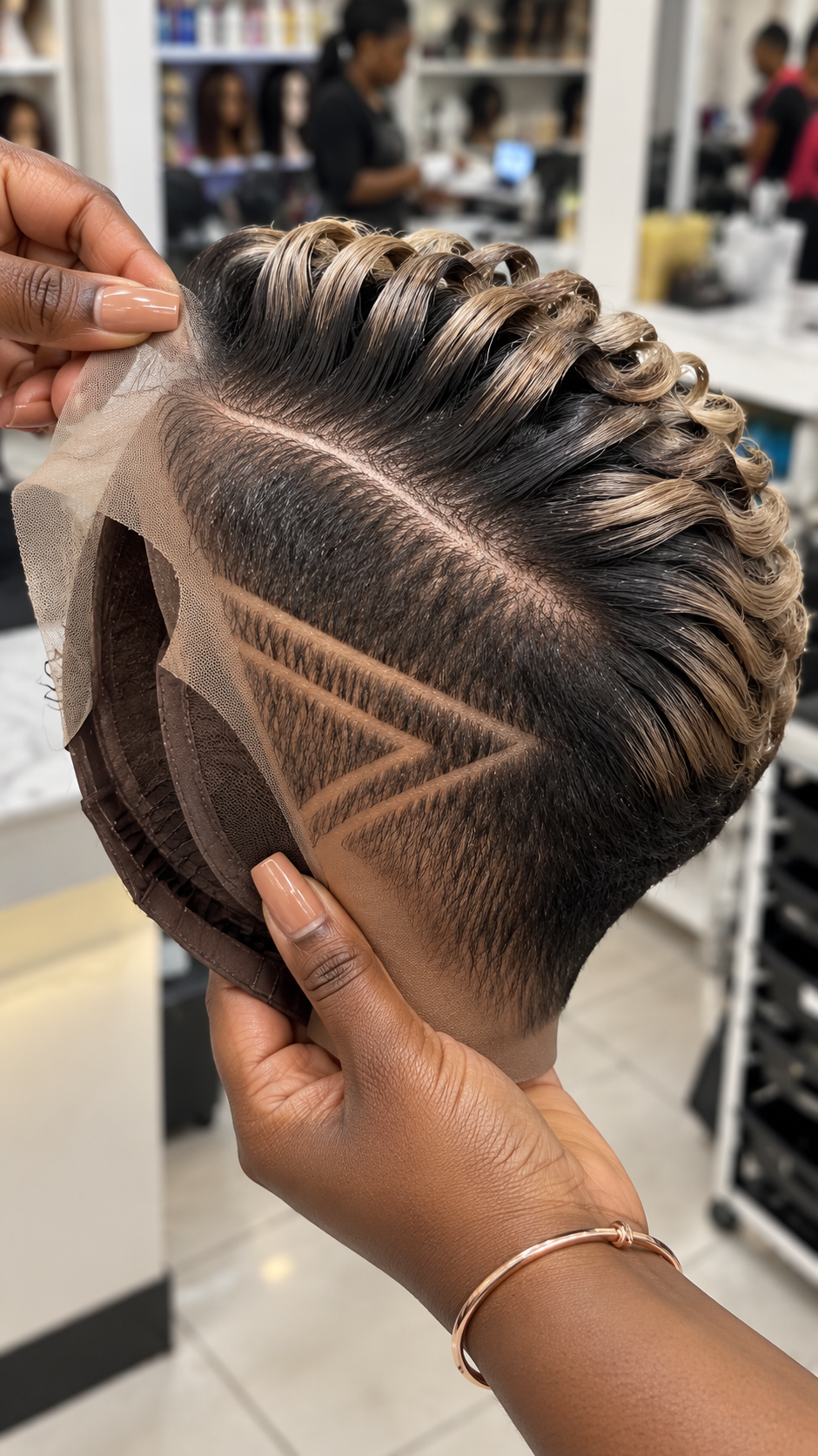
Imagine ordering a wig that combines the architectural precision of a barber’s geometric haircut with the elegance of champagne blonde curls. The result is something considerably more elaborate than a conventional highlighted pixie. In this salon photograph, a lace wig is held at an angle that reveals its most unusual detail: a sharply arranged zigzag pattern running across a closely cropped dark side section, beneath a raised arrangement of black and blonde ribbon-like curls.
The hairstyle relies on three distinct visual elements. A dark base provides contrast, pale blonde ribbons travel across the upper section in sculpted loops, and a geometric side design introduces a dramatic change in direction. The exposed lace and visible interior construction make the photograph particularly useful for customers researching custom wigs before installation.
Unlike a hairstyle whose appeal depends primarily on length, this design requires careful control of proportion. The upper loops need enough height to remain noticeable, but excessive volume would overwhelm the angular pattern beneath them. The side design also needs sufficient contrast to remain recognizable once the wig is fitted against the wearer’s head.
For customers considering a similar purchase, understanding these relationships is more valuable than searching for a generic blonde curly wig. The color arrangement, loop formation, geometric side artwork, and lace construction all contribute to the final result.
A Geometric Side Pattern That Changes the Entire Silhouette
The photograph provides an unusually clear view of the wig’s lower side section. Instead of ordinary tapered hair or decorative finger waves, the area displays an angular arrangement of lighter exposed channels against closely cropped dark hair. These channels form a zigzag composition with intersecting diagonal sections and triangular spaces.
One longer diagonal line travels across the upper portion of the design, while another angled section creates a pointed geometric shape below it. The result resembles a carefully planned barber design rather than a random collection of shaved stripes.
The exposed channels appear warm brown against the darker surrounding hair. This contrast makes the artwork visible even without additional coloring. The geometry also introduces a different visual rhythm from the circular loops above it: straight edges and sharp angles below, curved blonde ribbons above.
It is important to distinguish what the photograph actually demonstrates. The design has the appearance of precision-carved hair artwork, but a photograph alone cannot confirm whether every lighter channel was produced by shaving, specialized ventilation, or another construction method. A wig maker should explain how the pattern is created and whether it can be maintained or altered.
Why the Zigzag Placement Matters
The artwork occupies a substantial section of the visible side rather than being confined to a small detail near the temple. Its placement allows the triangular forms to remain recognizable beneath the upper hairstyle.
A buyer commissioning this design should request that the stylist preserve the relationship between the diagonal lines and the surrounding dark hair. Narrowing the exposed channels too much could make the geometry difficult to distinguish. Enlarging them excessively could reduce the dark hair area that gives the pattern its contrast.
The direction of the artwork also matters. A reversed design may still look attractive, but it will not reproduce the same composition. Customers should specify which side should carry the zigzag arrangement and request photographs from that exact angle before the wig is shipped.
The photograph does not establish whether an identical pattern appears on the opposite side. Anyone ordering a matching pair of side designs should make that requirement explicit rather than assuming symmetry.
Champagne Blonde Ribbons Against a Dark Hair Foundation
The upper section displays a combination of dark espresso-black hair and light champagne blonde strands. The blonde has a slightly beige, sandy quality rather than appearing pure platinum or bright yellow. Under the salon lighting, certain strands take on a warmer golden reflection.
The color is not distributed as a uniform blonde cap. Dark strands remain prominent near the base and between the raised curls, creating separation between the individual loops. Several blonde sections travel across the top in wide curved ribbons, while other highlighted curls gather toward the visible rear.
This distribution creates a particularly noticeable effect when the wig is viewed from an angle. The darker hair provides depth inside each curl opening, and the lighter strands trace the outer curves where light naturally catches them.
The contrast also connects the upper hairstyle with the dark lower side. Without that dark foundation, the geometric artwork might appear visually disconnected from the curls above it.
Ordering the Color Without Losing the Contrast
When contacting a wig supplier, describe the desired color as a dark black-brown base with champagne beige blonde highlights concentrated through the raised ribbon curls. This is more precise than simply requesting a blonde and black wig.
Ask whether the blonde sections are integrated into the hair before styling or whether the unit is colored after the curls are arranged. The answer may affect the consistency of the highlighted ribbons and the options available for later color adjustments.
A photograph taken in daylight can also help distinguish champagne blonde from ash blonde, honey blonde, and pale gold. These shades can appear similar under artificial salon lighting but produce noticeably different results outdoors.
If ordering a custom unit, request a small color reference or a photograph of the prepared hair before the final styling stage. This reduces the chance of receiving a wig with overly yellow highlights or insufficient contrast between the dark base and blonde ribbons.
Ribbon Loops Instead of Ordinary Hanging Curls
The upper hairstyle is composed of elevated, directional curls that resemble folded ribbons. Several sections rise from the dark foundation, curve backward, and form open loops. Others overlap at different angles, creating a layered arrangement across the visible upper surface.
These curls are noticeably different from small, tightly packed natural coils. Their strands appear arranged into wider bands, and the openings are elongated rather than uniformly circular.
Near the front, the blonde ribbons appear relatively broad and elevated. Toward the visible rear, the curls become more compact and gather into a tighter formation. This progression creates movement without allowing the upper section to become excessively long.
The hair also appears highly reflective. Individual strands are visible within the blonde ribbons, while the darker sections reflect narrower bands of light. The photograph shows a glossy styling result, although it cannot establish which finishing products or fiber properties produced that appearance.
The Difference Between a Similar Wig and a Faithful Reproduction
A standard highlighted curly wig might contain the correct colors but lack the elevated ribbon structure. Likewise, a wig with attractive loops could fail to resemble the reference if the blonde strands were distributed evenly throughout the hair.
For a closer match, a stylist needs to consider loop width, curl direction, the height of the upper arrangement, and the transition into the compact lower section.
The styling should be evaluated from multiple angles. A frontal photograph alone may conceal uneven loop placement, while a side photograph reveals whether the raised curls sit proportionately above the geometric design.
Customers should request a video showing the wig rotating slowly from front to side and rear. This is particularly valuable when purchasing online because a single flattering photograph cannot demonstrate the full three-dimensional shape.
The Exposed Parting and Lace Offer Important Buying Clues
Along the upper side, the photograph reveals a pale parting channel separating sections of dark hair. Fine strands emerge near this area, giving the arrangement a deliberate directional structure. The parting is visible because the wig is being held at an angle rather than worn on a head.
A broad section of untrimmed lace extends beyond the hairline. The mesh appears light beige-brown and is being held between the fingers at the upper edge. Additional lace is visible along the side, allowing the viewer to examine the relationship between the hairline and the geometric pattern.
The inside of the wig also appears partially exposed. A dark brown cap structure with stitched bands and fabric sections can be seen along the lower opening. However, the photograph does not clearly establish every interior attachment, cap dimension, or securing mechanism.
These observations are useful because the wig has not yet been installed. Once the lace is trimmed and the unit is positioned, some construction details will become less visible.
Before ordering, request photographs of the complete interior, the front lace area, and the cap perimeter. Ask the seller to identify the lace type, cap size, available adjustment mechanisms, and recommended installation method.
Visible lace does not establish that the product uses HD lace, and an exposed cap does not prove that the wig is suitable for adhesive-free wear. Both claims require product-specific confirmation.
Finding a Wig Maker Who Understands Both Curls and Barber Artwork
This design sits between two professional specialties. A wig stylist must arrange the elevated ribbon curls, while someone experienced with precision hair artwork must understand the geometry of the lower side.
Not every salon offering lace installations will have experience with this combination. Before booking, review photographs of previous work involving sculpted curls, closely cropped wig sections, and geometric hair designs.
Search for professionals using phrases such as custom pixie wig stylist, lace wig customization specialist, geometric hair design barber, or sculpted curl wig maker. A salon offering both wig construction and precision haircutting may be particularly useful.
When contacting a stylist, send the reference image and explain that the angular side artwork must remain visible beneath the blonde loop curls. Specify the desired color distribution and ask whether the stylist can reproduce the exposed parting and compact lower shape.
If the stylist cannot produce the geometric pattern directly on the wig, ask whether collaboration with a barber or specialist is possible. The construction method must be suitable for the wig’s material and density; cutting into an unsuitable base could permanently damage it.
A Practical Custom Order From Reference Photo to Final Approval
The ordering process should begin with a discussion of the finished silhouette rather than the hair color alone. Explain how high the upper loops should sit, how compact the lower side should remain, and which side should display the angular artwork.
Next, provide accurate head measurements according to the wig maker’s instructions. These may include circumference, front-to-nape distance, ear-to-ear measurements, and temple placement. The geometric section should align with the wearer’s head rather than sit awkwardly above or behind the intended position.
Once the cap and base hair are prepared, request a photograph showing the parting and the planned lower design. This is the best opportunity to identify a major placement problem before the curls conceal portions of the underlying structure.
After the highlighted loops are arranged, request another set of images under ordinary lighting. Compare the ribbon direction, blonde distribution, and side geometry with the reference.
Finally, confirm whether the quoted amount includes lace preparation, customization, shipping, and installation. A wig delivered with untrimmed lace may still require a separate salon appointment before it is ready to wear.
For ready-made purchases, the same principles apply, but customization options may be limited. Ask whether the seller can provide photographs of the exact unit being sold and whether alterations are permitted before dispatch.
Illustrative Prices for a Two-Tone Geometric Pixie Wig
Because this hairstyle combines contrasting colors, elevated curl styling, and intricate side artwork, the amount of manual customization may influence the total cost substantially. The following USD ranges are illustrative budgeting estimates, not verified current offers for the photographed product.
| Purchase Category | Estimated USD Budget | What the Budget May Cover |
|---|---|---|
| Premium Custom | $320–$750+ | Personalized cap measurements, advanced blonde placement, individually arranged ribbon curls, and detailed geometric side customization. |
| Standard Custom | $170–$360 | Customized two-tone styling, shaped upper loops, and a simplified or moderately detailed angular side pattern. |
| Basic Human Hair | $100–$240 | A human-hair base that may require separate coloring, precision cutting, and curl-setting services. |
| Premium Synthetic | $70–$180 | Higher-grade synthetic options with contrasting colors and prearranged curls, depending on manufacturer specifications. |
| Basic Synthetic | $30–$95 | Affordable two-tone pixie alternatives that may not include the elaborate side artwork or raised ribbon styling. |
These categories describe possible purchasing options; the photograph does not confirm whether the displayed wig is made from human hair or synthetic fibers.
One of the most important cost variables is the geometric side pattern. If the artwork must be created individually, the labor charge may be higher than for an ordinary tapered side. The precise method used to produce the pattern should be discussed before a deposit is paid.
Color preparation is another potential expense. Achieving pale champagne blonde sections against a dark foundation may require specialized coloring or the use of precolored hair. The cost will depend on the material and the supplier’s production method.
Installation, shipping, cap alterations, and future restyling may be charged separately. Buyers should compare complete quotations rather than relying on the advertised wig price alone.
Preserving the Blonde Loops Without Disturbing Their Shape
The elevated ribbon curls are likely to be the most vulnerable part of the hairstyle during everyday handling. Their appearance depends on the position of individual strands, and aggressive brushing can separate the ribbons or change the direction of the loops.
Before attempting maintenance, determine whether the wig is human hair, synthetic, or a blend. The appropriate washing, setting, and heat procedures depend on the confirmed material.
For human hair, the maker should explain whether the blonde sections have undergone lightening or other chemical processing. Previously lightened hair may require more cautious handling, particularly when repeated heat styling is involved.
For synthetic hair, heat resistance must be verified before using heated tools. Some synthetic fibers can tolerate specific temperatures, while others may deform permanently.
Regardless of the material, avoid applying excessive heavy products to the ribbon loops. Product buildup can make separate strands cling together and reduce the visual contrast between the blonde curves and dark openings.
Protecting the Angular Side Artwork
The geometric section needs a different maintenance strategy from the upper curls. Its appearance depends on the contrast between the dark hair and the lighter channels.
Frequent rubbing, uncontrolled trimming, or attempts to enlarge the lines can change the design. If the pattern requires refreshing, consult the original wig maker or a professional familiar with working on closely cropped wig sections.
Do not assume that a conventional barber can safely shave the pattern deeper. The available hair density, underlying cap, and construction method determine whether further cutting is possible.
During storage, avoid compressing the side against hard surfaces. A properly sized wig stand can help support the cap while keeping the upper loops from being flattened.
Deciding Whether This Statement Wig Suits Your Routine
The black and champagne blonde combination offers strong contrast, while the zigzag artwork makes the design especially distinctive from the side. This makes the hairstyle an interesting option for customers seeking a sculptural pixie appearance rather than loose curls or a conventional layered cut.
However, the same details that make it visually striking may also require more attentive care. The raised loops should retain their arrangement, the highlighted ribbons need appropriate handling, and the angular lower design may be difficult to recreate without professional assistance.
Someone who prefers minimal daily styling should ask the maker how much maintenance is necessary to preserve the original appearance. It is also worth confirming whether the curls are intended to remain permanently arranged or whether periodic resetting is expected.
The photograph demonstrates an impressive combination of color placement, geometric precision, and decorative curl construction. The best purchasing decision will come from finding a maker who can explain the underlying techniques, demonstrate previous comparable work, and provide clear photographs of the actual finished unit.
With accurate measurements, careful styling approval, and realistic maintenance expectations, a similar wig can offer the visual impact of champagne blonde ribbon curls while retaining the dramatic contrast of its dark geometric side design.
Search Terms
Black champagne blonde zigzag lace wig · Geometric triangle side design pixie wig · Beige blonde ribbon loop curls · Dark root blonde sculpted curl wig · Angular shaved effect side lace wig · Two tone pixie with exposed side parting · Untrimmed beige lace blonde black wig · Champagne blonde raised loop crown hairstyle