
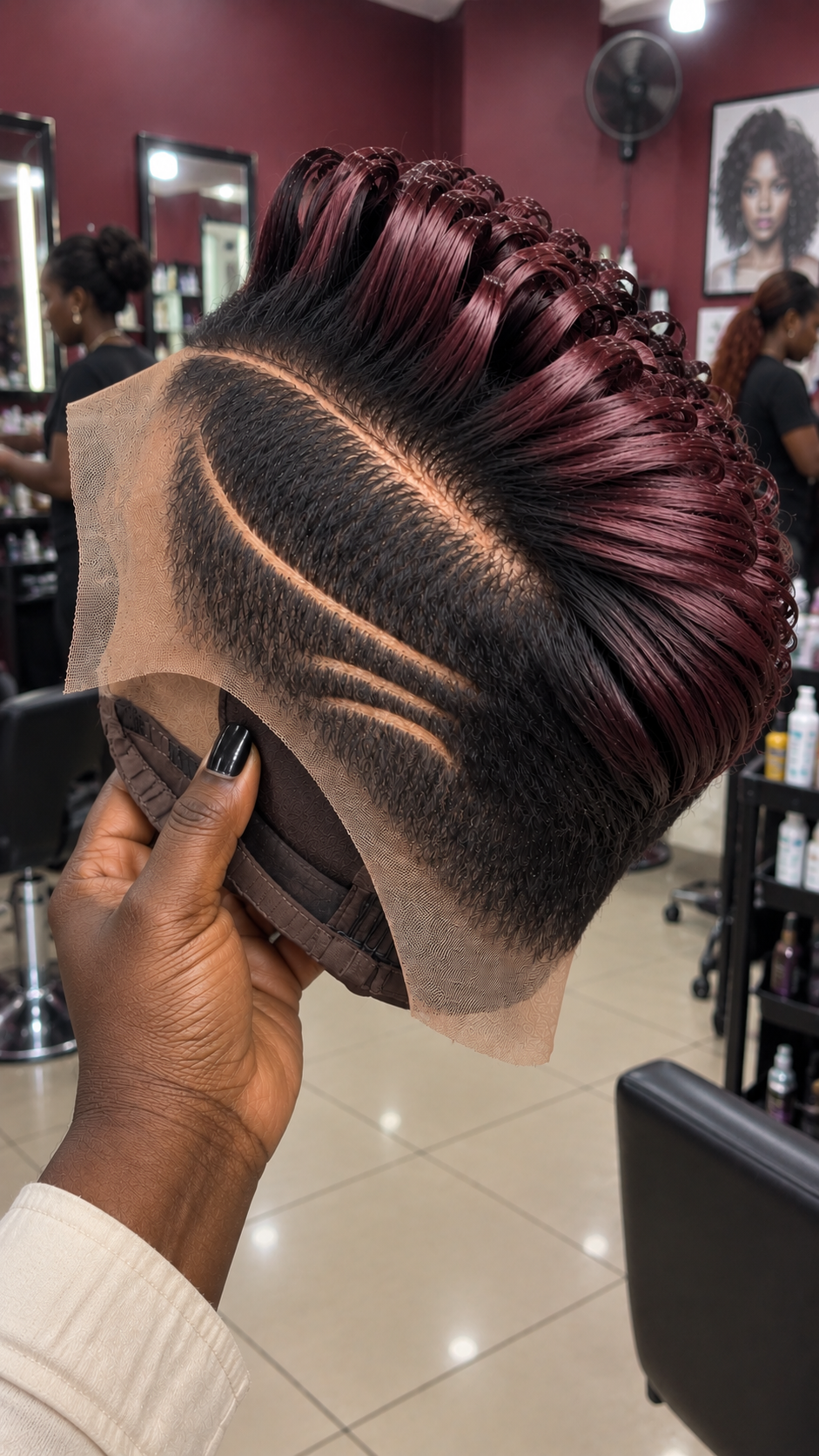
The first thing to notice about this wig is the direction of its hair. Deep burgundy strands rise from a dark foundation, curve backward into elongated ribbon formations, and gather into a rounded arrangement along the upper and rear-visible sections. Beneath that movement, two sweeping parting channels cross a closely cropped-looking black temple panel. The contrast between the elevated burgundy hair and the flatter side creates the hairstyle’s distinctive profile.
Photographed inside an active hair salon, the wig is held in one hand with its untrimmed lace and part of its interior construction exposed. The image offers a useful purchasing perspective because it shows more than a finished hairstyle. Buyers can examine the frontal mesh, the placement of the dark side sections, and the transition into the burgundy crown before deciding whether this type of wig suits their preferences.
For anyone searching for a burgundy pixie lace wig with decorative side partings, this design requires a more specific description than simply requesting red curls. Its recognizable appearance depends on the height of the upper strands, the direction of the ribbon formations, the position of the two curved channels, and the darker hair surrounding the temple.
A Burgundy Crown Built Around Backward Movement
Rather than forming small circular coils across the entire top, the burgundy section contains elongated, glossy strands that sweep upward and backward. Near the upper edge, several sections bend into narrow loops, while the hair below them remains comparatively straight and closely grouped.
This combination produces a different silhouette from a conventional curly pixie. The strands appear to travel in a coordinated direction before folding into their rounded ends. The loops are concentrated along the upper ridge and continue toward the rear-visible portion, creating a layered arrangement with considerable surface shine.
The front of the crown begins with dark roots. Burgundy becomes more prominent farther along the strands, giving the hairstyle a noticeable color transition without covering the entire wig in red.
From the photographed angle, the upper hair appears longer than the closely arranged side section. However, the image does not establish exact strand lengths or reveal the complete rear construction. Customers commissioning this hairstyle should request measurements rather than relying on an estimated length from the photograph.
The Importance of Preserving the Ribbon Shape
The individual loops are narrow and elongated rather than broad, round curls. This matters when discussing the hairstyle with a wig maker because a conventional curling technique could produce an entirely different appearance.
A buyer should specify that the upper strands need to rise together, curve backward, and form visible ribbon-like bends near their ends. The hair should not be transformed into loose waves or a uniformly curled crown.
It is also important to establish whether the arrangement is permanently set into the supplied material or depends on styling products and regular maintenance. A photograph cannot establish how long the formations will retain their shape.
The Double-Arc Side Pattern as a Design Boundary
The visible temple section contains two curved, exposed channels separating areas of very dark hair. The upper channel begins near the front and sweeps diagonally upward toward the crown. A second, shorter curve sits beneath it, following a similar direction before narrowing toward the side.
These channels create a layered appearance that visually divides the dark side panel from the burgundy hair above. The exposed areas appear scalp-toned, but the photograph does not reveal the precise method used to construct the separations.
The surrounding dark hair is arranged close to the underlying surface, with small directional strands visible throughout the temple. It resembles a closely cropped hairstyle, although the photograph shows a wig rather than hair growing from a person’s scalp.
There is no reliable basis for describing these channels as razor cuts made directly into natural hair. They are visible styling and parting details on the wig, and their construction should be confirmed with the maker.
Maintaining the Spacing Between Both Curves
The distance between the channels influences the entire side profile. If the upper separation moves too close to the burgundy section, the dark panel may appear smaller. If the lower curve is positioned too far downward, the temple arrangement can lose its compact appearance.
Customers ordering a similar wig should provide the photograph with both curves clearly visible. Ask the stylist to confirm their placement before trimming, thinning, or otherwise altering the side.
It is particularly important not to request additional decorative lines without considering the original design. The two visible arcs already provide a substantial amount of detail, and extra separations could interfere with the intended proportions.
Reading the Burgundy Color Under Salon Lighting
The upper strands display a deep burgundy tone with wine-red and muted plum reflections. The color is most apparent where the overhead lighting strikes the raised sections. Darker areas near the roots appear black or nearly black, creating a pronounced transition into the colored lengths.
The burgundy is not presented as a bright scarlet red, orange copper, or pink highlight. Its appearance is deeper and more restrained, with reddish-purple reflections across the glossy strands.
Lighting is an important consideration because the salon contains bright overhead fixtures and darker reddish walls. These surroundings can influence the apparent warmth of the hair in a photograph.
Before approving a custom color order, request a daylight photograph and a second image under neutral indoor lighting. These views help determine whether the burgundy remains sufficiently deep or appears brighter outside the salon.
A buyer can also ask for a color sample showing the dark root shade beside the intended burgundy. Matching only the red portion may produce an unsatisfactory result if the transition from the black foundation is overlooked.
Untrimmed Lace and the Visible Interior Assembly
The frontal mesh extends beyond the styled hairline, leaving a substantial area of beige lace visible. Its irregular position follows the contour of the wig as it is held toward the camera.
The lace is not yet cut to an individual wearer’s hairline. This is useful to recognize because the appearance of the frontal section will change after fitting and careful trimming.
The mesh appears relatively fine in the photograph, but its exact grade cannot be verified visually. It should not automatically be advertised as HD lace or another specialized construction.
Inside the lower portion of the wig, a dark brown cap structure and stitched bands are visible. Part of an interior comb can also be seen near the lower opening. These details demonstrate that the unit contains attachment-related hardware, but the photograph does not show the complete underside.
The presence of a comb does not establish that the wig is glueless. Nor does the exposed mesh prove that the cap will fit a particular head size without adjustment.
Questions to Resolve Before the Lace Is Cut
Ask the seller to photograph the entire interior with the wig opened and laid flat. This should make it easier to identify any additional combs, adjustment mechanisms, elastic components, or attachment points.
Request the cap circumference and any other measurements needed to establish the correct fit. The frontal lace should be evaluated against the wearer’s natural hairline and complexion before installation.
Because the temple channels extend close to the frontal area, inaccurate positioning could shift the decorative pattern away from its intended location. A wig that is too large or too small may therefore affect more than comfort.
A professional installer should check the position of the wig before trimming the excess lace. Removing lace is an irreversible alteration, so the fitting stage should not be rushed.
Finding a Wig Maker Who Understands This Construction
Searching for a burgundy curly wig may produce many unrelated products. A more targeted approach is to look for wig makers who specialize in sculpted pixie styles, decorative finger-wave arrangements, and custom lace-front construction.
Online wig boutiques, independent custom wig makers, and local salons offering bespoke hairpieces are reasonable places to begin. Customers should examine previous work rather than relying solely on promotional descriptions.
Look for examples showing close temple styling, exposed curved partings, and carefully positioned crown sections. A stylist experienced only with loose curls or long straight wigs may not necessarily have experience recreating this particular arrangement.
When contacting a potential supplier, send the reference photograph and explain that the hairstyle contains two distinct styling zones: a close dark temple panel with two curved channels and an elevated burgundy crown with backward-directed ribbon curls.
Request photographs of previous custom work showing similar structural details. If the supplier offers a ready-made unit, ask for actual photographs of the product being shipped rather than images of a different sample.
Choosing Between a Ready-Styled Unit and a Custom Commission
A ready-styled wig can be practical when its proportions, color, and side detailing already resemble the reference. It may reduce the amount of salon work required after delivery.
However, buyers should avoid assuming that a similar burgundy color means the hairstyle is equivalent. A wig with ordinary curls and an undecorated side will not reproduce the distinctive appearance without substantial alteration.
A custom commission may provide greater control over the position of the curves, the height of the crown, and the distribution of the burgundy strands.
Before paying a deposit, agree on the expected appearance, cap measurements, material, production timeline, revision policy, and whether the quoted price includes installation.
If the maker cannot reproduce the elongated ribbon curls, it is better to establish that limitation before production begins.
Coordinating Installation With the Crown’s Direction
The backward movement of the burgundy strands means the wig’s placement can influence how the finished hairstyle appears from the front and side.
An installer should first check the cap position and ensure that the dark temple panel aligns appropriately with the wearer’s face. The crown can then be assessed for balance without immediately disturbing the loops.
If minor styling adjustments are required, they should preserve the direction of the strands rather than changing the crown into an entirely different curl arrangement.
Customers may wish to book a consultation with a lace wig specialist before scheduling the full installation. This provides an opportunity to discuss lace preparation, attachment preferences, scalp comfort, and any necessary adjustments.
For extensive reconstruction of the side pattern, a stylist experienced in sculpted hair arrangements may be preferable to a general wig installer. A barber can sometimes assist with suitable hair-shaping work, but any cutting must be appropriate for the wig’s actual construction.
Once installed, photographs from the visible temple side and upper three-quarter angle can help assess whether the crown retains its intended elevation and whether the double-arc pattern remains clear.
Budgeting for Burgundy Color Work and Decorative Styling
This hairstyle may involve more labor than a basic pixie wig because the upper strands and temple panel require different styling approaches. The color transition adds another consideration, particularly when a customer requests precise placement of the burgundy sections.
The following amounts are illustrative USD planning ranges rather than verified current retail prices. They are not quotations for the wig in the photograph. Actual pricing depends on material, maker, region, construction quality, and included services.
| Purchase Category | Illustrative USD Range | Potential Scope |
|---|---|---|
| Premium Custom | $300–$700+ | Individually commissioned crown shaping, burgundy color placement, specialized temple work, and potentially extensive lace customization. |
| Standard Custom | $170–$350 | Personalized styling with selected adjustments to crown direction, side channels, and color distribution. |
| Basic Human Hair | $100–$240 | A possible human-hair foundation requiring separate styling to reproduce the ribbon curls and temple arrangement. |
| Premium Synthetic | $70–$165 | A potential pre-styled alternative if the manufacturer offers comparable ribbon formations and curved side detailing. |
| Basic Synthetic | $30–$85 | Budget alternatives may resemble the general burgundy silhouette but lack the more intricate styling. |
These categories represent potential purchasing routes and do not identify the actual fiber used in the photographed wig. Human hair and synthetic fibers can sometimes appear similarly glossy in photographs.
A custom quotation should distinguish between the base wig price and additional services. Color processing, hand styling, lace fitting, cap alterations, shipping, and installation can all affect the total.
Customers comparing prices should also ask whether the ribbon curls are delivered fully styled. A lower initial price may offer little advantage if the buyer must pay another specialist to reconstruct the crown.
Keeping the Burgundy Ribbons From Losing Their Shape
The main maintenance concern is the arrangement of the elevated strands. The hairstyle relies on their backward direction and the narrow loops near the upper edge.
Ordinary brushing could disturb these formations, particularly if the strands are held in place by setting products or a styling method that requires careful handling.
Before attempting to refresh the wig, confirm its fiber type and obtain appropriate instructions from the seller. Heat tolerance, washing methods, and product compatibility differ between materials.
If the unit contains synthetic fibers, heated styling tools should not be used unless the manufacturer specifically confirms suitable temperature limits. If it contains human hair, previous coloring and processing may influence how the burgundy strands respond to further heat or chemical treatment.
The dark temple panel also requires care. Excessive friction or manipulation may disturb the directional strands around the curved channels. This could make the separations appear less distinct.
When the wig is not being worn, support it in a manner that avoids crushing the raised loops. A suitably sized wig stand may be useful, provided it does not stretch the cap or place pressure on the styling.
If the crown begins to collapse or the temple arrangement loses its shape, professional restyling may be safer than attempting extensive corrections without knowing the original setting technique.
What Makes This Burgundy Wig Worth Considering?
The value of this design lies in its combination of contrasting styling directions. The burgundy strands move upward and backward, while the dark temple hair follows two sweeping curved channels. The exposed lace and visible cap allow buyers to evaluate some construction details before installation.
It is particularly suitable as a visual reference for customers who prefer decorative pixie wigs with pronounced side detailing rather than ordinary loose curls.
However, an attractive photograph should be the beginning of the buying process, not the only evidence used to make a purchase. Material, cap measurements, attachment options, and the exact styling method all require confirmation.
When comparing suppliers, prioritize photographs of their actual work, clear explanations of construction, and a willingness to discuss the specific ribbon arrangement and temple pattern. Those details will have a greater influence on the final resemblance than a generic burgundy wig description.
A successful custom version should preserve the dark foundation, the wine-burgundy upper strands, the elevated backward movement, and the two curved side separations without introducing unnecessary volume or decorative elements.
Search Terms
Wine burgundy ribbon curl lace wig · Black root burgundy pixie hairpiece · Double arc temple parting wig · Backward swept burgundy loop crown · Beige untrimmed frontal lace wig · Dark cropped side burgundy hairstyle · Glossy plum red ribbon curls · Burgundy sculpted crown with curved side channels