
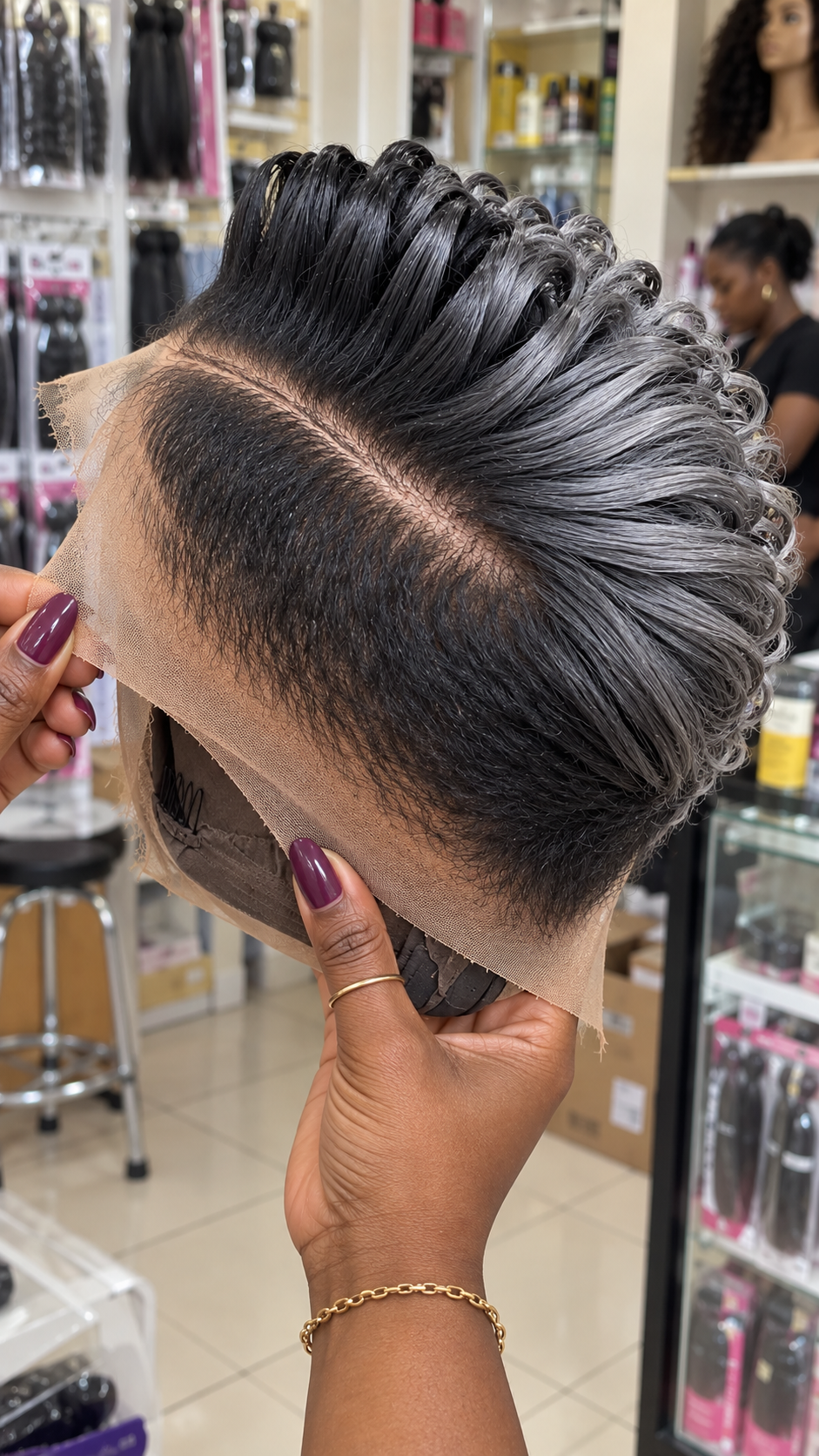
Silver hair does not have to begin with an entirely pale wig. In this particular design, the strongest visual effect comes from the way metallic silver strands emerge among darker hair, while a sweeping parting exposes a closely arranged black side section. The result is a sculpted pixie lace wig that uses directional styling and contrasting hair density to create its silhouette. Rather than appearing as a single block of gray hair, the upper section moves between glossy black, charcoal, smoky silver, and brighter ash-silver reflections.
The photograph captures the wig before installation, held by two hands inside a beauty supply store. Its broad beige lace remains untrimmed, and part of the interior cap is exposed. This presentation provides an opportunity to examine both the hairstyle and several practical details that are normally concealed once a wig is fitted. For someone considering a similar piece, the image offers a useful reference for discussing color placement, crown styling, hairline customization, and cap construction with a seller.
One detail deserves immediate attention: although the upper hair contains prominent silver sections, the lower side remains dark and comparatively close to the lace foundation. There are no obvious decorative razor stripes in that area. The principal dividing detail is a sweeping exposed part that separates the elevated upper styling from the darker side hair. Keeping that distinction accurate is essential when ordering a comparable wig.


Reading the Silver Placement Before Choosing a Wig Color
The photograph does not show an evenly colored silver hairstyle. Instead, black and charcoal tones dominate portions of the front and upper-left area, while increasingly visible silver strands appear across the central and rightward sections. The brightest silver is concentrated along raised hair surfaces, where the store lighting creates a metallic appearance.
Near the upper front, several glossy black sections curve backward. Farther along the visible crown, darker strands mingle with silver-gray hair, producing an ash-toned transition. The silver sections become especially noticeable toward the right side of the photograph, where the strands bend into raised curls and closely grouped loops.
This distribution gives the hairstyle dimension without requiring a uniformly platinum appearance. The darker hair supplies depth beneath the reflective sections, while the pale strands emphasize the direction of the styling.
When searching for a similar wig, terms such as silver ash, smoky gray, charcoal silver, and black-to-silver may help identify potential alternatives. However, these descriptions are not interchangeable. Some suppliers use silver to describe nearly white hair, while others apply the same label to medium gray or dark graphite shades.
Why a Single Color Sample May Be Misleading
A small strand sample can establish the approximate shade of a fiber, but it cannot show how that shade will appear when arranged into raised curls beside black hair. This hairstyle depends heavily on the interaction between dark and light strands.
For a custom order, ask the supplier to show the proposed colors together. Ideally, the sample should include the dark base and the intended silver shade under ordinary lighting. This helps determine whether the contrast will resemble the photograph or produce an unexpectedly pale result.
Buyers should also clarify whether the silver sections are distributed through the hair or concentrated in particular areas. The reference image shows an uneven visual distribution, with substantial dark hair remaining visible. Ordering a completely silver wig and expecting the same appearance would overlook that important characteristic.
The Sweeping Parting Is the Hairstyle’s Main Structural Boundary
Across the visible side, a long curved parting separates the upper hair from the darker lower section. The line begins toward the front of the wig and travels backward in a gentle arc. Its exposed foundation appears lighter than the surrounding hair, making the division recognizable even where the strands are densely arranged.
Above this parting, the hair rises into broad curved sections. Below it, the dark strands lie closer to the cap and follow a more restrained direction. The contrast between these two styling zones creates the impression of a tapered side without requiring the entire wig to have the same hair length.
The side is not visibly decorated with multiple carved lines, intersecting patterns, or elaborate barber artwork. A buyer requesting those details would be commissioning a different design. Here, the exposed parting provides the necessary visual separation on its own.
The dark side section also shows fine individual strands rather than a completely bare shaved surface. Although it resembles a closely tapered haircut, the photograph cannot establish the exact cutting technique or whether the hair was arranged using a particular barbering method.
Communicating the Parting to a Custom Wig Maker
When commissioning this design, describe the part as a long, sweeping separation between the elevated silver-and-black crown and the close dark side panel. Explain that the line should remain visible without being widened into an exaggerated shaved channel.
Ask the stylist to review the placement while the wig is positioned on an appropriately sized head form. The apparent angle of a parting can change when a cap is stretched or fitted differently.
A photograph taken directly from the side would be valuable before final approval. The supplied image is angled, which makes the general direction visible but does not reveal every section of the parting from beginning to end.
If a ready-made wig already includes the desired separation, unnecessary recutting should be avoided. Removing hair to widen the line may permanently change the appearance, particularly where the side density is relatively low.
Understanding the Raised Curls Without Calling Them Ordinary Ringlets
The upper hairstyle combines broad swept sections with smaller curled loops. At the front, the hair appears to rise in glossy, elongated sections that bend backward. Toward the center and visible rear, those sections become more curled, with individual loops standing close together.
The arrangement is neither a loose natural curl pattern nor a collection of identical round coils. Several sections resemble folded ribbons, while others form more compact curved openings. This variation gives the upper hair a sculpted appearance.
The crown is also not excessively tall. Although individual sections rise above the foundation, the overall silhouette remains relatively compact. That proportion matters because a larger, heavily rounded crown would change the hairstyle’s character.
Someone requesting this appearance should ask for directional ribbon curls with controlled height, rather than simply ordering a curly silver pixie. The latter description could lead to a wig with much smaller curls, greater overall volume, or a completely different silhouette.
Separating the Front Movement From the Rear Curl Pattern
The visible front section has a stronger backward sweep, while the hair toward the right and rear-facing area contains more concentrated curl openings. This distinction is useful for a stylist because it suggests that the entire upper surface should not be arranged in exactly the same way.
The front should retain enough directional movement to create a recognizable transition into the curled area. Meanwhile, the individual loops should remain visible rather than collapsing into an indistinct mass of hair.
The photograph does not show the complete back of the wig. Therefore, the exact rear progression, nape length, and symmetry of the curls cannot be confirmed. Buyers seeking an accurate reproduction should request a rear photograph rather than assuming that the visible arrangement continues unchanged around the entire cap.
The Untrimmed Lace Reveals an Important Stage of Preparation
A substantial beige lace section extends beyond the hairline and across the lower visible edge of the wig. The lace has not yet been cut to the wearer’s intended hairline. This indicates that fitting and customization may still be required before the unit can be worn as shown in a finished hairstyle photograph.
Fine dark hairs are visible near the front and along portions of the lace foundation. The image also shows a broad area of mesh without dense hair coverage, which is consistent with the excess lace commonly present before installation.
However, the exact lace specification cannot be established from the photograph. It should not automatically be described as HD lace, transparent lace, or a particular branded lace material. Its apparent beige color is visible, but the seller must confirm the actual product specifications.
Another important consideration is the final appearance of the hairline against the wearer’s skin. A lace color that looks suitable when held in a store may appear different when positioned against a forehead under natural light.
What the Interior Opening Does and Does Not Confirm
Part of the wig’s underside is visible beneath the lace. The photograph shows a brown interior cap area, dark stitching or mesh components, and what appears to be a small internal comb near the opening.
That partial view does not establish the complete attachment system. The presence of one visible component cannot confirm how many combs are installed, whether adjustment straps are present, or whether the wig is designed for adhesive-free use.
Before purchasing, request an underside photograph that includes the entire cap. Ask for the circumference, ear-to-ear measurements, and front-to-back dimensions. If the unit is advertised as glueless, request a specific explanation of its retention system rather than accepting the label without supporting information.
Cap fit is especially important for this hairstyle because an incorrect fit may alter the position of the sweeping parting and change how the elevated curls sit on the head.
Locating a Comparable Wig Through Sellers and Specialist Stylists
Finding an exact ready-made match may require more effort than finding a conventional silver pixie wig. Many available styles may share the same general color but lack the directional ribbon curls or the prominent dark side section.
Begin by searching online wig stores, local beauty supply shops, and independent wig makers using combinations of the hairstyle’s most distinctive characteristics. A useful description is a black and silver sculpted pixie lace wig with a sweeping side part and raised ribbon curls.
Compare product photographs carefully. A listing that displays only a frontal view may conceal important differences in side density, cap construction, or rear styling.
If the seller offers a custom service, send the reference photograph and explain which elements are essential. In this case, the priorities should include the dark-to-silver distribution, the controlled upper volume, the broad directional curls, and the single visible sweeping parting.
Do not assume that a seller displaying a similar photograph can reproduce the design. Request examples of completed customer orders, and confirm whether the photograph represents an actual available unit or an inspiration image.
Arranging a Salon Appointment Around the Actual Work Required
Before booking a salon visit, establish whether the wig will arrive fully styled. Some suppliers may provide the base unit and color but leave the final sculpted curls to a local professional.
For this hairstyle, a wig stylist experienced in precision setting and sculpted pixie arrangements may be more appropriate than a salon offering only basic lace installation.
Ask whether the appointment includes fitting, lace trimming, hairline customization, and any necessary curl adjustments. If the side parting needs correction, confirm that the stylist is comfortable working with the existing wig construction.
A practical appointment sequence begins with examining the delivered wig, checking the cap measurements, and confirming the styling against the reference photograph. The stylist can then fit the unit, assess the lace, and perform any approved finishing work.
Trimming the lace or removing hair before checking the fit introduces avoidable risks. These changes can be difficult or impossible to reverse.
Comparing the Cost of Silver Styling Across Wig Categories
The following table provides illustrative planning ranges in USD rather than verified live prices. These amounts are not quotations for the photographed unit. They represent possible purchasing categories, and actual prices will depend on supplier, location, fiber material, cap specifications, and styling labor.
| Purchase Category | Illustrative USD Budget | Potential Cost Considerations |
|---|---|---|
| Premium Custom | $320–$780+ | Individual cap construction, detailed silver color placement, sculpted curl work, and possible personalized fitting |
| Standard Custom | $170–$390 | Selected color arrangement, customized upper styling, and specified side-part placement |
| Basic Human Hair | $90–$240 | Base wig purchase, possible additional color processing, and separate styling services |
| Premium Synthetic | $60–$175 | Pre-styled curl structure, silver fiber appearance, cap quality, and maintenance limitations |
| Basic Synthetic | $25–$95 | General color resemblance, basic construction, and potentially less accurate sculpted detailing |
These categories should not be interpreted as evidence of the photographed wig’s material. The image does not establish whether the strands are human hair, synthetic fiber, or a blend.
The amount of hand styling required can be a substantial part of the total cost. A basic black-and-silver wig may be relatively straightforward to purchase, but reproducing the elevated ribbon curls and their directional arrangement may require additional professional work.
Silver coloring can also influence the budget. If human hair must be lightened or colored to achieve a pale ash appearance, the process may involve extra labor and may affect the condition of the hair. A pre-colored unit could avoid some of that work, depending on its specifications.
Before committing to a custom order, ask whether the quoted price includes the wig base, color, styling, lace customization, installation, shipping, and any applicable taxes. A lower initial price may not represent the lower total expense.
Preserving Metallic Silver Without Disturbing the Sculpted Arrangement
The visible silver sections are particularly dependent on the direction of the hair. Their reflective appearance comes partly from the way adjacent strands lie together across the raised curls.
Repeatedly separating those sections with a brush or comb could alter the sculpted pattern. Instead of treating the upper hair like an ordinary loose-curly wig, ask the supplier how the original arrangement was created and which maintenance methods are suitable.
The answer will depend on the actual fiber. Synthetic hair may have restrictions involving heat and chemical processing. Human hair may tolerate different techniques, but previously lightened or colored strands can require careful handling. Neither material should be subjected to an unverified treatment simply because the wig looks glossy in the photograph.
For a pale silver appearance, product buildup is another consideration. Heavy oils or residue may change the visual clarity of the lighter strands. A professional can recommend compatible products after identifying the material and styling method.
When a Curl Needs Professional Reconstruction
If one of the elevated loops becomes flattened or separates from its original arrangement, the safest response may be to have a stylist inspect it before attempting a complete reset.
The upper hair contains several different curve sizes and directions. Reconstructing one section without considering its neighbors could interrupt the visual progression of the hairstyle.
When the wig is not being worn, it should be supported in a way that does not compress the raised curls. A suitable wig stand or appropriately sized form may help, provided the cap is not stretched beyond its intended dimensions.
The dark side area should also be protected from unnecessary pulling. Its close arrangement and exposed parting are important to the overall appearance, even though they are less visually prominent than the silver crown.
Evaluating the Finished Piece Beyond the Store Photograph
A successful reproduction should be judged from several angles rather than from the reference view alone. The photograph demonstrates the relationship between the silver upper hair, black side panel, sweeping parting, and visible lace, but it does not show the complete installed result.
Before accepting a finished custom wig, request photographs showing the front, the decorated side, the opposite side, and the back. Check whether the silver sections remain concentrated in the intended areas and whether the raised curls retain their individual forms.
Next, examine the position of the parting. It should remain a clear division between the elevated hair and the dark lower section without becoming an exaggerated decorative stripe.
Finally, verify the cap fit and attachment details before any permanent customization. The visual appeal of a sculpted wig matters, but the unit must also be suitable for the intended wearer.
This black-and-silver hairstyle is most successful when its contrasting elements remain in balance. The dark hair provides the foundation, the ash-silver strands emphasize movement, and the sweeping side part gives the design its recognizable structure. Preserving those relationships is more valuable than adding extra curls, brighter coloring, or unnecessary carved patterns.
Search Terms
silver ash ribbon curl lace wig · black and smoky gray sculpted pixie · sweeping side part silver wig · charcoal root metallic silver curls · raised silver loop crown hairpiece · untrimmed beige lace gray pixie wig · black tapered side silver crown wig · glossy graphite and ash silver lace unit