
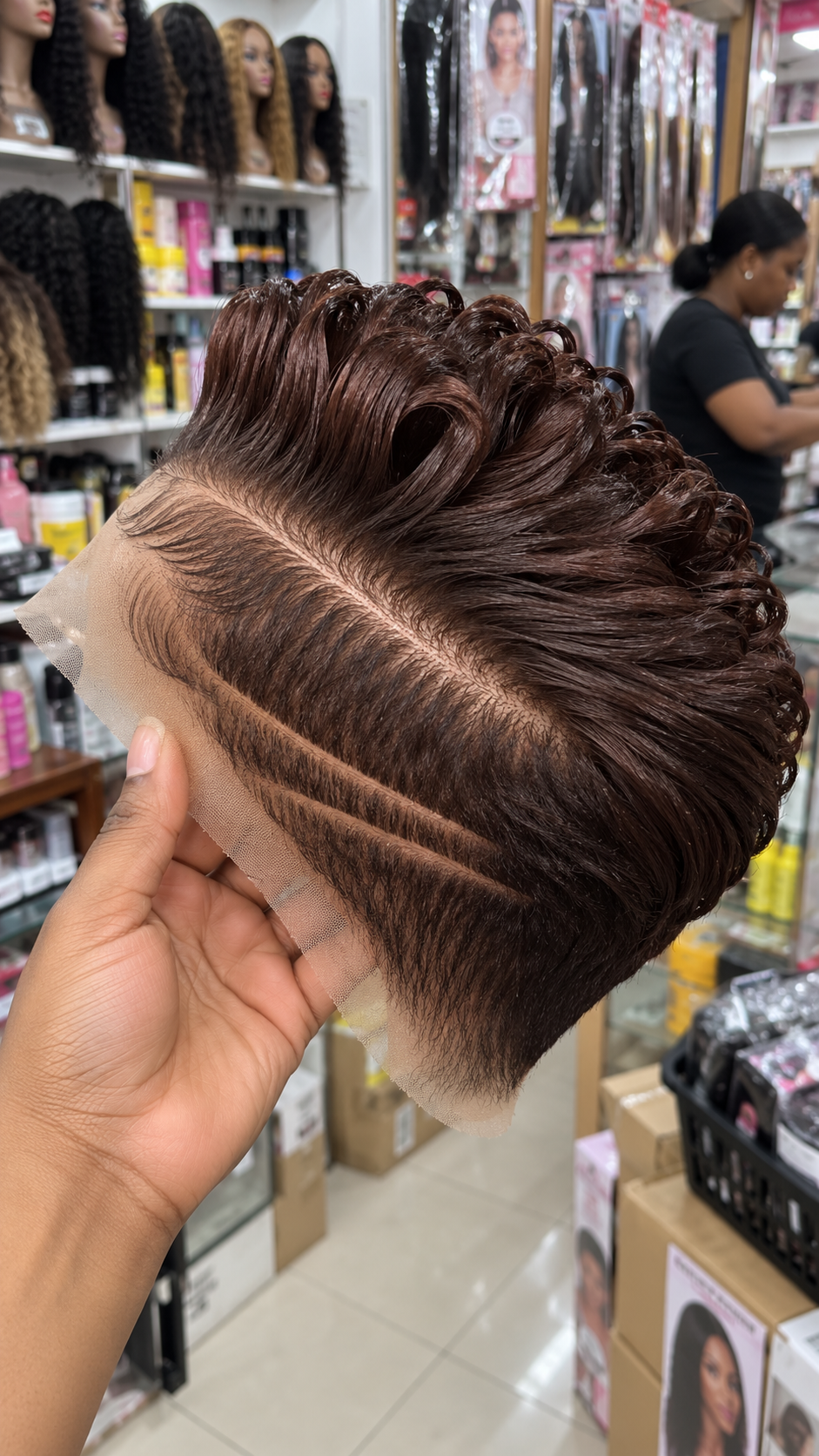
A hairstyle can communicate precision without relying on dramatic color contrasts or excessive volume. This chocolate brown lace wig demonstrates that principle through its directional styling, two visible side parting channels, and an elevated arrangement of glossy ribbon-like curls. Photographed inside a working beauty supply shop, the wig is held close to the camera, allowing shoppers to examine details that are often concealed in conventional model photographs.
The most important characteristic is the way the hair travels across the head. Rather than falling forward as a fringe or forming a rounded collection of small spirals, the longer upper strands rise from the front and sweep backward into curved loops. Beneath them, two pale channels divide the closely arranged side hair into distinct sections. These lines create a geometric contrast against the flowing upper hairstyle.
The photograph also reveals an extended section of tan lace surrounding the front and lower visible edges. The wig has not been installed on a person, and the lace remains untrimmed. Consequently, the image is especially useful for evaluating the styling before installation, although it cannot confirm the complete cap construction, fiber composition, or final fit.
For buyers interested in a chocolate brown pixie lace wig with decorative side parting, the principal challenge is finding a product that reproduces the actual directional design. A similarly colored curly wig will not necessarily deliver the same appearance. The position of the parting channels, the height of the upper curls, and the distribution of hair across the front all contribute to the final result.
Two Parting Channels Establish the Entire Design
The side detailing is the strongest distinguishing element in this photograph. Two clearly visible channels run across the exposed side section, separating the hair into three areas. The upper channel begins near the front and travels diagonally backward toward the main body of the hairstyle. A second channel sits below it, following a broadly similar direction.
These channels are not simply decorative lines placed over a finished hairstyle. They determine how the surrounding hair is organized. The upper section feeds into the elevated swept-back arrangement, the middle section forms a relatively narrow band of closely directed hair, and the lower section remains compact along the side.
The pale appearance of the channels comes from the exposed foundation beneath the parted strands. Because the wig is being held away from a person’s head, the photograph does not prove how these areas will appear against an individual scalp after installation.
It is also important not to confuse the design with a conventional barber fade containing two shaved razor lines. The visible channels appear to be formed through hair separation and arrangement on the wig. A buyer seeking this exact appearance should describe the design as double side parting or twin diagonal parting channels rather than automatically requesting shaved lines.
Placement Matters More Than Making the Lines Wider
For a custom recreation, the spacing between the channels should be established before the upper hair is permanently styled. If the middle band becomes too wide, the side may dominate the hairstyle. If it becomes too narrow, the two channels may visually merge, particularly when the hair is viewed from a distance.
The channels also need to follow the intended head contour. A design that looks correctly proportioned while held in the hand may change when the lace is positioned against the forehead and temple.
Ask the stylist to assess the side detailing during a fitting session, preferably with the wig temporarily secured. Any alteration to the channels should preserve sufficient hair density on both sides of each parting.
The Upper Hair Creates a Distinctive Backward Motion
Above the parted side, the hair rises into elongated curved sections. The front strands are lifted and directed backward, forming broad arcs that eventually join the curled upper and rear portions.
Several of the upper curls resemble polished ribbon loops rather than small circular coils. Their curved surfaces catch the shop lighting, producing bright reflections against the deeper brown areas between the strands.
The arrangement is particularly noticeable near the front, where the hair forms a raised sweep without covering the visible hairline. Toward the rear of the photographed section, the loops appear more closely grouped, producing a compact continuation of the upper hairstyle.
Although the wig appears relatively contained in length, the raised styling provides noticeable height. The volume is concentrated above the parting channels instead of being distributed equally around the entire head.
This distinction is useful when commissioning a similar hairstyle. Requesting a generic curly pixie could result in a rounded crown with curls pointing in several directions. Here, the styling has a dominant backward movement, and that direction should be preserved.
Matching the Curl Architecture
A stylist recreating the photographed design should consider the relationship between strand width and loop curvature. Broad upper strands help create the ribbon-like appearance, while the tighter grouping farther back provides structure.
Excessive teasing or added volume could obscure the individual arcs. Conversely, flattening the upper hair would remove the contrast between the elevated crown and the closely arranged side.
Before purchasing, ask for a video showing the wig rotating from the front toward the parted side. This can reveal whether the loops remain distinct and whether the upper silhouette maintains its intended shape.
The photograph does not provide a complete rear view, so the precise arrangement at the back should be confirmed separately rather than assumed to match the visible side.
Chocolate Brown Under Everyday Shop Lighting
The wig appears predominantly deep chocolate brown, with warm chestnut-like reflections where light strikes the upper strands. The color is richer than a pale caramel brown but does not appear uniformly black.
The highlights visible along the raised curls may result largely from the reflective surfaces and overhead lighting. They should not automatically be interpreted as separate dyed streaks or a deliberate balayage treatment.
There is no clearly established blonde transition, copper-colored tip treatment, or contrasting root section in the photograph. The dominant impression is a cohesive brown shade with varying brightness caused by the hair’s direction and illumination.
For shoppers comparing color options, this distinction can prevent an unnecessary customization expense. A seller may be able to supply a suitable chocolate brown base without additional highlighting, provided the finished shade resembles the reference under ordinary lighting.
Request a daylight photograph before ordering. Beauty supply shops frequently contain mixed lighting from ceiling fixtures, display cases, and surrounding reflective surfaces. Those conditions can influence how warm or dark brown hair appears on camera.
Buyers who prefer a deeper appearance can ask about dark chocolate alternatives, while those seeking a brighter result may consider chestnut brown. However, changing the shade should be a deliberate choice rather than an assumption about the photographed product.
Reading the Lace Before Making a Purchase
The untrimmed lace is particularly visible around the front and lower edge of the wig. It extends beyond the styled hairline, creating a mesh border that would normally be assessed during preparation for wearing.
Its tan appearance is evident in the photograph, but the exact lace grade, thickness, and transparency cannot be established visually. In particular, the presence of lace does not confirm an HD lace product.
The front hairline contains fine, closely arranged strands directed into the main hairstyle. The lace beneath them is visible because the wig is being displayed before installation.
Unlike a photograph showing the inside of an inverted cap, this image does not reveal the full underside. It therefore cannot confirm whether the wig includes attachment combs, elastic bands, adjustable straps, or a particular cap-construction system.
Measurements That Should Be Confirmed
Ask the seller for the cap circumference, front-to-nape measurement, and ear-to-ear dimensions. These measurements are more reliable than assuming that a wig labeled average size will fit comfortably.
The width and depth of the lace area should also be confirmed. A photograph can show that lace is present without establishing how far it extends across the front or toward the temples.
Because the side parting channels are visually prominent, their position relative to the wearer’s natural temple area is especially important. A poorly positioned cap can shift the channels away from their intended location.
Finally, request a photograph of the complete interior. This will help determine whether the wig’s attachment system is suitable for the intended use and whether additional customization is necessary.
Finding a Stylist Who Understands the Side Geometry
This design is best discussed with a wig customization specialist experienced in lace-front preparation and sculpted pixie styling. A stylist who also understands precision parting and directional hair placement may be particularly helpful.
When contacting a salon, avoid describing the hairstyle only as a brown curly wig. That description overlooks the parting structure and may lead to an entirely different result.
Instead, explain that the desired wig has a raised backward-swept crown, broad looped curls, two diagonal side parting channels, and a closely arranged lower side section.
Share the reference photograph and request examples of similar work. Photographs of finished installations are useful, but images showing the wig before installation can be equally valuable because they reveal how the stylist constructs the hair arrangement.
Choosing Between a Finished Wig and a Custom Order
A ready-made option may be suitable if the seller already offers the correct side detailing and upper curl direction. It can reduce the need for extensive styling appointments, although the lace may still require individual fitting.
A custom order offers greater control over the channel spacing, crown height, and overall proportions. However, it may cost more because the stylist must arrange the hair according to the reference rather than relying on a standard factory hairstyle.
Before paying a deposit, establish which characteristics must match the photograph and which can be adjusted. For example, a buyer might accept a slightly deeper chocolate shade but require the twin side channels to remain clearly separated.
Request confirmation of the material composition, cap size, production schedule, shipping arrangements, and any customization limitations. If ordering online, review the seller’s return policy carefully because personalized lace trimming or styling may affect return eligibility.
Preparing the Wig for Its First Installation
Once the wig arrives, inspect it before cutting or modifying anything. Compare the side channels with the product photographs and check that the upper loops have not been compressed during transportation.
The next step is a fitting appointment. The stylist should position the wig on the wearer’s head, assess the front hairline, and confirm that the parted side sits at the intended angle.
Only after the fitting is satisfactory should the lace be trimmed where necessary. Lace removal is an irreversible process, so cutting too much material before establishing the correct position can compromise the result.
The stylist can then evaluate whether minor adjustments to the front strands are needed. Such changes should be conservative because the front sweep is connected visually to the upper loops and the first parting channel.
If additional security is required, the appropriate method should be chosen according to the actual cap construction, the wearer’s hair, and personal comfort. The photograph does not provide enough information to classify this wig as glueless.
After installation, examine the hairstyle from the front and the parted side. The double channels should remain visible, the upper hair should retain its backward direction, and the lace should sit comfortably without excessive tension.
Illustrative Costs for a Precision-Parted Brown Pixie Wig
The price of a similar wig depends on more than its length or color. Reproducing the two parting channels and elevated ribbon curls may require additional styling time, particularly if the seller does not already manufacture this configuration.
The following USD amounts are illustrative budgeting estimates, not verified market quotations or confirmed prices for the photographed wig. Human hair and synthetic hair are listed as possible purchasing categories; the material in the image has not been independently identified.
| Category | Illustrative Price Range | Possible Purchase Characteristics |
|---|---|---|
| Premium Custom | $320–$780+ | Individual cap specifications, precision side separation, detailed crown shaping, and advanced lace customization. |
| Standard Custom | $160–$350 | Selected cap options with custom parting placement and professionally arranged upper curls. |
| Basic Human Hair | $95–$250 | Human-hair base unit that may require additional shaping, directional styling, and lace preparation. |
| Premium Synthetic | $55–$155 | Higher-grade synthetic alternatives with prearranged styling and potentially more consistent curl retention. |
| Basic Synthetic | $20–$65 | Lower-cost alternatives that may have less precise channels, simpler cap construction, or different curl placement. |
These ranges are intended for preliminary planning only. Actual prices vary by country, supplier, material, and the amount of manual work involved.
A quotation should clarify whether the side parting is already included or whether the stylist will create it after purchase. The same applies to the upper curl arrangement, lace preparation, and installation.
Shipping, color adjustments, fitting appointments, and additional salon labor may be charged separately. A lower initial wig price is not necessarily a better value if extensive reconstruction is required to match the reference.
Protecting the Side Channels During Regular Wear
The two exposed parting channels are likely to be among the first areas where careless handling becomes noticeable. Hair moving across either channel can reduce its visibility and interfere with the intended separation.
Rather than brushing across the entire side, follow the stylist’s instructions for maintaining the direction of each section. Any repositioning should respect the existing parting boundaries.
The upper loops require a different approach. Their appearance depends on retaining the curved strand arrangement, so repeated combing or forceful finger separation may disturb the shape.
For a synthetic wig, confirm whether the manufacturer permits heat tools before attempting to restore any curls. For human hair, ask about previous chemical processing and the safest temperature and styling products for the individual piece.
Washing frequency should reflect actual use, product buildup, and the supplier’s care recommendations. Excessive cleaning or aggressive manipulation can create unnecessary work when the hairstyle contains carefully positioned sections.
When storing the wig, avoid pressing the elevated upper hair against a flat surface. A suitable support can help maintain the silhouette, while a protective covering may reduce dust exposure without crushing the loops.
If the parting channels begin to lose their original appearance, a professional restyling appointment may be preferable to repeatedly applying additional products at home.
What Makes This Particular Wig Worth Comparing Carefully
Many brown pixie wigs can provide a compact hairstyle, but fewer reproduce the relationship between elevated backward curls and two prominent side channels. That relationship is the central reason to use this photograph as a purchasing reference.
A suitable reproduction should preserve the chocolate brown appearance, the direction of the front sweep, the broad curved upper strands, and the separation between the side sections. It should also provide a properly fitted lace foundation rather than relying solely on attractive product photography.
Before completing a purchase, compare the actual product from multiple angles, confirm its materials and measurements, and determine which salon services are included. If the side geometry is the deciding factor, prioritize a seller capable of demonstrating that detail clearly.
The strongest result will come from treating the wig as a coordinated hairstyle rather than a generic curly unit. Its color supports the design, but the disciplined hair direction and double side parting give it a recognizable identity that deserves careful attention during ordering, installation, and maintenance.
Search Terms
Chocolate brown double parting lace pixie wig · Swept back ribbon curl brown hairpiece · Twin diagonal side channel wig · Glossy chestnut brown sculpted crown wig · Untrimmed tan lace side parted pixie · Brown elevated loop curl lace wig · Precision separated temple hair wig · Deep chocolate backward curl wig