
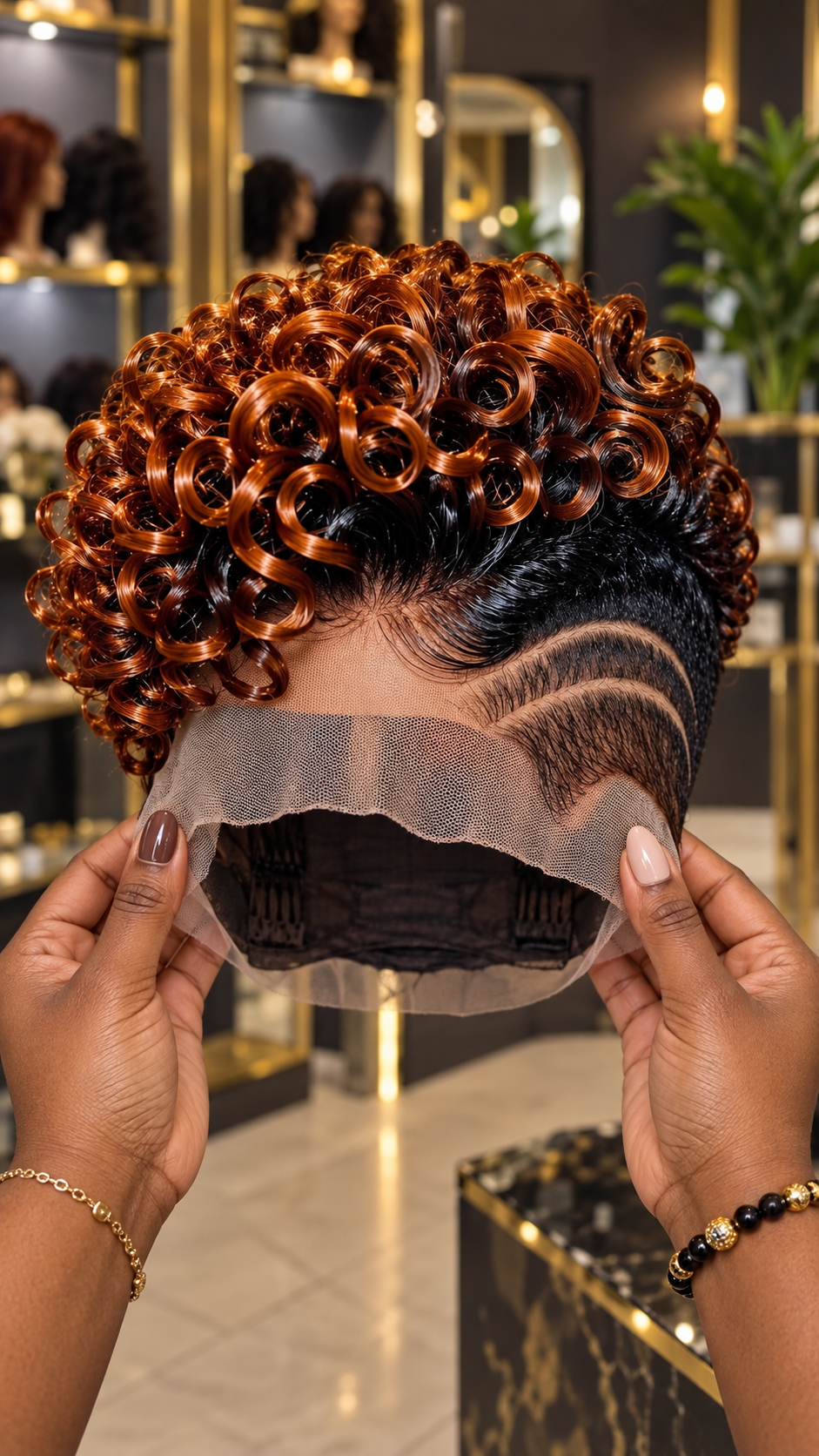
Before ordering a fiery copper wig with sculpted ringlets, there is one important distinction to make: a beautiful curl pattern is not automatically the same as a carefully constructed custom hairstyle. The quality of this particular unit depends on how its large copper circles interact with the dark root foundation, how the front hair flows into the side, and how the two curved side channels preserve their shape beneath the crown. Each element has a different purpose, and together they create a recognizable design that cannot be reproduced simply by curling an ordinary copper wig.
The photograph captures the unit before installation, held open with its front lace extended. Large copper-orange ringlets occupy the upper crown, while deep black roots create a dramatic transition into a closely arranged side. Two pronounced curved channels sweep above the temple, separated by retained dark hair. Fine black strands are directed across the front boundary, creating an orderly transition between the dense upper curls and the untrimmed lace.
Part of the dark interior cap is visible, along with comb-style attachment components. The photograph therefore provides evidence of both exterior styling and some internal construction. However, it cannot verify whether the fibers are human hair or synthetic, establish a particular lace grade, or guarantee adhesive-free installation. Those details should be confirmed independently before a customer pays for a premium specification.
The Copper Crown Should Be Evaluated for Curl Architecture First
Many wig listings use broad descriptions such as curly copper hair or auburn spiral wig. Those terms do not adequately describe the construction visible here. The crown contains large, individually rolled circular formations, several with remarkably open centers. Instead of hanging downward like conventional ringlets, they sit raised and closely arranged across the head.
The larger openings appear prominently toward the front and upper crown. Smaller circular sections fill the surrounding spaces, giving the hairstyle depth without creating a rigid sequence of identical curls.
This variation in size is important. If every spiral were exactly the same diameter, the crown could appear overly mechanical. If the curls were much smaller, the distinctive hollow-ring appearance would disappear.
When ordering a recreation, ask the maker to confirm that the crown will contain oversized tubular ringlets with visible circular centers. An overhead approval photograph should make this detail easy to inspect.
The desired outcome is not maximum volume at any cost. It is a rounded crown with controlled spacing, where individual coils remain recognizable even though the hair appears full.
The Color Transition Runs From Black Roots Into Fiery Copper
The color deserves separate attention because the upper and lower areas have markedly different appearances. The crown glows with rich copper, burnt-orange and auburn reflections, while the roots and closely arranged side remain predominantly black.
This is not a uniform copper wig. Nor is it a simple alternating pattern of black and orange streaks. The warm color dominates the raised spiral surfaces while the darker foundation remains visible beneath them.
Black inside the curl openings creates shadow, allowing the copper ribbons to stand out. Some raised strands appear brighter orange under the salon lighting, while recessed sections lean toward deeper reddish brown.
For a custom order, the correct instruction should focus on the placement of copper over a black foundation. Asking for an all-over orange-copper color could eliminate the dark depth that makes this design distinctive.
Likewise, a traditional blonde highlight arrangement would fail to reproduce the rich reddish warmth visible in the reference. Customers should request a color sample or photograph under neutral light to check whether the available copper leans too far toward yellow, red or brown.
The Largest Rings Need Open Centers, Not Extra Filling
The central crown contains several ringlets whose hollow openings are almost as visually important as the curled strands themselves. Those spaces reveal deeper hair beneath the copper surface, producing alternating bright and dark areas throughout the upper construction.
A common temptation during customization is to add more hair until every gap appears filled. For this style, that could make the result less accurate.
Large open rings require sufficient separation from their neighbors. When sections overlap too heavily, the circular centers become hidden and the crown starts resembling a mass of ordinary curls.
Professional setting should therefore preserve the shape of each major spiral. Smaller surrounding curls can provide support, but they should not obscure the larger formations.
A buyer inspecting the finished wig should look for consistent curl tension and visible openings rather than judging quality solely by how much hair has been used.
The Black Front Section Controls the Entire Face-Framing Direction
Underneath the copper curls, the front hair changes character. Instead of continuing with large spirals, fine black strands are arranged in a backward-flowing direction. These strands follow the contour of the forehead and move toward the temple.
The transition creates visual breathing room between the vibrant crown and the closely arranged side. It also keeps the copper ringlets from falling directly into the front perimeter.
This area should not be overlooked when recreating the wig. A maker who concentrates entirely on the copper crown may omit the directional black front and produce a significantly different appearance.
The black strands also give the hairline a softer progression before the dense upper crown begins. During fitting, their direction should be evaluated before unnecessary trimming is considered.
Two Crescent-Like Side Channels Establish the Geometric Signature
The side contains two prominent curved exposed paths that travel above the temple. The upper channel begins nearer the crown boundary and bends downward through the close black hair. Beneath it, a second curved path creates a layered crescent arrangement.
These are not ordinary straight barber stripes. Their rounded trajectories follow the contour of the wig, producing a flowing geometric design.
Dark strands remain between the channels, forming a substantial curved panel. This retained hair is essential: it distinguishes the two exposed paths and keeps the lower side from becoming one wide open area.
For a professional recreation, the pattern should be mapped against the exact side photograph before cutting. A generic instruction for two carved lines would leave room for straight, parallel or incorrectly positioned marks.
The lower channel also approaches the ear area, making cap alignment particularly important once the wig is fitted to the wearer.
The Uncut Lace and Interior Components Deserve Separate Inspection
The photograph provides a clear view of the extended front lace. The mesh remains attached beyond the front hair-bearing area, allowing a stylist to determine the final trimming boundary during installation.
Portions of the dark interior are visible, including comb-style attachments inside the cap. These details are useful because they give the buyer more information than a conventional finished mannequin photograph.
However, the complete underside is not exposed, so the image does not establish every cap component or the full attachment configuration.
Ask the seller whether the exact delivered unit includes the combs shown, whether additional adjustment options are available, and what cap sizes can be ordered.
Customers with particular attachment preferences should discuss them before buying. Visible combs do not automatically establish adhesive-free suitability, and lace appearance alone cannot verify HD lace.
A complete underside photograph is especially valuable when comparing different sellers offering similar exterior hairstyles.
Commissioning the Wig Requires Three Independent Approvals
A clear purchasing process can reduce the risk of receiving a unit that matches the color but not the construction. Instead of treating the reference as one general hairstyle, divide the commission into three approval stages.
The first concerns the crown. Confirm the diameter of the largest circular spirals, the mixture of supporting curls and the compact overall silhouette. The maker should show enough of the crown to demonstrate that the ringlets retain their hollow centers.
The second concerns color. Confirm the black root foundation and the fiery copper appearance across the raised curls. The transition should remain visible rather than becoming a uniform orange crown.
The third concerns the side. Approve the two curved channels, their spacing and the amount of dark hair preserved between them. The carved design should match the reference without unnecessary additional lines.
After these approvals, cap sizing, lace specifications, attachment preferences and delivery condition can be addressed. This separation makes it easier to identify errors before the wig has been shipped or permanently altered.
Finding a Stylist Who Can Reproduce Both Curl and Side Work
Creating large hollow spirals requires a different skill set from styling loose curly extensions. The professional must control the individual curl diameter, direction and placement while maintaining an even crown.
The side design introduces another specialty. Cutting crescent-like pathways into wig hair requires careful density management because removed strands cannot regenerate.
A custom lace-wig maker with experience in sculpted crowns is a practical starting point. Buyers can also search for wig stylists who specialize in finger curls, spiral setting and barber-inspired wig customization.
If the maker cannot provide both services, a coordinated approach may work. The wig specialist can prepare the copper crown and lace foundation, while an experienced barber or wig-cutting professional refines the side after fitting.
For local appointments, send the reference photograph in advance and explain whether the wig is already styled or still requires full construction.
Compare Quotes by Labor Already Completed
A compact wig can involve substantial hand work. The visible hair length may be modest, but forming many individual spirals, maintaining copper-black contrast and cutting two accurate side channels all require time.
When comparing prices, the important question is how much of that work the seller has already completed. A basic human-hair foundation may appear affordable but still need professional coloring, spiral setting and side customization.
A finished custom piece may command a higher initial price while reducing the need for separate salon appointments.
Estimated Pricing for a Copper and Black Sculpted Ringlet Wig
| Wig Category | Illustrative Price Range | Likely Customization Level |
|---|---|---|
| Premium Custom | $350–$640+ | Higher-grade hair, individualized cap sizing, planned copper coloring, hand-arranged hollow spirals, detailed crescent-side construction and personalized lace preparation. |
| Standard Custom | $215–$380 | Prepared copper ringlet crown, black root foundation, established curved side channels and standard fitting options. |
| Basic Human Hair | $125–$230 | A human-hair foundation that may require separate color processing, curl setting, side cutting and professional installation. |
| Premium Synthetic | $85–$170 | A higher-quality pre-colored and pre-set interpretation with potential shape-retention benefits but less flexibility for later modifications. |
| Basic Synthetic | $40–$95 | A budget alternative with potentially simpler curl placement, less precise color distribution, reduced side detail or different cap construction. |
These figures are illustrative budgeting estimates rather than verified retail prices for the photographed wig. Actual quotations vary according to seller, location, hair or fiber, cap construction, labor, shipping and installation.
Customers should request an itemized quotation showing whether the displayed ringlet crown and side channels are included. Prices should also clarify whether lace fitting and any additional adjustments will be charged separately.
Human Hair and Synthetic Versions Have Different Long-Term Costs
A human-hair version may provide greater freedom for professional spiral resetting. If individual curls relax, a stylist can potentially reconstruct selected sections without rebuilding the entire crown.
However, fiery copper coloring may involve processing that affects future heat and chemical tolerance. A professional should evaluate the condition of the hair before applying additional heat.
A high-quality synthetic version can be attractive when the wearer prefers the curls to remain largely pre-set. Some fibers retain sculpted formations well, although future color changes and heat styling may be restricted.
The better choice depends on how frequently the wig will be worn, whether the wearer expects to change its styling and whether professional maintenance is readily available.
Maintain the Crown and Carved Side as Separate Systems
The copper crown and black side should not be maintained using one universal styling technique. The crown contains raised circular spirals, while the lower section relies on compact directional strands and exposed channels.
Before washing, photograph the upper coils from above. This records the position of the largest rings and the smaller curls surrounding them.
During cleansing, minimize unnecessary friction between neighboring spirals. Broad rubbing can cause several curls to intertwine and obscure their open centers.
After drying, inspect the sections individually. Restore only the curls that have moved rather than automatically dismantling the entire crown.
The side should be inspected separately. If fine strands begin covering the crescent paths, repositioning may restore their clarity without cutting.
Protect the Copper Color Without Overloading the Rings
The ringlets have a highly reflective surface, but heavy oil or wax can reduce the appearance of individual curls. Excess product may cause strands to stick together and make the hollow centers less visible.
Buildup can also affect how the copper shade appears, making the brightest surfaces look darker or less distinct.
Use products compatible with the confirmed hair or fiber. If the wig is human hair and the color begins fading, a professional colorist can assess whether selected areas need refreshing.
The darker foundation should remain intact during future coloring. Applying one uniform copper formula throughout the entire unit would remove much of the original contrast.
The Side Channels Should Be Preserved Rather Than Recreated Repeatedly
The exposed crescent paths are permanent components of the wig. They do not need to be widened on a fixed haircut schedule.
In fact, repeated cutting can gradually remove the dark hair that separates them. Once those retained sections become too narrow, the original layered geometry may be difficult to restore.
When professional maintenance is necessary, use the original photograph as a reference for curvature and width.
The objective should be to retain the two distinct paths and the compact black panels around them, not to make the carving more dramatic every time the wig is serviced.
Book the First Salon Appointment for Fit and Inspection
When the finished unit arrives, inspect the crown, color placement, side geometry, lace and visible interior attachments before permitting irreversible alterations.
If the product differs substantially from a custom order, contact the supplier before cutting the lace or restyling the hair.
Once the wig has been accepted, a stylist can position the cap and assess the front hairline and ear area. The crescent side pattern should be checked in its final wearing position before additional trimming is considered.
If the design already matches the reference and sits correctly, further side cutting may not be necessary.
For appointment booking, explain that the unit has an existing sculpted copper crown and precision side geometry so the salon can plan a fitting rather than automatically scheduling a complete restyle.
Storage Must Preserve the Height of the Large Copper Spirals
The open coils can be distorted by compression during storage. A suitable wig stand or mannequin head provides space for the crown to retain its rounded arrangement.
Avoid stacking other hairpieces on top or pressing the side against a hard surface. Pressure can flatten the curls and shift fine strands across the exposed side channels.
The cap and lace should be fully dry before storage. For travel, choose packaging deep enough to protect the raised spirals without forcing the crown inward.
Preserving the physical arrangement reduces the need for repeated professional reconstruction and helps the copper crown retain its original balance.
The Finished Wig Should Preserve Contrast Without Excess
The defining quality of this piece is its division of visual roles. Fiery copper spirals dominate the upper crown, while black roots and directional front strands create a dark foundation. The side introduces two distinct crescent channels without allowing the exposed areas to overwhelm the closely arranged hair.
A successful recreation should retain large hollow ringlets, smaller supporting coils, rich copper reflections, visible black root depth and carefully spaced side curves. The lace and cap specifications should then be verified independently so the finished product is not judged on appearance alone.
For wig businesses, this unit is especially well suited to detailed construction photography. An overhead image reveals the copper ringlet arrangement, a direct side image documents the crescent geometry, and an interior photograph clarifies the attachment system. Together, these views allow customers to understand the work involved and compare custom options more accurately.
The strongest purchasing decision comes from evaluating color, geometry and fit as connected requirements. When each is specified clearly and approved before installation, a custom wig has a much better chance of retaining the distinctive character of this copper-and-black design.
Search Terms
fiery copper hollow ringlet wig · black root copper spiral crown · double crescent side wig · copper orange lace front wig · sculpted auburn ring curls · black temple wave wig · open tubular copper coils · untrimmed lace copper wig