
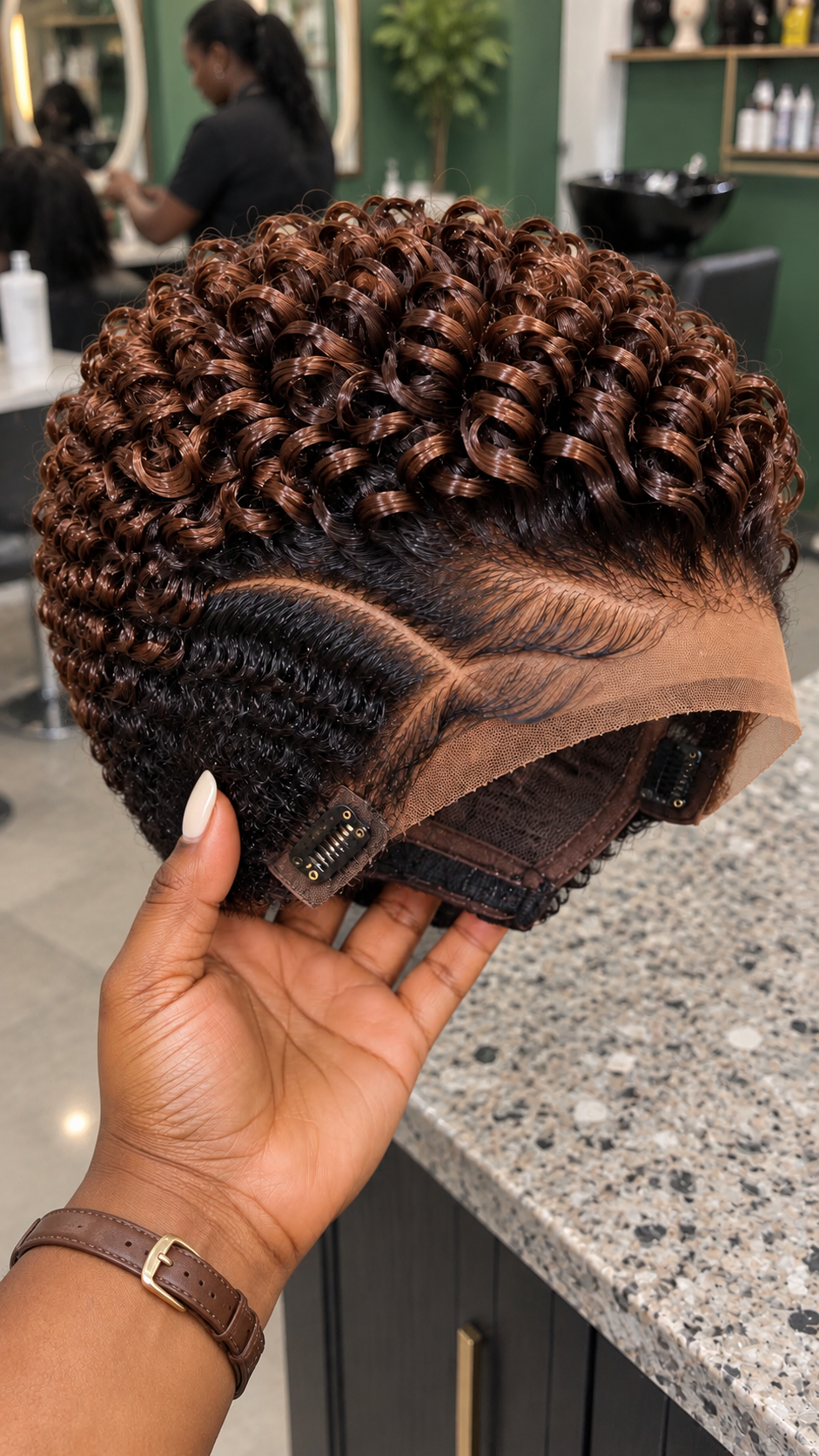
The appeal of this chocolate-root copper wig comes from a particularly interesting contrast: the upper crown is filled with warm copper-brown spirals, while the front and lower side remain predominantly dark. Rather than introducing elaborate shaved artwork, the design uses one pronounced curved parting, a directional wave section near the temple and densely arranged smaller curls along the lower side. The result is a compact sculpted wig with a rich copper crown and a more restrained, carefully organized perimeter.
The photograph offers an unusually useful view of the unit before installation. The lace extends beyond the front hairline, part of the inner brown cap is exposed, and two small comb attachments are visible around the interior perimeter. This helps buyers assess both the hairstyle and some practical construction details. The image confirms the presence of lace but does not establish its commercial grade, whether the fibers are human or synthetic, or whether the wig can be worn securely without adhesive.
One of the most distinctive qualities of this piece is that the copper is not distributed evenly from root to tip. Deep chocolate-brown roots remain prominent beneath the crown, while warm copper, cinnamon and auburn reflections appear across the raised spiral surfaces. This arrangement makes each curl more dimensional because darker hair remains inside the circular openings.
A Copper Crown Built From Compact Open Spirals
The crown contains a dense arrangement of tubular curls with clearly visible circular openings. Several of the central spirals are relatively large, while smaller curled sections occupy the surrounding spaces. This mixture helps create a rounded silhouette without making the crown unnecessarily bulky.
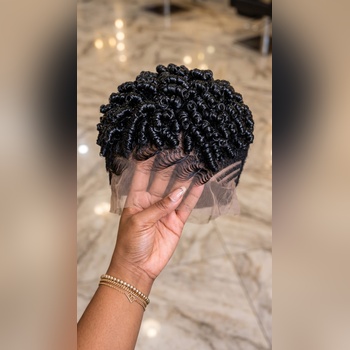
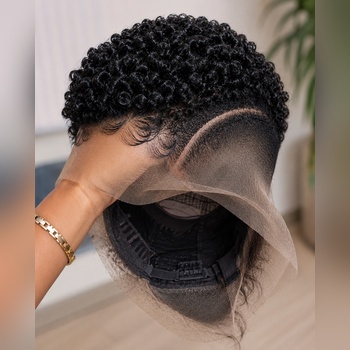
The spirals do not hang freely like conventional ringlets. They are positioned close to the head and arranged to form a continuous curled surface. Individual sections rise enough to remain recognizable, but their overall length stays compact.
For customers ordering a comparable wig, curl diameter should be specified rather than requesting a generic curly unit. A supplier could otherwise provide loose curls, tiny finger coils or ordinary roller curls that have a very different appearance.
The visible openings are an important part of the reference. Packing additional hair into every gap would increase density but could reduce the sculptural quality of the crown.
Chocolate Roots Give the Copper Its Depth
The darker foundation is visible through the root area, between spirals and throughout the lower side. This chocolate-to-deep-brown shade creates shadow beneath the brighter copper surface.
The result differs from an all-over orange-copper wig. Warm color becomes strongest where the strands rise into loops, while the underlying dark hair keeps the appearance rich and balanced.
A custom colorist should preserve that relationship. Lightening the entire foundation would reduce the contrast that makes the spiral centers visible and could make the crown appear flatter.
When discussing color, describe the desired combination as dark chocolate roots with warm copper-brown crown spirals rather than relying exclusively on a single shade name.
The Copper Reflects Several Warm Tones
Depending on the angle of each spiral, the raised surfaces appear copper, cinnamon, auburn or warm caramel-brown. These variations are particularly visible across the front and central crown.
The photograph does not establish whether several separate color formulas were used. Some of the apparent variation may come from lighting, reflected shine and the deeper foundation beneath the curls.
Buyers should therefore avoid assuming that the wig contains a specific multi-color dye system without supplier confirmation.
A neutral-light photograph of the actual unit can help determine whether the copper leans more toward red, brown or golden amber before an order is approved.
The Crown Changes Scale Around Its Edges
The central crown contains several prominent open spirals, while the outer areas use smaller curls to follow the rounded contour of the wig. This gradual variation gives the hair an organized appearance without making every section identical.
It also creates a practical transition into the side. Large curls remain concentrated where there is enough room for their openings, while smaller sections occupy the narrower areas near the perimeter.
A recreation should preserve that distribution rather than using one uniform coil diameter across the entire cap.
For made-to-order work, an overhead approval photograph is especially useful. It can show whether the maker has arranged the spirals into a balanced crown rather than simply repeating identical curls.
The Curved Parting Establishes the Front Direction
A pronounced curved separation begins near the front and travels diagonally toward the side. It divides the copper spiral crown from the flatter dark hair beneath it.
This exposed pathway has a structural purpose. It establishes the direction of the front styling and creates a visible break between two different hair arrangements.
Above the part, the crown remains raised and circular. Below it, strands become longer in direction but flatter against the foundation.
The curvature matters. A straight conventional side part would produce a different arrangement, even if the crown color and spiral density were similar.
Fine Front Waves Create a Softer Transition
Near the forehead, fine dark strands sweep along the lace perimeter before joining the heavier hair behind them. These strands are arranged in elongated curves rather than the circular shapes used in the crown.
The transition helps prevent the upper spirals from meeting the front edge abruptly.
For professional fitting, the front should be evaluated with the wig positioned on the wearer. Removing too many fine strands may produce a harder hairline than intended.
The current photograph shows the unit before lace trimming, which gives the installer an opportunity to determine the final boundary without immediately altering the front styling.
The Side Uses a Broad Directional Wave Panel
One important difference between this design and a wig with multiple shaved stripes is the way the side is constructed. Beneath the curved part, the hair forms a substantial dark wave panel that follows the side of the cap.
The strands remain compact and directional. They move backward through gentle curves, providing a calmer visual area beneath the more active copper crown.
This wave panel is not simply a row of additional spiral curls. Its flatter form is essential to the contrast between the upper and lower sections.
A stylist recreating this design should therefore treat the side independently from the crown. Using the same curling technique throughout could remove the distinction visible in the reference.
A Single Exposed Boundary Completes the Side Structure
A curved scalp-toned pathway separates the upper wave panel from the smaller lower curls. The exposed route follows the rounded shape of the wig rather than appearing as an unrelated straight stripe.
The path creates a clear boundary, but it does not form the elaborate multi-channel artwork seen on some other barber-inspired units.
This distinction should be preserved when ordering. Adding several decorative lines would create a different wig and make the lower side considerably busier.
The reference relies on one dominant curved separation with directional hair above and compact curls beneath it.
The Lower Side Remains Dark and Closely Curled
Beneath the visible separation, the hair becomes smaller in scale. Tight dark curls sit close to the cap, creating a dense foundation without projecting outward like the copper crown.
This lower section visually anchors the hairstyle. It also connects with the deep chocolate root areas above, creating color continuity between crown and side.
Maintaining the lower density is important. Excessive trimming could make the area sparse, while leaving it too full might obscure the intended transition.
Because wig hair cannot naturally regrow, any refinement should be conservative.
The Front Lace Has Not Yet Been Customized
The visible lace extends beyond the hairline and forms a broad mesh perimeter. This shows that the unit has not yet been fully fitted to an individual wearer.
For installation, the extra lace can be useful because the stylist can first establish the correct cap position.
Only after evaluating the front hairline and side alignment should the lace be trimmed.
The mesh appears warm beige-brown in the photograph, but lighting can alter its perceived shade. The exact lace material and available colors should be confirmed with the seller.
A visible lace front is not enough evidence to identify the material as HD lace.
The Interior Shows Two Comb Attachments
The photograph reveals portions of the inside cap, including small comb-style attachments near the inner perimeter.
This gives buyers useful practical information because attachment preferences vary. Some wearers prefer internal combs, while others may want a different securing arrangement.
The full cap is not visible, so the complete attachment system cannot be established from this photograph alone.
Before ordering, ask the supplier for an underside photograph showing the cap, available adjustment components and attachment placement.
Cap Fit Influences the Curved Part’s Position
The curved parting and side-wave panel are fixed to the foundation. When the cap moves, those details move with it.
A cap that sits too far forward may place the curved section closer to the face. A loose unit that shifts backward can change how the side aligns with the temple.
Correct sizing therefore affects appearance as well as comfort.
For a custom order, follow the maker’s measurement instructions. Depending on the construction, circumference, front-to-nape and ear-to-ear measurements may all be relevant.
Ordering Should Begin With the Curl Map
A useful order specification starts with the crown: compact open spiral coils arranged densely but with recognizable circular centers.
The second requirement is the color arrangement: deep chocolate roots with copper-brown reflections across the raised spirals.
The third requirement is the side construction: a curved front parting, elongated dark wave panel and closely curled lower section without additional decorative carving.
After those appearance decisions are agreed upon, discuss cap size, lace shade, interior attachments and whether the lace should remain untrimmed for local fitting.
Choose a Specialist Who Understands Spiral Setting
This hairstyle requires more than ordinary curling. The crown contains numerous individual spirals whose openings need to remain visible while the sections sit close together.
Look for wig makers who can demonstrate similar sculpted coil work in their portfolios.
Overhead photographs are especially useful because they reveal whether the coils are consistently arranged without becoming mechanically repetitive.
A professional experienced with directional finger-wave styling is also valuable because the side needs a different approach from the crown.
Where to Source the Wig
Custom lace-wig studios, specialist wig makers and salons offering sculpted hairpieces are practical places to begin.
A general wig retailer may have a suitable brown or copper foundation, but additional work could be required to reproduce the crown and side.
If purchasing online, send the reference photograph and ask whether the actual product includes the completed spiral arrangement and curved side styling.
When commissioning locally, a consultation can establish the desired coil size, root depth, front shape and fitting requirements before production begins.
Approval Photographs Should Reveal the Hair’s Three Main Zones
An overhead image should show the copper spiral crown, including the variation between larger and smaller coil openings.
A side photograph should capture the curved separation, flatter wave panel and compact lower curls.
A rear three-quarter image can confirm that the spiral construction continues around the back in a balanced manner.
If the cap or lace is part of the purchase decision, request a separate underside photograph. Styling photographs cannot verify every construction characteristic.
Color Approval Needs More Than Warm Salon Lighting
The photograph’s indoor lighting enhances copper and golden reflections. Under neutral lighting, the hair may appear deeper and more reddish-brown.
A buyer should request a neutral-light photograph of the actual available color before confirming a custom order.
The intended shade should preserve the chocolate root depth rather than becoming uniformly bright copper.
If human hair is used, ask whether the copper color was achieved through processing and what maintenance the seller recommends.
Pricing the Curl Construction and Custom Fitting
The cost of this wig should account for the individually arranged spirals, warm coloring, side-wave styling, cap construction and professional preparation.
Although the hairstyle is compact, the repeated curl formations can involve substantial hand work.
Estimated Pricing for a Chocolate-Root Copper Spiral Wig
| Category | Illustrative Price Range | What May Be Included |
|---|---|---|
| Premium Custom | $335–$600+ | Higher-grade hair, individual cap measurements, chocolate-to-copper color placement, hand-arranged spiral crown, directional side-wave styling and lace preparation. |
| Standard Custom | $205–$360 | Prepared copper spiral crown, curved side arrangement and standardized cap options with limited fitting adjustments. |
| Basic Human Hair | $120–$220 | A human-hair foundation requiring additional copper coloring, spiral setting, front-wave styling and professional installation. |
| Premium Synthetic | $80–$160 | A quality pre-colored and pre-set option with potential benefits for curl retention and less flexibility for major modifications. |
| Basic Synthetic | $40–$90 | A budget interpretation with potentially simpler coil placement, tonal depth, front styling or cap construction. |
These ranges are illustrative estimates rather than confirmed prices for the photographed wig. Actual costs vary according to material, seller location, labor, cap construction, shipping and installation.
Before purchasing, ask what work has already been completed. An inexpensive foundation that still requires coloring and extensive spiral setting may ultimately cost more than a prepared custom unit.
Human Hair Supports Professional Curl Resetting
A human-hair version may be useful for customers who expect periodic professional styling. Individual spiral sections can potentially be restored when they begin losing their original shape.
However, copper-colored hair may have undergone chemical processing. Future heat should be chosen according to the condition of the strands.
Repeated excessive heat can affect both the hair quality and the appearance of the color.
A stylist should consider these factors before performing a complete crown reset.
Synthetic Fiber Can Offer Pre-Set Shape Retention
A premium synthetic version may preserve the spiral arrangement with less frequent professional reconstruction.
This can be attractive for buyers who want the wig to remain close to its original display appearance.
The limitation is future styling flexibility. Heat tolerance varies by fiber, and conventional permanent dye should not be assumed suitable.
Confirm the exact material before attempting hot-tool work or recoloring.
Maintenance Should Preserve the Open Spiral Centers
The crown’s circular openings are important to the overall appearance. If neighboring curls become tangled or compressed, those openings may disappear.
Before washing, photograph the crown from above and from the side. These images provide a guide for restoring the original arrangement.
During cleansing, avoid aggressive rubbing between neighboring spirals.
After drying, adjust only the sections that have moved rather than automatically rebuilding the entire crown.
The Side Waves Need a Different Maintenance Approach
The flatter directional strands beneath the curved part should remain distinct from the upper spirals.
If a wave loses its direction, restore the elongated movement rather than converting the section into additional circular curls.
Heavy product can cause the wave ridges to merge, so styling aids should be used sparingly.
Keeping the side close and directional preserves the contrast that makes the copper crown appear more prominent.
The Exposed Parting Should Not Be Widened Repeatedly
The curved scalp-toned separation already creates a clear boundary between the crown and lower side.
There is no reason to deepen or widen that pathway automatically during every maintenance appointment.
If fine strands shift across the line, repositioning may restore clarity without additional cutting.
Because wig hair cannot regrow, conservative maintenance helps preserve the original density around the parting.
Protect the Copper Tone From Excessive Product Buildup
The raised spirals already reflect light strongly. Heavy oils, waxes or holding products may collect between curls and reduce their visible separation.
Buildup can also make the copper appear darker or less reflective.
Use only the amount appropriate for the confirmed hair or fiber.
If the crown begins looking dull because of residue, suitable cleansing may be more effective than adding more shine product.
Color Refreshing Should Maintain the Chocolate Foundation
If a human-hair version eventually needs color maintenance, the darker root areas should be preserved.
Applying one uniform copper shade throughout the crown could remove the contrast that gives the spirals their dimensional appearance.
A professional colorist can evaluate whether selected areas require refreshing while maintaining the deeper chocolate-brown foundation.
Synthetic versions should only be treated with methods appropriate for their confirmed fiber.
Book the Fitting Before Altering the Side
When the wig arrives, inspect the crown, color, curved parting, lace and visible interior hardware before making permanent changes.
The installer should establish the cap’s final position and assess where the side-wave panel falls around the temple.
Only after that fitting should the lace be trimmed and optional side adjustments considered.
If the existing styling matches the reference, additional cutting may be unnecessary.
Storage Should Protect the Rounded Crown
A suitable wig stand or mannequin head can help preserve the raised spiral formations between wears.
Avoid placing heavy items over the crown or compressing the smaller side curls against a hard surface.
Make sure the cap and lace are fully dry before storage.
For transportation, use packaging deep enough to protect the circular openings without forcing the crown into a flatter shape.
The Best Reproduction Preserves the Contrast Between Three Styling Zones
This chocolate-root copper wig succeeds because its crown, front and lower side perform different functions. The upper surface is densely populated with warm copper spirals. The front introduces fine directional strands and a curved separation. The lower side uses compact dark curls to complete the profile without competing with the crown.
For buyers, the most important quality checks are the visible spiral openings, mixed curl sizes, chocolate root depth, copper reflection, curved parting, directional side-wave panel, compact lower density and untrimmed lace.
For wig businesses, photographing those areas separately can help customers understand the craftsmanship involved. Accurate material information, realistic pricing and a clear explanation of the fitting process are more useful than unsupported claims about lace or fiber.
When a custom maker preserves the original curl map and the relationship between copper and chocolate-brown hair, the finished unit can retain the same distinctive character rather than becoming an ordinary reddish-brown curly wig.
Search Terms
chocolate root copper spiral wig · auburn open coil crown · copper brown curved part wig · directional temple wave wig · dark root copper lace front · compact lower curl wig · sculpted chocolate copper wig · untrimmed lace spiral hairpiece