
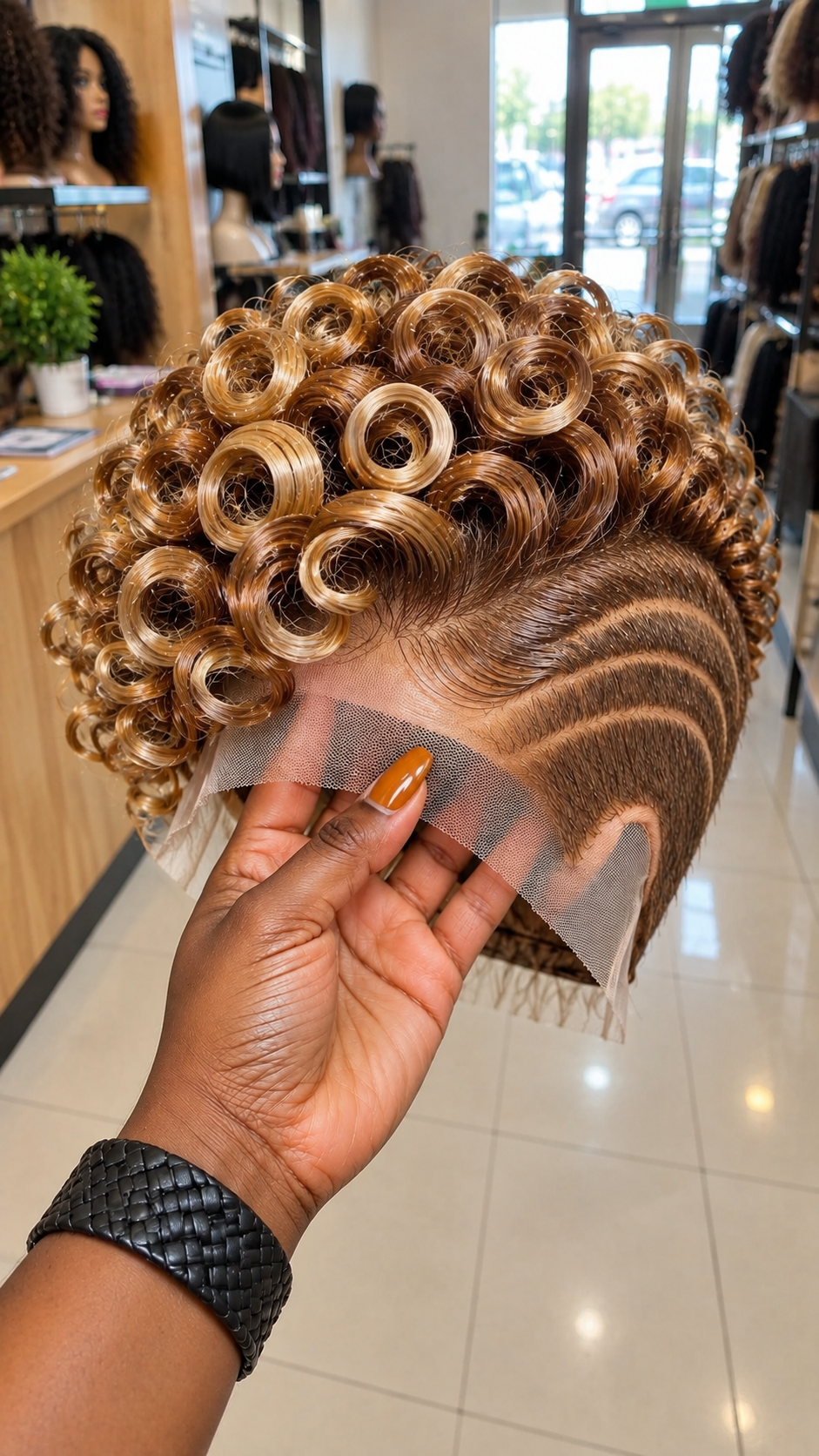
The first question worth asking about this golden ringlet wig is not whether the color is attractive. It is whether the wearer wants a crown built from large, open circular curls rather than ordinary tight ringlets. That distinction determines almost everything about the final result. The photographed unit has a striking arrangement of hollow, ribbon-like coils across the crown, with warm honey-gold surfaces, darker caramel interiors and a carefully organized side section containing three sweeping carved channels. The combination creates a compact silhouette that depends on exact curl placement, controlled density and the relationship between raised hair and exposed pathways.
The photograph shows the wig being held inside a hair-extension shop before installation. A generous section of lace extends beyond the front and side hair-bearing areas, while the large curls remain arranged in their completed crown pattern. This provides a useful opportunity to inspect the styling before it is placed on a wearer. The mesh is visible, but its exact commercial grade is not established by the image. A buyer should not assume HD lace, a particular fiber composition or adhesive-free suitability without confirmation from the supplier.
For someone considering a custom order, this wig has several unusually specific requirements. The rings must remain visibly hollow, the honey-gold shade needs darker depth within the curls, and the carved side should preserve separate curved channels rather than becoming one large exposed section. Those details matter more than simply finding a wig advertised as blonde and curly.
Large Hollow Coils Give the Crown Its Recognizable Shape
The crown contains numerous circular formations with unusually open centers. Several of the front and central curls appear like small rolled tubes, their golden strands circling around dark inner spaces. This construction differs from ordinary spring curls, which often fall vertically or form compact spirals without such prominent openings.
Here, the coils are arranged as individual sculpted sections. They sit beside and partly overlap one another, creating fullness while still allowing the eye to identify separate circular forms. Some are broad and open; others are smaller and more tightly rolled, particularly around the outer edges of the crown.
A custom wig maker should therefore receive more specific instructions than simply creating blonde finger curls. The requested arrangement should include large circular loops mixed with smaller supporting coils. Their openings must remain visible rather than being filled with extra hair.
This is also a useful quality-control point. A crown can contain plenty of hair yet fail to reproduce the reference if the curls are too small, too tightly packed or allowed to collapse into a continuous mass.
Honey Gold and Caramel Create Contrast Inside Each Ring
The dominant color appears golden honey blonde, with richer caramel and light chestnut depth in recessed portions. The brighter strands reflect salon lighting across the outer surfaces of the curls, while the areas inside the circular openings appear darker.
This tonal variation is essential to the appearance. It allows each coil to seem more substantial because the lighter outer ribbon stands apart from the deeper interior. The overall palette is warm rather than icy or platinum blonde.
A customer ordering a similar color should request honey-gold with caramel depth instead of an extremely pale blonde. The reference does not depend on a sharp black-to-blonde split, nor does it show a uniform light yellow surface.
For color approval, ask the maker to provide photographs under neutral illumination. Warm shop lighting can exaggerate golden and amber reflections, making the hair look more saturated than it may appear in daylight.
The Crown Is Intentionally Full Without Becoming Oversized
Although the ringlets are large, the hairstyle remains compact in overall length. The curls are concentrated around the crown rather than hanging down over the neck or shoulders. This arrangement gives the upper head a rounded silhouette and allows the side geometry to remain visible beneath it.
The distribution also matters. Larger rings dominate the forward and central crown, while smaller formations fill the outer areas. That change in scale helps the curls adapt to the rounded cap.
A maker should avoid adding excessive height simply because the reference contains broad loops. An oversized crown could overpower the side design and alter the intended balance.
When approving a custom version, request photographs from above and from the side. The overhead angle reveals coil distribution, while the side view shows whether the crown rises proportionately above the compact lower section.
The Three Curved Channels Need Their Own Construction Plan
The most distinctive lower detail is a set of three exposed sweeping paths along the side. These channels follow the rounded contour of the wig and create a layered sequence beneath the crown.
They do not read as three straight horizontal stripes. Their curves vary as they travel backward, with narrow sections of brown hair separating them. The upper channel sits closest to the long directional strands beneath the crown, while the middle and lower channels occupy progressively lower positions.
To recreate the pattern accurately, the maker should work from a direct side reference. A generic instruction requesting triple shaved lines would leave too much room for different interpretations.
The location, curvature and spacing should ideally be planned before any permanent cutting takes place. Hair removed from a wig cannot naturally grow back, so errors in the carved arrangement can be difficult to correct.
The Dark Hair Between the Channels Is as Important as the Exposed Paths
The three side lines remain individually recognizable because close caramel-brown hair survives between them. Those narrow retained sections create contrast against the scalp-toned openings and establish the visual separation between each channel.
This means that a successful barber-style customization involves preserving hair as carefully as removing it. If the channels become too wide, the intervening sections may disappear and the pattern can merge into a broad exposed area.
Future maintenance should follow the same principle. A stylist should not automatically widen the carved lines every time the wig is worn. If fine strands have shifted across an opening, they may simply need repositioning rather than additional cutting.
Keeping a photograph of the original side design can help preserve the initial proportions during later appointments.
The Front Uses Directional Hair to Connect the Ringlets to the Side
Between the circular crown and the exposed side channels, the hair changes direction. The strands become flatter and travel backward in elongated curves. This intermediate area prevents the large curls from sitting directly above the carved design without a transition.
The directional hair also emphasizes the diagonal movement through the side. It follows the crown’s lower boundary while guiding the eye toward the three curved pathways beneath it.
For a custom reproduction, the stylist should preserve this intermediate section. Creating only the ringlets and the shaved channels would omit an important part of the design.
The crown, directional transition and carved side should be viewed as distinct styling zones, each requiring different treatment.
The Front Hairline Should Be Evaluated Before Lace Trimming
The visible lace perimeter extends beyond the finished hairline. Near the front, fine strands provide a gradual transition toward the denser upper styling. These strands are particularly important because the crown contains substantial volume only a little farther back.
An installer should first position the wig and determine how the front aligns with the wearer. The excess lace can then be trimmed according to that placement.
Removing the mesh before fitting may restrict adjustment options. The same caution applies to the ear-area lace, where the perimeter needs to accommodate the wearer’s anatomy.
The photograph does not establish that the mesh will disappear against every skin tone. Buyers should ask the supplier about actual lace-shade options and request material specifications when paying for a particular grade.
Cap Sizing Influences Where the Side Artwork Lands
Because the three channels are incorporated into the wig, their placement changes whenever the entire cap shifts. A cap positioned too far forward may place the side pattern closer to the face, while a unit sitting too far backward can move the design away from the temple.
This makes measurement a styling consideration rather than simply a comfort question. Customers ordering a custom unit should follow the manufacturer’s measuring instructions and provide all requested dimensions.
Depending on the cap, these may include circumference, front-to-nape length and ear-to-ear distance. A professional wig stylist can help with measurements if the customer is uncertain.
The fitting should establish the final position before additional side cutting is considered.
Buying the Exact Construction Requires More Than a Product Search
A search for golden curly wigs may return many products that share the color but not the construction. Some will have ordinary ringlets, others will contain smaller finger coils, and many will have no carved side design.
The buyer should identify the combination that makes this reference distinctive: oversized hollow honey-gold ringlets, darker caramel interior depth, a compact rounded crown, flatter directional strands and three sweeping side channels.
Specialist wig makers, custom wig salons and sellers offering reference-based orders are more relevant than generic long-hair retailers when exact reproduction is required.
Before placing an order, ask whether the seller has previously produced large open-coil crowns and precision side designs. Portfolio photographs should show these skills clearly rather than relying on examples of unrelated curly wigs.
Decide Whether to Buy Finished or Customize Locally
There are two principal purchasing approaches. A completed custom unit may arrive with the color, ringlets and side geometry already prepared. This can be convenient when the maker has demonstrated reliable craftsmanship and the buyer provides accurate cap measurements.
Alternatively, a customer may source a compatible foundation and arrange professional styling locally. This offers greater control over the final position of the side channels, particularly when fitting needs to happen before precision cutting.
The second route should be priced carefully. Coloring, coil formation, carved side detailing and lace fitting can involve separate labor charges.
A cheaper base does not necessarily mean a cheaper completed hairstyle. Ask for an estimate of the entire process before deciding.
Approval Photographs Should Reveal the Openings Inside the Curls
For this wig, an elevated crown image is one of the most useful forms of product verification. The photograph should clearly show the large circular centers and the smaller surrounding coils.
A direct side image should then confirm the number and placement of the carved channels. It should reveal enough detail to compare their curvature, width and spacing against the reference.
A rear three-quarter view is also worthwhile because the supplied photograph does not fully establish the construction of every section around the back.
Finally, if the supplier claims a specific lace or cap material, request an additional photograph of the interior. Appearance photographs and construction verification serve different purposes.
Color Matching Needs a Warm but Balanced Blonde
The ideal reproduction should retain the richness visible in the reference. Golden honey dominates the raised ringlets, but darker caramel-brown sections keep the crown from looking uniformly pale.
An overly yellow blonde could make the wig look artificial in a way that differs from the intended warm golden tone. An excessively dark caramel color might reduce the contrast between the ringlet surfaces and their centers.
During custom coloring, a professional should evaluate how the finished shade behaves when the hair is rolled into its final formations. Color viewed on straight strands does not always create the same impression once those strands are curled into large circular ribbons.
The actual fiber or hair quality must also be considered before any chemical work begins.
Price Comparison for a Golden Honey Ringlet Construction
The cost of this hairstyle is influenced by curl placement, color work, side geometry, cap construction and professional fitting. The crown may be compact, but creating many individual hollow coils and maintaining consistent side detail can require substantial labor.
| Category | Estimated Price Range | What the Price May Cover |
|---|---|---|
| Premium Custom | $350–$630+ | Higher-grade hair, individualized sizing, custom honey-gold coloring, large hand-arranged ringlets, precision triple-channel styling and personalized lace preparation. |
| Standard Custom | $215–$375 | Prepared golden-blonde ringlet crown, established side-channel work and standardized cap options with limited fitting adjustments. |
| Basic Human Hair | $125–$230 | A human-hair foundation that may require additional coloring, large-coil setting, side customization and professional installation. |
| Premium Synthetic | $85–$170 | A quality pre-set interpretation designed to maintain larger curled formations with less frequent professional reconstruction. |
| Basic Synthetic | $40–$95 | A budget alternative where ring diameter variation, color depth, lace construction or side-detail accuracy may be simplified. |
These are illustrative planning ranges rather than confirmed prices for the wig shown. Actual costs depend on the seller, location, material, cap construction, labor, shipping and installation.
Ask for an itemized quotation before comparing options. The cost of completing the crown and side work can be more important than a small difference in the initial base-wig price.
Human Hair Offers Flexibility for Future Ringlet Reconstruction
A human-hair version may be useful for customers who intend to refresh the crown professionally. Individual coils can potentially be rebuilt when their openings begin to collapse, provided the hair remains suitable for the styling technique.
The golden-blonde shade may have required processing depending on the starting hair. Future heat and chemical work should therefore be based on the condition of the strands.
A professional stylist can reset individual ringlets without necessarily dismantling the entire crown. This selective approach may reduce unnecessary handling and help maintain the original arrangement.
Premium Synthetic Can Be Practical for Pre-Set Circular Shapes
A well-made synthetic version may retain the hollow ringlet formations with relatively little daily manipulation. Pre-colored fibers can also reduce the need for repeated color services.
The tradeoff is limited freedom for major changes. Some synthetic fibers tolerate controlled heat, while others can be permanently damaged by hot tools.
Confirm the exact fiber specification before attempting curl resetting or recoloring. Conventional human-hair dye should not be assumed compatible with synthetic material.
Daily Inspection Should Focus on the Largest Rings
The most prominent ringlets are likely to show displacement first because their openings are visually important. Before applying products or combing the crown, inspect whether the largest circles still retain their intended shape.
If only one or two sections have moved, address them individually. Working through every curl may create unnecessary disturbance.
The smaller surrounding ringlets should also remain separate enough to support the larger formations without covering their open centers.
A photograph taken when the wig is new can serve as a useful reference for the original coil placement.
Washing Should Preserve the Crown’s Circular Arrangement
Before the first wash, photograph the crown from above and from both sides. These images document the ringlet diameter, placement and surrounding smaller curls.
During cleansing, avoid aggressively rubbing the entire crown together. Such movement can cause neighboring ringlets to intertwine, potentially closing their hollow centers.
Use products appropriate for the confirmed human-hair or synthetic composition and follow the maker’s care recommendations.
After drying, reconstruct only the sections that have shifted. The goal is to maintain the original crown rather than create a different arrangement after each wash.
The Side Channels Should Not Be Recut on a Fixed Schedule
The carved pathways are permanent design elements. Unlike a haircut on growing hair, they do not need routine deepening simply because several weeks have passed.
When fine strands move across an exposed channel, careful repositioning may restore the original appearance.
If cutting becomes necessary, use the original side photograph and preserve the width of all three paths. The darker sections between them should remain substantial enough for the pattern to stay readable.
Repeated aggressive recutting can gradually change the design and may eventually make professional reconstruction necessary.
Protect the Golden Color Without Overloading the Curls
The ringlets already reflect light strongly. Heavy oils or waxes can make neighboring strands adhere together and reduce the separation that gives the crown its distinctive appearance.
Product buildup can also make the golden surfaces look darker or less dimensional.
Use only the amount recommended for the material. If residue reduces clarity, appropriate cleansing may be more effective than applying additional shine product.
For colored human hair, future tonal refreshing should preserve the relationship between golden outer surfaces and deeper caramel interiors.
Salon Installation Should Be Planned Around the Existing Artwork
When the unit arrives, inspect the lace, curl arrangement and side markings before any permanent alteration. If a made-to-order wig differs materially from the approved reference, contact the seller first.
Once the unit has been accepted, a wig stylist can establish cap placement and assess the front and ear-area lace.
Any additional barber work should follow the fitting rather than precede it. The side geometry may already be complete, in which case further cutting may offer little benefit.
When booking, explain that the wig has both sculpted ringlets and precision side channels so the salon can reserve the appropriate service time.
Storage Needs Space for the Oversized Circular Coils
Large ringlets are particularly vulnerable to compression. A suitable wig stand or mannequin head gives the crown room to retain its hollow openings.
Avoid laying other items across the top or pushing the side against a hard surface. Pressure can flatten the coils and disturb the closely arranged strands around the carved channels.
The cap and lace should be fully dry before storage.
For transportation, choose a container that supports the crown without forcing the large circles inward. Preventing compression is generally easier than arranging a complete professional reset.
Buy the Construction That Makes This Golden Wig Distinctive
The strongest quality of this wig is the relationship between the large honey-gold ringlets and the carefully spaced side design. The crown uses rounded hollow forms and warm reflected color, while the lower side introduces long controlled curves through compact brown hair.
A buyer comparing similar wigs should therefore look beyond blonde color alone. The most important checkpoints are the diameter of the ringlets, their open centers, the balance between large and small coils, the curved parting, three separate side channels, retained hair between the lines and the amount of untrimmed lace available for fitting.
For wig businesses, this design offers an opportunity to demonstrate customization through detailed photography rather than broad marketing claims. An overhead crown photograph, a precise side image and verified cap information can help customers understand what makes the unit different from ordinary golden curly wigs.
The best purchasing decision is the one that accounts for both appearance and future care. When the ringlet construction, warm color depth, side geometry and fitting requirements are all agreed upon in advance, the customer has a much clearer basis for ordering a wig that genuinely resembles the reference rather than merely sharing its color.
Search Terms
golden honey hollow ringlet wig · oversized blonde coil crown · triple curved side channel wig · caramel root honey blonde wig · sculpted circular ribbon curls · golden ringlet lace front wig · swept side arc hairpiece · untrimmed lace honey curl wig