
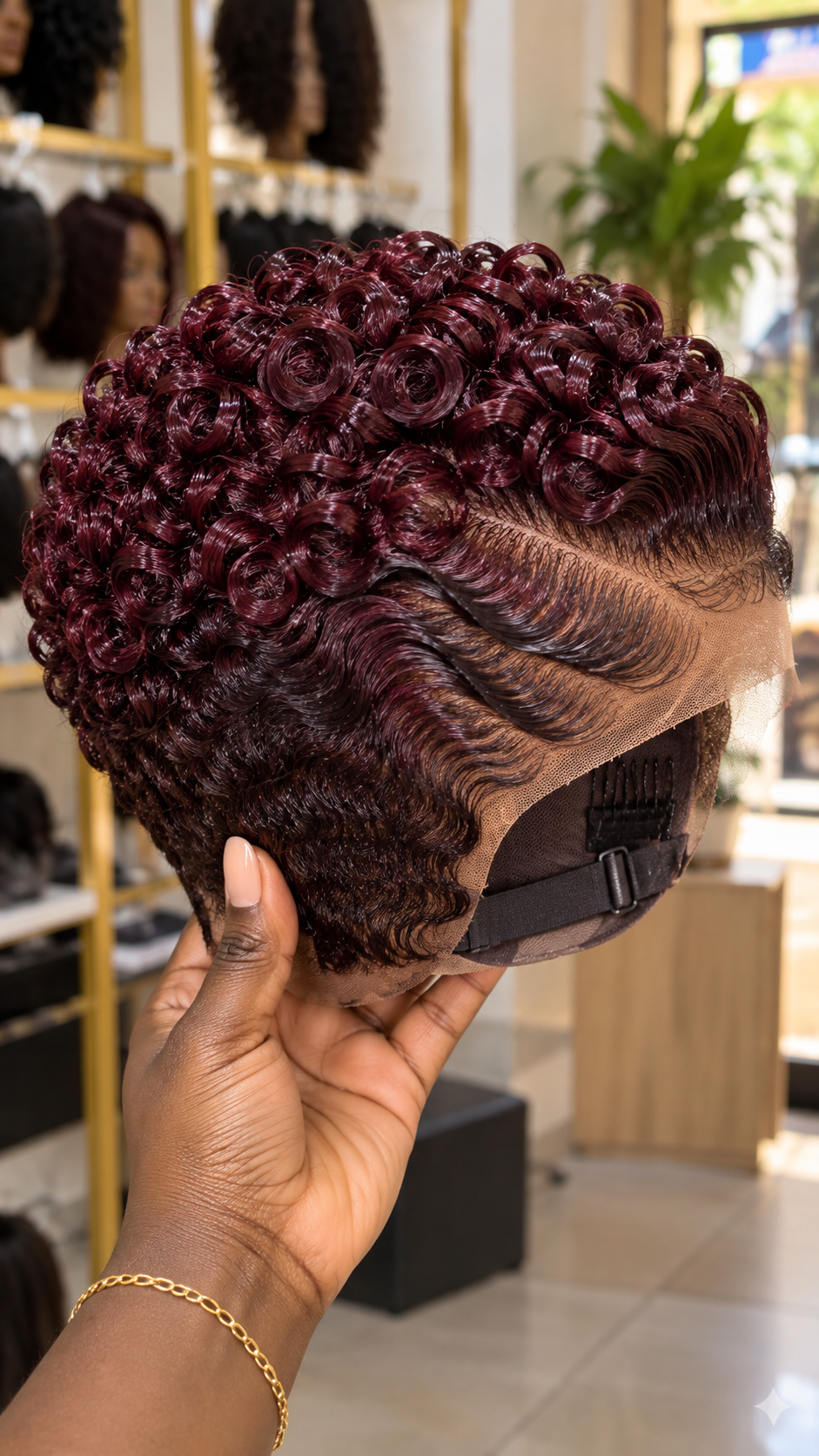
A burgundy wig can attract attention through color alone, but this particular design makes a stronger impression through its unusual combination of circular curls and carefully arranged hairline waves. The photograph shows a lace-front wig held in one hand inside a hair salon, with densely arranged burgundy spirals rising above a darker, closely shaped lower section. Across the front and temple, the hair follows sweeping wave patterns that create a striking contrast with the rounded curls above them.
What makes this hairstyle particularly interesting for buyers is the relationship between its decorative appearance and its practical construction. The wig is photographed before installation, allowing several details to be examined that would normally disappear once it is worn. The lace extends beyond the styled hairline, while part of the interior cap, a securing comb, and an adjustable strap remain visible. These details help explain what a customer should inspect before purchasing a similar design.
The overall appearance is luxurious, but it should not be mistaken for evidence of a particular hair grade or manufacturing method. A photograph can reveal curl placement, color, visible construction, and styling quality. It cannot establish whether the fibers are human hair, whether the lace belongs to a specialized category, or how well the finished unit will perform after repeated use.
The Burgundy Color Has More Depth Than a Single Flat Shade
The upper spirals display a rich wine-burgundy appearance with reddish reflections across their curved surfaces. Some sections appear brighter where the salon lighting strikes the hair, while the recessed areas look considerably darker. This interaction between the glossy surface and the shadowed interior gives the hairstyle visual depth without requiring a dramatic blonde or copper contrast.
The lower portions lean toward deep brown, almost black in certain areas. Around the hairline, burgundy tones blend with darker strands, creating a more restrained transition near the face. This distinction matters because an entirely bright red wig would produce a different impression, especially when viewed from the side.
Customers requesting this appearance should avoid relying exclusively on color names such as burgundy, wine red, or dark cherry. Those labels can represent different mixtures of violet, red, and brown depending on the seller. The most useful ordering reference is a photograph taken under ordinary daylight, accompanied by a second image under indoor lighting.
A buyer can ask whether the dark areas are intentionally colored, whether the reddish reflections come from the fiber itself, and whether the finished unit will maintain a similar relationship between the upper curls and the lower waves. These questions are especially important for custom orders because an incorrect color distribution can change the entire character of the hairstyle.
Why the Circular Curl Arrangement Requires Skilled Styling
The upper area contains numerous compact, rounded spirals. Several curls form recognizable circular openings, while others overlap or angle away from the camera. The arrangement is not a simple collection of loose ringlets hanging downward. Instead, the curls are gathered into a raised, interconnected composition that creates fullness while retaining individual spiral shapes.
Near the front, several larger circular loops stand out against the smaller surrounding curls. Farther toward the visible rear portion, the loops appear more closely packed. This variation helps prevent the upper surface from looking like an evenly repeated pattern.
The curl openings also influence how light moves across the hairstyle. Their curved strands reflect illumination in narrow bands, making the burgundy color appear particularly vivid around the circular edges.
For someone commissioning this wig, the important instruction is not simply to request curly hair. A stylist needs to understand the approximate diameter of the visible loops, their orientation, their concentration, and the intended overall height.
Ordinary spiral curls may fall or expand differently from the structured arrangement shown here. If a ready-made wig has the correct color but loosely hanging curls, it may require substantial restyling to resemble the reference.
Controlling Height Without Creating Excessive Bulk
The upper hairstyle has noticeable volume, but its shape is controlled. The front curls sit above the sculpted waves without forming an excessively tall crown. The lower section also narrows the silhouette, preventing the wig from appearing equally bulky from top to bottom.
When discussing a custom version, request a front-facing photograph at eye level and another from approximately forty-five degrees. These angles will reveal whether the spirals maintain the intended proportions or spread too widely across the temples.
A stylist should also consider the wearer’s head dimensions. A curl arrangement that appears balanced on a display stand may sit differently on a smaller or larger head. The finished proportions should therefore be evaluated during fitting rather than judged solely from a product photograph.
Following the Sculpted Waves Along the Visible Temple
The most distinctive transition occurs beneath the spirals, where the hair changes direction and becomes a series of sweeping, closely arranged waves. The visible temple section includes several curved ridges running diagonally toward the lower side. These are styled hair waves rather than shaved lines or razor-carved patterns.
At the front, the hairline contains smaller, delicately arranged curves. These meet the broader temple waves without an obvious separation between the two styling areas. The result is an intricate design that combines the softness of curled hair with the precision of finger-wave styling.
The lower side appears darker and more closely fitted to the cap. Its compact appearance helps emphasize the circular curls above it. There is no clear evidence of a razor-carved side design, and describing the visible waves as shaved artwork would be misleading.
For buyers, the distinction matters. A sculpted wave is created through hair direction and setting techniques, whereas a carved line involves removing hair or changing its length. These approaches require different maintenance methods and cannot be treated as interchangeable services.
Checking the Pattern Before Installation
A professional wig stylist should examine the temple waves before any lace is removed. Their alignment with the wearer’s natural temple position can affect how convincing the hairstyle looks after fitting.
If the wig sits too far forward, the waves may extend unnaturally toward the forehead. If it sits too far back, the intended hairline detail can become difficult to appreciate. The correct position depends on the cap measurements, the wearer’s own hairline, and the available lace.
Because the photograph primarily reveals the front and one side, buyers should request additional images of the opposite temple and rear. Those views will establish whether the wave arrangement continues around the head or changes into another pattern.
What the Exposed Lace and Interior Hardware Reveal
The wig is presented with an untrimmed lace extension along the front and visible side. The lace appears as a fine beige-brown mesh that projects beyond the arranged hairline. Its presence allows a stylist to assess the approximate front contour before cutting, although the photograph does not establish its exact material specification.
Inside the cap, a dark securing comb is visible. A black adjustable strap with fastening hardware also crosses the interior. These are practical details worth considering because they influence how the unit may be positioned and secured.
However, visible adjustment hardware does not prove that the wig can be worn without adhesive under every circumstance. The fit of the cap, the tension of the strap, the available attachment points, and the wearer’s activity level all affect security.
Likewise, the photograph does not establish that the lace is HD lace or that the entire unit uses a particular ventilating technique. Those specifications should come from the seller or wig maker.
Before purchasing, ask for a clear photograph of the complete underside. It should show the cap perimeter, the placement of any additional combs, the adjustable components, and the available lace area. This information will help a stylist determine whether the wig is suitable for the intended installation.
Commissioning the Right Version Instead of Settling for a Similar Photograph
This hairstyle presents an interesting shopping challenge: the color, circular curls, and temple waves must all work together. A seller may offer a burgundy curly wig that matches one characteristic while missing the others.
Start by sending the reference photograph to a wig maker or salon specializing in structured curls and finger-wave work. Ask whether the stylist can reproduce the visible curl arrangement and the close-fitting wave section without significantly changing the proportions.
Next, establish the construction requirements. Provide head circumference and other measurements requested by the maker, usually including front-to-nape, ear-to-ear, and temple measurements. A properly sized cap is particularly important when a hairstyle has detailed hairline work that needs to sit in a specific position.
For a custom order, request photographs at two stages: after the basic curl arrangement is completed and after the hairline waves have been set. This gives the customer an opportunity to identify major differences before final delivery.
Ready-made options may be less expensive, but a close visual match should not be assumed. Ask for photographs of the actual available unit rather than relying exclusively on promotional images. If the product is manufactured in batches, the curl arrangement may differ between individual wigs.
Online buyers should also confirm the return policy before requesting lace trimming, coloring, or other customization. Many sellers treat altered wigs differently from untouched products.
Installation Planning for a Hairline With Decorative Waves
The fitting appointment should begin with an examination of the wig as delivered. The stylist can check the cap, straps, comb placement, lace condition, and whether the visible styling has survived shipping.
After establishing the appropriate position, the lace can be assessed for trimming. This step deserves particular care because the decorative waves approach the front hairline. Removing too much lace or cutting into the styled hair can permanently affect the appearance.
The installer should determine whether adhesive, a suitable alternative securing method, or additional adjustments are appropriate for the wearer. A visible comb and strap are useful components, but they are not substitutes for a proper fitting assessment.
Once the unit is positioned, only necessary corrections should be made to the curls and waves. Excessive manipulation during installation can disturb the spiral openings or flatten the ridges along the temple.
Customers booking a salon appointment should mention that the wig has a sculpted front design. This allows the salon to allocate time for detailed fitting rather than treating the appointment as a routine installation of a loose curly unit.
Estimated Investment for a Burgundy Spiral and Wave Wig
The following figures are illustrative USD planning ranges, not verified live prices or quotations for the photographed wig. They represent possible purchasing categories with different levels of customization, materials, and styling labor. Actual costs vary by market, hair quality, construction, and service provider.
| Wig Category | Illustrative USD Range | Possible Scope |
|---|---|---|
| Premium Custom | $280–$650+ | Individual measurements, specialized curl placement, detailed wave styling, and potentially premium material choices. |
| Standard Custom | $150–$320 | Selected burgundy coloration, customized upper curls, and salon-shaped front and temple sections. |
| Basic Human Hair | $95–$220 | A simpler human-hair base that may require additional professional styling to approach the reference. |
| Premium Synthetic | $65–$165 | Higher-priced synthetic options with prearranged curls or specialized styling, subject to product specifications. |
| Basic Synthetic | $25–$85 | Budget-friendly alternatives that may resemble the color but not reproduce the detailed spiral and wave construction. |
The most significant expense may come from the styling labor rather than the color alone. Producing a convincing arrangement of circular spirals takes time, especially when the upper curls must remain visually separate from the lower finger-wave area.
Color processing may also affect the final quote. A maker working from an already burgundy-colored base could have different costs from one preparing a custom mixture of dark wine tones and deeper lower sections.
Ask whether the quotation includes cap adjustments, lace customization, curl setting, delivery, and installation. Some suppliers price the wig separately from the salon services needed to achieve the photographed appearance.
For a buyer comparing quotations, a detailed breakdown is more useful than choosing the lowest advertised amount. A less expensive unit that requires extensive corrective styling may ultimately cost more than a carefully prepared custom wig.
Protecting the Spiral Openings and Glossy Burgundy Surface
The main maintenance challenge is preserving the individual circular curls without disturbing their arrangement. Running a conventional brush through the upper section could separate the loops, increase frizz, or change the carefully balanced shape.
Instead, the wearer should ask the maker how the curls were formed and which products or setting methods are compatible with the actual fiber. Some styles rely on techniques that require professional resetting, while others may permit limited finger adjustments.
The visible glossy surface should not encourage heavy oil application. Excessive product can collect between the tightly arranged spirals, attract residue, and reduce the separation that makes the circular shapes noticeable.
Burgundy coloring introduces another consideration. If the wig is made from dyed human hair, repeated washing, sunlight, and heat exposure may affect the shade. If it is synthetic, the color behavior and permitted care methods depend on the manufacturer’s specifications. Neither material can be reliably identified from this photograph alone.
Keeping the Temple Waves in Their Intended Direction
The closely arranged side waves should be handled differently from loose curls. Repeated rubbing, aggressive combing, or pressure from headwear may disturb their ridges. The wearer should avoid trying to rebuild them with high heat unless the material and recommended styling procedure are confirmed.
If the waves lose their arrangement, a professional stylist familiar with finger-wave techniques may be better equipped to restore the pattern than someone attempting to reshape it without knowing how it was originally set.
When the wig is not being worn, support it on an appropriately sized stand that does not stretch the cap. Avoid pressing the spiral section against shelves or other objects. For transport, a protective container that provides enough clearance above the curls can help reduce crushing.
Choosing This Design for Its Craftsmanship, Not Merely Its Color
This burgundy lace wig is especially appealing to customers who appreciate decorative hair craftsmanship. Its identity comes from the contrast between raised circular spirals and flowing temple waves, supported by a dark lower section and a rich wine-colored upper surface.
The exposed lace and visible adjustable hardware provide useful starting points for evaluating construction, but they do not replace proper product specifications or a fitting consultation. Buyers seeking a close reproduction should prioritize accurate photographs, cap measurements, and confirmation of the maker’s experience with structured curl styling.
A successful purchase will preserve the balance seen in the reference: prominent but controlled spirals, carefully directed hairline waves, and a burgundy color that retains depth around the darker lower sections. Those details are what separate this design from an ordinary curly wig and make professional preparation worth considering.
Search Terms
Wine burgundy circular spiral lace wig · Burgundy ringlet crown with temple waves · Dark cherry sculpted finger wave hairline · Burgundy lace front with exposed mesh · Glossy wine red loop curl wig · Deep brown burgundy side wave hairstyle · Adjustable strap spiral curl lace wig · Burgundy pre installation wig with interior comb