
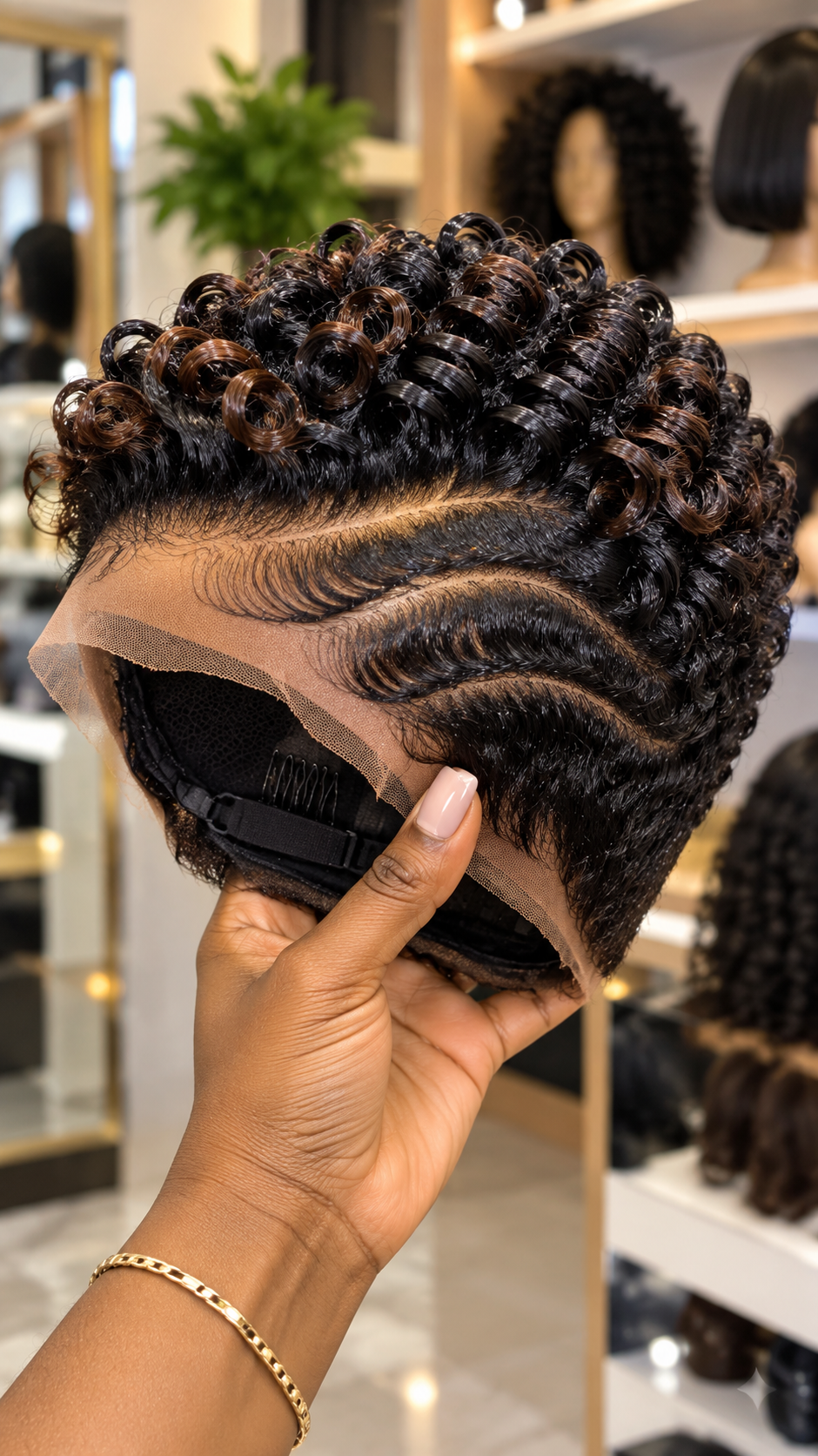
A remarkable wig can reveal its craftsmanship before it ever reaches a customer’s head. In this photograph, the most striking detail is the relationship between the circular curls above and the carefully arranged waves running across the temple. Instead of relying on height or oversized volume, the hairstyle creates visual interest through compact ribbon-like rings, selective chestnut-brown accents, and closely arranged hair that follows the shape of the head.
The wig is being held in one hand inside a hair retail environment, allowing prospective buyers to examine details that would normally be concealed after installation. An extended beige lace front, a dark interior cap, a visible comb, and an adjustable fastening component are all present. These construction details make the photograph particularly useful for understanding what to inspect before purchasing a similarly styled unit.
Its appeal comes from several distinct design decisions working together. Dark hair provides the foundation, warm brown strands introduce contrast within individual curls, and the temple waves create a directional pattern beneath the fuller crown. Buyers interested in sculpted pixie wigs, circular ring curls, or decorative finger-wave styling should pay attention to these relationships rather than searching by color alone.


The Circular Curl Arrangement That Gives This Hairstyle Its Identity
The upper section contains numerous glossy circular curls arranged in a compact, closely connected formation. Several rings face the camera directly, revealing their hollow centers, while others are angled toward the side or back. This variation creates depth without requiring long strands or an exaggerated silhouette.
The curls resemble carefully formed ribbon loops rather than loose natural spirals. Individual sections appear guided into rounded shapes, with strands traveling around each ring in a controlled direction. The result is an ornamental crown that reflects light across multiple curved surfaces.
One important purchasing consideration is the relationship between curl diameter and overall crown height. Larger loops can dramatically change the proportions of this hairstyle, even when the color remains identical. A customer commissioning a similar wig should therefore request a crown photograph from above and a second photograph taken at eye level.
These two views help establish whether the curls sit close together, whether their openings remain visible, and whether the completed crown maintains the compact profile shown in the reference.
The photograph does not establish which styling products, setting techniques, or fiber treatments were used to form the rings. Their appearance demonstrates the intended visual result, not a particular manufacturing method.
Why Ring Direction Matters More Than Curl Count
Counting individual curls is less useful than understanding their orientation. In the visible crown, the rings do not all point in one direction. Some face forward, others lean diagonally, and several are partially overlapped by neighboring curls.
This arrangement prevents the hairstyle from resembling a row of identical rollers. It also allows the dark and brown sections to interact naturally as the viewing angle changes.
When communicating with a wig maker, customers can request varied ring orientation while preserving a compact crown. This is more specific than simply asking for curly hair or a pixie hairstyle.
Chestnut Reflections Within a Dark Hair Foundation
The color arrangement deserves careful examination because the brown accents are not distributed as a conventional ombré effect. The photograph shows a predominantly black or very dark brown foundation, interrupted by warm chestnut and chocolate-brown reflections concentrated within selected circular curls.
Some rings contain substantial brown sections, while neighboring curls remain almost entirely dark. The warmer color is particularly noticeable across portions of the front and upper crown, where the light catches the curved strands.
The temple area remains predominantly dark, which helps separate the ornamental crown from the sculpted waves below. This contrast gives the hairstyle a recognizable structure without requiring bright colors.
Lighting influences the apparent intensity of these brown accents. The warm salon illumination may make certain strands appear more copper-toned than they would under daylight. Customers seeking an exact match should request additional photographs under neutral lighting before approving a color order.
Matching the Color Without Creating Unwanted Highlights
A common problem with custom wig orders is describing a hairstyle as black with brown highlights without specifying where the brown should appear.
For this particular design, a more useful instruction would be to preserve the dark temple waves and concentrate the warmer chestnut accents within selected crown rings. The color should appear integrated into the circular shapes rather than forming broad stripes across the head.
Customers should also establish whether the brown sections are produced using separately colored fibers, previously processed human hair, or another method. That distinction affects future coloring options, maintenance requirements, and potentially the cost.
The photograph alone cannot confirm the material or the coloring process.
Two Sweeping Temple Channels Beneath the Crown
One of the most recognizable elements appears along the visible side of the wig. Two prominent curved parting channels separate closely arranged sections of dark hair, producing a layered finger-wave appearance.
The upper channel begins near the frontal area and sweeps diagonally toward the side. A second curved separation follows beneath it, creating a nested pattern. The hair between these channels is directed into glossy, elongated waves that contrast with the rounded rings above.
These are visible scalp-like separations within the styled hair, not evidence of a shaved design on a person’s natural scalp. The photograph shows a removable wig, and the exact construction beneath these channels cannot be determined from the exterior alone.
The lower side section appears comparatively close to the cap, while the upper crown maintains more height. This difference is essential to the design.
A wig maker who adds too much hair around the temple could obscure the channels. Conversely, excessive thinning might create gaps or reveal construction materials. Maintaining the intended balance requires attention to the density and direction of each section.
Discussing the Wave Pattern With a Stylist
Customers should use a close-up reference photograph when requesting this temple arrangement. Terms such as finger waves, sculpted temple waves, and curved side partings can help communicate the concept, but they do not guarantee an identical result.
Ask the stylist to identify the starting and ending points of both visible curves before any irreversible cutting or thinning begins.
It is also useful to confirm whether the wave arrangement is already incorporated into the purchased wig or must be recreated during installation. A ready-styled unit may require relatively little additional work, whereas a custom construction could involve separate styling and fitting appointments.
What the Untrimmed Lace Reveals Before Installation
The wig is photographed before its front lace has been trimmed. A broad section of beige mesh extends beyond the visible frontal hairline, particularly toward the left side of the photograph.
This extended lace provides an opportunity to inspect the relationship between the hairline and the underlying mesh. Fine strands appear positioned near the front edge, and the visible frontal styling includes curved, hairline-adjacent strands.
However, the photograph does not prove that the lace is HD lace, transparent lace, or any other specialized lace category. Such descriptions require confirmation from the seller or manufacturer.
Likewise, the presence of lace does not automatically establish that the wig can be worn without adhesive. Whether adhesive is necessary depends on fit, construction, attachment options, and the intended wearing conditions.
The lace color should also be evaluated against the wearer’s complexion. A shade that looks suitable in a retail photograph may behave differently against skin under daylight.
Preserving the Frontal Hairline During Fitting
Because the front contains carefully arranged hairline details, cutting the lace too aggressively could interfere with the intended appearance.
A professional fitting should begin with positioning the wig on the wearer’s head and checking where the hairline naturally sits. Only then should the installer determine how much excess lace needs removal.
Trimming should be conservative and performed with suitable tools. Once too much lace has been removed, restoring the original edge may require specialist repair or replacement.
Customers purchasing online should request a close frontal photograph showing the lace lying flat, ideally without fingers covering the edge. This helps them evaluate the hairline before the unit is shipped.
Inside the Cap: Visible Hardware and Unanswered Questions
Unlike a photograph of a wig already installed on a model, this image exposes part of the interior. A dark mesh-like cap structure is visible, along with a comb and an adjustable strap or fastening assembly.
These components can contribute to positioning and securing the wig, but their presence does not guarantee that the cap will fit every customer comfortably.
The interior photograph also leaves several questions unanswered. The full circumference, rear construction, number of additional combs, and precise cap dimensions cannot be established from this viewing angle.
For that reason, a buyer should not assume that the visible fastening arrangement is the only attachment system included.
Request an underside photograph showing the complete cap laid open. Ask the seller to identify all combs, straps, elastic sections, and any adjustable components.
People with sensitive scalps or areas of reduced hair density may wish to discuss whether the comb placement is appropriate for their needs. A secure fit should not depend on uncomfortable tension.
Commissioning This Hairstyle Without Losing Its Proportions
A customer ordering a similar unit has two main purchasing paths: finding an existing wig with comparable styling or commissioning a custom version from a wig maker.
A ready-made wig may be convenient if its crown, temple waves, and color distribution already closely resemble the photograph. However, a generic curly pixie wig is unlikely to reproduce the circular ring arrangement without additional work.
Custom production offers more control over the placement of the brown accents, the size of the loops, the frontal lace, and the curved temple sections. That control may come with additional labor charges and a longer production period.
Before placing an order, prepare a reference package containing the original photograph and written notes identifying the elements that must remain unchanged.
The most important instructions are the compact ring-curl crown, selective chestnut accents, dark sculpted temple waves, two visible curved channels, and a frontal lace configuration appropriate to the wearer’s measurements.
A reputable seller should be able to explain which aspects can be reproduced and which may vary because of material availability or construction methods.
Measurements Worth Confirming Before Payment
Head circumference is important, but it is not the only measurement that may affect the result. Depending on the cap design, front-to-nape distance, ear-to-ear measurements, and the desired position of the frontal hairline may also be relevant.
Ask the seller for the actual cap measurements rather than relying exclusively on labels such as small, medium, or large.
For a custom order, confirm whether adjustments are included after the first fitting. The compact temple styling makes accurate positioning particularly important because shifting the wig can change how the curved channels align with the face.
Planning the Salon Appointment Around the Finished Wig
This hairstyle should be assessed as a completed decorative arrangement rather than treated as an ordinary wig requiring extensive restyling after purchase.
When the unit arrives, inspect the rings and temple waves before attempting to manipulate them. Compare the delivered wig with the approved reference photographs, especially around the front and side.
A wig stylist can then check the cap fit, evaluate the lace against the wearer’s skin, and determine whether minor adjustments are needed.
If the temple area requires a small density correction, that work should be discussed before cutting begins. The side pattern depends on precise spacing, and removing too much hair may change the design permanently.
Customers may also benefit from requesting a brief consultation before the installation appointment. Sharing the reference image in advance allows the stylist to decide whether the job requires lace preparation, specialist wave styling, or assistance from a barber experienced with decorative hair shaping.
The finished result should be photographed from the front, visible temple, and upper three-quarter angle. These views make it easier to confirm that the circular crown and side arrangement remain consistent after fitting.
Estimated Purchase Budgets for Ring-Curl Lace Wig Construction
The decorative curl formation and carefully arranged temple waves can affect the labor required to produce this hairstyle. Color placement, cap construction, material selection, and any additional fitting services may also influence the final price.
The following USD figures are illustrative planning ranges, not verified live prices, supplier quotations, or confirmed offers for the pictured wig. Actual costs can vary significantly by country, maker, material quality, and customization requirements.
| Wig Category | Illustrative USD Budget | Purchasing Considerations |
|---|---|---|
| Premium Custom | $280–$650+ | Individually commissioned construction with detailed ring placement, selective color work, lace fitting, and potentially extensive hand styling. |
| Standard Custom | $160–$320 | Personalized crown arrangement and temple styling with selected construction and color options. |
| Basic Human Hair | $95–$220 | A possible human-hair starting category; reproducing the pictured rings and waves may require additional specialist labor. |
| Premium Synthetic | $65–$155 | A potential option when the manufacturer can supply the required curl structure and decorative side arrangement. |
| Basic Synthetic | $25–$75 | Lower-cost alternatives may capture the general silhouette without matching the individual ring construction or temple detailing. |
These categories describe possible purchasing options, not the verified composition of the photographed unit. Neither human hair nor synthetic fiber can be conclusively identified from the image.
When comparing quotations, request an itemized explanation of what is included. Lace customization, cap resizing, additional color processing, salon installation, delivery charges, and later restyling may be priced separately.
For this design, an inexpensive base wig can become costly if substantial work is needed to recreate the circular crown. Conversely, a more expensive ready-styled unit may represent better value if the original ring arrangement and temple waves already meet the customer’s expectations.
Protecting the Decorative Rings Between Wears
The principal maintenance challenge is preserving the shape of the circular curls. Unlike loose curls that can sometimes be refreshed through ordinary styling, these rings depend on their individual geometry.
Repeated brushing, pulling, or compressing can disturb the openings and alter how neighboring curls overlap. Handling should therefore focus on supporting the hairstyle rather than separating the rings unnecessarily.
Before using water, setting products, steam, or heat, confirm the fiber type and manufacturer instructions. Some synthetic fibers cannot tolerate conventional hot tools, while processed human hair may require additional care because of its coloring and styling history.
The temple waves present a different concern. Their appearance depends on the hair remaining aligned along the curved channels. Frequent rubbing or aggressive combing may disrupt that alignment even when the crown remains intact.
For routine upkeep, ask the original stylist which products are compatible with the material and whether the ring shapes can be refreshed at home. Professional maintenance may be preferable when the curls begin losing their circular formation.
Keeping the Chestnut Sections Visually Balanced
The brown accents contribute to the crown’s depth, so changes in color appearance can affect the entire hairstyle. Product buildup, unsuitable treatments, and environmental exposure may influence how the strands reflect light.
If the wig is made from color-treated human hair, any further chemical processing should be evaluated carefully. If it is synthetic, conventional hair dye may be ineffective or unsuitable.
Avoid attempting to recolor the brown rings without first confirming the material and consulting someone familiar with the construction.
The Final Buying Decision Should Be About Craftsmanship
This wig stands apart because its decorative details are integrated rather than competing with one another. The circular crown creates movement, the chestnut accents emphasize selected rings, and the dark temple waves establish a contrasting direction beneath them.
For a customer seeking this particular appearance, the strongest buying strategy is to prioritize accurate construction over generic product labels. A seller offering a black-and-brown curly wig may not necessarily provide the compact rings, curved channels, or frontal styling visible here.
Examine actual product photographs, request additional views of the cap and hairline, confirm the material and measurements, and discuss any alterations before payment. If commissioning a custom version, agree on the curl arrangement and color placement before the maker completes the final styling.
The result worth pursuing is not simply a glossy curly wig. It is a carefully proportioned hairstyle in which circular rings, warm brown accents, and sculpted temple waves retain their individual character while contributing to one cohesive design.
Search Terms
Black chestnut ribbon ring curl lace wig · Circular loop crown with brown accents · Double curved temple wave wig · Untrimmed beige lace frontal pixie · Sculpted black side wave hairpiece · Glossy chocolate accent ring curls · Adjustable strap curly lace wig · Compact spiral crown with sweeping side partings