
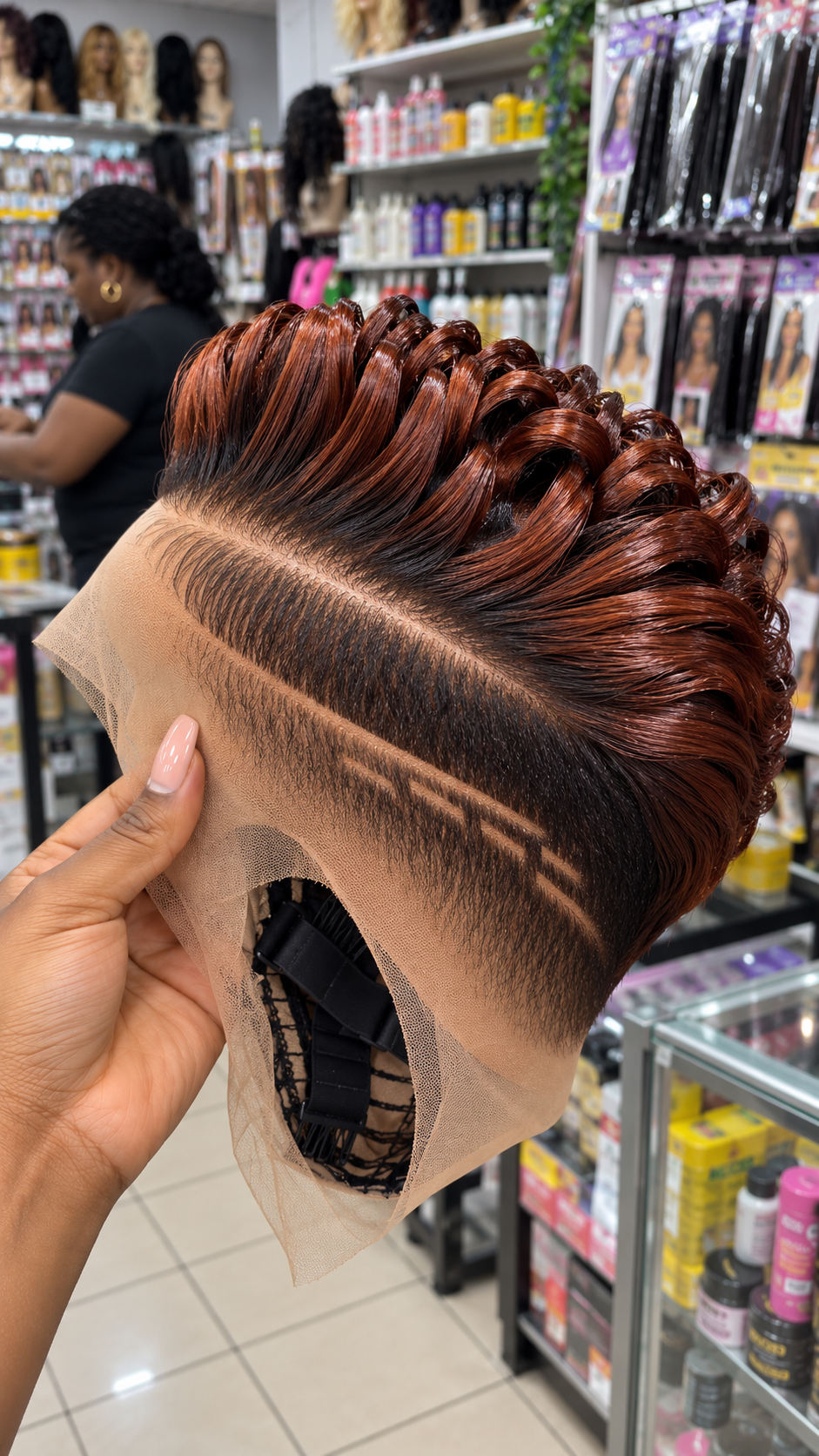
A hairstyle can look entirely different depending on where its color catches the light, where its volume begins, and how its smaller details connect. This auburn copper lace wig brings those decisions together in an unusually striking arrangement. The upper section contains glossy, sculpted ribbon-like loops, while a dark side panel introduces a sharp diagonal parting and a narrow carved design. Instead of relying on length or excessive fullness, the hairstyle creates visual interest through the direction of its hair and the contrast between its polished upper surface and closely arranged side strands.
The photograph shows the wig being held inside a beauty supply store before installation. A broad section of beige lace extends below the hairline, and part of the black interior cap construction is visible through an opening beneath the lace. These details make the photograph especially useful for prospective buyers because it shows more than the finished hairstyle. It provides a partial view of how the unit is presented before fitting, while leaving important questions about its material, sizing, and attachment method for the seller to answer.
For women considering a sculpted pixie wig with warm copper coloring, the most useful starting point is understanding the relationship between the elevated loops, the darker foundation, and the side geometry. Those three elements give this particular hairstyle its identity.
Where Auburn Copper Meets the Dark Foundation
The dominant visible color is a rich auburn copper with reddish-brown undertones. Under the store lighting, several curved sections reflect brighter copper highlights, particularly along their raised surfaces. The recessed areas between the loops appear considerably darker, creating a sense of depth without requiring every strand to have a separate highlight color.
The side section contains a much deeper brown-to-black appearance. Near the diagonal parting, the dark strands are especially noticeable because they run in a different direction from the elevated copper hair. The contrast creates a deliberate visual boundary: warm, reflective hair above and a closely arranged darker section below.
It would be inaccurate to describe this as a uniformly copper wig. The photograph clearly shows a substantial dark foundation, particularly through the side and beneath the upper styling. However, the image does not establish whether the copper appearance was achieved through individual strand coloring, a previously processed hairpiece, or the use of differently colored fibers.
Anyone requesting this appearance from a wig maker should provide the original photograph rather than relying exclusively on a color number. Terms such as auburn, ginger, copper brown, and reddish chestnut can refer to noticeably different shades between suppliers.
Choosing a Copper Shade That Works in Everyday Lighting
A buyer comparing similar wigs should ask for a photograph taken near a window and another under ordinary indoor lighting. Warm artificial lights can make copper appear more orange, while cooler illumination may emphasize its brown or red undertones.
For this particular design, preserving the difference between the copper loops and the dark side panel is more important than obtaining a universally brighter color. If both sections are made equally light, the diagonal separation may lose some of its visual impact.
A custom order should therefore specify two priorities: the upper loops should retain a rich auburn copper appearance, and the darker side should remain visually distinct. A stylist can then discuss suitable color samples before construction begins.
The Architecture Behind the Raised Ribbon Loops
The upper hairstyle is not a conventional collection of loose curls. Its most recognizable characteristic is a series of broad, glossy hair sections that rise, bend, and return toward the main body of the wig. Several of these sections resemble ribbon loops, with visible openings and curved surfaces that catch the light.
At the front and upper center, the hair rises in closely positioned sculpted sections. Farther toward the visible rear, the loops appear to progress into a more layered arrangement. This creates an organized sequence rather than an unrestricted curly silhouette.
The copper strands are arranged in coordinated directions, giving each elevated section a polished appearance. Some areas look like curved sheets of hair, while others reveal more distinct loop openings. This difference is important because the style depends on controlled variation in shape rather than identical circular curls repeated across the entire head.
A buyer commissioning this wig should not simply request a curly pixie. That description could produce a much rounder and fuller result. A more accurate instruction would be to request compact sculpted ribbon loops with directional movement and limited outward expansion.
Why Loop Proportions Matter More Than Extra Hair
Adding more hair does not automatically improve a sculpted hairstyle. Excessive density can make the upper structure heavy, obscure the openings between loops, and turn a controlled arrangement into a bulky mass.
The photograph demonstrates a relatively compact overall silhouette despite the elevated styling. The upper sections provide height, but the hair does not extend into long hanging curls. This balance is worth discussing with a stylist before ordering.
For a custom piece, ask the maker to show the hair from a slightly elevated front angle during styling. That view can reveal whether the individual loops remain recognizable and whether the upper volume is developing beyond the requested proportions.
The exact techniques needed to preserve the loops will depend on the hair material and styling products used. A photograph alone cannot establish whether the shape was created with heat, setting tools, molding products, or another professional method.
A Diagonal Parting That Changes the Entire Side Profile
The most distinctive lower detail is the long diagonal separation running beneath the copper upper section. It begins near the front portion of the visible side and continues backward across the darker hair.
This exposed channel visually separates two areas with different styling directions. Above the channel, the copper strands sweep into the sculpted upper arrangement. Below it, the dark hair follows a flatter, more closely arranged pattern.
Within the lower side section, a narrow carved line runs at an angle and develops into a small tapered detail. It is not a collection of numerous parallel stripes or an elaborate geometric network. The visible design is relatively restrained, which helps the larger diagonal parting remain the dominant side detail.
This distinction matters when communicating with a barber or wig stylist. Asking for multiple decorative lines could produce a different hairstyle, even if the upper copper loops were accurately reproduced.
The image shows the carved design on the side facing the camera. It does not confirm whether an identical design appears on the opposite side or how the hair is arranged at the back. Those views should be requested before purchasing a ready-made unit.
Planning a Barber Appointment Without Damaging the Pattern
Some buyers may prefer to purchase a wig with the upper hairstyle already completed and have a specialist refine the side detail afterward. That approach requires caution.
A carved line removes or displaces visible hair in a small area, and an incorrect cut may be difficult to disguise. The wig should first be positioned on the intended wearer’s head or a correctly sized fitting form so that the design can be evaluated at its actual wearing angle.
Before any trimming, the stylist should identify the existing diagonal separation and confirm which smaller detail, if any, requires adjustment. If the design is already present and accurately positioned, additional carving may be unnecessary.
For a custom order, having the wig maker and barber agree on the side pattern before final styling may reduce the risk of unnecessary alterations.
What the Exposed Lace and Interior Actually Tell Buyers
Unlike a photograph of a wig already installed on a person, this image shows an unfinished fitting stage. A substantial beige lace area extends beyond the front and side hairline. The lace is visibly untrimmed, which is consistent with a unit awaiting customization or installation.
Fine dark hairs are visible near the front hairline, although the photograph does not establish how those hairs will appear after the lace is fitted against someone’s skin. The apparent lace color should also be evaluated carefully because lighting and the background beneath the mesh can change its appearance.
The underside opening reveals a black interior structure, including mesh-like material and a dark band or strap component. However, the complete cap is not visible. It would be inappropriate to claim a particular cap size, full-lace construction, attachment system, or specific number of combs based on this angle alone.
Similarly, visible lace does not prove that the product uses HD lace. That designation requires reliable product information from the seller.
Questions Worth Asking Before Paying
Request a clear underside photograph showing the entire cap, including the back, sides, and any adjustment hardware. Ask whether the dark band visible in the photograph is adjustable and whether the unit includes combs, clips, or another retention method.
Confirm the cap circumference, front-to-back measurement, and ear-to-ear dimensions. If the seller offers several sizes, compare those specifications with measurements taken around your own head rather than assuming that a standard size will fit.
Ask whether the lace is intended to be trimmed by the customer or a professional, whether the wig requires adhesive, and whether an adhesive-free fitting is supported by the actual cap construction. The photograph cannot confirm that this is a glueless wig.
A careful buyer should also request information about the fiber material, styling limitations, return conditions, and whether the pictured unit is the exact item being shipped.
Finding a Stylist Who Can Reproduce This Particular Design
Not every wig salon specializes in sculpted ribbon-loop hairstyles. A salon that primarily installs straight lace-front units may be excellent at hairline fitting but less experienced with maintaining elevated, individually arranged hair sections.
When contacting a wig maker, describe the project as an auburn copper sculpted pixie lace wig with a dark diagonal side panel and a restrained carved detail. Send the original photograph and explain that the upper structure must remain compact.
Ask for examples of previous work involving sculpted curls, loop arrangements, finger-wave-inspired styling, or precision side detailing. The examples do not need to have the same color, but they should demonstrate the stylist’s ability to control hair direction and create consistent shapes.
Local wig shops, specialist hair salons, and online custom wig makers may all be possible starting points. Availability, however, should be confirmed directly. The beauty supply store shown in the photograph cannot be identified reliably from the image alone.
Separating Construction, Coloring, and Installation
A complicated custom order may involve several services. One professional might prepare the wig base, another might handle the color, and a stylist or barber might create the final sculpted arrangement.
Before booking, ask which services are included in the quoted price. A unit advertised as custom-made may still arrive without the final hairline fitting or installation.
For this design, it is particularly useful to establish who is responsible for the upper loops and who will complete any final side adjustments. Otherwise, a buyer could receive the correct copper color but discover that the sculpted hairstyle must be purchased as an additional service.
For an online order, request approval photographs before shipping. A front three-quarter view, the decorated side, the opposite side, and a rear view would provide a more complete understanding of the finished product.
Budgeting for Copper Coloring, Sculpted Styling, and Lace Work
The following amounts are illustrative USD planning ranges, not verified current prices for the photographed wig. They are broad estimates for comparing potential purchasing categories. Actual quotations may vary substantially by location, hair material, workmanship, and included services.
| Wig Category | Illustrative USD Range | What to Evaluate |
|---|---|---|
| Premium Custom | $300–$750+ | Individual construction, advanced color work, detailed loop styling, and potential fitting services |
| Standard Custom | $160–$350 | Customized color placement, selected cap options, and professional sculpted styling |
| Basic Human Hair | $85–$220 | Base unit quality, hair density, coloring requirements, and additional styling labor |
| Premium Synthetic | $55–$160 | Pre-styled loop appearance, fiber specifications, lace construction, and shape retention |
| Basic Synthetic | $25–$85 | Visual resemblance, cap fit, fiber limitations, and potential differences from the reference |
These categories are purchasing possibilities rather than an identification of the wig in the photograph. Neither human hair nor synthetic fiber can be confirmed visually.
For this design, the main cost drivers may include achieving the copper-and-dark color arrangement, creating the raised loops, maintaining the diagonal separation, and producing the small side carving. A supplier offering a basic wig at a lower price may not include those finishing details.
Installation, shipping, taxes, lace customization, color adjustments, and barber services may be charged separately. A complete quotation should identify each included service so the buyer can compare the total cost rather than only the advertised wig price.
Protecting the Loop Arrangement Between Salon Visits
The greatest styling concern with this wig is preserving the individual curved sections. Brushing through the upper hair without understanding its construction could separate the ribbon-like strands and alter the intended arrangement.
Before washing or restyling, ask the supplier which products and procedures are compatible with the actual fiber. A synthetic unit may have restrictions involving heat, coloring, and certain styling products. A human-hair unit may offer different possibilities, but previously processed copper coloring can still influence how the hair responds to further treatment.
Avoid assuming that a high-gloss appearance requires heavy oils. Excessive product can collect between the loops and change how the raised sections sit against one another. A professional can recommend an appropriate amount of product once the hair material is established.
If the upper structure begins losing its shape, professional resetting may be safer than attempting to reconstruct each loop without knowing how it was originally formed.
Keeping the Dark Side Detail Legible
The side panel has a different maintenance priority from the upper hair. Its appearance depends on the visibility of the diagonal channel and the smaller carved detail.
Heavy product buildup or uncontrolled movement of nearby strands can make these lines less noticeable. During routine styling, avoid pulling the copper upper sections downward across the exposed separation.
If the side requires refreshing, ask a stylist to assess the existing hair before cutting. Repeatedly widening a carved line can permanently change the design, particularly when the available hair density is limited.
The lace edge deserves separate attention. Any trimming should be performed only after the wig has been positioned correctly. Removing too much lace or cutting into the hairline cannot simply be reversed.
The Final Inspection Before This Wig Becomes Wearable
The photograph presents a compelling pre-installation hairstyle, but a successful purchase depends on how closely the delivered wig matches the reference once it is fitted.
Begin by checking the copper tone in ordinary lighting. Next, examine whether the upper loops maintain their individual curved forms and whether the overall height remains compact. Compare the visible diagonal parting and smaller side detail with the original image.
After confirming the exterior, inspect the underside and verify the cap measurements and attachment components. Only then should a professional proceed with fitting, any necessary lace trimming, and final positioning.
The finished result should preserve the relationship that makes this wig recognizable: rich auburn copper ribbon loops rising above a dark foundation, a prominent diagonal side separation, and a restrained carved accent. Buyers who communicate those priorities clearly are better positioned to evaluate ready-made alternatives or commission a faithful custom version without paying for unnecessary changes.
Search Terms
auburn copper ribbon loop lace wig · dark root sculpted copper pixie wig · diagonal temple parting lace hairpiece · copper brown raised loop hairstyle · black side panel carved line wig · untrimmed beige lace pixie unit · glossy auburn sculpted wave wig · copper ribbon crown with dark side detail