
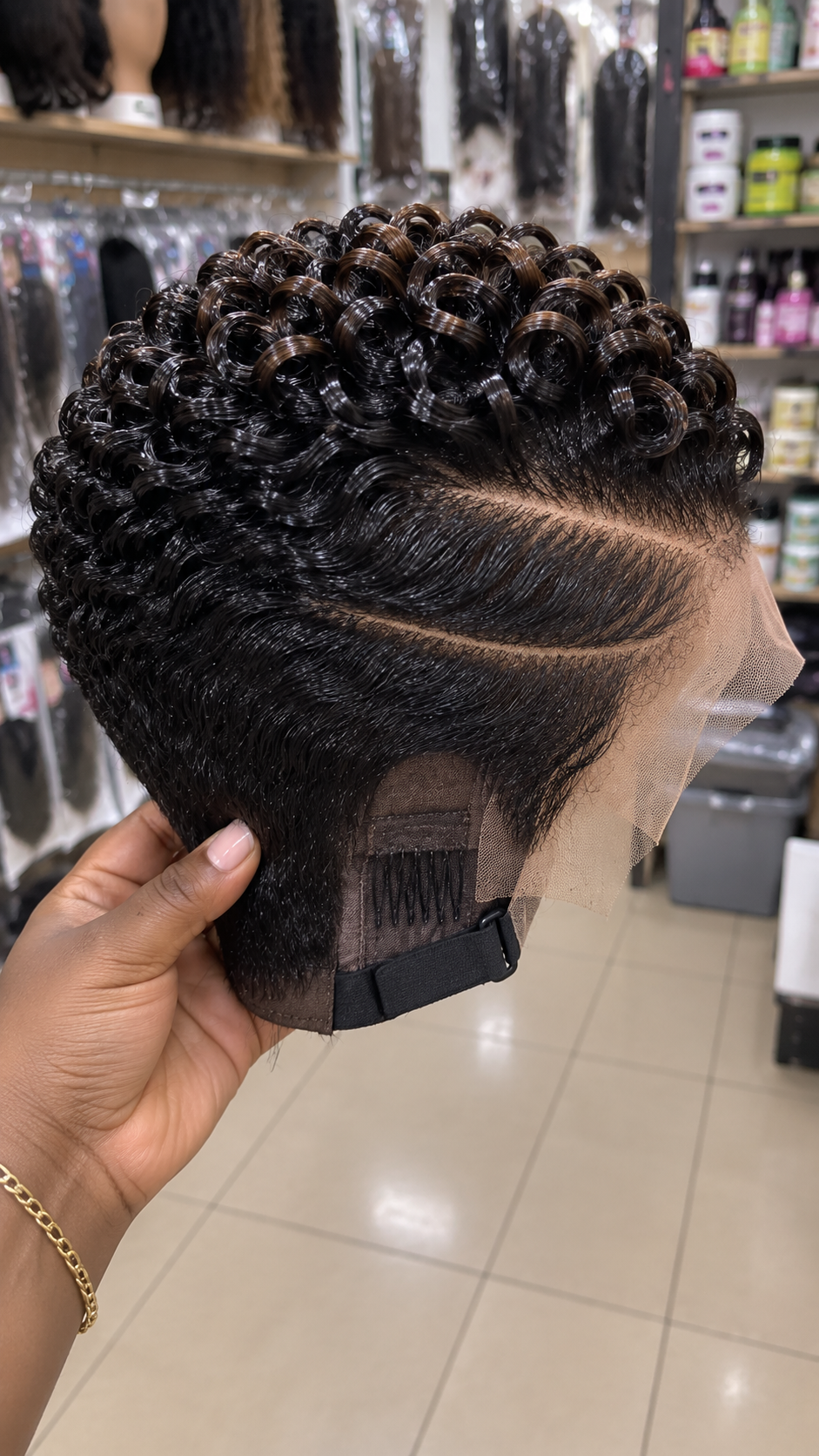
A hairstyle can look impressive from the front while revealing very little about how it was made. This particular wig offers a more informative perspective. Held in one hand inside a hair supply shop, it exposes an intricate arrangement of circular loops, carefully directed temple waves, a diagonal separation channel, and part of the cap construction beneath the hair. The photograph captures the wig before installation, allowing prospective buyers to examine details that would normally disappear once the lace is fitted and the hairpiece is worn.
The most striking element is the relationship between the rounded upper hairstyle and the flatter, directional hair along the temple. Rather than relying on length or exaggerated height, the design creates visual interest through controlled changes in hair direction. Dark reflective strands form closely packed loops above, while the lower sections follow the contour of the head in sweeping, polished patterns.
For women exploring sculpted pixie wigs, finger-wave lace wigs, or circular curl hairstyles, this example provides a useful starting point for understanding construction, selecting a stylist, and evaluating custom-order quality. It also demonstrates why a beautiful photograph should be accompanied by practical questions about the cap, hair material, lace, and installation requirements.
The Circular Loop Arrangement That Gives This Wig Its Identity
The upper section contains numerous rounded, hollow-looking hair loops positioned closely together. Their arrangement resembles a collection of small circular ribbons rather than ordinary loose curls. Individual loops are visibly separated by darker spaces, allowing light to travel across their curved surfaces and emphasize the hairstyle’s three-dimensional appearance.
The loops vary slightly in orientation. Some face forward, displaying their circular openings, while others turn diagonally or overlap neighboring sections. This variation helps the hairstyle avoid the appearance of identical manufactured rings arranged in rigid rows.
Most of the visible loop structure sits across the upper and rearward portion of the wig. Its silhouette rises above the flatter side sections without extending into a tall, loosely curled crown. The result is a compact, rounded upper profile that draws attention to the workmanship rather than excessive hair volume.
The color appears predominantly very dark brown-black, with warm brown reflections visible across several loops under the shop lighting. Those reflections should not automatically be interpreted as separately dyed highlights. Glossy dark hair can appear considerably lighter wherever overhead lighting strikes a curved surface.
Understanding the Difference Between Loops and Ordinary Ringlets
A conventional ringlet typically falls or projects outward in a continuous spiral. Here, many of the curls appear arranged into relatively compact circular forms that return toward their starting direction. This creates a sculptural effect associated with carefully positioned loop curls and salon-set hair designs.
Reproducing the appearance requires attention to loop diameter, spacing, anchoring, and hair direction. A stylist might use setting techniques, appropriate styling products, and controlled shaping to create a comparable result, but the photograph alone does not establish the exact manufacturing process.
Customers commissioning this hairstyle should therefore discuss the desired finished appearance rather than assume that every wig maker uses the same technique. A reference photograph from the front, side, and upper angle is more useful than a description such as curly pixie wig.
A Diagonal Separation Channel Beneath the Upper Hairstyle
One particularly important detail appears where the upper loop arrangement meets the lower temple section. A narrow diagonal channel exposes a brown-toned base or parting area beneath the surrounding dark hair. The channel travels across the visible side, creating a distinct boundary between two different styling directions.
Above this separation, the hair rises into the rounded loop formation. Immediately below it, the strands lie flatter and follow a more controlled directional pattern. This contrast gives the hairstyle its architectural character.
The visible channel is not the same as a collection of decorative razor lines cut into a faded side. The photographed wig does not show multiple parallel shaved stripes, geometric cross-lines, or an elaborate barber-carved motif. Describing it as a multi-line shaved design would misrepresent the reference.
Instead, the visual distinction comes from the diagonal separation and the sweeping hair sections around it. Anyone requesting a reproduction should make this difference clear to the stylist, especially when ordering from a supplier whose catalog includes several types of pixie wigs with carved patterns.
Following the Temple Waves Toward the Front Hairline
The temple area reveals a second level of styling precision. Dark strands are directed into broad, curved formations that travel forward and downward. The hair appears closely arranged against the wig base, producing a low-profile side rather than a thick mass of curls.
Near the front, the strands become finer and transition toward the lace edge. The photographed hairline includes delicate, curved baby-hair styling, although the exact finished appearance after installation will depend on positioning, trimming, and any additional customization.
The contrast between the circular upper loops and the flatter temple waves is especially important for buyers who want a dramatic hairstyle without a bulky silhouette around the face.
However, the visible side should not be treated as proof that the opposite temple has an identical pattern. The photograph provides one principal side angle. Before placing a custom order, request a photograph of the opposite side to establish whether the styling is symmetrical or intentionally different.
Why the Front Transition Requires Careful Fitting
The front hairline is the area where the wig’s construction must meet the wearer’s natural proportions. A beautiful arrangement of loops and waves will not compensate for a cap that sits too far forward, a lace edge that lifts, or a temple section that extends beyond the intended position.
Because this hairstyle incorporates visible directional styling near the forehead, moving the wig significantly during installation may alter the balance between the upper curls and the front wave pattern.
A professional wig stylist should assess the cap position before cutting the lace. If the wearer has a different forehead shape or temple contour from the original styling reference, adjustments may be needed without disturbing the overall design.
What the Uninstalled Lace and Interior Hardware Actually Reveal
The photograph shows a broad section of untrimmed lace extending from the front and temple region. Its light beige appearance contrasts with the dark hair, making the lace boundary easy to inspect before installation.
The lace has a visible mesh structure. That alone does not establish whether it is HD lace, transparent lace, Swiss lace, or another marketed category. Those classifications require reliable product information from the manufacturer or seller.
Inside the lower side of the wig, a dark comb attachment is visible. An adjustable black strap and associated hardware also appear near the cap edge. These details indicate that the photographed unit includes at least some internal securing and adjustment components.
Nevertheless, the visible comb and strap do not prove that the wig can be worn securely without adhesive by every customer. Fit, cap dimensions, attachment placement, hair preparation, and personal comfort all influence whether a particular installation method is suitable.
The photograph also does not show the entire underside. It cannot confirm the total number of combs, whether an elastic band crosses the back, the complete lace coverage, or the construction of the rear cap.
Questions Worth Asking About the Cap
Before purchasing, ask the seller to provide a full underside photograph with the cap turned inside out. Request measurements of the circumference, front-to-back length, and ear-to-ear dimensions. If adjustable hardware is included, ask how much adjustment it provides and whether the strap can be replaced.
Buyers with sensitive scalps may also want to discuss comb placement. Some people find comb attachments useful, while others prefer different securing methods because of pressure or tension on their natural hair.
These questions matter particularly for an elaborate hairstyle whose upper structure should not be repeatedly pulled or repositioned during wear.
Choosing a Wig Maker Who Can Reproduce the Hair Direction
Ordering this hairstyle requires more than finding a seller who advertises curly lace wigs. The supplier must understand the relationship between circular upper loops, the diagonal separation channel, and the close-fitting wave sections along the temple.
A ready-made wig may be a reasonable choice if its photographed styling, cap measurements, and materials match the buyer’s requirements. However, a generic curly pixie wig should not be assumed to reproduce the carefully positioned loops shown here.
Custom production becomes more attractive when the buyer needs specific loop dimensions, a particular crown silhouette, a revised hairline, or a cap fitted to individual measurements.
When contacting a wig maker, send the original side-view photograph and explain which elements must remain unchanged. Identify the compact loop formation, the narrow diagonal separation, the flattened temple waves, and the delicate front hairline as the key visual requirements.
Ask whether the loops are permanently arranged, whether they require regular resetting, and how the construction responds to moisture. The answers may vary considerably according to the material and styling method.
Before paying a deposit for custom work, request recent examples of comparable sculpted hairstyles. A supplier experienced in ordinary curly units may not necessarily specialize in controlled loop arrangements.
Planning the Salon Appointment Around the Finished Hairstyle
Once the wig arrives, the first step should be inspection rather than immediate installation. Examine the loop placement, compare the visible temple section with the reference, and check whether the lace and cap match the seller’s description.
Try the wig on before removing any lace. A stylist can assess how the diagonal channel sits relative to the temple and whether the circular upper section maintains its intended balance when the cap is correctly positioned.
If the wig fits properly, the stylist can determine whether lace trimming, hairline refinement, or minor repositioning is necessary. Cutting the lace too aggressively can reduce fitting flexibility and may permanently affect the edge.
Barber assistance may be useful if the wig requires a controlled adjustment to its lower hair sections. However, using clippers or razors directly on a finished wig should never be treated as routine. The amount of available hair, underlying cap construction, and proximity of lace must be evaluated first.
For an appointment, ask whether the salon offers wig fitting, lace preparation, and sculpted-curl maintenance. Not every installation specialist provides detailed loop-setting services, so confirming that expertise before booking can prevent disappointment.
Illustrative Purchase Budgets for Different Construction Levels
The visible complexity of this hairstyle can influence its price, especially if the loops require individual shaping and the temple waves must be arranged by hand. However, the photograph does not establish the fiber type, supplier, labor time, or actual selling price.
The following amounts are illustrative planning ranges in US dollars, not verified quotations or live product listings. They represent possible purchasing categories rather than confirmed versions of the photographed wig.
| Wig Category | Illustrative USD Range | Possible Purchase Scope |
|---|---|---|
| Premium Custom | $280–$650+ | Individual measurements, detailed loop shaping, specialized temple styling, and potentially extensive hand customization. |
| Standard Custom | $150–$320 | Selected cap sizing and customized styling with a more limited range of construction options. |
| Basic Human Hair | $95–$230 | A human-hair purchasing category that may require additional salon work to approach the photographed design. |
| Premium Synthetic | $65–$170 | A higher-grade synthetic option, potentially supplied with a prearranged loop-and-wave hairstyle. |
| Basic Synthetic | $25–$85 | A lower-cost category where exact loop placement, lace construction, and styling accuracy may vary. |
These categories do not identify the material of the photographed unit. A glossy surface cannot reliably distinguish human hair from synthetic fibers, especially when styling products and strong lighting are involved.
Buyers should also clarify whether the quoted price includes lace customization, cap adjustments, shipping, installation, or future restyling. A less expensive wig that requires extensive corrective work may ultimately cost more than a carefully prepared unit.
For this particular design, the quality of the upper loop arrangement and the accuracy of the temple styling deserve greater attention than the lowest advertised price.
Protecting the Sculpted Loops Without Disturbing Their Placement
The most vulnerable aspect of this hairstyle is its arranged circular structure. Brushing through the loops as though they were loose curls could separate their formations and change the intended silhouette.
Before attempting maintenance, establish whether the hair is human hair, heat-resistant synthetic fiber, or conventional synthetic fiber. Also ask which styling products were used to hold the loops in position.
For a synthetic unit, avoid applying heat unless the manufacturer confirms the permitted temperature and method. Some fibers cannot safely tolerate hot tools, and a circular loop may lose its shape when exposed to inappropriate heat.
For a human-hair unit, resetting the loops may be possible, but the process still depends on prior chemical treatment, hair quality, and the technique used during construction. Human hair should not automatically be considered immune to heat damage.
The temple waves deserve separate attention. Heavy manipulation, aggressive combing, or excessive product buildup may disrupt their direction. If a section begins to lift, a stylist familiar with sculpted hairstyles can advise whether localized correction is possible.
Because the upper loops sit close together, any cleansing method should account for the possibility of trapped moisture between styled sections. Follow the maker’s washing guidance and ensure the cap and hair are properly dried before prolonged storage.
Evaluating the Photograph Before Committing to an Order
This image provides unusually useful evidence about the hairstyle because the wig is held at an angle that exposes both its exterior design and part of its internal construction. Still, several purchase-critical details remain outside the frame.
The rear hairline is not fully visible, the opposite temple cannot be evaluated, and the underside is only partially exposed. The photograph also cannot demonstrate how securely the wig stays in place during movement or how the loops behave after washing.
For a remote purchase, request a brief unedited video showing the wig rotating from front to back. Ask the seller to bring the camera close enough to reveal the circular loops, diagonal channel, lace edge, and cap attachments without relying on beauty filters.
A separate photograph taken under neutral lighting would also help determine whether the warm reflections are actual brown coloration or simply light bouncing off the dark hair.
If ordering a reproduction, obtain written confirmation of the requested styling details before production begins. This is especially valuable when a supplier uses one reference photograph to represent several possible cap types or hair materials.
The Buying Decision Comes Down to Shape Accuracy and Wearability
The appeal of this wig is not dependent on dramatic color or added length. Its identity comes from disciplined hair placement: compact circular loops above, sweeping temple waves below, and a narrow diagonal channel separating the two styling directions.
The exposed lace, visible comb, and adjustable strap provide useful information for buyers, but they should prompt further questions rather than unsupported assumptions about material quality or adhesive-free wear.
A successful purchase should preserve the hairstyle’s distinctive proportions while providing a cap that fits comfortably and an installation approach suited to the wearer. For anyone commissioning this design, the most valuable investment is accurate communication with a capable wig maker, supported by clear photographs and realistic expectations about future maintenance.
When the loop structure, temple direction, hairline placement, and cap fit are treated as connected decisions, the finished hairstyle has a much better chance of resembling the reference rather than becoming an ordinary curly wig with a vaguely similar outline.
Search Terms
Glossy brown black circular loop wig · Sculpted spiral crown lace wig · Diagonal side parting pixie wig · Black finger wave temple hairstyle · Untrimmed front lace loop curl wig · Side comb adjustable strap wig cap · Compact ringlet crown hairpiece · Dark sculpted wave and loop wig