
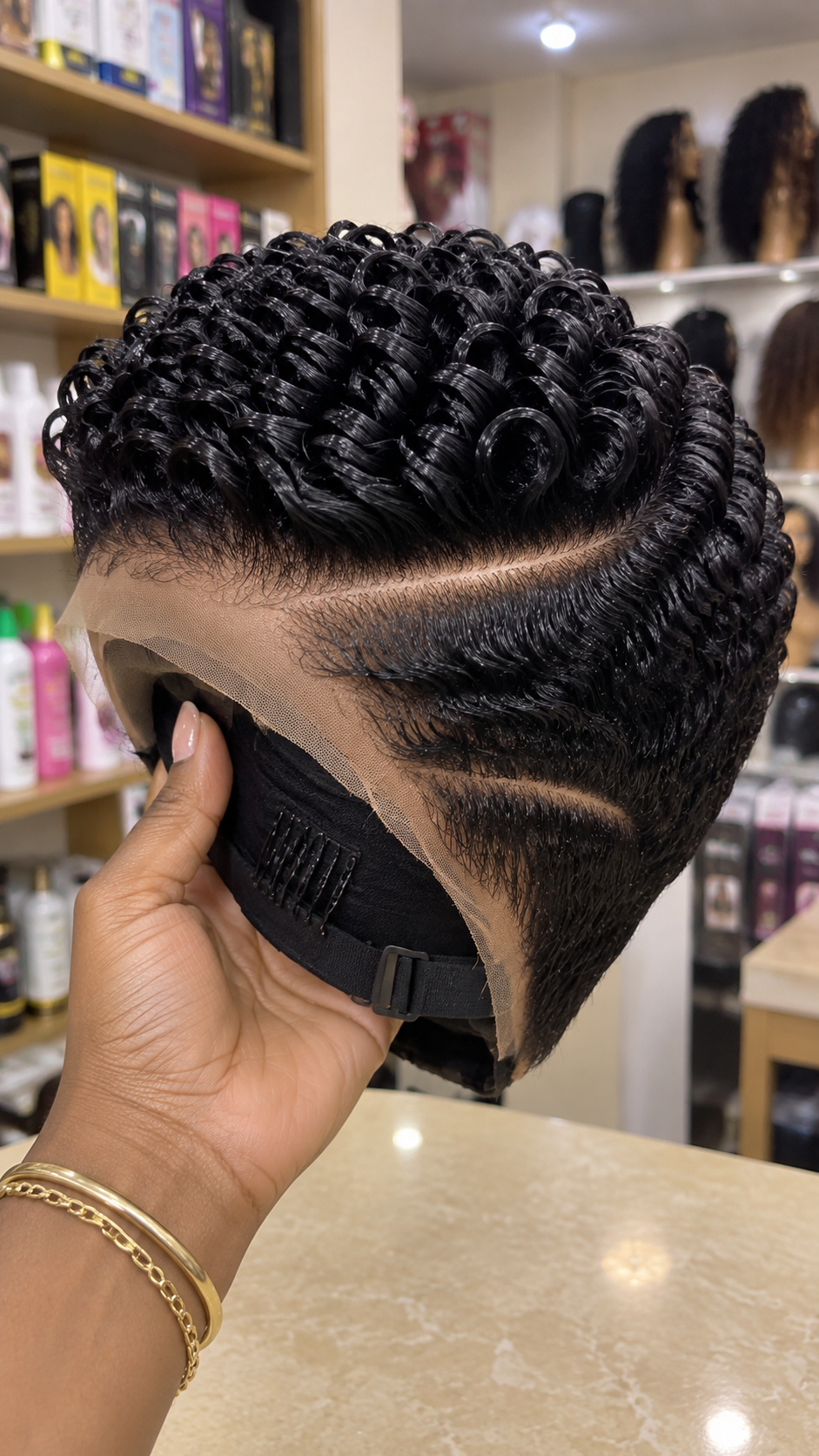
A hairstyle can look striking because of its color, its silhouette, or the precision of the work behind it. This black lace wig draws attention through something more intricate: the contrast between a densely arranged collection of glossy spiral rings and a carefully sculpted temple section. The photograph captures the wig before installation, making it possible to examine the relationship between its decorative hair arrangement, exposed lace, and adjustable interior construction.
The upper section is filled with compact, rounded loops that resemble individually shaped spiral ribbons. Beneath this elevated arrangement, the hair changes direction into closely laid waves following the contour of the side. Two visible curved parting channels interrupt the dark surface, creating a distinctive architectural pattern without relying on contrasting hair colors.
For buyers interested in a black spiral curl lace wig, this example offers an important lesson: the appearance depends on the placement and consistency of the hair as much as the quality of the strands themselves. A similar product with ordinary loose curls would not reproduce the visual effect. The individual rings, their orientation, the temple waves, and the relationship between the upper and lower sections must all be considered when requesting a comparable wig from a stylist or custom wig maker.
Reading the Hairstyle as a Three-Dimensional Design
The first impression is an abundance of glossy circular movement. Rather than falling naturally around the face, the upper hair has been arranged into a raised collection of controlled loops. These rings overlap in several directions, creating a rounded silhouette with considerable visual depth.
Some loops appear almost circular, while others have elongated openings or slightly compressed shapes. This variation prevents the surface from looking like a repetitive row of identical curls. At the same time, the individual pieces remain sufficiently consistent to produce a coordinated appearance.
The visible color is a deep black with reflective highlights produced by the lighting. No clearly separate blonde, copper, brown, or burgundy color sections are visible. The bright streaks across the loops appear to be reflections on the glossy hair rather than evidence of another dye shade.
This distinction matters when ordering. A photograph containing strong reflections can sometimes lead a buyer to request unnecessary highlights. For this hairstyle, a consistent black color is a more faithful starting point than a multicolored interpretation.
The Importance of Loop Orientation
Each visible spiral contributes to the overall surface. The upper rings rise and curve back toward the surrounding hair, creating a compact, layered arrangement. The shape is noticeably different from an ordinary curly pixie wig with free-moving corkscrew curls.
A wig maker attempting to reproduce this appearance should study how the loops are anchored and directed. The central area contains numerous overlapping circular forms, while the front edge transitions into smaller strands approaching the hairline.
The photograph does not establish whether the rings were produced through finger styling, setting tools, a particular curling technique, or another salon process. Those construction details should be discussed with the stylist rather than assumed from appearance alone.
What can be observed is the finished geometry: elevated spiral rings, dark reflective strands, closely spaced curls, and a rounded upper profile that contrasts with the flatter temple styling.
The Temple Section Changes the Entire Personality of the Wig
Without the side arrangement, the hairstyle would be primarily a collection of black spiral curls. The temple section introduces a second visual language, combining closely laid directional waves with curved exposed channels.
The upper boundary of the temple section begins beneath the spiral arrangement. A long, gently sweeping parting channel separates the elevated curls from the closely arranged hair below. This exposed line curves diagonally across the visible side, emphasizing the difference in height between the two sections.
Within the lower temple area, the strands follow a series of directional waves. Their reflective surface makes the pattern especially noticeable under the salon lighting. Farther down, a second, shorter curved channel interrupts the hair, producing a layered design rather than a single uninterrupted wave panel.
The two channels are not simple parallel straight lines. Their curves follow different paths, and their placement helps guide the eye from the front hairline toward the lower side.
This arrangement should not automatically be described as a shaved design on the wearer’s natural scalp. The image shows a wig, and the visible channels belong to the wig’s styling and construction. Whether they were created through deliberate parting, density control, trimming, or a combination of methods requires confirmation from the maker.
Why the Side Pattern Requires Careful Customization
Reproducing the side design involves more than asking for finger waves. The stylist must understand where the longer separating channel begins, how far it travels, and how the smaller lower curve relates to the temple area.
A custom order should include the original side photograph alongside a front-facing reference. The customer should indicate which side of the head should display the design when the wig is worn.
This is particularly important because a photographed wig may be turned or held at an angle. A stylist should confirm the intended left-or-right placement rather than simply copying the image orientation without discussion.
If the customer prefers the decorative channels to remain prominent, the stylist should also consider how the wig will sit around the ear and natural temple. Hair that shifts during fitting could partially cover the pattern.
What the Exposed Lace and Interior Actually Reveal
One of the most useful aspects of this photograph is that the wig is being held with its interior facing partly toward the camera. This provides information that a conventional mannequin photograph might conceal.
A beige lace material extends beyond the styled hairline and remains visibly untrimmed. The lace can be seen across the front and along the exposed side. Its mesh appearance is apparent, but the photograph alone cannot establish its commercial grade or whether it belongs to a particular lace category.
Inside the wig, a dark fabric cap is visible. A small interior comb appears along one section of the cap, while an adjustable strap and buckle can be seen near the lower edge.
These components suggest that the wig includes internal fitting hardware. However, their presence does not prove that the wig can be worn securely without adhesive by every customer.
Actual retention depends on the cap size, the position and function of the hardware, the wearer’s head shape, and the installation method recommended by the seller.
Questions Worth Asking Before the Lace Is Cut
The exposed lace makes this an especially suitable design for discussing fitting before permanent customization. A buyer should request the lace dimensions, cap measurements, and additional photographs showing the complete underside.
The image does not reveal the entire back construction, all attachment points, or the full perimeter of the lace. A rear photograph would help establish whether the back includes additional adjustment hardware or other construction details.
The customer should also ask whether the visible front lace is intended to be trimmed during installation and whether the wig maker provides that service.
Trimming should be performed only after checking the fit. Cutting away too much lace can make subsequent positioning more difficult, particularly when the design contains a closely arranged front hairline and decorative side work.
Choosing a Wig Maker Who Can Reproduce Sculpted Spiral Work
Finding a seller who offers black curly wigs is relatively easy. Finding a stylist capable of reproducing this specific combination of spiral rings and temple waves requires a more selective approach.
The most useful portfolio photographs are those showing close-up examples of sculpted curls, finger-wave styling, lace-front construction, and controlled hair arrangements. General photographs of long curly wigs may demonstrate hair quality but do not necessarily establish expertise in this type of styling.
A buyer can begin with a local wig salon, an independent wig maker, or an online business accepting custom orders. The reference photograph should be accompanied by a clear explanation of which elements are essential.
For this design, the priorities should include the compact upper rings, the consistent black color, the sweeping upper side channel, the lower curved separation, and the closely laid temple waves.
The stylist should confirm whether these elements can be reproduced on the proposed cap and hair material. If the seller offers a ready-made alternative, request photographs of the actual unit rather than relying exclusively on a promotional image.
A Practical Custom-Order Conversation
Instead of requesting a generic black pixie lace wig, describe the hairstyle as a black sculpted spiral-ring wig with a raised crown, a closely waved temple panel, and two visible curved separating channels.
Ask the maker to provide an estimate based on the amount of styling labor involved. The price may depend on whether the upper loops are constructed individually, whether the side design requires additional handwork, and whether the cap is being built or modified for the customer.
It is also worth discussing the expected behavior of the hairstyle after wear. Some sculpted arrangements may require more careful handling than ordinary free-moving curls. The stylist should explain whether the chosen material and setting method are suitable for the intended frequency of use.
Before paying a deposit, request written confirmation of the agreed design, color, cap size, customization services, estimated completion date, and revision policy.
Fitting the Wig Without Disturbing Its Side Geometry
The installation process deserves particular attention because the decorative section extends close to the front and side hairline. A poor fit could alter the apparent position of the curved channels even if the wig itself has been styled accurately.
Begin by checking the cap against the wearer’s measurements. Circumference is important, but front-to-nape and ear-to-ear measurements can also affect how the wig sits.
Once the unit arrives, inspect the visible lace, cap fabric, adjustment strap, and comb before installation. Any damaged stitching or loose hardware should be addressed before the wig is worn.
The initial fitting should establish where the front hairline naturally rests and how the temple waves align with the face. This is best evaluated before trimming the lace or making any permanent changes.
If additional shaping is necessary, a wig stylist familiar with sculpted hairstyles can adjust the placement while preserving the original pattern.
A barber may be useful if the customer specifically wants changes to the lower silhouette or temple outline. However, cutting into the curved channels without a clear plan could permanently change the design. The reference image should remain available throughout the appointment.
Adhesive use, if necessary, should be determined by the cap construction, fitting results, and the wearer’s preferences. The visible comb and strap alone are not enough to establish a universal installation method.
Understanding the Cost of This Particular Hairstyle
The main cost consideration is not the black color. It is the labor required to produce and preserve the upper spiral arrangement while maintaining a separate, carefully organized side panel.
A simpler black curly wig may require less specialized styling. This example contains numerous circular loops and directional waves that could increase preparation time, especially when the customer expects a close reproduction of the reference photograph.
The following USD amounts are illustrative planning ranges only. They are not verified prices for the photographed wig, live seller quotations, or confirmed market listings.
| Wig Category | Illustrative USD Range | Budget Considerations |
|---|---|---|
| Premium Custom | $320–$750+ | Potentially includes individually planned spiral placement, custom cap work, detailed temple styling, and multiple fitting or refinement stages. |
| Standard Custom | $170–$380 | May accommodate a customized black spiral arrangement and curved side pattern using a suitable existing cap foundation. |
| Basic Human Hair | $95–$240 | A possible starting unit if the material and length suit the design; specialized spiral and temple styling may cost extra. |
| Premium Synthetic | $65–$175 | May offer a pre-styled alternative, provided the fiber and construction can support the required ring arrangement. |
| Basic Synthetic | $25–$85 | A lower-budget option for a similar silhouette, although precise sculpted detailing may not be available. |
These categories represent possible purchasing routes, not a determination of the material used in the photograph. The image does not establish whether the hair is human hair, synthetic fiber, or a blend.
Installation, lace customization, shipping, additional cap adjustments, and later styling corrections may be quoted separately. Buyers should request an itemized estimate rather than comparing prices without knowing what each package includes.
For this particular design, it may be more economical to pay for a properly executed upper arrangement and temple pattern at the beginning than to purchase an unsuitable curly wig and commission extensive corrective work afterward.
Keeping the Circular Rings Intact During Everyday Wear
The biggest maintenance concern is preserving the shape of the upper loops. Unlike loose curls that can move freely, the visible rings appear intentionally positioned to create a particular silhouette.
Repeatedly separating them with the fingers, brushing across their openings, or compressing the upper section may disturb the arrangement. The customer should ask the stylist which parts can be gently handled and which should remain untouched.
The reflective appearance should not be treated as proof that heavy oils are necessary. Excess product could accumulate between closely arranged strands and affect the way the loops sit.
If the wig is made from human hair, cleansing and conditioning should be planned around its styling history and any products used to hold the rings in place. A stylist may need to restore the arrangement after washing.
If synthetic fiber is used, heat resistance and washing instructions must be confirmed with the manufacturer or seller. Applying a curling tool without knowing the fiber’s temperature tolerance could damage the hair permanently.
Protecting the Lower Wave Panel
The closely arranged temple waves have a different maintenance requirement from the upper rings. Their appearance depends on the strands remaining aligned along the curved side pattern.
Frequent rubbing against hats, scarves, or other accessories may disturb the surface. The exposed channels may also become less visible if neighboring strands shift across them.
Any correction should be performed cautiously. Adding product or repeatedly combing the area without understanding the original styling method could make the design harder to restore.
For customers who intend to wear this wig frequently, it is sensible to ask the maker whether periodic salon restyling is recommended and how much such a service would cost.
Evaluating a Seller’s Photograph Before Committing
A convincing product listing should allow the customer to distinguish between the actual wig being sold and an example of a hairstyle the seller hopes to reproduce.
The photograph here provides a useful view of the spiral rings, temple waves, lace edge, and part of the interior. It does not provide a complete rear view, a full frontal view on a wearer, or a demonstration of how the hairstyle behaves during movement.
Before purchasing, request a front photograph, an opposite-side photograph, a rear view, and an underside photograph. A brief video taken under ordinary lighting can also help show the depth of the rings and the continuity of the side pattern.
When reviewing a custom sample, compare the actual geometry rather than judging only the overall impression. Check whether the upper loops remain compact, whether the black shade is consistent, and whether both curved channels are present in the requested positions.
It is also important to examine the transition from the raised curls to the lower wave panel. A wig may contain attractive spirals and an attractive side design independently, yet fail to reproduce the intended relationship between them.
Who Is Likely to Appreciate This Sculpted Black Wig?
This hairstyle is particularly suitable for someone who enjoys distinctive salon artistry without relying on vivid hair colors. Its visual impact comes from controlled circular shapes, directional movement, and the contrast between elevated and closely laid hair.
It may appeal to customers seeking a statement hairstyle for photography, celebrations, fashion events, or occasions where the hair itself becomes an important part of the overall appearance.
For everyday use, the decision should depend on the comfort of the cap, the security of the fit, and the amount of maintenance required to preserve the styling. A visually elaborate wig is not necessarily impractical, but its care requirements should be understood before purchase.
The dark color also provides considerable flexibility when coordinating clothing and accessories. Because the hairstyle already contains numerous reflective loops and curved details, it can stand out alongside relatively simple outfits.
Customers who prefer a less elevated silhouette should communicate that preference before ordering. Reducing the height of the upper rings may be possible in a custom interpretation, but it would change the proportions seen in this reference.
The Final Decision Belongs to the Details
What makes this wig memorable is the way two contrasting styling techniques share one compact design. The upper spiral rings produce height, movement, and glossy reflections, while the temple waves and curved channels introduce precision and direction.
The visible lace and interior hardware add useful purchasing information, but they do not replace the need for measurements, material confirmation, and additional product photographs.
A successful purchase should therefore begin with accurate visual references and continue through a conversation about construction, fitting, styling labor, and future care. Buyers who prioritize the actual ring placement and side geometry will be better positioned to distinguish a faithful custom reproduction from a generic curly alternative.
For anyone considering this black sculpted lace wig, the most valuable investment is a stylist who understands the relationship between the circular upper arrangement and the carefully patterned temple. That craftsmanship, rather than a fashionable label or an unsupported product claim, is what determines whether the finished hairstyle captures the character of the photographed design.
Search Terms
Black spiral ring lace wig · Glossy circular loop crown hairstyle · Double curved temple parting wig · Sculpted black finger wave side panel · Untrimmed beige lace front wig · Raised spiral ribbon curl hairstyle · Black wig with adjustable buckle strap · Curved side channels spiral crown wig