
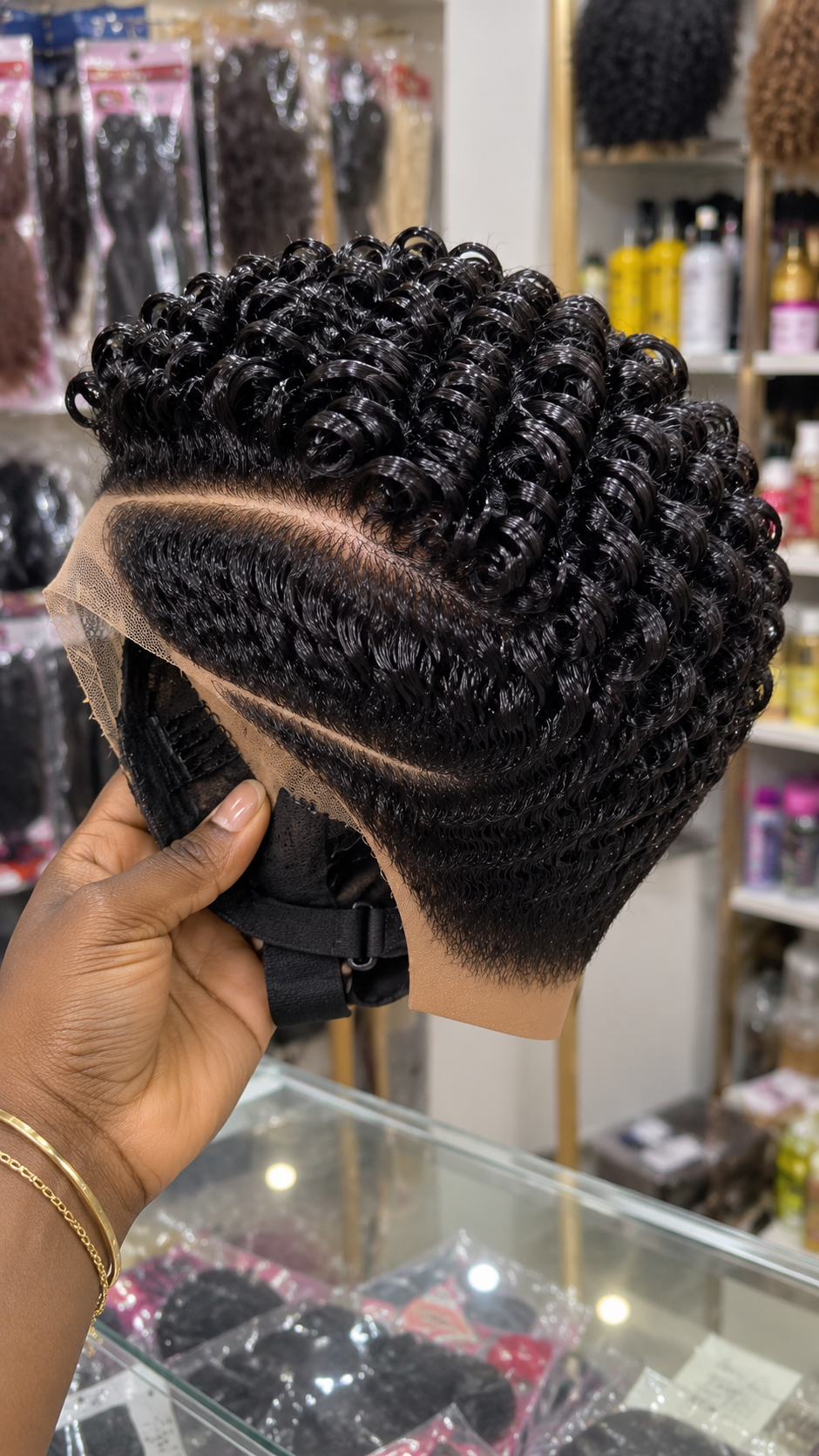
This jet-black wig stands apart from the previous loop-crown pieces because its visual identity comes from tightly organized spiral coils and layered wave bands rather than color contrast. The crown is packed with glossy tubular curls that run in deliberate rows, while the lower side changes into flatter directional waves separated by a narrow exposed pathway. Beneath those waves, the hair becomes progressively closer and finer toward the perimeter. The entire unit stays within a deep black palette, so the construction has to create the dimension that highlights or multiple colors would normally provide.
The pre-installation photograph also exposes useful structural information. Lace is visible around the perimeter, portions of the black interior cap can be seen, and an internal comb and adjustment hardware are present. Those details can be discussed with confidence because they are visible. The precise lace grade, however, cannot be established from the photograph. It would be inappropriate to describe the unit as HD lace without confirmation from the seller or manufacturer.
The Crown Is Organized as a Field of Elongated Spiral Coils
The upper section contains numerous glossy black coils, but they are not arranged as isolated circular rings scattered across the surface. Many of them form elongated spiral shapes that travel backward, giving the crown a directional rhythm. Their open centers remain visible, while neighboring sections overlap enough to create substantial density.
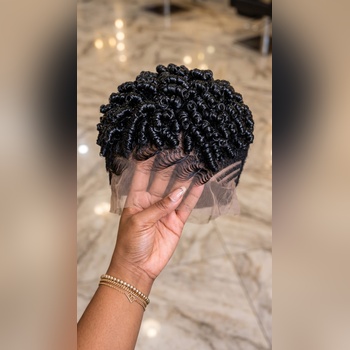
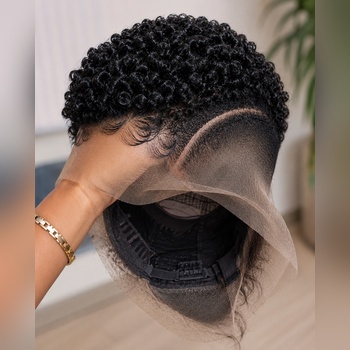
This arrangement gives the crown a more continuous sense of movement than a collection of separate ringlets. The eye follows the repeated spiral forms from the forward area toward the rear instead of stopping at individual circles.
For custom work, this distinction matters. A request for ordinary finger coils could result in flatter circular formations. The reference calls for raised, rolled spirals with visible openings and a clear backward orientation.
Uniform Black Makes Coil Spacing More Important
There is no obvious second color helping one curl stand apart from another. Instead, the wig relies on reflected light, shadow and open space. Bright salon light creates narrow silver-like reflections along the outer surfaces, while the interiors remain deep black.
The gaps between neighboring coils therefore have functional value. They allow the viewer to understand where one spiral ends and another begins. Filling those spaces with additional hair could make the crown appear heavier while actually reducing its visual detail.
A custom maker should prioritize coil separation and direction rather than simply maximizing density.
The Forward Coils Stand More Upright Than the Rear Sections
Near the front, several spirals rise noticeably from the foundation. Their elevation establishes the crown’s highest point. Moving backward, the coils gradually lean more strongly with the contour of the cap.
This progression keeps the silhouette controlled. The wig has enough height to showcase the spiral construction but does not maintain maximum projection all the way around the rear.
An elevated side photograph is one of the best approval angles for a custom version. It can reveal whether the maker has reproduced this change in direction rather than repeating one coil angle throughout the crown.
The Rear Becomes Denser Without Becoming Larger
Toward the back, the curls appear more closely grouped and follow the rounded rear contour. Their overall scale remains compact even though the number of visible sections increases.
This allows the rear to look fully completed without creating excessive bulk. It also provides a natural endpoint for the backward movement established by the forward spirals.
When purchasing remotely, request a rear three-quarter image of the exact wig. A carefully constructed front does not guarantee that the same attention has been given to the rear.
A Broad Wave Band Separates the Crown From the Lower Side
Below the spiral crown, the hair changes direction dramatically. Instead of continuing with raised curls, strands are arranged into flatter S-shaped waves. These waves travel horizontally and diagonally around the side, creating a broad transition zone.
This band is a major part of the design. It gives the eye somewhere to rest between the busy spiral crown and the close lower section. Without it, the curls would move directly into the tapered side and the silhouette would lose an important layer.
A recreation should therefore preserve the wave band as its own styling zone rather than reducing it to a narrow parting.
The Wave Ridges Depend on Consistent Parallel Direction
Several fine ridges travel together through the side panel. Their repeated S-curves create a flowing surface, but the hair remains much closer to the foundation than the crown above it.
The visual effect comes from consistency. Individual strands follow neighboring strands closely enough to create recognizable wave bands without becoming one solid block.
During maintenance, these sections should not be rolled into spiral curls. Their flatter direction is intentional and provides the contrast that makes the upper crown appear even more dimensional.
A Narrow Exposed Path Gives the Side a Clear Break
Beneath the broad wave section is a narrow exposed route that travels through the side. It separates the upper wave band from another compact section below.
The line remains restrained rather than becoming a wide shaved channel. Dark hair is preserved on both sides, which keeps the profile layered and prevents the exposed area from dominating the design.
For future maintenance, preserving this width is important. Repeatedly widening the path can gradually remove the dark sections that make the layered arrangement readable.
The Lower Side Uses Another Directional Wave Before the Taper
Below the exposed pathway, the hair does not immediately become bare or uniformly close. Another dark wave section remains visible. Its movement follows the general direction of the upper band but sits closer to the foundation.
This creates a stepped transition: spiral crown, broad wave band, exposed path, lower wave section and finally the tapered perimeter. Each level becomes progressively quieter.
That progression is one of the most distinctive aspects of this wig and should be preserved when commissioning a recreation.
The Tapered Perimeter Completes the Compact Silhouette
Near the lower edge, the strands become fine and very close. The density gradually decreases toward the lace rather than ending in a hard block of heavy hair.
This keeps the lower profile from competing with the crown. The spirals remain the dominant element, while the perimeter acts as a visual foundation.
Repeated trimming should be conservative. Wig hair cannot regenerate, and unnecessarily reducing the lower density can eventually make the transition appear sparse rather than intentionally tapered.
The Black Palette Makes Product Control Particularly Important
The hair has a highly reflective appearance, but heavy shine product is not necessarily responsible for a better result. Excess oil or wax can cause neighboring spiral sections to adhere together and make the wave ridges below less distinct.
Use only the amount of product appropriate for the confirmed hair or fiber. If residue begins dulling the crown, suitable cleansing may restore the reflective surface more effectively than applying additional product.
The goal is glossy separation: individual coils should reflect light while remaining visibly independent.
The Lace Perimeter Remains Available for Final Fitting
Visible lace extends beyond the hair-bearing edge, showing that the unit has not yet been fully customized to a wearer. This gives an installer useful room for positioning.
The cap should be placed first so the spiral crown and layered side sit correctly. Only after the final position has been established should the excess lace be trimmed.
The apparent lace color in the photograph is affected by lighting and surrounding tones. Buyers should ask which actual lace shades are offered rather than selecting solely from the image.
The Interior Comb and Adjustment Hardware Are Visible
The photograph reveals part of the black interior construction. An internal comb is clearly visible, along with adjustment components near the lower cap. This gives the buyer useful information that is often hidden in finished mannequin photographs.
The complete underside is not visible, however. A customer should still request a full interior photograph of the exact unit if attachment method and cap construction are important purchasing factors.
For a custom order, internal comb placement can also be discussed in advance. Customers who prefer another attachment method should communicate that before production.
Cap Sizing Affects the Position of Every Side Layer
The broad wave panel, exposed pathway and tapered lower section are all fixed to the cap. If the wig shifts, all of those zones shift together.
Correct sizing is therefore important for visual placement as well as comfort. A unit that sits too far forward can move the layered side toward the face, while one that slides backward changes where the transition appears around the temple.
Follow the maker’s measurement instructions carefully. For a higher-value custom piece, professional measurements from a wig stylist can help reduce fitting problems.
The Best Order Brief Should Describe Vertical Zones
This design is easier to communicate when it is divided vertically. The upper zone is a dense field of glossy backward spiral coils. Beneath it is a broad S-wave panel. A narrow exposed pathway follows, then a lower compact wave section, and finally a fine tapered perimeter.
The color specification is simpler: deep jet or natural black throughout, without contrasting highlights. The styling itself should provide the dimension.
After those exterior details are confirmed, discuss cap sizing, lace shade, internal comb preferences and whether the lace should remain untrimmed for local fitting.
Choose a Maker Who Can Reproduce Directional Setting
This unit requires more than someone who can produce attractive curls. The stylist needs to control several different hair directions within one compact wig. The crown spirals, broad side waves and lower taper cannot all be created using the same technique.
Ask potential makers for photographs of similar sculpted work. Look for consistency in the wave ridges and whether the curls remain separated rather than becoming a dense undefined mass.
If the wig will be finished locally, bring the reference to the appointment so the stylist understands that the side should remain layered rather than being converted into a conventional close crop.
Approval Images Should Prioritize Side Architecture
A slightly elevated side view is the most informative angle for this wig. It can show the spiral crown, the wave band and the exposed lower pathway simultaneously.
An overhead photograph should reveal the density and backward orientation of the coils. A rear three-quarter image can confirm that the spiral construction continues appropriately around the back.
If the unit is being purchased as custom work, request photographs of the actual finished wig before shipment rather than relying exclusively on previous examples.
Price Is Driven by Multi-Zone Styling Rather Than Color Processing
Because the wig remains black, the customization budget does not need to focus on elaborate color placement. Instead, labor is concentrated in spiral formation, wave setting, density transitions, cap preparation and lace work.
| Category | Estimated Price Range | Potential Scope of Work |
|---|---|---|
| Premium Custom | $310–$550+ | Higher-grade hair, personalized cap sizing, hand-arranged spiral crown, layered side-wave setting, controlled taper and detailed lace preparation. |
| Standard Custom | $185–$320 | Prepared black spiral crown and established side-wave architecture with more standardized sizing and finishing. |
| Basic Human Hair | $110–$200 | A human-hair foundation requiring professional spiral setting, side-wave construction, density refinement and fitting. |
| Premium Synthetic | $75–$145 | A quality pre-set alternative that may retain the spiral and wave arrangement with less frequent rebuilding. |
| Basic Synthetic | $35–$80 | A budget interpretation where spiral separation, wave precision, taper control or cap construction may be simpler. |
These figures are general budgeting references rather than verified prices for the photographed unit. Hair source, fiber, cap construction, lace, seller location, labor, shipping and installation can all change the final cost.
When comparing quotations, ask whether both the spiral crown and layered side waves are included. A cheaper base requiring extensive professional setting after purchase may ultimately cost more than a finished custom unit.
Human Hair Gives a Stylist More Freedom to Rebuild Individual Zones
A human-hair version can be practical for someone who expects professional maintenance. Individual spiral coils can potentially be reset when they loosen, while the wave bands can be addressed separately.
This allows selective maintenance rather than dismantling the entire wig. If the crown remains intact but one side wave lifts, only that area needs attention.
Heat should still be appropriate for the condition and quality of the hair. Human hair does not require maximum temperature to maintain a sculpted form.
Premium Synthetic May Offer Strong Shape Retention
A high-quality pre-set synthetic unit can be attractive when preserving the original spiral arrangement is more important than future restyling flexibility. Some fibers can hold complex curled forms with relatively limited daily intervention.
Heat tolerance varies substantially, however. Buyers should confirm the exact fiber before using heated tools or attempting structural changes.
The decision between human hair and synthetic should be based on future maintenance plans rather than assuming one category is universally superior.
Photograph Every Styling Zone Before the First Wash
An overhead image should document the spiral crown. A side photograph should capture the broad wave band, exposed pathway and lower taper. A rear image can record how the coils finish around the back.
These photographs become a maintenance map. If sections move during cleansing, the original direction can be restored rather than guessed.
This is particularly important for a monochromatic black wig because subtle directional differences can be difficult to remember once the hair is wet.
Wash Without Turning the Spiral Crown Into One Curl Mass
Aggressive rubbing can cause neighboring coils to intertwine and close their open centers. Clean the hair according to the confirmed material and avoid scrubbing all of the crown sections together.
After drying, inspect the individual spirals. If only several have shifted, reset those rather than rebuilding the entire crown.
This selective approach reduces manipulation and helps maintain the original density distribution.
Treat the Wave Bands Differently From the Crown
The side waves need to remain flatter and more directional than the spirals above them. Their ridges should travel together rather than being rolled into circular curls.
If a wave lifts, guide it back along its existing route. The original side photograph can help preserve the spacing between ridges.
Using one maintenance technique across the entire wig would gradually erase the contrast between the upper and lower styling zones.
Preserve the Exposed Path Instead of Widening It
The narrow pathway beneath the main wave panel is already sufficient to create separation. It does not need to become broader with every maintenance visit.
If fine strands move across the path, reposition them first. Cutting should only be considered when actual refinement is necessary.
This preservation-first approach protects the dark hair above and below the line and helps the layered side retain its original proportions.
The Lower Taper Needs Less Cutting Than It May Appear
The close perimeter can look like an area that requires frequent barber work, but wig hair does not grow. Once the correct density has been established, repeated cutting can gradually make the area too sparse.
Use controlled setting to manage strands that lift away from the foundation. Remove hair only when a genuine correction is required.
This can extend the lifespan of the lower side and keep the transition into the lace looking intentional.
Book the First Appointment as a Fitting Session
When the unit arrives, inspect the crown, side architecture, cap and lace before making irreversible changes. A custom wig that differs significantly from the approved design should be discussed with the seller before trimming.
Once the unit is accepted, the stylist can establish the final cap position and prepare the lace. The spiral and wave work should be preserved wherever it has survived shipping correctly.
If only minor restoration is needed, targeted work is preferable to automatically booking a complete restyle.
Storage Should Preserve Both Height and Side Direction
A suitable wig stand or mannequin head provides the crown with enough room to keep its spiral openings. The side should also remain clear of walls and other objects so the wave ridges are not flattened.
Make sure the cap and lace are completely dry before storage. Avoid stacking another wig on top of the crown.
During travel, choose packaging deep enough to protect the upper coils without forcing the lower wave panel into an unnatural position.
The Value of This Wig Is in Its Layered Construction
The absence of vivid color makes the craftsmanship easier to evaluate. Glossy black spirals dominate the crown, a broad wave panel changes the direction below them, a narrow exposed route creates separation and a second compact wave section leads into the tapered perimeter. Each layer performs a different role while remaining part of one coherent black design.
For buyers, those zones provide a practical quality checklist. Examine spiral separation, backward direction, side-wave consistency, pathway width, lower density, lace condition and visible interior hardware. Confirm cap and lace specifications directly with the seller rather than assuming them from appearance.
For wig businesses, the strongest product presentation would show this unit from above, from the side and from underneath before installation. Those angles explain why a monochromatic black wig can still require substantial skilled labor. Accurate construction information, realistic pricing and maintenance guidance then give customers a clearer understanding of what they are actually purchasing.
Search Terms
jet black spiral coil wig · layered side wave lace wig · glossy black tubular curl crown · narrow side path wig · tapered black side hairpiece · backward spiral crown wig · sculpted S wave wig · untrim