
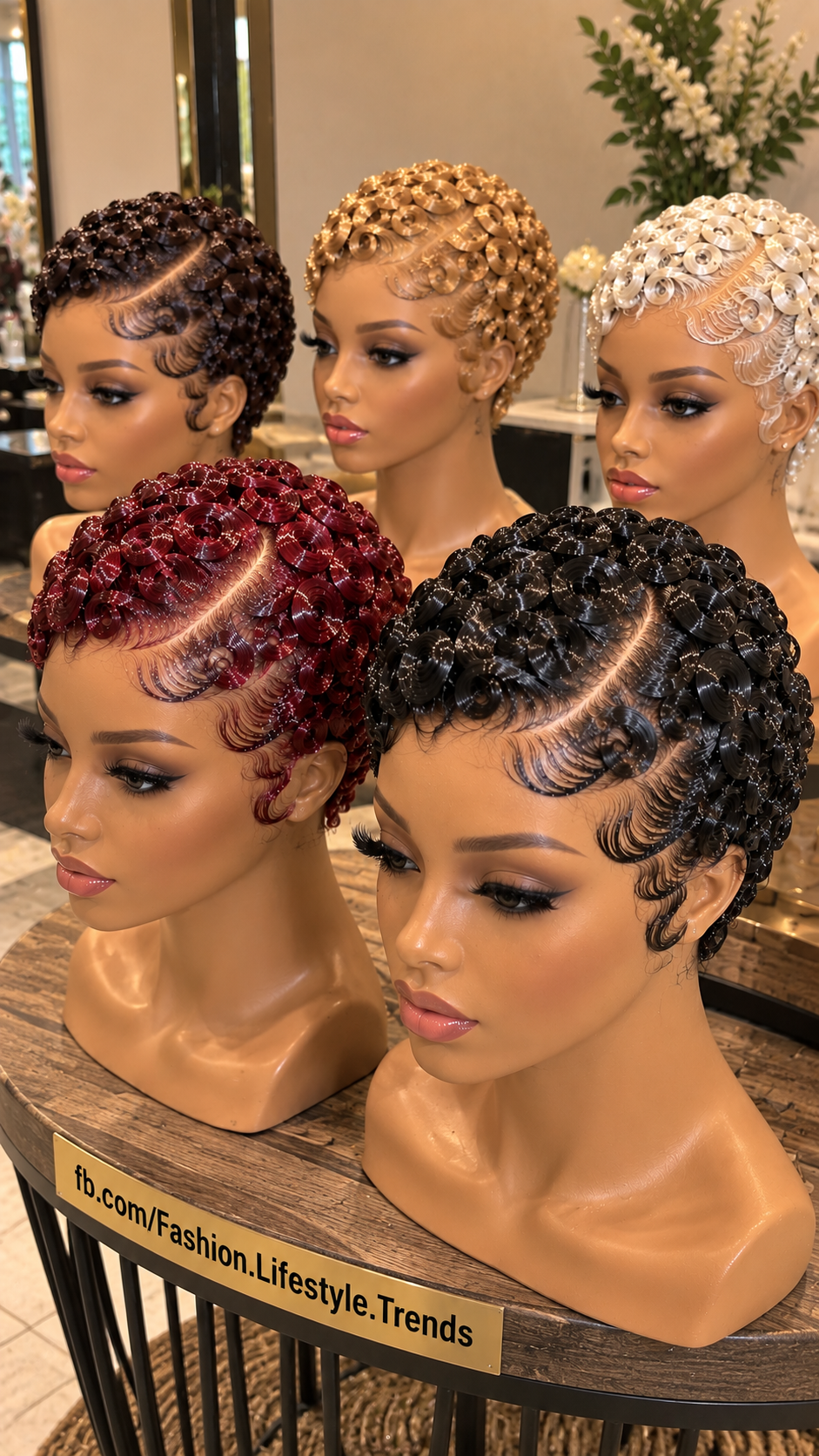
This five-wig salon display offers a useful way to compare one sculpted finger-coil family across four very different color directions. Two foreground units establish the strongest contrast: one is deep burgundy with glossy wine-red rings, while the other is rich black with large circular coils and an extended sequence of sweeping temple waves. Behind them, dark chocolate, golden blonde and pearl blonde interpretations show how dramatically the same compact crown concept can change when shadow, brightness and strand visibility are altered.
The most important observation is that these wigs are not merely identical units recolored five times. Coil diameter, crown density, part placement and the amount of face-framing wave work vary visibly from mannequin to mannequin. The black foreground piece uses especially large rings and a pronounced diagonal division. The burgundy wig concentrates rich red circles around a similar directional route but creates a different balance at the temple. The two blonde options make the physical construction much easier to see because fewer strands disappear into dark shadow.
The photograph shows finished wigs positioned on mannequin heads. Their interior caps and underside construction are concealed, so no specific lace grade can be verified from this view. The scalp-like divisions visible between the coils should not automatically be described as HD lace. A buyer should request construction details and off-mannequin photographs of the exact unit before paying a premium for a particular lace specification.
The Foreground Pair Demonstrates Two Different Ways to Create Depth
The black and burgundy wigs use related circular styling but achieve dimensional contrast differently. Black depends heavily on reflected light. Bright highlights travel across the glossy outer surfaces of the rings, while their centers remain extremely dark. Burgundy creates additional tonal variation because its raised sections appear brighter red while recessed portions move toward wine and deep cherry.
That difference affects the first impression. The black unit emphasizes geometry. The viewer notices the circular openings, the diagonal route and the elongated front waves. Burgundy introduces color as an additional visual layer, so the crown reads simultaneously as a sculpted shape and a rich red surface.
For buyers deciding between these two options, the question is therefore not simply whether black or red is preferred. It is whether the wearer wants the construction itself to dominate or wants color to participate more strongly in the final effect.
Large Circular Coils Give the Black Crown Its Strong Identity
The foreground black unit contains some of the most clearly visible ring formations in the display. Several coils have broad open centers and sit prominently across the crown. Smaller circular sections fill the remaining spaces and help the pattern adapt to the rounded shape of the head.
This mixed-diameter approach is important. A crown made entirely from identical rings could appear rigid and repetitive. Here, the larger coils act as focal points while smaller ones create transitions.
A customer ordering this construction should specify mixed ring sizes rather than simply requesting finger coils. An elevated reference photograph can communicate the preferred diameter and spacing far more accurately than a generic hairstyle name.
The Diagonal Division Creates an Asymmetrical Crown Map
A pronounced exposed route travels through the foreground black wig. It separates the large ring field from the flatter directional strands near the forehead. The burgundy unit uses a related diagonal arrangement, although its curl distribution differs.
This division controls how much visual weight sits on either side of the head. The large crown field occupies one side, while the exposed route creates breathing room before the hair transitions into sweeping front sections.
Moving this path toward the center would alter the entire balance. For custom work, part placement should therefore be approved as an early design decision rather than left to the final styling appointment.
The Forehead Waves Are Longer Than the Crown Coils
One of the strongest details on both foreground wigs is the change in scale near the face. The crown uses compact circular formations, but the strands bordering the diagonal division stretch into much longer arcs. Several run almost parallel as they sweep toward the temple.
These elongated sections should be treated as a distinct styling zone. They are not simply stray perimeter strands and should not be reduced to a generic baby-hair description. They occupy enough space to become an important part of the overall composition.
When a stylist refreshes the wig, those arcs should retain their longer directional movement rather than being rolled into additional circular coils.
The Temple Finishes the Movement With Smaller Curves
After the long forehead waves complete their sweep, smaller curved pieces appear closer to the ear. This creates a gradual progression from large crown rings to long arcs and finally to compact side curls.
The sequence is especially clear on the black wig because the glossy strands reflect light along every curve. On burgundy, color helps reveal the same directional transition.
A custom consultation should include the amount of temple work desired. Some customers may prefer several visible side curls, while others may want the area quieter. Making that choice before construction is easier than removing finished sections afterward.
Burgundy Turns Every Coil Into a Range of Red Tones
The burgundy wig is not visually one flat red. Its deepest recesses approach dark wine, while the raised rings catch brighter cherry and ruby reflections. This gives the crown substantial depth without obvious blonde or copper highlighting.
The directional front strands also display this tonal range. Areas facing the light appear brighter, while curves turning away from it become darker. The hairstyle therefore changes subtly as the viewing angle changes.
Because red is highly sensitive to lighting and camera processing, customers should ask for a neutral-light photograph before approving a custom burgundy unit. The shade may appear considerably deeper away from warm salon lighting.
Dark Chocolate Offers a Quieter Alternative to Black
The dark brown wig in the rear left keeps much of the depth associated with black while introducing warmer reflections. Circular coils remain clearly visible, but the overall contrast is slightly softer.
This can be useful for a customer who wants a dark natural-looking palette without the intensity of highly reflective black. Under bright light, chocolate and espresso tones can reveal the direction of individual strands while still maintaining deep shadow inside the rings.
Color names vary between sellers, so customers should request a photograph of the actual brown option rather than relying entirely on terms such as chocolate, espresso or dark mocha.
Golden Blonde Shifts Attention Toward Strand Direction
The central rear blonde unit uses a warmer golden palette. Because the hair is considerably lighter, the viewer can follow the individual circular sections with less dependence on dark shadow.
This changes the character of the wig. The crown appears brighter and more decorative, while smaller perimeter details become easier to notice. The circular construction itself becomes one of the main attractions.
If the wig is made from human hair, a buyer should ask how the blonde shade was achieved and what heat limitations apply. Highly processed blonde hair may require a different maintenance strategy from minimally processed dark hair.
Pearl Blonde Produces the Highest-Visibility Coil Pattern
The pale blonde wig at the rear right moves even farther away from the dark palettes. Its pearl-to-creamy tone makes practically every ring edge and front curve visible.
This high visibility places greater emphasis on consistency. A misplaced coil or uneven transition may stand out more clearly than it would on black or chocolate hair.
The pale shade should also be verified under neutral light. Warm salon illumination can make pearl blonde appear more golden or creamy than it actually is.
Material remains an open question from the photograph. The seller should confirm whether the selected unit is human hair or synthetic and provide the appropriate care information.
Blonde and Burgundy Require Different Color-Maintenance Budgets
Color choice affects long-term cost as well as appearance. A dark black or chocolate unit may require relatively little tonal maintenance, although its crown still needs shape preservation. Burgundy human hair may eventually need color refreshing if the wine-red depth fades.
Light blonde human hair can require even more cautious maintenance depending on how extensively it was processed. Additional chemical work should be approached carefully rather than treating the wig as an unlimited recoloring base.
Pre-colored synthetic fiber creates a different maintenance profile. The shade may remain stable without conventional dye services, but major recoloring options can be limited.
The Display Is Best Used to Build a Combination
A buyer does not necessarily need to choose every characteristic from one mannequin. The black wig may provide the preferred crown map, while burgundy provides the desired color. Another customer may prefer the golden blonde palette but want fewer temple curls.
For custom work, identify those preferences separately. Choose coil diameter, crown density, diagonal placement, forehead-wave length, temple treatment and color as individual variables.
The maker can then explain which combinations are practical. This is much clearer than sending the full display photograph and asking for one of the wigs without identifying which construction is intended.
A Custom Brief Should Describe the Crown Before the Shade
Begin with mixed-diameter circular coils and specify whether the crown should be densely populated or retain more open spacing. Next, establish the diagonal division and which side should carry the larger coil field.
Then describe the elongated front waves and the desired amount of smaller temple work. Only after that should the final palette be selected: glossy black, deep burgundy, dark chocolate, golden blonde or pearl blonde.
Practical specifications can follow, including cap measurements, verified hair or fiber type, available lace construction and whether the wig arrives fully styled.
Ask for the Exact Wig to Be Photographed Individually
A salon gallery helps with comparison, but it should not be the final product inspection. Once a customer chooses a unit, ask for individual photographs of that exact wig.
An overhead image should show the full coil map and directional division. Both sides should reveal the face-framing work, while the rear should confirm whether the circular pattern continues consistently.
If lace or another cap construction is advertised, request an underside photograph with the unit removed from the mannequin. This allows styling and structural claims to be evaluated separately.
Use Neutral Lighting for Final Color Approval
Salon lighting can make all five palettes look warmer. Burgundy may become brighter red, chocolate may appear more copper, and pearl blonde may shift toward cream.
Before a custom unit ships, request at least one photograph under neutral indoor light or indirect daylight. This is particularly useful when the color itself is a major reason for the purchase.
The customer can then approve both the hairstyle and the actual shade rather than discovering a significant color difference after delivery.
Where to Buy Depends on How Specific the Combination Is
If an existing salon unit already combines the preferred crown, color and perimeter work, purchasing ready-made stock can be the simplest route. The customer mainly needs to confirm material, sizing and what fitting services remain.
A specialist wig maker becomes more useful when the buyer wants to combine elements from different mannequins. This may include changing the crown color while preserving a particular diagonal part and wave arrangement.
A third option is to purchase an appropriate base and book a local wig stylist. Before choosing this route, obtain a styling estimate so the total cost of the finished unit is understood.
Pricing Should Reflect the Number of Decisions Being Customized
A compact wig can still carry substantial labor costs when crown mapping, color, perimeter direction and cap preparation are customized individually. The price should be judged by completed craftsmanship rather than hair length alone.
| Category | Estimated Price Range | Typical Scope |
|---|---|---|
| Premium Custom | $330–$595+ | Higher-grade hair, personalized sizing, custom color, mixed-diameter coil mapping, directional crown division and detailed face-framing work. |
| Standard Custom | $200–$350 | Prepared circular crown, selected shade and planned perimeter arrangement with more standardized sizing options. |
| Basic Human Hair | $120–$215 | A restylable foundation requiring additional professional coil setting, color adjustment or front-wave construction. |
| Premium Synthetic | $80–$155 | A quality pre-set option that may retain circular coils and face-framing sections with less frequent resetting. |
| Basic Synthetic | $35–$90 | A budget interpretation where coil variation, color depth, perimeter detail or cap construction may be simpler. |
These figures are general budgeting references rather than confirmed prices for the wigs in the photograph. Hair source, fiber, coloring, cap construction, seller location, labor, shipping and fitting can all affect the total.
When comparing quotes, ask exactly what will arrive completed. A lower-cost human-hair foundation may still require enough professional styling and color work to exceed the cost of a prepared custom wig.
Book the Appointment According to the Remaining Work
A finished mannequin unit may only need fitting and minor restoration after shipping. If its coil map is already correct, the stylist should preserve as much of the original work as possible.
A basic foundation intended to become this style requires a much longer booking. Creating the circular crown, directional division and sweeping perimeter can represent the majority of the styling labor.
Tell the salon what condition the wig will arrive in before scheduling. This allows the appropriate service length and specialist to be selected.
Human Hair Provides More Freedom for Future Coil Reconstruction
A human-hair unit can be useful when the wearer expects periodic professional resetting. Individual rings may be reconstructed as they relax, provided the hair remains in suitable condition.
The amount of previous processing should guide heat use. This is especially relevant for burgundy and blonde units, where coloring or lightening may have altered the hair more substantially.
Future styling should prioritize preservation rather than repeatedly exposing the entire crown to maximum heat.
Synthetic Fiber Can Favor Long-Term Shape Retention
A quality synthetic unit may require less rebuilding when its circular crown has been permanently or semi-permanently pre-set. This can be useful for someone who intends to preserve the display style rather than frequently change it.
The limitation is customization after purchase. Heat tolerance varies, and standard human-hair coloring methods should not be assumed suitable.
Buyers should confirm the exact fiber and its care limits before deciding which material better matches their routine.
Photograph the Crown From Above Before Washing
An overhead photograph creates a map of the original coil arrangement. It records the large rings, smaller fillers and directional division. Side photographs should capture the elongated forehead waves and temple sections.
These references become useful after cleansing, travel or long storage. A stylist can restore displaced sections according to the original design rather than gradually creating a different pattern.
Keeping the first set of photographs with the wig’s care information can also help when the unit is maintained by a different salon later.
Wash Without Combining Neighboring Rings
The crown should not be scrubbed as one loose mass. Aggressive circular motion can intertwine several coils and close their visible centers.
Clean according to the confirmed material and handle individual sections gently. After drying, identify which rings have actually moved before beginning any resetting.
If most of the crown remains intact, leave it alone. Selective maintenance usually preserves the original construction better than rebuilding everything routinely.
Keep Product Away From the Open Coil Centers
Heavy oils and holding products can accumulate inside circular sections. As residue builds, neighboring strands may stick together and the rings can begin to lose their open appearance.
Use product sparingly and choose formulas appropriate for the material. When buildup reduces shine, cleansing can be more effective than layering additional product.
The objective is a reflective surface with visible separation, not a heavily coated crown.
Protect the Long Front Arcs From Gradual Shortening
The sweeping strands near the forehead require enough length to complete their broad curves. Repeated trimming can slowly convert them into smaller perimeter curls.
If an arc becomes displaced, restore its direction first. Use the original side photograph as the reference before considering any cutting.
This preservation-first approach helps maintain the contrast between circular crown rings and elongated face-framing movement.
Store Each Unit With Enough Crown Clearance
A wig stand or appropriately sized mannequin head gives the raised coils room to retain their shape. Avoid placing the wig beneath other units or compressing it inside a shallow container.
The sides also need clearance because pressure can disturb the forehead and temple waves. Make sure the wig is fully dry before storage.
Pale blonde hair should be protected from surfaces that might transfer color, while all units should be transported with enough space to prevent crushing the crown.
The Best Color Is the One That Supports the Desired Curl Visibility
Black, burgundy, chocolate, golden blonde and pearl blonde do more than change the palette. Each alters how the sculpted crown is perceived. Black makes shadow and shine dramatic. Burgundy introduces red tonal depth. Chocolate softens the contrast. Golden blonde reveals more individual strand movement, while pearl blonde places almost every curl edge in full view.
For buyers, the smartest sequence is to choose the crown architecture first, the directional part and face-framing work second, and the final shade third. Verify material and cap information separately and request photographs of the exact unit before making irreversible alterations.
For wig businesses, a display like this can become an effective consultation system when each mannequin is treated as a distinct construction reference. Customers can compare coil scale and perimeter work, select a color that complements those choices and understand whether they are purchasing ready-made inventory or commissioning a custom combination. That makes the ordering process clearer while keeping every product claim tied to what can actually be verified