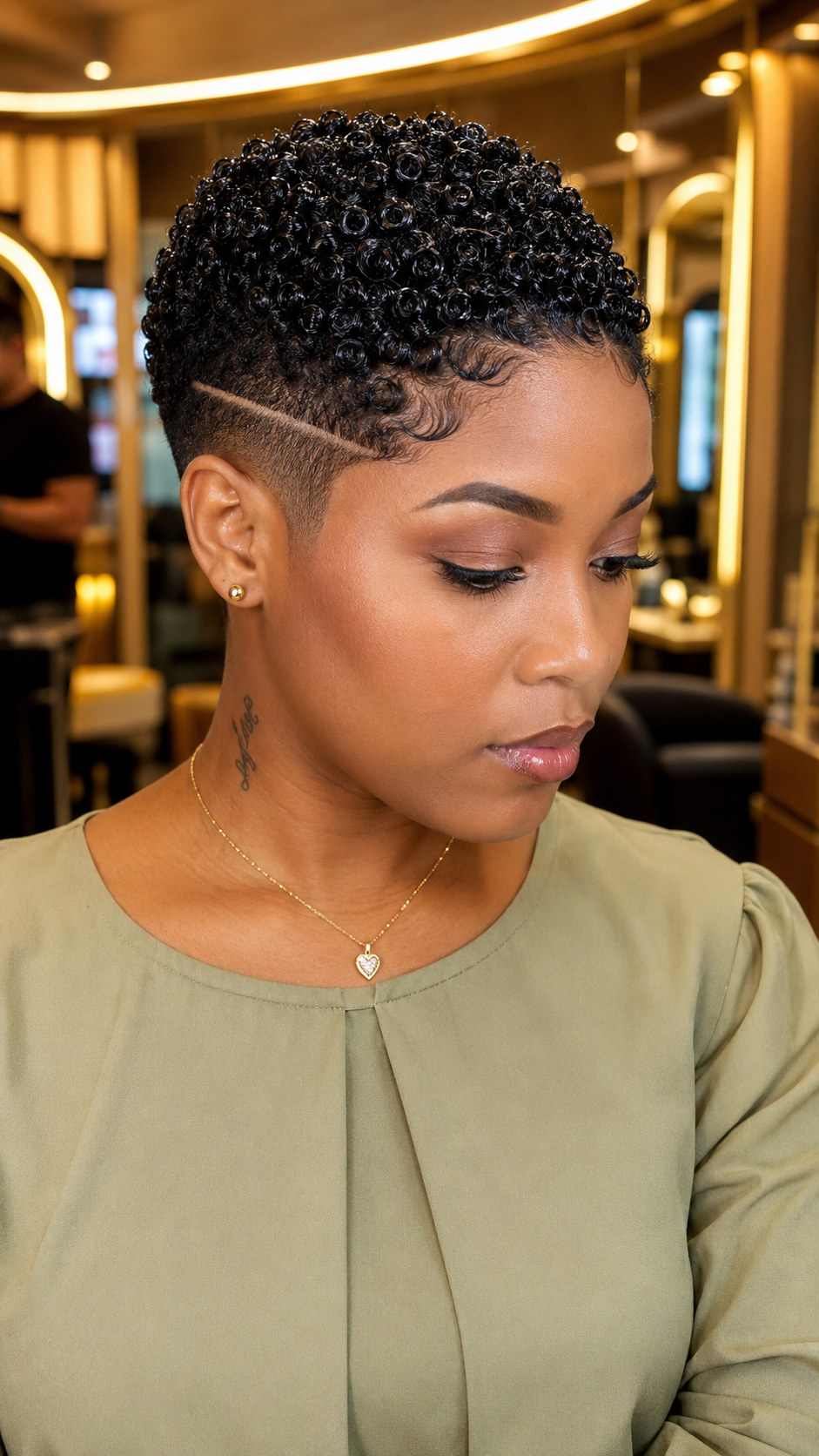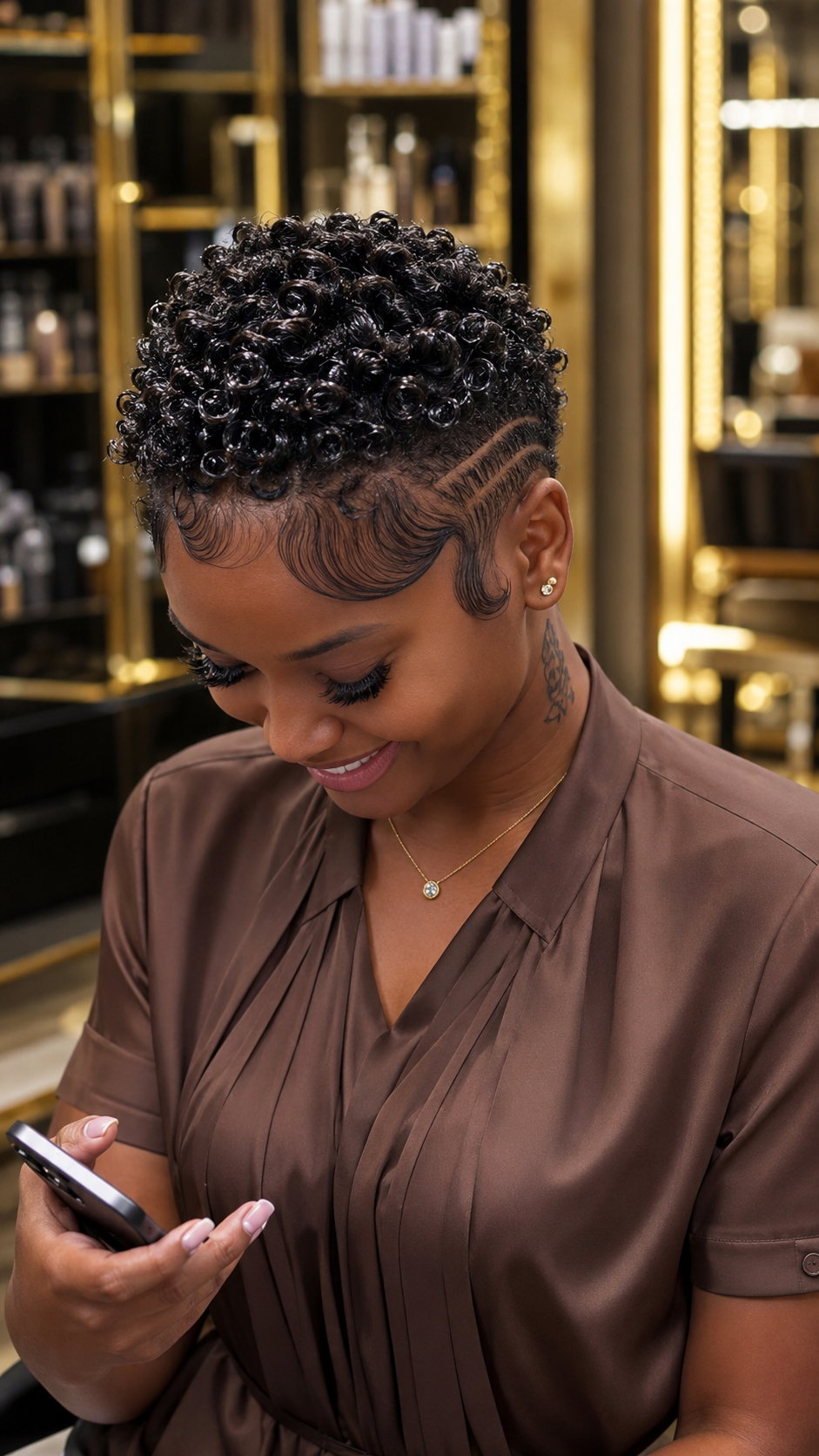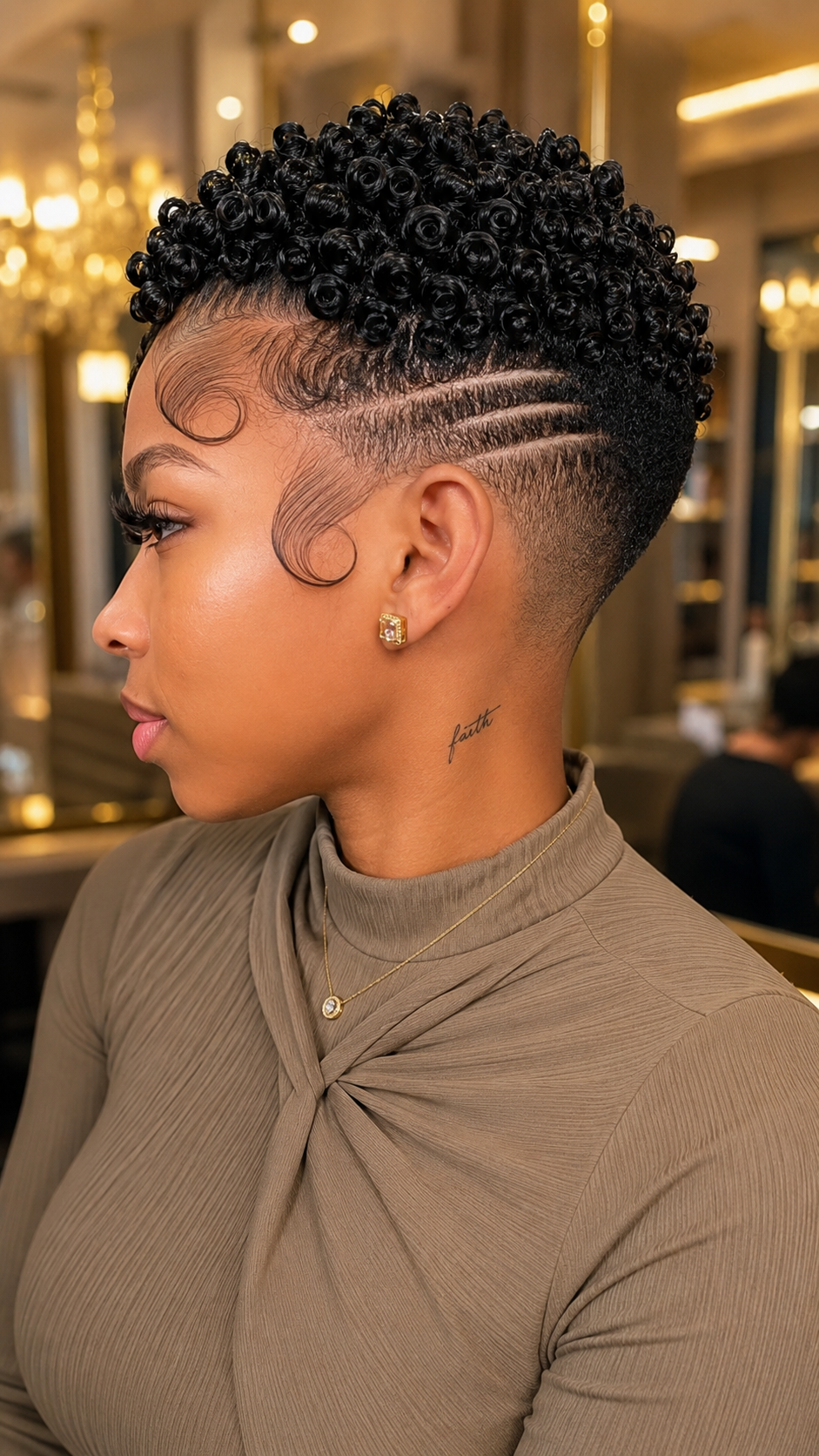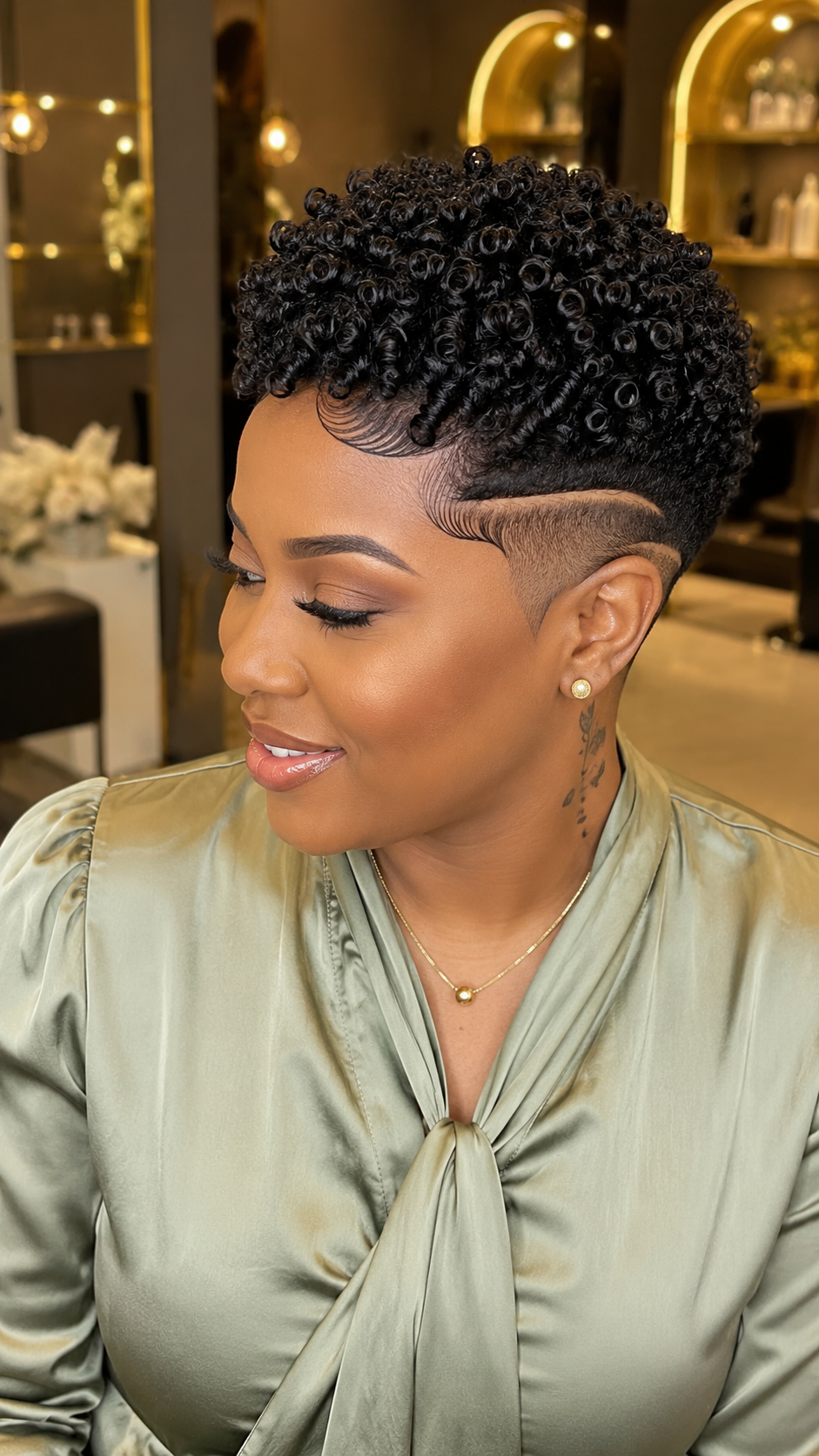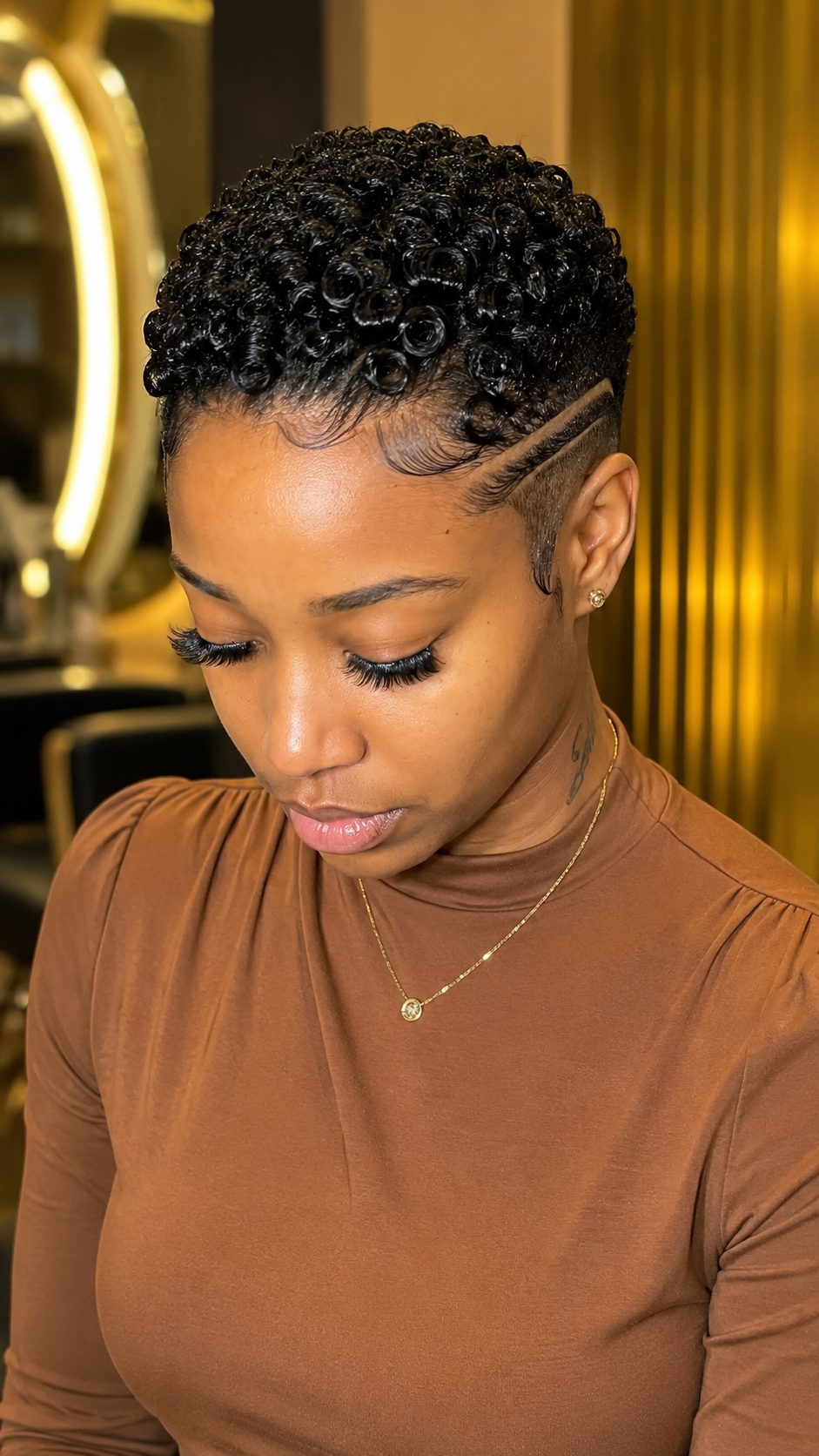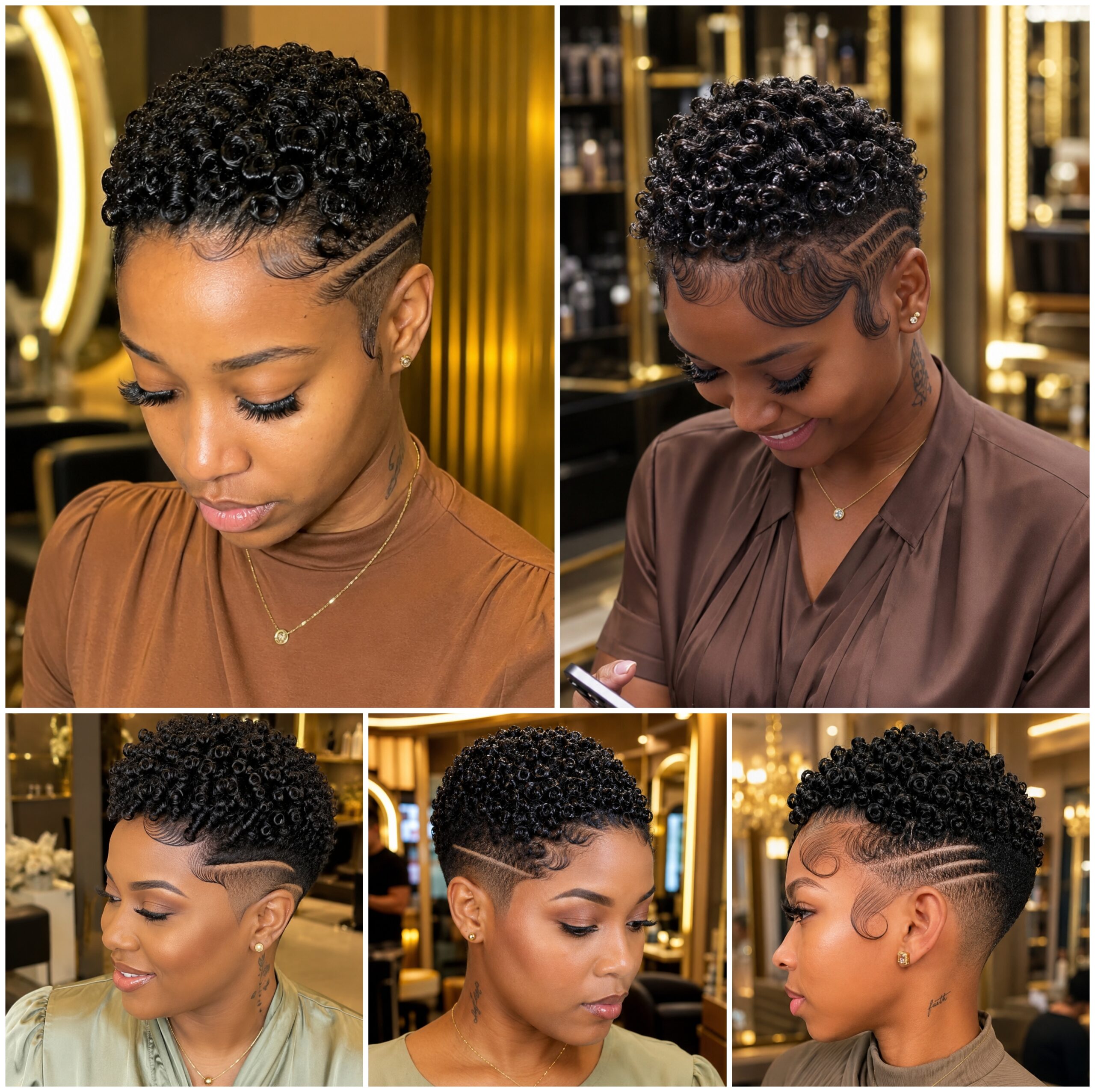
A dense ringlet crown paired with sleek faded sides creates a striking balance between concentrated texture and closely shaped detailing. The upper section carries compact, individually visible ringlets that build a rounded silhouette, while the sides gradually reduce in length toward the temples and lower perimeter. This difference in density allows the curls to become the main visual focus without making the hairstyle appear excessively bulky.
The success of this look depends on proportion. The ringlets need enough density to create a full crown, but they should still remain separated so their circular structure is visible. At the same time, the faded sides must transition gradually into the upper section rather than creating an abrupt division between the two areas.
This hairstyle can be recreated on suitable natural hair or used as inspiration for a customized wig. Whichever approach is chosen, crown height, ringlet size, side density, and the fade transition should be discussed with the stylist before the work begins.
Building a Crown Filled with Compact Ringlets
The upper section is the defining element of this hairstyle. Numerous small ringlets sit closely together to create concentrated volume across the crown. Although the overall appearance is dense, each curl should retain enough separation to show its individual circular formation.
Curl diameter has a significant effect on the finished silhouette. Larger curls create wider spaces and a looser appearance, while smaller ringlets produce greater visual density. Medium-small curls are particularly suitable when the objective is to create a compact crown without losing recognizable curl definition.
Direction also matters. The curls do not need to face exactly the same way, but their placement should contribute to a balanced dome. Uneven distribution can produce unwanted flat areas or isolated sections that extend too far beyond the intended shape.
A glossy surface can enhance this structure. Reflective highlights following the curves of individual strands make the ringlets easier to distinguish and give the crown additional depth under daylight, salon lighting, or camera flash.
Managing Fullness Without Hiding the Curl Pattern
Dense curly hairstyles require careful control of volume. Adding more hair does not automatically produce a stronger result. Excessive density can cause neighboring ringlets to overlap until the individual curl pattern becomes difficult to see.
The highest concentration of volume should remain across the crown. As the hairstyle approaches the upper sides, the density begins to decrease gradually. This helps establish the transition toward the faded sections below.
For natural hair, shrinkage should be considered before the final shape is established. Coily and curly textures may become noticeably shorter as they dry, so a stylist familiar with the client’s texture can determine the appropriate length before finishing the silhouette.
With a custom wig, density distribution should be considered during construction rather than corrected entirely through cutting afterward. A unit designed around a tapered or faded silhouette generally gives the stylist greater control than a heavily constructed curly wig that must be dramatically reduced around the sides.
Using the Fade to Emphasize the Upper Texture
The faded sides provide the visual contrast that makes the ringlet crown appear more prominent. Hair gradually becomes closer toward the lower sides and temple area, creating a controlled transition rather than maintaining equal density around the entire head.
The fade should connect naturally with the upper curls. Removing too much hair immediately below the crown can create a visible shelf, while leaving excessive density through the middle section can weaken the contrast between the top and sides.
A barber experienced with curly or coily textures can adjust the fade according to head shape, natural hair density, and the desired crown height. The transition does not need to be identical for every wearer because individual proportions influence where the fade looks most balanced.
For wig construction, producing the same effect requires careful control of hair placement. The side sections need enough coverage to maintain a believable appearance while remaining substantially closer than the ringlet-filled crown.
Achieving a Reflective Ringlet Finish
Shine can make compact curls considerably more visible because light follows the circular path of each ringlet. The objective is a glossy appearance without coating the hair so heavily that the curls lose movement.
On suitable natural hair, moisture and styling products can support curl formation and help control unwanted frizz. Product selection should be based on the individual’s texture and porosity rather than assuming that one method will work for every curl type.
Human-hair wigs may provide flexibility for reshaping, depending on how the hair has been processed and constructed. Synthetic units require different care, particularly regarding heat. Heat tools should only be used when the manufacturer specifically identifies the fiber as heat-safe.
Mirror-like glossy hair, a silky reflective finish, individually visible strands, and highly visible ringlet separation can give the crown the polished appearance associated with this hairstyle.
Natural Hair or a Custom Wig Version?
Natural hair can be a practical choice when the existing texture and length are suitable for forming compact ringlets. A barber can establish the faded perimeter while a curl specialist works with the upper section. In some salons, one stylist may be comfortable performing both stages.
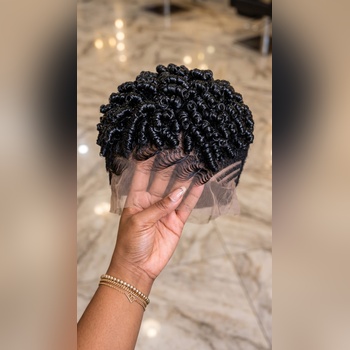
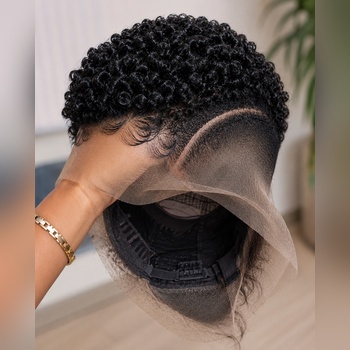
A custom wig provides another option for someone who wants to wear the silhouette without permanently maintaining closely faded sides. The maker can construct the crown with greater density while deliberately reducing hair around the perimeter.
However, buyers should not assume that every curly wig can be converted successfully. A unit containing excessive side density may require substantial reconstruction before it resembles a carefully faded hairstyle.
Before deciding between natural hair and a wig, consider maintenance frequency, styling flexibility, budget, and how often the hairstyle will be worn.
Price Categories for a Customized Version
Prices can vary substantially according to hair material, construction technique, density, customization, seller location, and the amount of hand-finishing required. The categories below are intended to help compare different levels of customization rather than represent fixed prices.
| Option | Price Position | Typical Characteristics |
|---|---|---|
| Premium Custom | Highest range | Detailed construction, personalized measurements, controlled crown density, individual ringlet preparation and precision side shaping |
| Standard Custom | Upper-mid range | Customized curl pattern, adjusted crown proportions and tailored side density |
| Basic Human Hair | Mid to upper range | Human-hair base with simpler customization and additional shaping after construction |
| Premium Synthetic | Lower to mid range | Higher-quality synthetic fiber with established ringlets and customized perimeter shaping |
| Basic Synthetic | Entry range | Ready-made curly construction with limited density and silhouette adjustments |
When comparing sellers, construction quality should be considered alongside price. A lower-priced unit that requires extensive reconstruction may ultimately involve additional styling costs.
What to Request from a Wig Maker
A clear reference photograph is one of the most useful tools when ordering this hairstyle. Generic descriptions such as curly pixie or tapered curly wig can refer to many different silhouettes, curl sizes, and densities.
Explain that the crown should contain numerous compact ringlets with visible separation. Specify that most of the volume should remain on top while the side density gradually decreases toward the temple and lower perimeter.
Ask whether the maker has previously produced wigs with closely shaped sides. Photographs from the front alone are not enough to evaluate this type of work. Request side and rear examples whenever possible.
Before placing a custom order, confirm the hair or fiber type, color, measurements, construction time, deposit requirements, shipping cost, alteration options, and return conditions. Custom-made products frequently have different policies from standard ready-to-ship units.
Finding a Stylist for This Ringlet-and-Fade Combination
For natural hair, search for professionals who regularly work with curly and coily textures as well as faded cuts. A portfolio containing similar crown shapes can provide a better indication of relevant experience than general salon photographs.
When searching locally, phrases such as “ringlet taper stylist,” “curly fade specialist,” “Afro curl barber,” and “custom curly pixie stylist” can help narrow the results. Adding a city or neighborhood name can make the search more practical.
For wig work, look for makers who display cropped curly units from several angles. Long wig construction and cropped tapered construction require different approaches to density and perimeter shaping.
Send the reference image before booking. Ask whether the professional can create both the dense ringlet crown and closely faded appearance so expectations are clear before the appointment.
How to Search for a Similar Wig Online
When shopping online, examine the shape of the wig rather than relying entirely on the product title. Search photographs should show the crown, temple area, sides, and preferably the rear.
Look for a unit with enough upper density to create compact ringlets but avoid designs where the same heavy density continues through the entire side area. Significant side bulk can make it difficult to reproduce the intended faded profile.
Useful shopping searches may combine terms describing the actual appearance, including ringlet crown, tapered curly wig, faded side curls, or compact curly pixie. Product terminology varies between sellers, so reviewing photographs remains essential.
Before ordering, contact the seller if the construction is unclear. Ask whether the side density can be customized and whether the crown height can be adjusted to match the reference.
A Practical Custom-Order Process
Begin by selecting the preferred hair or fiber category. Next, confirm the base color and send several reference photographs showing the hairstyle from useful angles. If the seller requires head measurements, follow their measuring instructions carefully rather than estimating.
Specify the approximate ringlet size, crown height, and desired density. Explain that the sides should become progressively closer toward the lower perimeter while remaining naturally connected to the upper curls.
Request confirmation of these details before making the final payment. For highly customized work, written confirmation helps both the buyer and stylist understand the agreed design.
If progress photographs are available, use them to check the overall silhouette rather than focusing exclusively on color. Crown-to-side proportions are particularly important for this hairstyle.
Preserving Ringlet Definition After Styling
Maintenance should concentrate on protecting the individual curls. Frequent brushing or unnecessary manipulation can cause neighboring ringlets to merge and gradually reduce their definition.
For natural hair, moisture requirements depend on texture, porosity, and the products used during styling. Follow the recommendations of the professional who created the curls, particularly if strong-hold products were used.
Wigs should be stored so that the crown is not compressed. A suitable wig stand can help retain the rounded silhouette between wears. Avoid placing heavy items against the curls during storage or transportation.
Human hair and synthetic fiber require different care routines. Products and heat settings that work for one material may damage another, so follow the manufacturer’s instructions whenever they are available.
Keeping the Faded Areas Looking Balanced
Natural hair growth gradually changes the appearance of a fade. As the lower sections become longer, the difference between the crown and sides becomes less pronounced.
A barber can refresh the perimeter while preserving the existing upper curls. This can be useful when the ringlets still look good and do not require complete restyling.
Maintenance frequency varies between individuals. Hair growth rate, preferred fade depth, and desired sharpness all influence how often the sides need attention.
For wig versions, there is no natural regrowth, but the perimeter may still require occasional reshaping if repeated wear alters the original silhouette.
Adjusting the Hairstyle to Personal Preferences
The proportions can be modified while preserving the central idea of dense curls over closely shaped sides. A lower crown produces a more compact silhouette, while slightly longer ringlets create additional height and movement.
The fade can also be adjusted. Some wearers may prefer an extremely close lower perimeter, while others may want slightly more visible texture around the sides. The transition should be selected according to the desired contrast rather than following one fixed formula.
Color can further change the appearance of the ringlets. Natural black and deep brown emphasize the overall silhouette, while caramel, honey, copper, auburn, burgundy, or other dimensional shades can make individual curls more noticeable under light.
When using more than one shade, placement should support the ringlet pattern. Highlights positioned through selected curls can emphasize their circular structure, while excessive color variation may make the compact crown appear visually crowded.
Planning the Reference Before Your Appointment
A strong reference set should ideally include front, side, and rear views. The front image communicates crown width and height, while the side image shows how quickly the density decreases toward the fade. A rear angle helps demonstrate how the taper continues around the head.
Identify the most important characteristics for the stylist: dense individual ringlets, rounded crown volume, visible strand separation, gradual side reduction, and a closely shaped lower perimeter.
For custom wigs, these details should be discussed before construction begins. For natural hair, the barber or stylist can adapt the proportions according to the wearer’s existing density and head shape.
The strongest version of this hairstyle comes from maintaining contrast without disconnecting the sections. The ringlets provide concentrated texture and volume, while the faded sides create the controlled foundation that makes the crown stand out.
Search Terms
Dense Ringlet Crown · Sleek Faded Sides · Compact Ringlet Top · Curly Crown Fade · Glossy Ringlet Hair · Tapered Ringlet Crown · Close Faded Curly Sides · Rounded Ringlet Top