
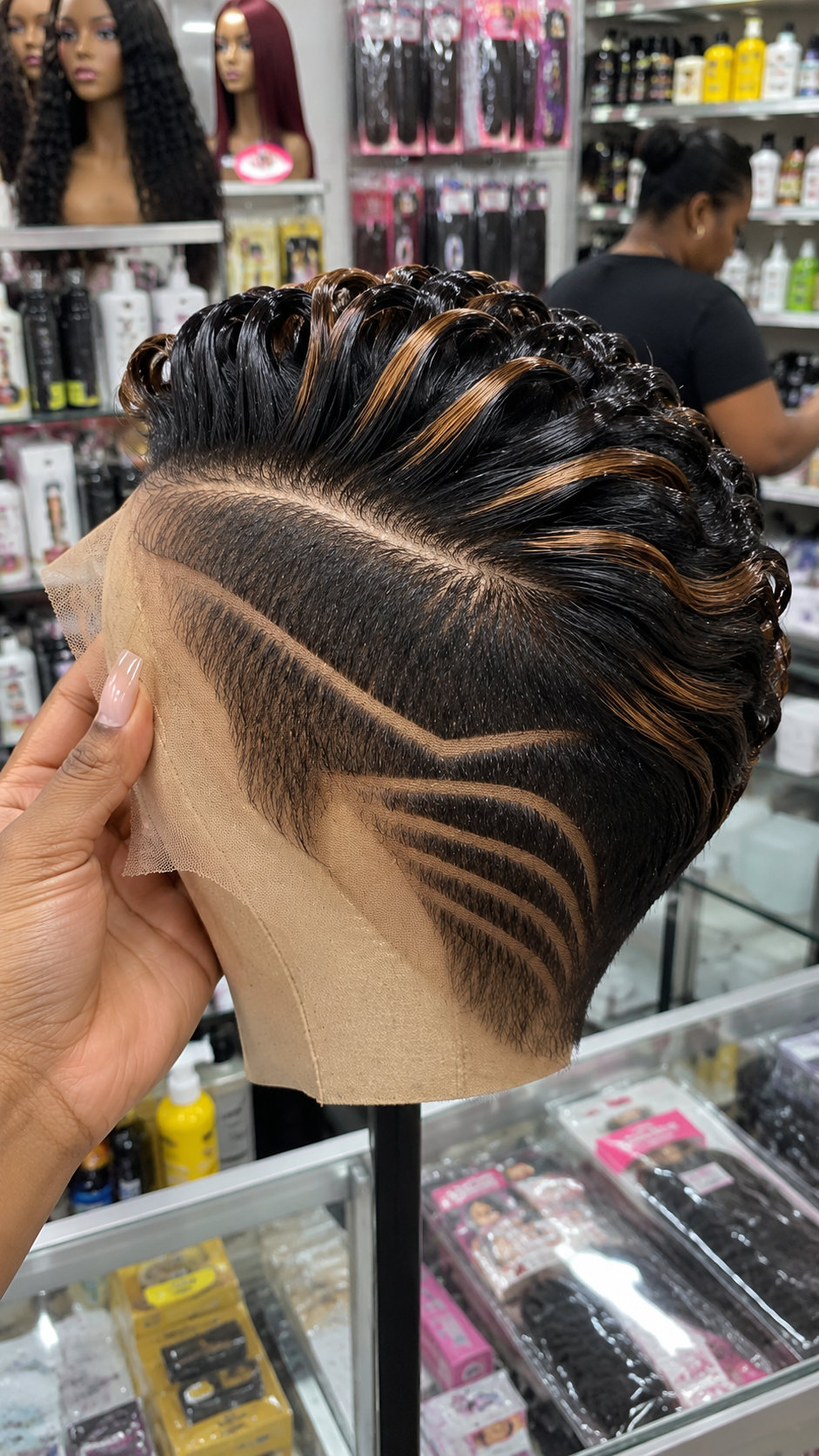
A beautifully sculpted pixie hairstyle can achieve a striking appearance without relying on excessive length or dramatic color changes. The wig pictured here demonstrates the appeal of carefully positioned caramel highlights, glossy black ribbon curls, and intricate side geometry. Its upper hair rises into elongated, backward-bending loops, while the lower side contains a series of carefully arranged curved channels that create a distinctive layered pattern.
The hairstyle is photographed inside a busy beauty supply shop, where the wig is presented on a beige foam display form and held in one hand. This elevated side angle reveals the relationship between the highlighted upper curls, the prominent diagonal parting, and the closely arranged lower hair. Unlike a finished installation photograph, the image makes the styling divisions particularly easy to examine.
The color arrangement is restrained but noticeable. The foundation appears predominantly black, while narrow caramel and golden-brown strands travel through selected upper curls. Rather than appearing as broad blonde patches, the lighter sections follow the direction of the hair, emphasizing the backward movement of the raised loops.


Along the visible side, several curved separations create a layered design. The uppermost channel runs beneath the lifted crown, while additional narrower channels descend through the lower hair and bend toward the rear. Dark strands remain visible between these divisions, maintaining a compact side profile.
For women considering a black pixie wig with caramel highlights, this hairstyle offers a useful example of why color placement, curl direction, and decorative side work should be evaluated together. A wig may contain the correct colors but still look entirely different if its upper loops are smaller, its side channels are rearranged, or its crown is made excessively full.
Caramel Highlights Follow the Movement of the Hair
The most distinctive characteristic of the upper hairstyle is the placement of the caramel-colored strands. The lighter sections are not scattered uniformly across the wig. They appear as narrow ribbons running through selected black curls.
Near the front, several caramel streaks rise from the darker foundation before bending backward. Their direction follows the surrounding black hair, creating elongated arcs across the upper hairstyle.
Some streaks appear warm golden brown, while others resemble deeper caramel or light chestnut. The difference may result from color variation, indoor lighting, or the angle at which individual strands reflect light.
The upper curls remain predominantly black. This darker foundation is essential because it allows the lighter ribbons to stand out without making the entire hairstyle appear blonde.
Toward the rearward section, the caramel strands become less uniformly visible as they curve into overlapping loops. Several remain noticeable along the outer surfaces, while other areas appear almost entirely dark.
This creates a natural visual progression from the highlighted front sections toward the denser curls farther back.
Why Narrow Highlight Placement Matters
The reference uses relatively narrow lighter sections compared with the surrounding black hair.
If a wig maker replaces these accents with broad blonde panels, the hairstyle may appear significantly lighter. If the caramel strands are reduced too much, their effect may become difficult to recognize.
The most accurate reproduction would preserve the contrast between a predominantly black foundation and selective warm-brown ribbons.
When ordering, explain that the highlights should follow the existing curl direction rather than appearing as random patches.
Ask the supplier to provide photographs of the actual color placement from the front, side, and above. These different views can reveal whether the lighter strands remain concentrated in the intended areas.
The Crown Uses Elongated Ribbon Loops
The upper hair is arranged into broad, elevated sections that curve backward before folding into rounded loops.
These curls differ from ordinary small ringlets. Their shapes are elongated, with groups of strands traveling together through a relatively wide arc.
Several loops rise noticeably above the front-side foundation, creating height without making the overall hairstyle excessively tall.
Farther toward the visible rear, the curls become more tightly grouped. Their overlapping arrangement creates a rounded silhouette that remains compact.
The upper surface contains a mixture of larger and smaller loop formations. Some have visible openings near their upper edges, while others are partially concealed by neighboring curls.
The hair direction is particularly important. The sections rise from the front and sweep toward the back rather than falling forward as a fringe.
This creates a lifted appearance that complements the closely arranged lower side.
Why Ordinary Loose Curls Would Change the Design
A generic curly pixie wig may contain numerous independent spirals distributed across the crown.
The reference instead relies on groups of strands traveling together through broad backward curves.
Replacing these elongated formations with loose ringlets could produce more visible individual curls but weaken the hairstyle’s distinctive directional appearance.
Likewise, increasing crown height excessively would change the relationship between the lifted upper sections and the lower side panels.
For custom production, ask the maker to preserve the broad ribbon-loop structure and compact overall proportions.
The photograph does not establish how the curls were formed, so the supplier should explain which styling method is appropriate for the proposed hair material.
The Main Diagonal Parting Establishes the Side Structure
A pale diagonal separation travels across the upper side beneath the raised curls.
This channel forms a visible boundary between two areas with different hair directions.
Above it, the hair rises into elongated black-and-caramel loops. Below it, the strands remain darker and lie considerably closer to the wig base.
The exposed separation begins near the forward section and continues toward the rearward side, gradually changing direction with the contour of the hairstyle.
Its width is not perfectly uniform. Some portions appear more prominent where the surrounding strands have been directed away from the channel.
The parting helps create the hairstyle’s layered appearance without requiring the lower section to be completely shaved.
The photograph does not establish whether the separation was created through cutting, deliberate parting, or another styling method. It is more accurate to describe the visible arrangement than to assume a specific technique.
Nested Side Curves Add an Intricate Lower Pattern
Beneath the main diagonal separation, the visible side contains additional narrow channels that form a descending, layered pattern.
The upper lower-side channel bends toward the rear, creating a broad angular curve. Beneath it, smaller separations follow related paths through the darker hair.
These divisions are not identical straight stripes. They change direction and become more closely grouped as they approach the lower rearward portion.
The result resembles nested curves, with several dark hair panels arranged between the exposed channels.
One particularly noticeable section forms an angular transition before bending downward. The lower divisions become narrower as they travel toward their visible endings.
The side design is intricate but does not depend on a completely bare fade.
Visible dark strands remain throughout the surrounding panels, helping the pale channels stand out.
For an accurate reproduction, the number, direction, and approximate spacing of the visible separations should be preserved.
Why Adding Extra Lines Would Be a Mistake
Decorative side patterns can vary considerably between sculpted pixie wigs.
Some use one broad curve, others contain multiple parallel stripes, and some rely on intersecting geometric designs.
This reference has a distinctive arrangement of descending, closely related curves rather than a random collection of shaved-looking lines.
Adding several new stripes would create a busier design and reduce the resemblance to the original.
When commissioning a custom wig, provide a close photograph of the temple and ask the maker to reproduce only the visible channels.
The stylist should also consider the underlying construction before removing or separating hair, particularly where the channels become narrow.
The Lower Hair Panels Maintain a Compact Appearance
The dark hair between the curved channels appears closely arranged against the wig base.
Its strands follow the direction of the surrounding separations, creating a coordinated layered effect.
The broad panel immediately beneath the main parting contains more visible hair coverage than some of the narrower lower sections.
Near the bottom, the hair becomes finer and tapers toward the edge of the display form.
This gradual reduction contributes to the compact side profile.
The photograph does not demonstrate a bare skin fade. The visible lower sections retain dark strands, even where the exposed channels are particularly prominent.
For buyers who want a sculpted pixie with decorative side geometry, this distinction is important. A product with extensively exposed cap material may look considerably different.
The lower panels should remain dark enough to contrast with the caramel-highlighted crown.
Color and Side Geometry Should Be Evaluated Together
The contrast between the highlighted upper hair and the nearly black lower side is central to the hairstyle.
The caramel accents direct attention toward the elevated curls, while the dark panels allow the decorative channels to remain visible.
If the lighter color continued uniformly through the lower side, the exposed separations might create a different visual effect.
Likewise, a completely black crown would emphasize shape but remove the warm color movement visible in the reference.
For this reason, selecting the correct color is not simply a matter of choosing a shade number.
The placement of lighter and darker strands should be discussed alongside the curl structure and side design.
Buyers should request photographs under neutral daylight before confirming a custom color, since salon lighting may affect the apparent warmth of the caramel accents.
The Front Hairline Is Relatively Restrained
Near the front, fine black strands are directed backward toward the upper curls.
The hairline does not contain the elaborate circular baby-hair decorations seen on some other sculpted pixie wigs.
Instead, the front relies on closely positioned strands that transition into the elevated ribbon sections.
This restrained arrangement allows the upper highlights and layered side channels to remain the strongest visual elements.
The photographed wig is displayed on a foam form, so its final appearance against a wearer’s forehead cannot be established.
Cap positioning, lace preparation, and any additional hairline customization may influence how the front strands sit during installation.
A stylist should avoid adding unrelated decorative swirls if the buyer wants to maintain the appearance of the reference.
The Beige Display Form Does Not Reveal the Complete Cap
The wig is supported by a beige foam display form that is partially exposed around the lower sections.
Its shape helps present the hairstyle from an elevated side angle, but the form should not be confused with the actual wig cap.
A section of beige-toned lace extends beyond the front-side hairline.
Along the lower edge, part of a dark attachment or perimeter component is also visible.
However, the photograph does not establish the entire cap construction or complete attachment system.
The number of combs, the presence of adjustable straps, and the full rear structure remain uncertain.
Buyers should request a separate underside photograph rather than interpreting the foam form as evidence of the wig’s internal technology.
Understanding the Untrimmed Lace Before Installation
The visible lace appears beige-toned and extends beyond the styled front edge.
This extra mesh may provide material for fitting and customization, but the photograph does not establish the exact lace coverage.
It also does not confirm a commercial classification such as HD lace or Swiss lace.
Those specifications require reliable seller information.
When comparing products, ask whether the selected wig uses a lace front, a closure, or a broader frontal construction.
These options may provide different amounts of hairline customization.
A closure generally has a more limited lace area, while a frontal may extend across a wider section of the front hairline. Actual dimensions vary by manufacturer.
If adhesive-free installation is preferred, confirm whether the unit has been designed for that method rather than assuming that visible lace or an attachment component guarantees glueless wear.
The final construction choice should accommodate the intended hairstyle and the wearer’s measurements.
Finding a Wig Maker With Directional Curl Experience
This hairstyle requires experience with more than ordinary curly wig styling.
The maker must understand how to arrange broad backward-bending hair sections while preserving narrow caramel accents and detailed side geometry.
Specialized wig boutiques, custom lace wig makers, and salons experienced in sculpted pixie hairstyles are suitable places to begin searching.
Useful search descriptions include black caramel ribbon curl pixie wig, highlighted sculpted lace wig, layered temple parting pixie, and backward loop curl hairpiece.
Review the supplier’s previous work carefully.
A portfolio containing only loose spiral wigs may not demonstrate the skills required for this particular design.
Look for completed hairstyles showing controlled upper hair direction and decorative side sections with consistent spacing.
For online purchases, request actual photographs of the unit being sold rather than relying entirely on catalog images.
How To Order a Comparable Wig
The strongest order instructions should begin with the exact relationship between the upper curls and lower side.
Send the reference photograph and explain that the upper hair should contain elongated black ribbon loops with selective caramel accents.
Specify that the lighter strands must follow the direction of the raised curls rather than appear randomly throughout the hairstyle.
Next, identify the prominent upper diagonal parting and the descending nested channels beneath it.
Ask the maker to preserve visible dark hair coverage between the separations.
Confirm the intended crown height, keeping the overall silhouette compact.
Finally, request written information about the fiber material, lace construction, cap dimensions, and installation options.
If the wig is custom-made, ask whether a progress photograph can be provided before the final styling is completed.
This can help identify major differences while corrections are still feasible.
Choosing Between Ready-Made and Custom Styling
A ready-made highlighted pixie wig may offer convenience, particularly when a suitable color and cap size are already available.
However, standard products may not reproduce the exact side geometry shown in the reference.
Some ready-made units contain ordinary blonde highlights but lack the broad backward-directed loops. Others may reproduce the curled crown while using simple straight lines or a different temple arrangement.
A custom unit offers greater control over the placement of the caramel streaks, the direction of the upper curls, and the spacing of the lower channels.
Custom production may also allow the buyer to specify cap measurements and other fitting preferences.
The disadvantages may include higher cost, additional production time, and more detailed communication.
The best choice depends on whether an available ready-made unit already matches the essential styling characteristics.
Illustrative Pricing for a Caramel-Highlighted Sculpted Pixie Wig
Producing a comparable wig may involve several separate cost considerations. The selective caramel coloring, directional ribbon curls, detailed side channels, and cap construction can each influence the final quotation.
The photograph does not establish the manufacturer, fiber composition, or actual selling price.
The following US dollar figures are illustrative planning estimates rather than verified current retail prices.
| Wig Category | Illustrative USD Range | Potential Purchase Scope |
|---|---|---|
| Premium Custom | $355–$845+ | Individual cap measurements, selective caramel coloring, hand-arranged ribbon curls, and precision layered temple styling. |
| Standard Custom | $190–$455 | Selected adjustments to highlighted curl placement, side-channel geometry, cap sizing, and upper silhouette. |
| Basic Human Hair | $115–$300 | A human-hair base unit that may require separate highlighting, professional curl setting, and additional side customization. |
| Premium Synthetic | $80–$225 | A higher-grade synthetic option with potentially prearranged ribbon curls and blended caramel accents. |
| Basic Synthetic | $35–$120 | A budget alternative where exact color placement, curl structure, and side-channel accuracy may be limited. |
These categories describe possible purchasing approaches and do not identify the material of the pictured wig.
Shipping, professional installation, lace preparation, cap alterations, color customization, and future restyling may be charged separately.
Ask for an itemized quotation that specifies whether the price includes the layered temple pattern and the required highlighted upper styling.
Planning a Salon Appointment Around the Side Design
Once the wig arrives, examine the highlighted curls and side channels before making any alterations.
The first fitting should establish whether the cap sits comfortably and whether the diagonal parting aligns with the intended position near the temple.
The stylist should also evaluate the relationship between the upper loops and the lower side panels.
If the wig sits too far forward, the exposed channels may appear in an unintended position. If it sits too far backward, the lifted upper curls may lose their intended relationship with the forehead.
Only after confirming the fit should excess lace be trimmed where necessary.
Any additional cutting near the side pattern requires particular care because the supporting wig material may lie directly beneath the hair.
When booking, ask whether the stylist has experience installing sculpted pixie wigs with detailed side partings and directional curls.
Preserving the Caramel Ribbons During Maintenance
The upper hairstyle depends on groups of strands retaining their backward-directed curl shapes.
Brushing aggressively through the ribbons could separate the grouped hair and reduce the visibility of the caramel accents.
Before washing, ask the supplier how the curls were formed and whether they are intended to retain their arrangement afterward.
If the wig contains synthetic fibers, heat styling should only be performed within manufacturer-confirmed temperature limits.
If human hair is used, professional resetting may be possible, but the method should account for previous color processing and the condition of the strands.
Color-treated human hair may experience tonal changes after repeated washing, excessive heat, or prolonged sunlight exposure.
Synthetic fibers have different care requirements, and conventional hair dye should not be assumed compatible.
The aim should be to preserve the relationship between the black foundation and the selective caramel ribbons rather than repeatedly changing the hairstyle.
Keeping the Layered Temple Channels Visible
The lower decorative pattern requires a different kind of attention from the upper curls.
Its appearance depends on dark strands remaining directed away from the exposed channels.
Repeated brushing across the separations may move hair into those spaces and reduce their visibility.
Aggressive cutting to restore the pattern can be risky because the cap may be directly beneath the strands.
Ask the maker whether localized restyling is possible and which products are appropriate for the confirmed fiber material.
When storing the wig, avoid compressing the upper loops or distorting the side panels.
The maintenance schedule should depend on the frequency of wear, the stability of the original styling, and the material rather than an arbitrary fixed interval.
Additional Views That Can Prevent Ordering Mistakes
The reference provides a strong view of the highlighted crown and one side, but several useful details remain unseen.
A direct front photograph would show how the raised curls frame the forehead.
An opposite-side photograph would reveal whether the nested channels are repeated or whether the other side has a different arrangement.
A rear photograph would establish how the caramel ribbons continue toward the nape.
A complete underside image would help identify the cap construction, attachment components, and actual lace coverage.
A short video under neutral lighting could clarify the relationship between the black strands and caramel accents.
These views are particularly valuable when buying remotely because the visible styling is too specific to judge from a generic product description alone.
The Benefits and Trade-Offs of This Sculpted Pixie
The main advantage of this hairstyle is its ability to create detailed visual movement within a compact silhouette.
The caramel highlights emphasize the upper curl direction, while the dark lower side provides contrast through its carefully arranged channels.
Its relatively limited length may appeal to women who prefer compact hairstyles over longer wigs.
Another advantage is the ability to commission variations in color intensity and cap fit, provided the supplier offers suitable customization.
However, the design also has practical trade-offs.
The broad upper curls may require careful maintenance to preserve their shape. The narrow decorative channels may be difficult to restore if the surrounding strands move out of position.
Exact custom reproduction may also cost more than a conventional curly pixie because the color placement and side geometry require additional attention.
These considerations should be discussed before purchasing rather than discovered after installation.
The Appeal of a Black Pixie With Selective Caramel Movement
This hairstyle demonstrates how a small amount of strategically positioned color can change the appearance of a compact wig.
Caramel-brown strands follow broad backward-bending loops, creating visible movement across an otherwise dark crown. Beneath them, a diagonal separation and several descending side channels form a distinctive layered arrangement.
The dark side panels retain hair coverage, allowing the decorative geometry to remain visible without creating a completely shaved appearance.
The partially visible lace and display form provide useful information about the photographed presentation, but they do not establish the complete wig construction, fiber composition, or installation suitability.
For buyers seeking a comparable style, the most important purchasing considerations are the accuracy of the caramel placement, the direction of the ribbon curls, the proportions of the side channels, and the suitability of the cap.
A successful reproduction should preserve those characteristics without introducing unrelated decorative lines, excessive crown height, or a uniformly blonde upper section.
With precise instructions, an experienced wig maker, and professional fitting appropriate to the confirmed material, this sculpted pixie can offer a distinctive combination of warm highlights and carefully arranged dark side styling.
Search Terms
Black caramel streaked pixie wig · Layered angular temple parting hairpiece · Golden brown backward ribbon curls · Espresso black highlighted crown wig · Nested curved side channels pixie · Beige lace caramel accent hairstyle · Honey brown loop curls dark side · Sculpted black pixie with caramel ribbons