
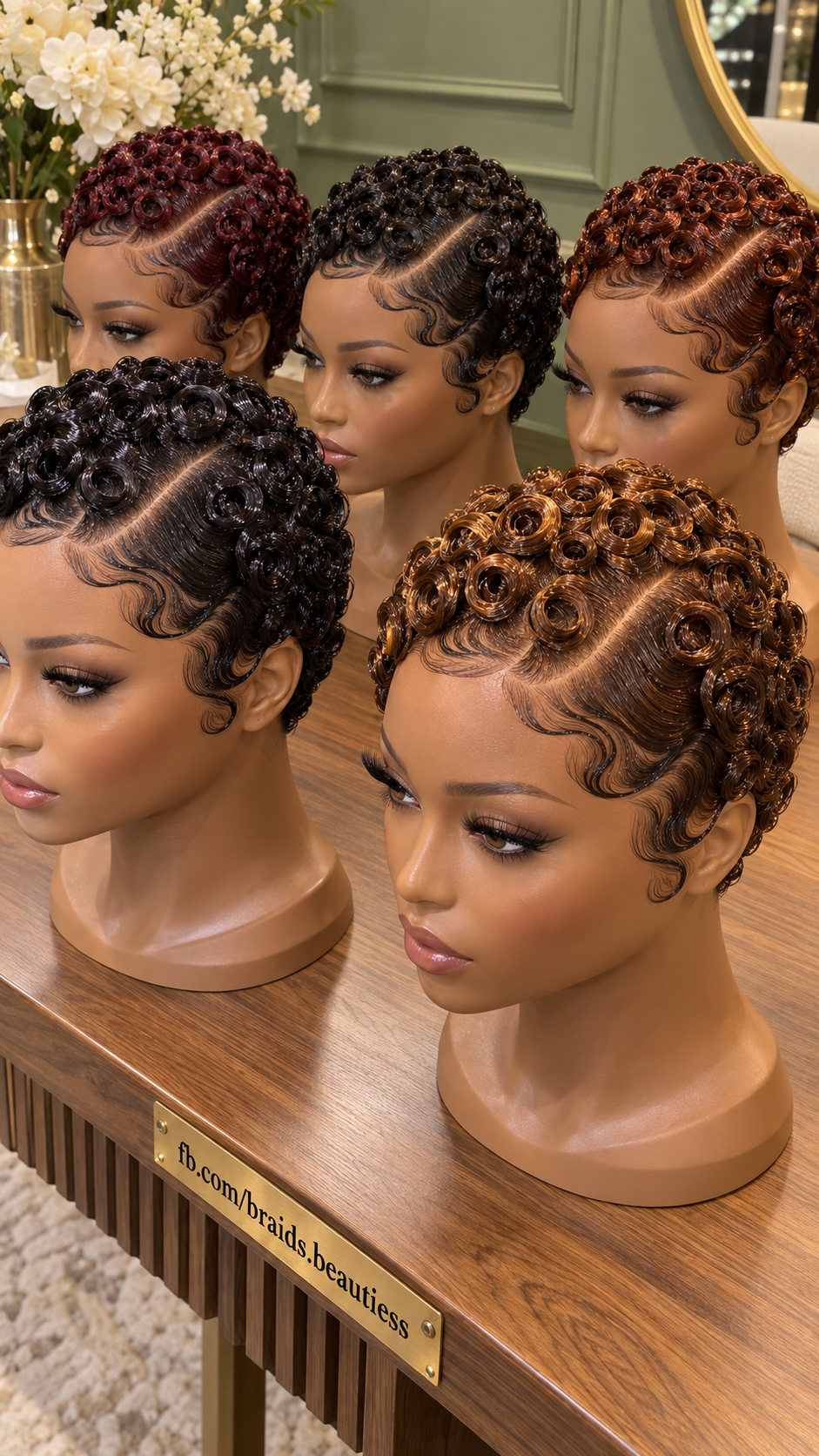
This five-wig collection focuses on a very specific pixie construction: densely arranged circular ringlets across the crown, a long diagonal side part and dramatic sculpted S-wave sections around the forehead and temples. The same overall structure appears in jet black, deep burgundy, copper auburn and warm golden-brown variations, making the display especially useful for comparing how different shades interact with an identical curl concept.
What makes these wigs visually distinctive is the separation between the raised ringlet crown and the flatter perimeter styling. The upper curls create height and dimension, while the side section is pressed into long flowing waves that follow the contour of the head. The result is compact in length but highly detailed.
Polished Ringlets Build the Upper Silhouette
The crown consists of dozens of small circular curls positioned closely together. Each ringlet has a clearly visible opening and a highly reflective outer surface. Rather than falling downward like conventional curls, these sections sit against the head in rounded formations.
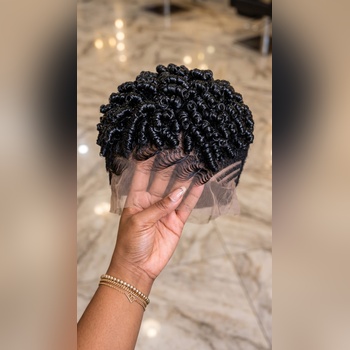
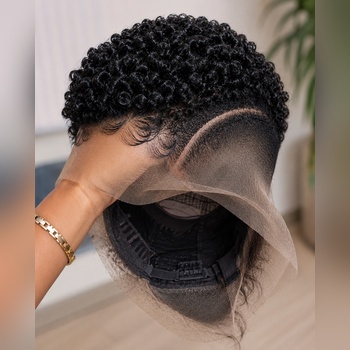
The arrangement produces a controlled dome shape. There is noticeable volume, but the curls do not extend far away from the head. This proportion is essential when asking a stylist to recreate the look because oversized curls could quickly change the compact pixie silhouette.
A useful description for a custom order is small, densely packed circular ringlets with individually visible glossy strands and a close rounded crown.
The Diagonal Part Is More Than a Simple Side Division
A prominent diagonal part travels from the frontal area toward the crown. It provides a clean visual boundary between the ringlet-heavy upper section and the flatter sculpted hair below.
The part is relatively narrow and precise. Hair on either side follows clearly different directions, which makes the division look intentional rather than accidental.
If commissioning this design, send a photograph showing the entire parting line. Asking only for a “side part” leaves too much room for interpretation because its angle and length strongly influence the final appearance.
Large S-Waves Sweep Across the Temple
The side styling is particularly elaborate. Fine strands emerge beneath the part and travel in broad alternating curves, forming a sequence of S-shaped movements toward the temple.
These waves are much larger than ordinary baby-hair curls. Several parallel strand groups follow the same direction, producing a feathered pattern with clearly visible spacing between individual hairs.
Near the ear, the styling becomes tighter and finishes with smaller curled sections. This gradual reduction helps connect the expansive temple waves with the compact hair around the perimeter.
Jet Black Highlights Every Sculpted Strand
The jet-black versions place the greatest emphasis on contrast. The polished ringlets reflect strong highlights while their inner openings remain dark, giving the crown substantial depth.
Along the temple, the black strands stand clearly against the scalp-toned foundation. This makes the repeated S-wave pattern particularly easy to see.
For buyers who want the curl architecture and perimeter styling to remain the main focus, a deep black shade provides a straightforward option without additional color transitions competing for attention.
Deep Burgundy Adds Wine-Red Dimension
The burgundy version keeps the same compact ringlet structure while introducing deep wine-red reflections. Darker portions remain visible between the curls, preventing the crown from becoming uniformly bright.
Under direct lighting, the raised ringlet surfaces reveal stronger red tones. Areas facing away from the light appear considerably deeper. This natural variation makes the circular curls look more dimensional.
When ordering, use the reference photograph because “burgundy” can describe anything from violet-red to brighter cherry tones. The example here is comparatively deep and dark.
Copper Auburn Creates a Rich Warm Alternative
The copper-auburn unit uses a warmer red-brown direction. Its reflective finish makes individual ringlets appear lighter along their outer curves while deeper reddish-brown tones remain underneath.
The warm shade also makes the long temple waves highly noticeable because light travels continuously across their curved surfaces.
For a custom color request, describe it as a rich copper-auburn or deep ginger-brown direction and include the photograph for tonal reference.
Golden Brown Brings Out the Circular Curl Pattern
The golden-brown wig is the brightest warm option in the group. Honey, caramel and amber-like reflections appear across the upper ringlets depending on the direction of the light.
Because lighter hair exposes more surface detail, the individual circular formations are especially easy to distinguish. The dark depth retained between the curls prevents the crown from appearing flat.
If ordering this variation, request a dimensional golden brown rather than an extremely pale blonde. Preserving some deeper areas helps maintain the visual separation between neighboring ringlets.
The Hairline Uses Fine Feathered Sections
The perimeter contains numerous thin, deliberately separated strands. These sections are arranged into long sweeps rather than being brushed straight backward into the crown.
This styling requires precision because the strands need to remain readable without becoming excessively rigid. A heavily coated surface can make them resemble solid painted shapes, while too little control can cause the pattern to lose definition.
When reviewing a stylist’s portfolio, look closely at their frontal and temple work. A stylist who can create fine, separated swoops will be better suited to reproducing this particular design.
The Compact Length Keeps Attention on Detail
These wigs achieve visual impact without relying on long hair. Nearly all of the interest comes from curl placement, parting direction, shine and sculpted perimeter work.
The close silhouette also means proportion is important. Excessive crown height or bulky sides could alter the character of the style considerably.
When requesting a custom unit, specify that the ringlets should remain close and rounded rather than building into a tall curly top.
How to Have a Similar Wig Made Professionally
Look for a wig stylist experienced in pixie units, precision curl setting and sculpted perimeter work. Send the reference before booking and ask whether the stylist can reproduce both the circular crown and the broad temple waves.
Explain the hairstyle in separate zones: a dense ringlet crown, a narrow diagonal part, long S-wave temple sections and compact curled finishing around the ear.
If you already own a wig, ask whether its current length and density are suitable before taking it to the salon. Not every base unit contains the correct distribution of hair for this construction.
Finding a Comparable Wig Online
Search specialist wig boutiques, independent custom wig makers and sellers offering made-to-order pixie units. Generic curly-wig searches will usually return styles that are too broad.
Use descriptive terms involving the actual visible elements, such as circular ringlet crown, diagonal side part and sculpted temple waves. Once you find a seller producing comparable work, send the reference photograph directly.
Ask whether the listing represents the exact wig being sold or merely a sample of a style that will be recreated. With detailed hand-set curls, individual made-to-order units may naturally show minor differences.
A Practical Custom-Order Checklist
First choose the exact color direction you want. Next, provide the stylist with clear reference photographs and your required cap measurements. Confirm the hair material, cap construction, approximate density and whether the curls will arrive completely set.
Specify the direction of the diagonal part and show which side should contain the sweeping temple design. Do not assume the stylist will automatically orient the design exactly like the reference.
Before production begins, ask whether lace or perimeter customization, fitting and final styling are included in the quoted amount. If possible, request photographs of the completed unit before shipment.
Booking a Salon for Final Customization
If an online seller provides the base wig but not the detailed finishing, book a local wig stylist for the final customization. Send the salon photographs before scheduling so they can estimate the work involved.
Useful services may include pixie reshaping, ringlet setting, perimeter sculpting, part refinement and lace finishing where applicable.
Ask whether the salon prefers the wig to arrive untouched. Cutting or restyling it yourself before the appointment can reduce the stylist’s options.
Estimated Cost for Comparable Custom Work
| Category | Estimated Range | Typical Configuration |
|---|---|---|
| Premium Custom | $450–$900+ | Higher-grade human hair, extensive hand-set ringlets, color work and detailed perimeter sculpting |
| Standard Custom | $250–$500 | Human-hair pixie with custom curl setting, diagonal parting and temple shaping |
| Basic Human Hair | $140–$300 | Human-hair foundation with simpler finishing or additional salon work required |
| Premium Synthetic | $80–$180 | Higher-grade fiber with compact pre-set curls and stronger shape retention |
| Basic Synthetic | $40–$95 | Lower-cost fiber with simpler ringlet and perimeter detailing |
These figures are general estimates rather than prices for the wigs pictured. Hair material, coloring, cap construction, stylist experience, location and the amount of hand styling can all affect the final quotation.
Maintaining the Ringlets Without Opening Them
Do not routinely brush through the circular curls. Their visual identity depends on each section remaining wound into a compact ring.
When removing the wig, handle it primarily from the cap and avoid crushing the crown. Store it on a suitable wig stand with enough space around the top and sides.
If one or two ringlets loosen, targeted resetting is preferable to disturbing the entire crown. Follow care instructions appropriate to the actual hair material.
Keeping the S-Wave Sections Intact
The flatter temple design needs protection from friction. Repeatedly touching the side, placing the wig against other objects or storing it tightly can separate the fine strand groups.
Avoid applying excessive product during maintenance. The goal is to preserve the individually visible strands and sweeping movement rather than turning the waves into solid sections.
If the wig is synthetic, confirm its heat tolerance before using heated tools. For complex perimeter repairs, professional resetting may preserve the original design more effectively.
Color Changes the Mood Without Changing the Construction
This collection demonstrates how strongly color can influence a compact hairstyle. Jet black emphasizes contrast and precision. Burgundy produces deep wine-colored reflections. Copper auburn adds brighter warmth, while golden brown makes the circular crown especially luminous.
The important point for a custom order is that the underlying construction remains consistent: small polished ringlets above, a pronounced diagonal division and sweeping feathered waves below.
Choose the shade first, then use close photographs to communicate the curl diameter, crown density and exact side-wave arrangement. That gives a wig stylist a much clearer blueprint than relying on a color name and the phrase “curly pixie” alone.
Search Terms
Glossy Circular Ringlet Crown · Deep Diagonal Side Part · Sculpted S-Wave Temples · Jet Black Polished Ringlets · Deep Burgundy Ringlet Pixie · Copper Auburn Circular Curls · Golden Brown Ringlet Crown · Feathered Temple Strand Pattern