
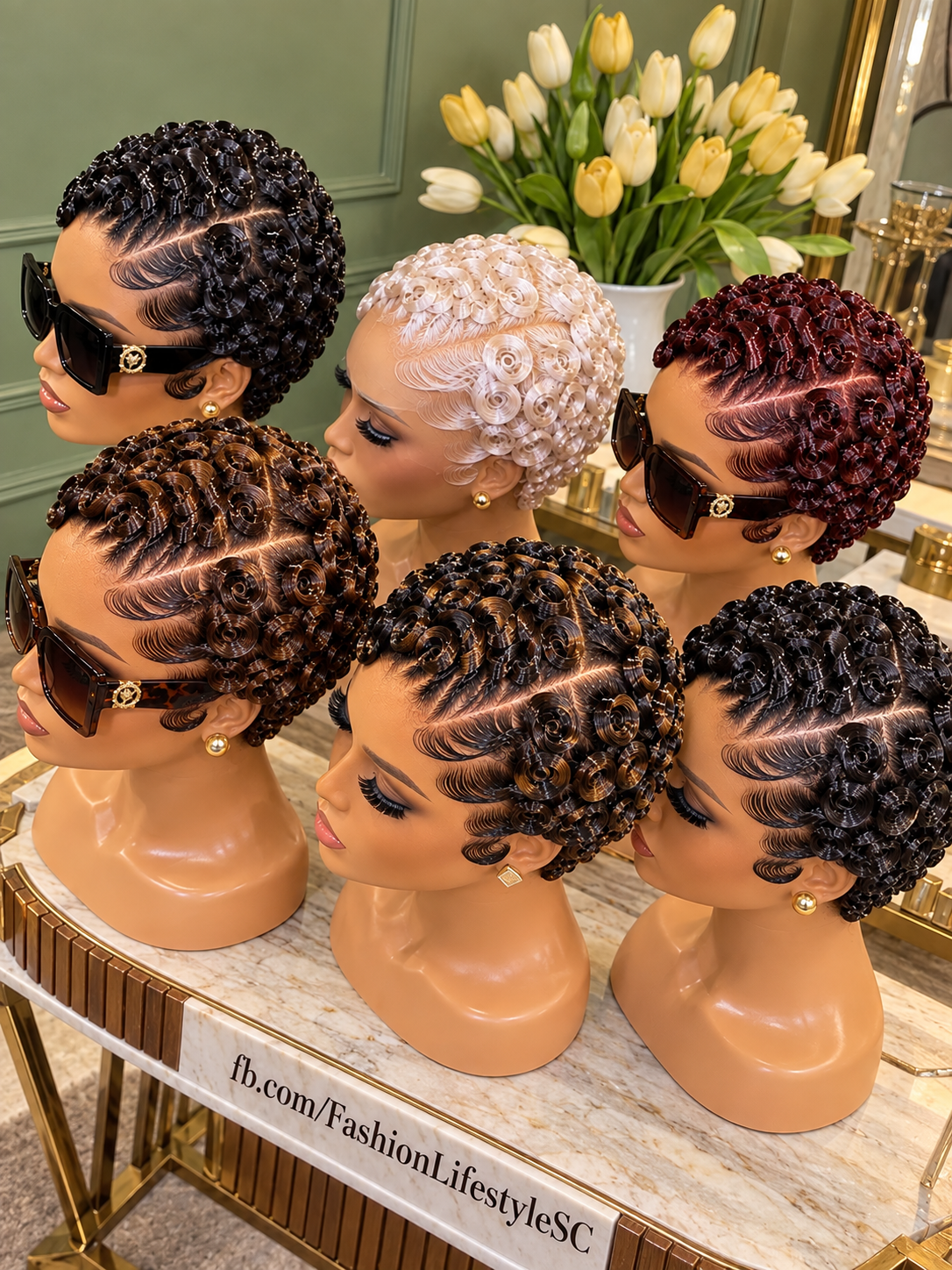
This six-piece collection centers on small glossy ringlets, sweeping feather-like waves and carefully exposed curved parting. Although every unit follows the same compact pixie concept, the color selection gives each wig a noticeably different character. The visible palette includes glossy black, deep burgundy, pale champagne blonde and several warm brown variations ranging from chocolate to caramel-bronze.
The styling is especially interesting because the crown and side sections are treated differently. Tight circular curls dominate the upper area, while the hair beside the part is pressed into longer curved strokes. That combination creates dimension without requiring extra length or an oversized silhouette.
A Crown Built From Hundreds of Polished Curves
The first detail that attracts attention is the concentration of circular curls across the crown. Rather than forming loose spirals that fall downward, these curls remain close to the head. Each one resembles a compact ring with a clearly visible center.
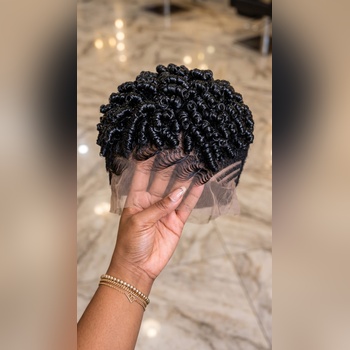
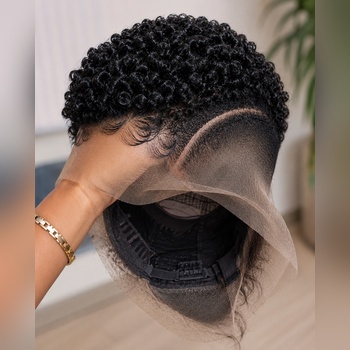
The placement is dense, yet individual curls remain distinguishable because their directions and reflections vary. Some face upward, others tilt slightly toward the side, and the smaller curls fill spaces between the larger rings. This produces a full crown without making it appear like one continuous mass of hair.
For a custom recreation, ask for closely arranged circular ringlets with individually visible loops. A standard roller set may create larger, softer curls and will not necessarily produce the same compact appearance.
Curved Parting Gives the Style Its Direction
A clearly visible part runs diagonally through each hairstyle. Its gentle curve separates the dense ringlet area from the flatter wave work around the side of the head.
This exposed section is particularly noticeable on the darker wigs because the scalp-toned line contrasts strongly against black, burgundy and deep brown hair. On the champagne-blonde unit, the contrast is softer, allowing the part to blend more subtly into the surrounding color.
The location of this part should be discussed before a custom wig is styled. Moving it farther forward, backward or toward the opposite side changes the direction of the waves and can substantially alter the finished appearance.
Feathered Waves Sweep Across the Temple
The most intricate work appears directly beneath the part. Here, the hair changes from circular curls into elongated waves formed from numerous fine parallel strands. Each wave begins relatively narrow before widening into a curved feather-like section.
Several waves are stacked beneath one another, creating a layered pattern that travels toward the temple. Their ends curve back into the surrounding hair rather than hanging freely.
This is an important distinction when requesting the hairstyle. A stylist should understand that the side is not simply brushed flat. It requires precise finger-wave shaping and controlled strand placement to reproduce the visible pattern.
Glossy Black Creates Dramatic Depth
The black variations produce some of the strongest visual contrast in the collection. Their ringlets appear almost mirror-like where light reaches the curved surfaces, while the centers of the curls remain considerably darker.
This alternating highlight and shadow makes the crown appear deeper and more dimensional. Black also emphasizes the fine lines within the sweeping side waves, making their construction particularly easy to see.
For buyers who want this appearance, request a rich black with a polished finish rather than a dull or heavily matte fiber.
Deep Burgundy Adds Wine And Cherry Reflections
The burgundy unit introduces a rich red direction while preserving the same curl architecture. Its darkest sections appear close to wine red, whereas direct reflections reveal brighter cherry tones.
The variation becomes particularly attractive across the ringlets because every curved surface catches light differently. Instead of appearing as one flat red color, the crown shifts between dark burgundy and brighter ruby-like reflections.
If ordering this color online, ask for photographs under neutral lighting. Burgundy shades can vary considerably, and some sellers may provide a much brighter red or a more purple interpretation.
Champagne Blonde Creates the Brightest Interpretation
The pale blonde version immediately stands apart from the darker units. Its light creamy tone makes virtually every curl visible, including smaller rings that can disappear into the shadows of black hair.
The shade appears warmer than icy platinum and considerably lighter than conventional honey blonde. Depending on lighting, it can move between pale champagne, creamy beige and very light warm blonde.
When discussing this shade with a colorist, photographs are more reliable than simply requesting blonde. A slight change in warmth can move the finished wig toward platinum, gold or beige.
Chocolate Brown Keeps the Look Rich and Deep
One of the warm brown units uses a deep chocolate direction that sits between jet black and the brighter caramel shades. The color remains dark through recessed portions of the curls while direct highlights reveal warmer brown reflections.
This makes the ringlets easy to distinguish without producing the dramatic brightness of blonde or copper. It is a useful option for someone seeking a naturally dark appearance with more warmth than black.
A colorist can deepen or brighten this type of brown according to the desired result while preserving the same crown construction.
Caramel Bronze Brings More Light Into the Ringlets
The brighter brown variations contain noticeable caramel and bronze reflections. Because these tones sit closer to the middle of the color spectrum, they reveal curl separation very effectively while still maintaining darker depth between the rings.
Warm lighting strengthens the golden character of these shades. In more neutral lighting, the underlying brown becomes more apparent. This changing appearance is one reason buyers should request several photographs before approving a custom color.
For a similar direction, terms such as caramel brown, bronze brown or warm golden brown can help begin the conversation with a wig colorist.
The Side Curls Complete the Transition
Another subtle detail is the group of circular curls positioned near the ends of the sweeping waves. These curls create a bridge between the flat wave work and the densely curled crown.
Without this transition, the hairstyle could appear divided into two unrelated sections. Instead, the smaller side rings gradually introduce the circular pattern before it becomes dominant toward the back and top.
This is worth showing clearly to a stylist because reproducing only the crown and front wave may leave the finished wig looking less cohesive than the reference.
Reflective Hair Makes the Precision Work Visible
All six wigs depend heavily on surface shine. The ideal result is mirror-like glossy hair, a silky reflective finish, luminous highlights and individually visible strands. The shine reveals the circular shape of each curl and the narrow strand lines inside the side waves.
At the same time, excessive oils or heavy finishing products can cause neighboring curls to stick together. The objective should be controlled reflection rather than a saturated or greasy appearance.
Product selection should also match the fiber. Human hair and synthetic fibers can react differently to sprays, heat and finishing products, so manufacturer guidance should always be considered before restyling.
Finding a Stylist for This Type of Curl Work
A conventional haircut appointment may not be enough for this design. Search for a wig stylist experienced in pixie units, finger waves, ringlet setting and detailed sculpting. Their portfolio should contain close photographs showing how they handle small curls and perimeter work.
Send the reference photograph before booking. Point out the circular crown curls, curved part and layered side waves separately so the stylist understands that all three elements are required.
Ask whether the stylist supplies the base wig or expects customers to provide one. If coloring is required, confirm whether that service is included or handled separately.
Choosing a Base Wig That Can Support the Design
Crown density is important because the hairstyle requires enough hair to create many separate ringlets. A sparse unit may look acceptable before styling but develop visible gaps once the hair is divided into smaller sections.
The sides also require sufficient workable length for the elongated waves. Starting with hair that is already cut extremely close can make those larger curves difficult to reproduce.
If purchasing a base independently, send its specifications to the stylist before ordering. They can advise whether the length, density and fiber are appropriate for the intended result.
Ordering a Similar Unit From a Wig Seller
When shopping online, use detailed descriptions instead of requesting only a curly pixie. Mention the small ringlet crown, diagonal curved part, feathered side waves and glossy finish. Providing the reference image can prevent misunderstandings.
Confirm the cap size, hair type, density and final shade. If the wig is being made specifically for you, ask whether the seller can send a photograph or video of the completed unit before dispatch.
For color orders, clarify whether the shade is solid or blended. Warm browns can contain caramel, bronze, copper or darker chocolate tones that may not be obvious from a basic product description.
Custom Wig Price Expectations
| Category | Typical Range | Commonly Included |
|---|---|---|
| Premium Custom | $450–$900+ | Higher-grade hair, personalized color work, detailed ringlet setting and precision wave shaping |
| Standard Custom | $250–$500 | Custom shade, crown curl formation, parting and professional finishing |
| Basic Human Hair | $130–$320 | Human-hair base suitable for additional professional cutting and curl work |
| Premium Synthetic | $80–$200 | Higher-quality synthetic fiber with pre-set curls and stronger shape retention |
| Basic Synthetic | $35–$100 | Entry-level pre-styled unit with fewer customization options |
Prices vary according to hair source, fiber quality, cap construction, coloring, location and the amount of manual styling involved. Detailed ringlet placement and individually shaped waves can increase labor compared with a simpler pixie unit.
Booking a Custom Styling Session
Contact the salon or wig stylist with the reference image before scheduling. State which color you want, whether you already own the base wig and whether the finished unit needs to be ready for a specific date.
Ask about the deposit, estimated completion period and fitting procedure. Some stylists prefer to perform most of the curl work on a mannequin head before the customer arrives, followed by smaller adjustments during the fitting.
If the unit is being shipped to a stylist, confirm the delivery address and turnaround time in advance. Detailed custom work should not be left until immediately before an event.
Keeping Small Ringlets Intact After Styling
The finished wig should be stored on a stand where the crown remains free from pressure. Avoid placing the unit inside a tight container immediately after wear because the raised curls can become flattened.
Do not comb through the crown. Each circular curl has been deliberately formed and positioned, so conventional brushing can quickly dismantle the arrangement.
If a few rings become loose, they can often be corrected individually. For significant reshaping, returning the wig to a professional is safer than applying uncontrolled heat at home.
Using Color Variety for a Coordinated Wig Display
This hairstyle lends itself particularly well to a multi-color product range. Black provides maximum depth, burgundy offers a rich red alternative, champagne blonde creates brightness, and the brown family allows several levels of warmth without changing the recognizable silhouette.
For sellers, displaying multiple shades together gives customers an immediate way to compare how color affects the same curl construction. Separate close-up images can then highlight the parting, ringlet size and side-wave pattern.
A consistent styling concept also makes it easier to expand the range later with additional shades such as copper ginger, honey caramel, mocha brown or smoky silver while retaining the identity of the collection.
Search Terms
Curved Side Part Ringlets · Feathered Temple Waves · Glossy Black Circular Curls · Deep Burgundy Ringlet Crown · Champagne Blonde Spiral Curls · Chocolate Brown Side Waves · Caramel Bronze Ringlets · Layered Finger Wave Sections