
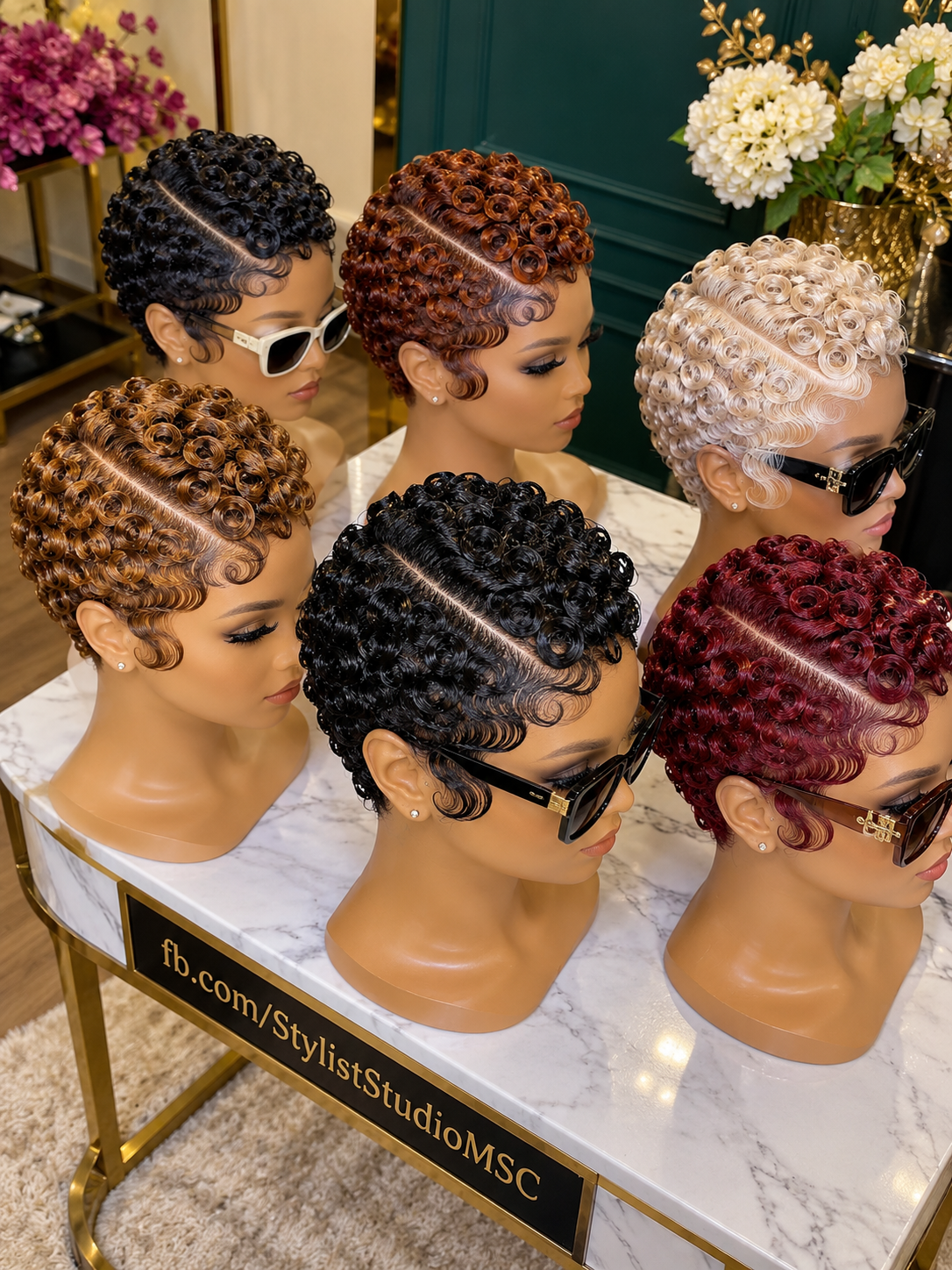
This six-piece wig display focuses on one highly recognizable idea: compact sculpted curls combined with deep side parting and polished finger-wave detailing. Although every mannequin follows the same general pixie family, the different colors and slight changes in curl placement give each unit its own appearance.
The collection includes glossy jet black, warm copper, golden caramel-brown, pale champagne blonde and deep burgundy shades. Several units also use darker roots or subtle tonal variation to create extra depth around the curls.
For shoppers looking for a similar wig, the most important details to communicate to a stylist are the small circular crown curls, diagonal side part, sculpted temple waves, close-fitting silhouette and high-shine finish.
The Curl Pattern Creates the Signature Look
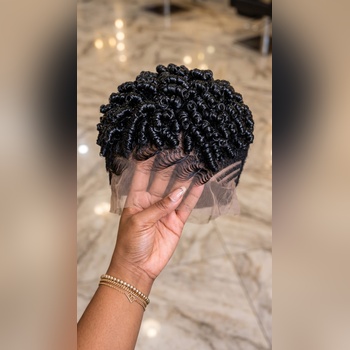
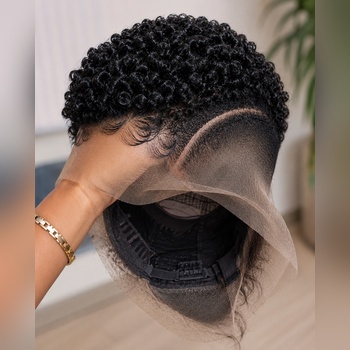
The most noticeable element across the collection is the large number of small circular curls covering the crown. These are tightly arranged rather than loose or fluffy, producing a controlled pixie silhouette that stays close to the head.
Each curl has a visible spiral or ring formation. Because the hair is arranged in individual sections, light reflects from different directions and gives the surface a dimensional appearance.
The curls become especially dense toward the upper crown and rear. Near the side part, they transition into flatter sections so that the separation remains clearly visible.
This distinction matters when commissioning the style. Asking only for a “curly pixie wig” may produce loose curls or a completely different silhouette. A better description would be compact glossy ring curls with sculpted finger waves around the side and hairline.
A Deep Diagonal Part Shapes the Front
Every unit uses a pronounced diagonal separation across the upper front and side. This parting provides structure and prevents the numerous curls from appearing visually crowded.
On the black center wig, the separation is especially prominent because the exposed scalp-toned area contrasts strongly against the dark hair. Similar contrast appears on the burgundy and copper versions.
The part travels diagonally rather than directly backward from the forehead. Hair on one side forms the dense curled crown, while the opposite side transitions into carefully arranged waves.
When ordering, show the stylist the desired direction of the part. Reversing it can substantially change how the finished wig frames the face.
Finger Waves Add Detail Around the Temple
The temple sections are considerably flatter than the crown. Fine strands are arranged into repeated curved ridges that follow the contour of the mannequin’s forehead and side.
These sculpted waves create a gradual transition from the exposed part into the compact curls. Larger curled sections appear around the ear and temple on several of the units.
This combination is one reason the hairstyle has more visual complexity than a standard curled pixie. The crown provides volume while the side remains controlled and close-fitting.
Jet Black Gives the Curls Maximum Contrast
Two prominently visible wigs use a very dark glossy black. The color makes every individual circular curl easy to distinguish because strong highlights appear against an almost-black base.
The front-center black wig is particularly useful for seeing the construction. Its crown is packed with compact rings, while the diagonal separation exposes a narrow scalp-toned line.
Along the temple, the hair changes into tightly sculpted waves before finishing in a larger curved section near the ear.
For this variation, search or request a jet-black sculpted curl pixie wig with deep side part and finger-wave sides.
Copper Creates a Warmer Version of the Style
The upper-center wig uses a rich copper shade with darker tonal depth between the curls. Under warm interior lighting, the raised sections appear brighter while the recessed portions become deeper reddish brown.
This color works particularly well with the circular curl pattern because every ring catches light around its outer edge.
A similar effect can be requested using descriptions such as deep copper, copper auburn or rich ginger-copper. However, these names are not standardized between wig suppliers, so reference photographs should accompany any custom color request.
Caramel Brown Adds Multi-Tonal Dimension
The lower-left unit uses a warm brown base with golden caramel highlights running through many of the curls. The result appears more dimensional than a completely uniform brown.
Darker areas remain between the rings, while the raised strands catch golden reflections. This produces a layered appearance without changing the fundamental curl structure.
If ordering something similar, request dark brown with warm caramel or golden-brown dimension rather than a flat light-brown shade.
Champagne Blonde Makes Every Wave Visible
The pale blonde wig at the upper right creates the strongest contrast between hair and mannequin. Its light color makes the individual strands around the temple especially easy to see.
The shade appears closer to champagne or creamy platinum blonde than a strong yellow-gold blonde under the lighting shown.
Because pale colors reveal the construction clearly, precision around the side part and temple becomes particularly important. Uneven curl placement can be more noticeable on a light unit.
A dark-rooted blonde would create a different effect, so buyers wanting this appearance should clarify whether they prefer consistent pale color or darker root shading.
Burgundy Gives the Collection Its Deepest Warm Color
The lower-right wig uses a saturated burgundy-red tone. Darker sections remain visible beneath the curls, giving the color greater depth.
Depending on lighting, burgundy wigs can shift visually between wine red, cherry and deep plum. Requesting photographs under neutral lighting is therefore useful before approving a custom color.
For online searches, phrases such as burgundy finger-wave pixie wig or wine-red sculpted curl pixie wig are more specific than simply searching for a red wig.
The Silhouette Stays Compact
Despite the large number of curls, these wigs do not create a tall or oversized crown. The rings sit relatively close together and follow the rounded contour of the head.
This gives the collection its characteristic compact pixie shape. The volume comes primarily from the curl structure rather than from substantial hair length.
That distinction should be mentioned when booking a stylist. A longer curly unit can quickly become much fuller and may not reproduce the close silhouette shown here.
Gloss Is Essential to the Finished Appearance
The entire collection has a pronounced reflective finish. The desired visual quality can be described as mirror-like glossy hair, silky reflective finish, healthy wet-look shine, individually visible strands and ultra-defined hair texture.
The shine is particularly noticeable on the black and burgundy wigs, where bright highlights trace the circular shape of each curl.
However, product choice should depend on the actual fiber. Excessive oil or heavy styling products can weigh down human hair, while some products may not be suitable for synthetic fibers.
Are These Human Hair or Synthetic Wigs?
The photograph alone does not reliably establish the fiber type. Both human hair and quality synthetic fibers can produce glossy, tightly sculpted pixie styles.
If purchasing a similar wig online, check the product specification rather than attempting to identify the material from photographs.
For human hair, ask about hair origin, processing and whether the unit can safely be recolored. For synthetic hair, ask whether the fiber is heat-resistant and obtain the manufacturer’s maximum temperature recommendation.
Where to Have a Similar Pixie Wig Made
Look for a custom wig stylist who regularly works with sculpted pixie units, finger waves and precision curl setting. This style requires more than simply cutting a longer wig into a shorter shape.
A stylist’s portfolio should ideally include close photographs of the crown and temple. These areas reveal whether the stylist can produce consistent circular curls and fine wave patterns.
Search locally using phrases such as custom pixie wig stylist near me, finger wave wig stylist, sculpted pixie wig salon or custom curly pixie wig maker.
When contacting a salon, send the reference image before booking and ask whether the styling can be completed on a wig rather than directly on natural hair.
How to Order a Similar Wig
Begin by choosing the color. Jet black offers the strongest contrast, copper provides a rich warm appearance, champagne blonde makes the wave pattern highly visible, caramel brown adds softer dimension, and burgundy creates a deeper red finish.
Next, specify the structural details: compact circular crown curls, pronounced diagonal side part, flat finger waves through the temple and larger curved pieces around the sideburn area.
Send front, side and top reference photographs whenever possible. A single frontal image may not adequately communicate the direction of the crown curls or the exact parting placement.
Before payment, confirm the cap size, fiber, density, base construction, final color and whether the wig arrives fully styled.
Buying a Similar Wig Online
When browsing online wig stores or marketplaces, search for the styling characteristics rather than relying exclusively on broad terms such as “pixie wig.”
Product photographs should be inspected carefully. Compare the curl diameter, part direction, temple waves and overall height of the crown.
Also determine whether the photographed wig represents the product exactly or is an example of additional styling performed after purchase. This can make a substantial difference when the design contains detailed sculpted curls.
For custom sellers, ask for recent photographs or video of completed units in the requested color before placing the order.
Booking an Installation Appointment
If the unit requires professional fitting, book with a stylist experienced in pixie wigs. Send the wig specifications and reference image in advance so the stylist knows whether additional shaping will be required.
Ask whether the appointment includes hairline preparation, fitting, final curl adjustment and finishing. Services vary significantly between salons.
If the wig already arrives heavily sculpted, tell the stylist that the crown structure should be preserved during installation. Excessive handling can disturb the circular curl arrangement.
How Much It Costs
The photograph does not show pricing, and the exact cost of these displayed wigs cannot be determined from the image. Prices for similar styles vary according to fiber, cap construction, customization and the amount of hand styling involved.
| Wig Category | Typical Estimated Price Range |
|---|---|
| Premium Custom | $300–$750+ |
| Standard Custom | $160–$400 |
| Basic Human Hair | $90–$260 |
| Premium Synthetic | $55–$150 |
| Basic Synthetic | $25–$85 |
These ranges are general estimates rather than prices for the wigs in the photograph. Custom coloring and detailed sculpting can increase the final quote.
Before paying a deposit, request an itemized quote showing whether coloring, styling, cap customization and final finishing are included.
Keeping the Circular Curls in Shape
The crown should be handled carefully between wears. Brushing through the curls can separate the rings and alter the original arrangement.
Instead, follow the maintenance method recommended by the wig maker for the specific fiber. If individual curls become displaced, they may need to be reset rather than simply combed back into position.
A wig stand can help protect the rounded silhouette during storage. Keep enough clearance around the crown so the curls are not compressed against other items.
Protecting the Finger-Wave Sections
The flatter temple waves require different handling from the crown. Frequent touching can disturb the fine curved ridges and make them lose their sculpted appearance.
Avoid applying random styling products without first confirming compatibility with the wig material. Human hair and synthetic units may require very different maintenance routines.
If the wig needs washing, ask the maker how the sculpted sections should be restored afterward. Some units may require professional restyling to reproduce the original pattern accurately.
Choosing Between the Different Colors
Color changes the way the same curl structure is perceived. Jet black emphasizes gloss and contrast. Caramel brown highlights the dimensional pattern between individual curls. Copper brings warmth, while burgundy creates a richer red appearance.
The champagne blonde version exposes the smallest strand details because of its lighter tone. Buyers wanting maximum visible contrast in the sculpted waves may therefore prefer lighter shades, while darker colors create stronger reflective highlights.
The key is preserving the same underlying construction regardless of color: tight circular crown curls, a strong diagonal part and carefully laid temple waves.
Search Terms
Glossy Finger Wave Pixie Wig · Circular Curl Pixie Wig · Jet Black Sculpted Pixie Wig · Copper Finger Wave Pixie Wig · Champagne Blonde Curly Pixie Wig · Burgundy Sculpted Curl Wig · Caramel Brown Finger Wave Wig · Deep Side Part Curly Pixie Wig