
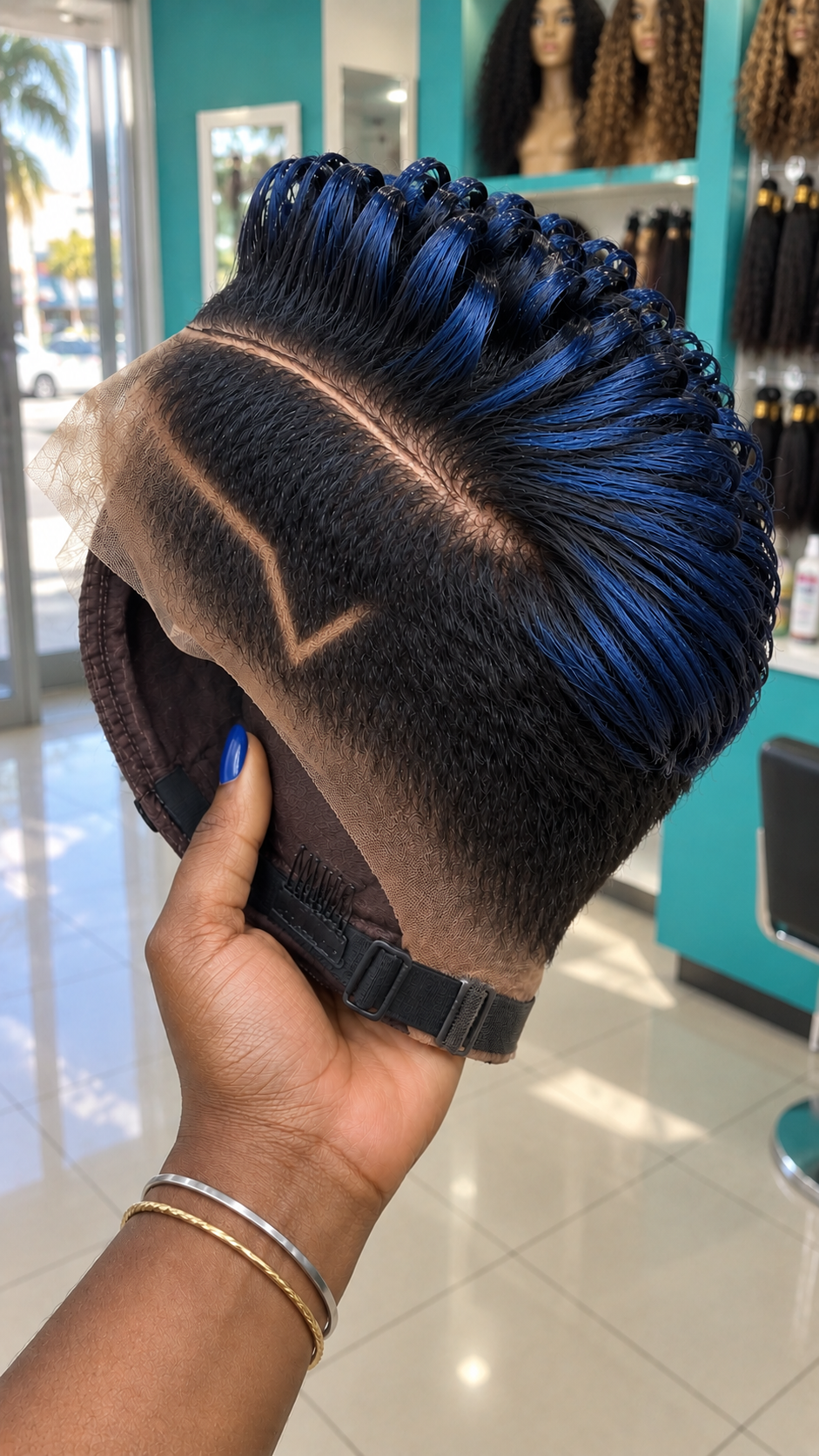
This sculpted pixie wig combines a deep natural-black foundation with vivid sapphire-blue upper sections, creating a dramatic color transition that follows the shape of the hairstyle. The crown rises into broad polished loops before sweeping backward into longer curved sections, while the side stays extremely close and carries a distinctive angular separation.
The photograph shows the unit before installation, so several construction details remain visible. The lace has not yet been trimmed, the interior cap and adjustable strap can be seen, and the side pattern is fully exposed. This makes the image particularly useful for anyone who wants to commission a similar custom wig and needs to explain the structure to a stylist.
Sapphire Blue Brings the Crown Into Focus
The blue is concentrated primarily through the longer upper hair rather than covering the entire wig. It appears as a rich sapphire-to-electric blue under the bright salon lighting, with darker navy tones visible wherever the strands fall into shadow.
The roots remain predominantly black. That dark foundation continues upward for a short distance before the blue becomes increasingly noticeable through the raised loops and swept rear sections.
This placement creates considerably more depth than a completely blue wig would have. The black base visually separates the individual upper sections and allows the brighter color to appear more dimensional.
When requesting a similar custom color, describe it as natural black roots with saturated sapphire-blue lengths through the sculpted crown. Reference photographs are important because terms such as royal blue, navy and sapphire can vary between sellers.
The Front Crown Uses Tall Sculpted Loops
The front portion of the crown contains several broad sections that rise sharply from the darker base. Each section curves backward rather than falling toward the forehead.
The loops are deliberately large and elongated. They are not conventional compact finger coils or small ringlets. This gives the upper silhouette considerably more height while preserving a directional shape.
As the loops progress backward, they become slightly lower and begin to merge into the longer swept sections at the rear. Smaller curls are also visible along the upper back edge.
This progression from tall front loops to lower rear movement is one of the characteristics a stylist would need to preserve for a close recreation.
The Blue Placement Follows Every Curve
The color becomes particularly effective because it follows the physical direction of the hairstyle. Sapphire strands bend around the outer surfaces of the loops, creating bright blue reflections exactly where the hair changes direction.
Farther back, the blue continues through elongated sections that sweep around the head. The result is not a collection of isolated highlights. Instead, the color visually connects the front crown to the rear.
Some sections retain considerably more black than others. This prevents the color from becoming uniformly bright and maintains the dark-and-blue contrast visible throughout the design.
An Angled Side Detail Sets This Wig Apart
The close side contains a particularly recognizable geometric element. A long exposed separation begins toward the front and travels diagonally backward before changing direction sharply near the lower portion.
This produces an angular V-like side design rather than the parallel double or triple lines commonly used on sculpted pixie wigs.
The upper boundary also follows the transition between the close side and the longer crown hair. Together, these lines divide the side into visually distinct sections while still leaving fine hair visible throughout the surface.
If ordering this design, avoid simply asking for “a line on the side.” A more useful description is one long diagonal sweep that finishes with a sharp angled V-shaped turn near the lower rear section.
The Close Side Retains Fine Hair Detail
Although the side is extremely close, it is not represented as a completely bare surface. Numerous tiny dark strands remain visible throughout the section.
This detail creates a convincing transition between the exposed separation and the fuller crown. It also provides strong contrast against the lighter scalp-toned line.
The black color should remain dominant here if the goal is to reproduce the appearance in the photograph. Extending bright blue across the entire close section would substantially change the balance of the design.
The Rear Has a Longer Swept Structure
Moving toward the rear, the hairstyle changes from upright loops into longer sections that lie closer to the head. These strands sweep backward and downward while maintaining the same glossy finish.
Blue becomes especially visible across these elongated rear sections. Dark strands remain underneath and between them, producing alternating areas of black, navy and brighter sapphire depending on the lighting.
Small curled pieces can be seen around the upper rear edge, providing a softer transition from the structured loops.
The photograph does not provide a complete straight-on rear view, so the exact center-back arrangement cannot be confirmed. For a precise custom recreation, a rear reference should also be supplied to the wig maker.
The Lace Shows the Pre-Installation Construction
Untrimmed lace extends around the visible perimeter. This is expected for a wig photographed before final fitting and should not be interpreted as the intended finished hairline.
The mesh appears fine in the image, but a photograph is not sufficient to identify a specific commercial lace grade. In particular, the image alone does not confirm that the unit uses HD lace.
Anyone purchasing a similar wig should ask the seller to specify the lace type, lace shade, coverage and dimensions rather than relying solely on appearance.
The Interior Cap And Adjustable Strap Are Visible
The open underside provides a useful look at the construction. A dark brown interior cap is visible along with an adjustable strap and buckle system near the lower edge.
A small comb is also visible inside the unit. These components suggest that the wig includes mechanisms intended to help stabilize the fit.
However, only part of the interior is shown. The photograph does not establish the complete number or position of attachment points throughout the cap.
If you specifically want a glueless unit, ask the seller whether the wig is designed for secure glueless wear and request a complete interior photograph before ordering.
Correct Cap Size Helps Position the Side Design
Fit is especially important with a wig that has such a recognizable side pattern. If the cap rotates even slightly after installation, the angular line may move away from the intended temple position.
A cap that is too large can also alter how the elevated crown sits, while excessive tension from a small cap may affect the lace perimeter.
Follow the individual wig maker’s measurement instructions carefully. For custom work, measurements commonly include head circumference, ear-to-ear distance and front-to-nape length.
The Hair Has a High-Gloss Reflective Surface
The finish plays a major role in the appearance of the blue color. The intended visual quality is mirror-like glossy hair, silky reflective finish, healthy wet-look shine, individually visible strands and ultra-defined hair texture.
Strong highlights run across the curved blue sections, while the recessed areas become almost navy-black. This gives the crown significantly more visual depth than a flat matte blue would provide.
Lighting also changes the perceived shade substantially. If exact color matching matters, request additional photographs under neutral indoor light or daylight before approving a custom color.
Where to Have This Style Made
A style with this combination of close side work, sculpted loops and directional color is best discussed with a custom pixie wig maker or wig stylist experienced with precision lace units.
When evaluating a stylist, examine previous work that shows side profiles. A portfolio containing only frontal photographs may not demonstrate whether the stylist can reproduce the angular close-side construction accurately.
It is also worth checking whether the same stylist handles coloring and sculpting. Having both processes completed together can make it easier to align the sapphire sections with the intended crown direction.
Useful searches include sapphire blue custom pixie wig stylist, blue sculpted pixie wig maker, black and blue lace pixie wig and custom pixie wig salon near me.
Ordering a Similar Black And Blue Wig
Start by sending clear photographs showing the crown, side and interior construction. Tell the wig maker that the base should remain natural black while sapphire blue becomes dominant through the longer upper strands.
For the crown, request large elevated loops at the front transitioning into swept sections and smaller curls toward the rear.
For the side, explain that you want extremely close dark hair with a long diagonal separation that changes direction into a sharp angular lower section. A marked reference photograph can prevent the stylist from substituting ordinary parallel barber lines.
Before placing the order, confirm the cap size, fiber type, lace construction, color placement, styling service and expected production time.
Where to Buy Similar Styles Online
Generic searches such as “blue wig” will return many unrelated products. More specific phrases can narrow the results toward the visible construction.
Try searching for sapphire blue pixie lace wig, black root blue sculpted pixie wig, blue loop crown pixie wig or blue pixie wig with side design.
When comparing listings, examine whether the blue begins directly at the scalp or transitions from dark roots. Also compare the crown height, because many commercially available pixie wigs use much flatter curls than the elevated loops visible here.
Confirm whether the photographed styling is included with the purchase. Some sellers offer a basic unit and use heavily styled photographs only as examples of what can be created afterward.
Booking a Stylist for an Existing Wig
If you already own a suitable dark pixie wig, a specialist may be able to reshape it into a similar silhouette depending on its fiber, density and existing cut.
Send the stylist photographs before booking and ask specifically whether they provide wig sculpting, precision side detailing and color customization.
If blue color needs to be added, identify the wig material first. Human hair and synthetic fibers require different processes, and standard human-hair dye techniques should not automatically be used on synthetic units.
For synthetic hair, confirm the manufacturer’s recommendations before using heat or attempting color modification.
Human Hair or Synthetic?
The photograph does not provide enough reliable evidence to identify the fiber of this particular wig. Glossiness alone cannot establish whether hair is human or synthetic.
A human hair version may provide greater flexibility for future reshaping and color adjustment. However, maintaining the elevated crown could require restyling after washing.
A quality synthetic version may hold a preset sculpted shape effectively, depending on the fiber. Heat tolerance varies considerably, so the manufacturer’s temperature guidance should always be checked before using hot tools.
How Much It Costs
No price is visible in the photograph, so the cost of this exact wig cannot be established from the image. A custom version can cost more than a basic pixie because of the two-tone coloring, close side construction and extensive hand styling.
| Wig Category | Typical Estimated Price Range |
|---|---|
| Premium Custom | $350–$800+ |
| Standard Custom | $175–$425 |
| Basic Human Hair | $100–$275 |
| Premium Synthetic | $60–$160 |
| Basic Synthetic | $30–$90 |
These figures are broad estimates and are not a valuation of the photographed unit. Hair material, lace type, cap construction, coloring, stylist location and customization can all significantly affect the final price.
When requesting a quote, ask whether the amount includes the finished sapphire coloring, side design and sculpted crown rather than only the underlying wig.
Maintaining the Sapphire Color
Blue shades can require additional attention, particularly when applied to human hair. Follow the wig maker’s recommendations for washing frequency, water temperature and products.
Avoid assuming that every color-safe product is appropriate for the unit. The correct routine depends on the actual fiber and coloring method.
Excessive washing and heat can alter both the color and the carefully arranged crown. If the wig begins losing its original silhouette, professional reshaping may be preferable to repeatedly manipulating the loops at home.
Protecting the Crown Between Wears
Store the wig on a stand that does not compress the raised upper sections. The front loops need open space around them to retain their height.
Avoid brushing directly through the entire sculpted crown. Instead, maintenance should preserve the individual directional sections wherever possible.
The close side should also be handled carefully so the fine strands around the angular separation remain in their intended position.
A Bold Blue Pixie With Precision Side Work
This wig gets its character from the relationship between black roots, saturated sapphire-blue lengths, elevated crown loops and a sharply angled close-side design.
The color follows the movement of the hair rather than covering every section equally. At the same time, the dark close side provides enough contrast for the exposed angular line to remain clearly visible.
For a close recreation, preserve those elements together: natural-black roots, sapphire-blue upper lengths, tall front loops, swept rear sections, fine close side hair and the distinctive diagonal-to-angular separation.
Search Terms
Sapphire Blue Pixie Wig · Black Root Blue Pixie Wig · Sapphire Blue Sculpted Crown Wig · Blue Loop Crown Lace Pixie Wig · Black And Blue Pixie Wig With Side Design · Sapphire Pixie Wig With Angled Side Line · Blue Sculpted Pixie Lace Wig · Black Root Sapphire Crown Wig