
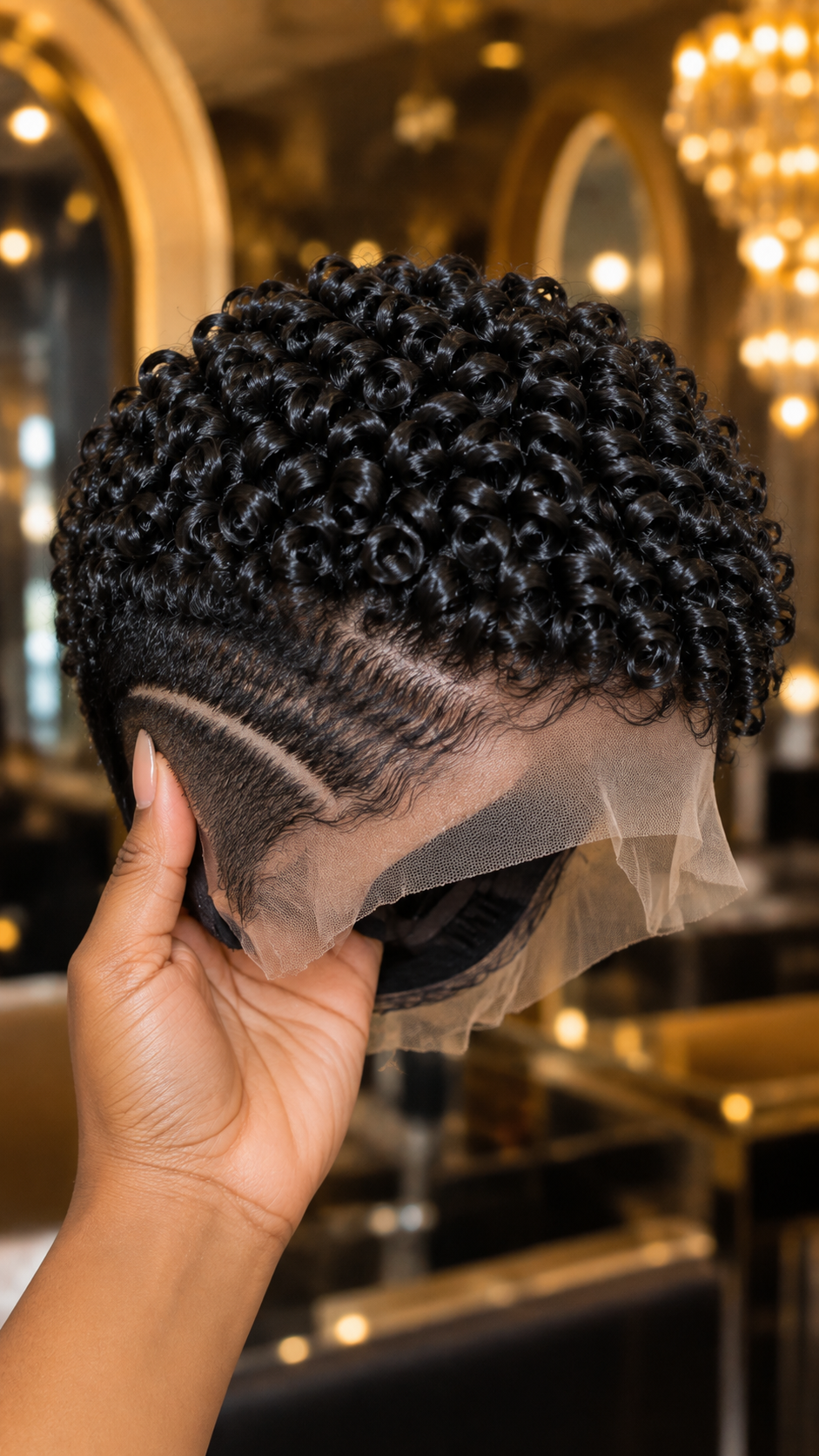
One clean horizontal line on the side of this unit does more permanent work than every curl on top of it. The dense black spirals catch the light and dominate the first glance, but the real decision sits lower: a sharp, deliberate part cut into the lace that separates full density from a faded, almost skin-like zone. That line is not decoration. It is a lock.
Once the hard side line is built into the unit, the wig can only be worn one way. Flip it, shift the part, or try to centre the curls and the geometry breaks. The line that looks intentional from the correct angle becomes a random scar from the other. Buyers who fall for the crown and ignore the side often discover this only after the first wear, when the unit refuses to sit “the other way” without looking unfinished.
Where To Buy This Hard Part Pixie
Custom makers
Independent lace specialists and small studios that build short curly units to order remain the most reliable source for a clean hard side line. They control the placement, the depth of the fade, and the knot density along the line itself. Ask for photos of previous hard-part work from multiple angles, not only the front.
Instagram and TikTok sellers
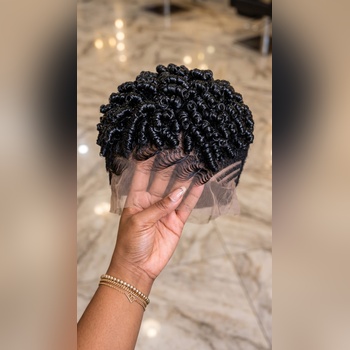
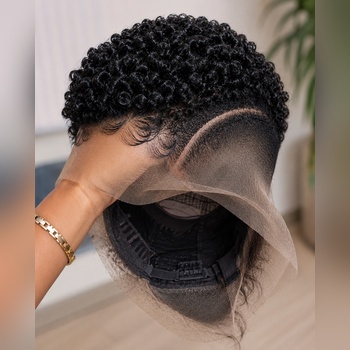
Search terms that surface real makers rather than resellers include “hard part curly pixie”, “side line lace front”, and “black spiral hard part”. Watch for accounts that show the unit on a head, not only on a mannequin, and that turn the side fully toward the camera.
Etsy
Filter for shops with repeated short curly inventory and clear close-ups of the side construction. Read the description for the words “hard part”, “carved side”, or “razor part”. Avoid listings that only show the top of the head.
Marketplaces like Amazon, AliExpress, and Temu
These platforms carry the style, but the hard side line is frequently printed, painted, or cut after the fact rather than knotted. Price is usually lower; longevity and cleanliness of the line are usually lower as well. Inspect return policies carefully.
Local beauty supply shops and salons
Some denser urban shops keep a small selection of ready-to-wear short curly lace fronts. You can hold the unit, check the side line under real light, and feel whether the fade zone is knotted or simply thinned with scissors. That tactile check is worth the trip.
Vendors and wholesalers direct
If you buy in volume or for clients, direct vendors in major wholesale markets can supply the construction. Request a sample of the exact side-line technique before placing a larger order.
Regionally (Lagos, Accra, Atlanta, London, South Africa)
These cities have concentrated maker communities that specialise in short, high-definition curly units. Local Instagram circles and WhatsApp vendor groups often move stock faster than global platforms and allow in-person inspection of the side line.
Vet the seller
Ask for a straight-on side photograph and a three-quarter rear angle. The hard line should remain sharp and continuous; any blur, double line, or sudden density jump is a red flag. Confirm whether the line is knotted into the lace or only cut into the hair.
Red flags
Listings that never show the side. Units photographed only from above. Descriptions that call every short curly unit “hard part” without visual proof. Prices that undercut the market by a wide margin while claiming hand-tied fade work.
When you order, send
Your head circumference, preferred side for the hard line (left or right), how deep you want the fade zone, and a note that you need the line to remain clean after the first wash. Clear communication reduces returns.
Contact / order inquiries: WhatsApp [WhatsApp: +XX XXX XXX XX XX]
How Much It Costs
Tiered pricing
Human-hair versions with a properly knotted hard side line and dense spiral curl typically sit between $180 and $420 depending on lace grade, density, and whether the unit is made to measure. Mid-range human units with a clean but simpler side line land around $150–280. Basic human or mixed-fibre pieces start lower, often $90–160. Good synthetic versions that hold the spiral and the side geometry range from $65 to $140. Basic synthetic can be found from $30 to $70.
What that includes and excludes
The quoted price usually covers the unit as shown, with the hard side line already built and the lace left long for trimming. It rarely includes extra styling product, a second adjustable band, or custom density changes after the unit is finished. Shipping, duty, and any colour-matching adjustments sit outside the base figure.
Shipping and duty
International shipping commonly adds $15–45. Duty and tax vary by country and can add another 10–25 % of the declared value. Factor both into the true landed cost before you compare sellers.
Ongoing costs
A hard side line needs regular cleaning of product build-up along the fade zone and occasional light trimming of the thinned hairs that try to grow out of the clean edge. Leave-in conditioner, a soft brush, and occasional lace tint top-ups are normal. Expect $40–80 per year in maintenance products if you wear the unit several times a week.
First-year total
Add the unit price, shipping, duty, and one year of products. A solid mid-range human hard-part curly pixie often lands between $250 and $520 all-in for the first twelve months.
Cost per wear
At three wears a week the mid-range unit costs roughly $1.60–$3.30 per wear in the first year. After that the cost drops because the major outlay is already behind you, provided the side line stays clean and the curls do not mat.
What a very low price signals
A hard side line that looks perfect in photos for under $80 on human hair is usually either cut rather than knotted, printed, or photographed under flattering light that hides density jumps. Extremely low prices almost always mean the geometry will soften or disappear after the first few washes.
Deposit structure
Most custom makers request 30–50 % to begin work, with the balance due before shipping. Use a payment method that allows dispute if the finished side line does not match the agreed photographs.
Shipping, Delivery, And What To Expect After Ordering
Ready-to-ship units usually leave within 1–5 business days. Custom hard-part work takes 2–5 weeks depending on the maker’s queue. Once shipped, most international orders arrive in 7–18 days. Track the parcel and photograph the outer packaging on arrival. Open the unit under good light and check the side line first: the horizontal edge should still be sharp, the fade zone should show graduated single knots, and the lace should be intact with no pulled threads along the part. If the line has already blurred or the density jumps, contact the seller immediately with clear side photographs before any washing or trimming.
The Side Line Is A Second Hairline
Most buyers judge a curly pixie by the crown and the front hairline. On a unit with a hard side line those two zones are only half the story. The side line functions as a second, permanent hairline that sits lower and more laterally. It is visible in every profile photograph, every mirror check, and every turn of the head. Because it is built into the lace rather than styled with product, it does not move when the curls shift. That permanence is the feature and the constraint at the same time.
A well-executed hard side line shows a clean density drop: full spiral above the line, rapidly thinning single-knot hairs below it, then open lace. The transition must be gradual enough to look like a barber fade and sharp enough to read as intentional. If the maker simply cut the hair short without reducing knot density, the line looks blunt and the lace remains obvious. If the knots are reduced but the placement is uneven, the line wobbles. Both faults become more noticeable once the unit is on a real head and viewed from the side in daylight.
Orientation Lock
The hard side line removes most of the unit’s directional freedom. You cannot part the hair on the opposite side without the original line sitting in the wrong place. You cannot centre the curls for a more symmetrical look without the fade zone appearing on the wrong half of the head. The unit is effectively one-way. This is useful if you always wear your natural hair with a preferred side part; it is limiting if you like to change the part according to face shape, outfit, or mood.
Before you buy, decide which side the line should live on and communicate that clearly. Some makers default to the wearer’s left; others follow the model’s left in the product photo. Confirm the orientation in writing. Once the knots are tied, the decision is permanent.
Lace Quality Shows More On The Side
Front hairlines receive the most attention in product photography and in buyer checks. On a hard-part unit the side lace is equally exposed and often more harshly lit by profile angles and side mirrors. Any mismatch in lace tint, any coarse mesh, or any unbleached knots becomes visible the moment the head turns. The crown curls can hide a mediocre lace; the side line cannot. When you evaluate a unit, hold it so the hard line faces the light and look for the same melt you expect at the front. If the side lace reads as a film or a grid, the unit will do the same on your head.
Curl Pattern Versus Side Geometry
The spirals on this unit are tight, uniform, and high-shine. That pattern is independent of the side line, yet the two elements interact. Dense, springy curls above a clean hard part create strong contrast; the eye reads the geometry immediately. If the curls are looser or more irregular, the same line can look softer and less deliberate. The maker who builds both the curl set and the side line must keep the two in visual balance. A perfect hard part under limp or uneven curls loses its authority. Conversely, excellent curls above a poorly graduated fade still look unfinished from the side.
Before You Pay
Does the seller provide a clear, straight-on side photograph that shows the full length of the hard line and the fade zone beneath it?
Is the hard line knotted into the lace with graduated density, or is it only cut into the hair after the unit was finished?
Which side will the line sit on when the unit is worn, and have you confirmed that orientation in writing?
Can the lace along the side line melt against your skin tone in daylight, or does it remain visible as a separate layer?
After the first wash, will the side line still read as a clean geometric edge, or does the seller warn that product and handling will soften it?
Trimming The Lace
Leave the excess lace intact until the unit is on your head and the hard side line is positioned exactly where you want it. Trim in small stages with sharp lace scissors, following the natural curve of your hairline and the existing fade zone. Do not cut into the knotted area along the hard line itself. Once the lace is cut, the margin for repositioning disappears. If you are unsure, have a stylist who understands short lace units make the first cut while you watch the side line in a mirror.
Search Terms
black hard part curly pixie · side line lace front spiral · tight black spiral hard part · hard part fade curly unit · black rod set side line pixie · knotted hard part short curly · one way hard part lace wig · clean side line black pixie
Final Thoughts
The curls on this unit are what first pull the eye, but the hard side line is what decides how the unit can actually be worn. It is a permanent piece of geometry that locks direction, exposes lace quality, and turns every profile view into a construction check. Treat the side line as a second hairline that must be evaluated with the same seriousness as the front. If the line is clean, graduated, and correctly oriented for the way you wear your hair, the unit becomes a precise, one-direction tool. If the line is blunt, uneven, or placed on the wrong side, no amount of curl definition will hide the mismatch.
A short curly pixie with a hard side line is not a flexible everyday shape. It is a deliberate design choice that rewards buyers who understand the constraint before they pay and disappoints those who discover it only after the unit arrives.