
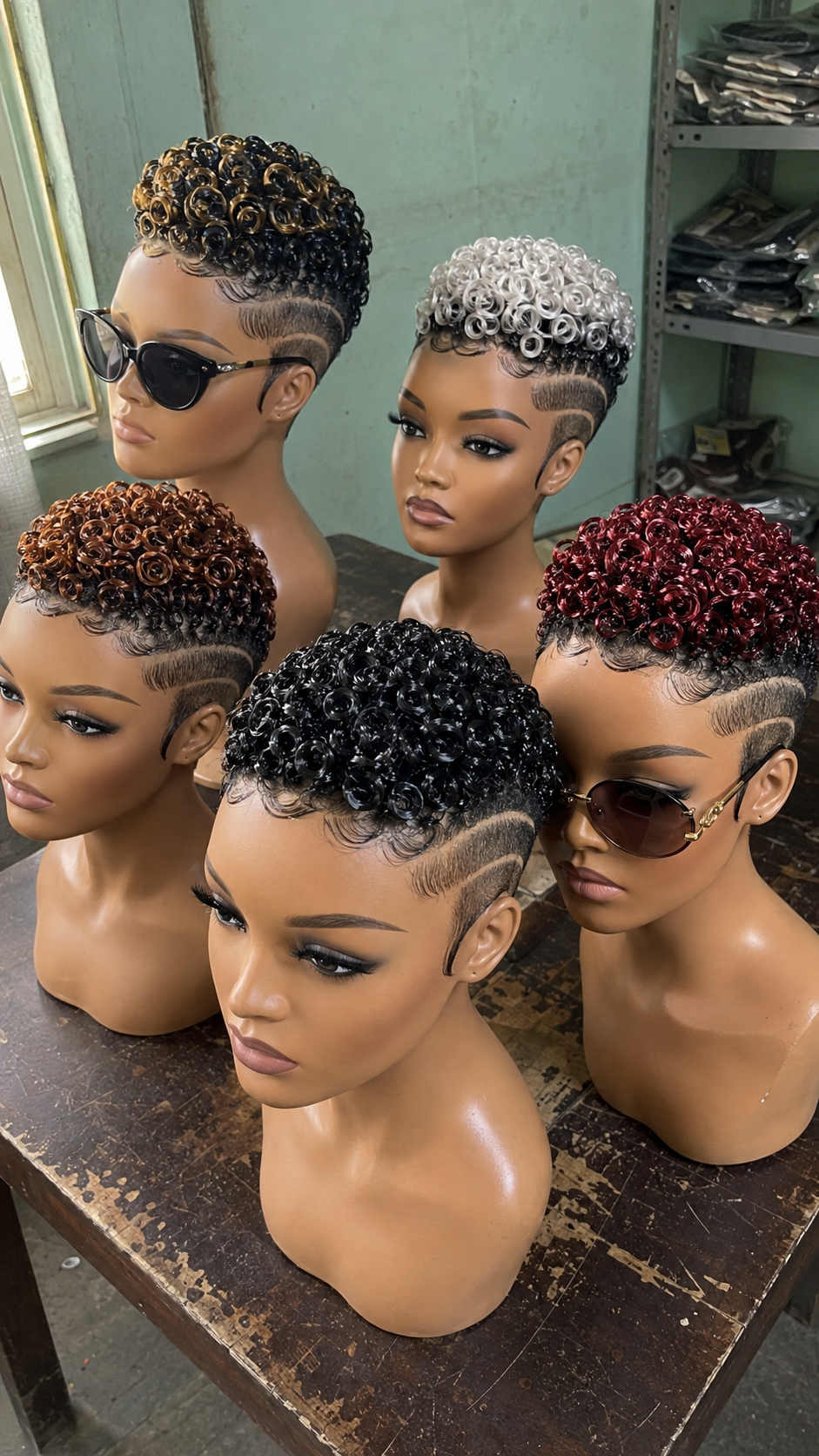
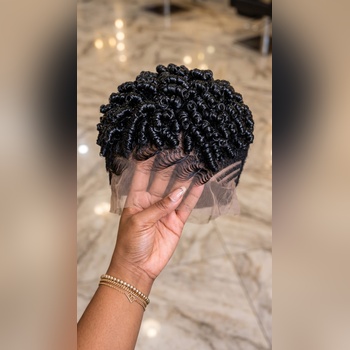
After the first month the curls will still be curly. The side lines will tell you whether the unit was built to last or only to photograph. On this black spiral pixie the top is dense, high-shine, and tightly coiled. What separates it from a standard short curly unit is the side: several curved razor lines stacked above the ear, creating a deliberate signature pattern that sits higher and more visibly than a simple hard part or single fade.
That pattern is not neutral. It turns the side of the head into a second design surface. Every profile view, every mirror check, and every photograph taken from an angle now includes the carving. The curls provide volume and texture; the multi-line side provides identity. Buyers who only evaluate the crown often miss that the side design is the element that will either elevate the unit or become the first thing to look tired.
Where To Buy This Carved Side Pixie
Custom makers
Makers who specialise in short curly units with signature side work are the safest route for a clean multi-line design. They control the spacing, the depth of each curve, and the density drop between the lines. Request previous examples of multi-curved side patterns, not only single hard parts or basic fades.
Instagram and TikTok sellers
Search phrases such as “multi line carved pixie”, “signature side curly unit”, and “black spiral side design” surface accounts that show the full side. Prioritise sellers who post close-ups of the lines under natural light and who turn the head so the carving is fully visible.
Etsy
Look for shops that list short curly lace fronts with clear side photographs. Descriptions that mention “carved design”, “razor side pattern”, or “signature side” are more useful than generic “pixie cut” language. Check recent reviews for comments about how the side lines held after washing.
Marketplaces like Amazon, AliExpress, and Temu
These platforms stock similar silhouettes, but multi-line side work is frequently cut or printed rather than knotted with graduated density. The lines may look sharp in the listing and soften or disappear after the first few wears. Return windows matter more here.
Local beauty supply shops and salons
If a shop carries ready-to-wear short curly units, hold the piece and examine the side under bright light. Feel whether the lines are created by reduced knot density or simply by cutting the hair short. A true multi-line design should show progressive thinning between the curves.
Vendors and wholesalers direct
Wholesale sources can supply the construction in volume. Ask for a sample unit with the exact side pattern before committing to a larger order. Confirm that the lines are built into the lace rather than added after the unit is finished.
Regionally (Lagos, Accra, Atlanta, London, South Africa)
These markets have dense communities of makers who regularly produce short curly units with decorative side work. Local networks often allow in-person inspection of the carving quality and spacing before payment.
Vet the seller
Demand a clear profile photograph that shows every line from the temple down to the fade. The curves should be continuous and evenly spaced. Any broken line, uneven gap, or sudden density jump is a construction warning. Ask whether the design is knotted or cut.
Red flags
Listings that never show the side. Units photographed only from the front or top. Descriptions that call every short curly unit “carved” without visual proof of multiple distinct lines. Prices that sit far below the market while claiming detailed hand-carved side work.
When you order, send
Your preferred side for the design, how high you want the highest line to sit relative to the temple, the approximate number of curves, and a note that the lines must remain readable after the first wash. Precision at the order stage reduces disappointment later.
Contact / order inquiries: WhatsApp [WhatsApp: +XX XXX XXX XX XX]
How Much It Costs
Tiered pricing
Human-hair units with a properly executed multi-line carved side and dense black spiral curl typically range from $190 to $450. The extra labour of multiple graduated curves pushes the price above a plain hard-part or single-line unit. Mid-range human versions with cleaner but simpler side work sit around $160–300. Basic human or mixed units start near $100–170. Good synthetic versions that hold both the spiral and the side geometry usually fall between $70 and $150. Entry-level synthetic can be found from $35 to $75.
What that includes and excludes
The base price covers the unit with the multi-line side already built and the lace left long for custom trimming. It does not normally include extra styling product, a second elastic band, or later redesign of the side pattern. Shipping, import charges, and any post-purchase adjustments sit outside the quoted figure.
Shipping and duty
International shipping commonly adds $15–50. Duty and tax depend on the destination and can add 10–25 % of the declared value. Calculate the full landed cost before comparing offers.
Ongoing costs
Multiple curved lines collect product and skin oils more readily than a plain side. Regular clarifying of the fade zone, light trimming of any hairs that try to bridge the lines, and occasional lace tint top-ups are normal. Budget $50–90 per year in maintenance if the unit is worn several times a week.
First-year total
Unit price + shipping + duty + one year of products. A solid mid-to-upper human multi-line carved curly pixie often lands between $280 and $560 for the first twelve months.
Cost per wear
At three wears a week the mid-range unit costs roughly $1.80–$3.60 per wear in the first year. After that the major cost is behind you, provided the side lines stay distinct and the curls do not mat.
What a very low price signals
A multi-line side that looks sharp in photos for under $90 on human hair is usually cut rather than knotted, or the lines are only surface-deep. Extremely low prices almost always mean the geometry will blur after washing and daily handling.
Deposit structure
Custom makers typically request 30–50 % to begin, with the balance due before shipping. Use a payment method that allows dispute if the finished side pattern does not match the agreed design.
Shipping, Delivery, And What To Expect After Ordering
Ready-to-ship units usually leave within a few business days. Custom multi-line side work takes 2–6 weeks depending on the maker’s schedule. Once shipped, most international parcels arrive in 7–20 days. On arrival, open the unit under strong light and check the side first. Every curve should still be sharp and continuous. The density between the lines should drop in clear steps. If any line is already soft, broken, or uneven, contact the seller with profile photographs before washing or trimming.
Multi-Line Carving Turns The Side Into A Design Surface
A single hard part or basic fade is functional. Multiple curved lines are declarative. They announce that the side of the head is part of the overall design rather than merely the place where the hair ends. On a short curly unit this matters more than on longer styles because there is less hair to distract from the geometry. The eye travels from the dense spirals straight to the carved pattern. If the lines are clean, the unit reads as intentional and custom. If the lines are uneven or already softening, the unit reads as unfinished.
The height of the design is also consequential. Lines that sit high on the temple interact with the ear, the jawline, and any earrings or glasses the wearer uses. A pattern placed too low can disappear under the ear or under a collar. A pattern placed too high can compete with the front hairline. The maker must balance the vertical placement against the wearer’s face shape and typical accessories. That balance is rarely visible in a front-only product photograph.
Maintenance Multiplies With Every Extra Line
Every additional curve is another edge that can collect product, another place where single hairs can bridge the gap, and another surface that needs to stay clean to remain readable. A plain hard part requires basic upkeep. A multi-line signature pattern requires more frequent attention to the fade zones between the curves. Buyers who love the look in the product photo sometimes underestimate the weekly effort needed to keep five or six distinct lines from blending into a soft blur.
The curls themselves are relatively forgiving. Tight spirals can look presentable even when slightly frizzy. The side design is less forgiving. Once the lines lose definition, the unit loses the very feature that differentiated it from a standard short curly pixie. That is why the construction method matters: knotted graduated density holds the geometry longer than a simple cut.
Orientation And Face Framing
Like any permanent side design, a multi-line pattern locks the unit to one direction. You cannot flip the wig or move the design to the opposite side without the pattern sitting in the wrong place relative to the face. Before ordering, decide which side will carry the carving and confirm it in writing. Some makers default to the model’s left in the listing photo; others follow the wearer’s dominant side. Ambiguity at the order stage produces units that feel “off” the moment they are put on.
The design also frames the face differently from a swept-back or centre-parted short curly unit. The eye is pulled toward the carved side. This can highlight a strong jaw or cheekbone on that side and minimise the opposite side. Wearers who prefer symmetrical framing may find the asymmetry of a multi-line side more pronounced than they expected.
Lace And Knot Quality Under The Design
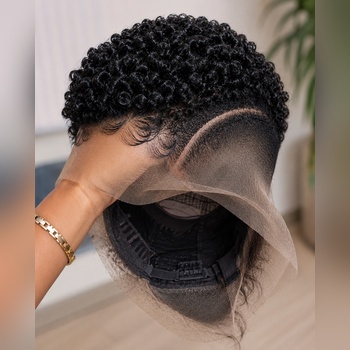
The lace beneath a multi-line carve is under more scrutiny than the lace at a plain hairline. Each curve exposes a strip of lace and a transition in knot density. Coarse mesh, visible knots, or a tint that does not match the skin become obvious the moment the head turns. High-shine black curls can hide mediocre lace on the crown; they cannot hide it between the carved lines. When you evaluate a unit, examine the side under the same daylight you will wear it in. If the lace reads as a separate layer between the curves, it will do the same on your head.
Before You Pay
Does the seller provide a clear profile photograph that shows every curve of the side design from temple to fade?
Are the lines created by graduated knot density or only by cutting the hair after the unit was finished?
Which side will the multi-line pattern sit on, and has that orientation been confirmed in writing?
How high does the highest line sit relative to the temple, and does that height suit the way you wear earrings or glasses?
After the first wash and a week of normal wear, will the individual lines still read as distinct, or does the seller warn that the pattern softens quickly?
Trimming The Lace
Leave the excess lace in place until the unit is on your head and the side design is positioned exactly where you want it relative to your ear and temple. Trim gradually with sharp lace scissors, following the existing fade rather than cutting into the knotted curves. Once the lace is removed, the margin for adjusting the height or angle of the design disappears. If you are uncertain, have a stylist experienced with short carved units make the first cuts while you monitor the side in a mirror.
Search Terms
multi line carved black pixie · signature side spiral curl · curved razor side curly unit · black tight curl side design · multi curve carved lace front · high temple carved pixie · decorative side black spiral · knotted multi line short curly
Final Thoughts
The dense black spirals give this unit its volume and its first impression. The multi-line carved side gives it its identity. That side pattern turns a short curly pixie into a directional, high-visibility design that must be maintained as carefully as it was built. It locks the unit to one orientation, multiplies the places where lace quality can be judged, and demands more upkeep than a plain hard part or single fade.
If the lines are clean, evenly spaced, correctly placed for your face, and built with graduated density, the unit becomes a precise statement piece. If the lines are uneven, too low, too high, or already softening in the product photos, no amount of curl definition will compensate. Evaluate the side with the same seriousness you give the crown. On a unit like this the side is not secondary. It is the feature that decides whether the wig still looks intentional after the first month.