
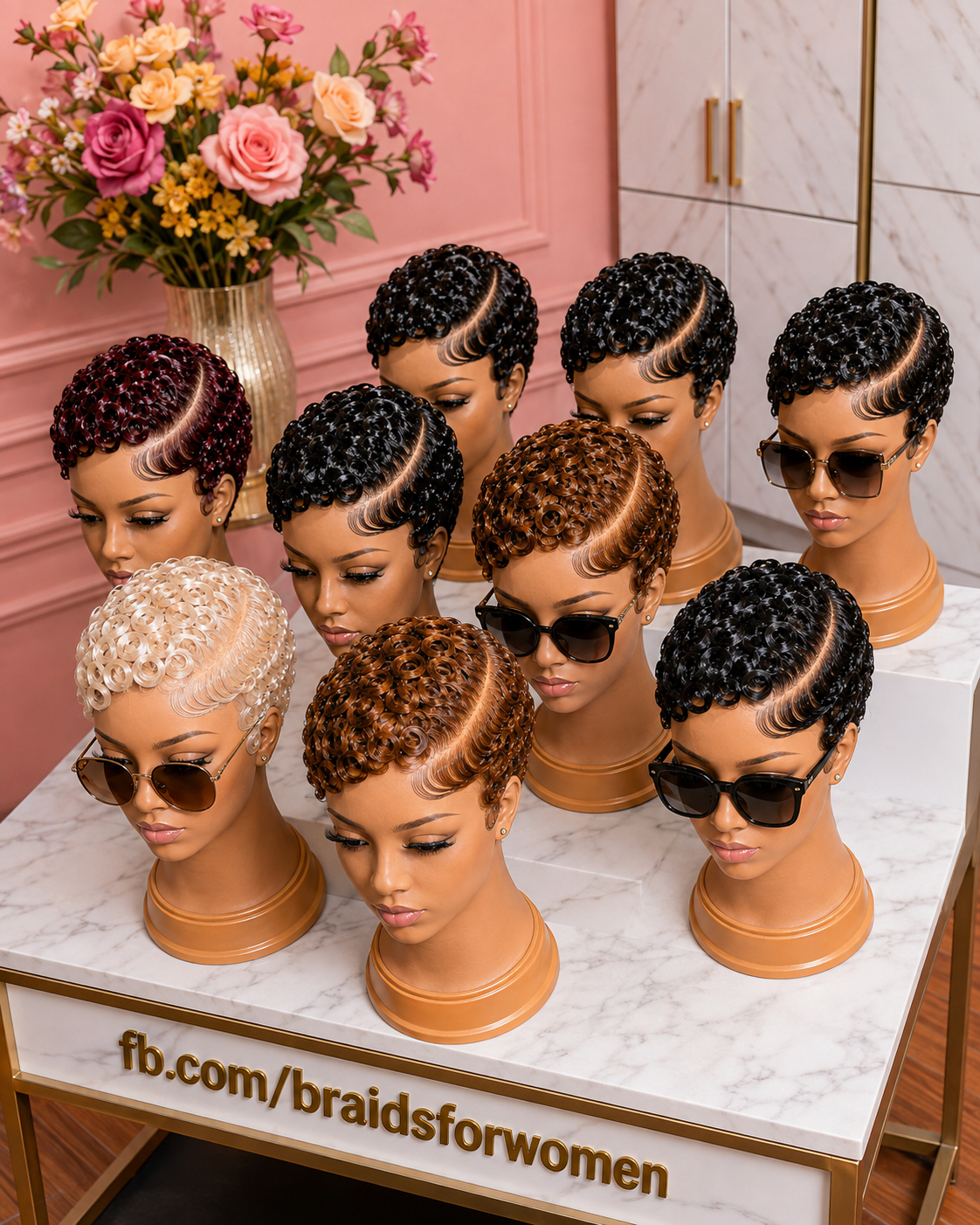
Put the same short curl pattern on several wigs and one thing becomes obvious very quickly: colour changes much more than colour. It changes how dense the curls appear, how clearly the parting line shows, how easily individual ringlets can be seen, and even how much attention the eye gives to the hairline.
This collection is especially useful because the basic haircut and curl arrangement stay very similar while the colour changes from jet black to burgundy, pale blonde, and warm copper. That creates something buyers rarely get from a normal listing: a side-by-side comparison where the colour itself becomes easier to isolate. Before deciding that one version looks thicker, sharper, or more expensive than another, ask whether you are actually judging the construction or simply reacting to contrast.
Where To Buy A Short Curly Pixie Wig In Different Colours
Custom wig makers. A custom maker is useful if you already know which pixie shape you want but need help choosing the colour. Ask to see the same or very similar unit in several shades rather than comparing completely different hairstyles.
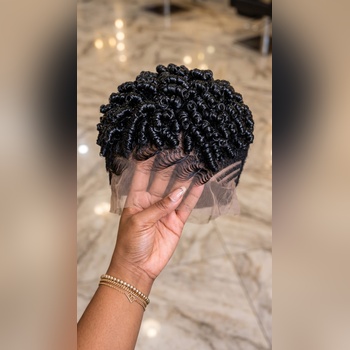
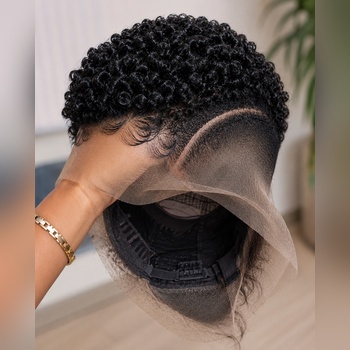
Instagram and TikTok sellers. Look for sellers who show colour ranges under similar lighting. If the black unit is photographed indoors and the blonde unit is photographed beside a window, you are not getting a fair comparison.
Etsy. Independent makers may allow you to choose a base colour, root colour, or custom tone. Ask whether the photos show the same hair type and density across the different colour options.
Marketplaces like Amazon, AliExpress, and Temu. Colour menus can be large, but do not assume every colourway uses exactly the same fibre, lace, density, or processing. Read the specification for the exact shade you are ordering.
Local beauty supply shops and salons. Seeing several colours together in person is extremely useful. Place them under the same light and look at the crown, part, hairline, and curl separation rather than judging only which colour catches your eye first.
Vendors and wholesalers direct. If a vendor offers the same pixie in black, burgundy, blonde, and copper, ask whether all colours use the same cap construction, density, lace type, and curl-setting process.
Regionally. Wig sellers in Lagos, Accra, Atlanta, London, and major South African hair markets may carry multiple colourways of similar short units. Use a reference image and colour code where available because names such as copper, ginger, auburn, and burgundy are not used consistently by every seller.
Vet the seller. The best comparison is several actual units photographed together or under the same conditions. That reduces the chance that lighting, editing, or styling is creating a false difference between colours.
Red flags. Be cautious if one colour looks dramatically fuller than another but the seller cannot confirm that they use the same density, if blonde photos are heavily overexposed, or if only the darkest colour is shown close enough to inspect the part and hairline.
When you order, send. Provide the exact reference colour, preferred root depth, cap size, hair type, curl pattern, and whether you want the colour to be uniform or rooted. Do not order from a colour name alone when a photograph can communicate the target more accurately.
Contact / order inquiries: WhatsApp [WhatsApp: +XX XXX XXX XX XX]
How Much It Costs
Premium custom human hair. A customized short human-hair pixie can commonly fall around $220–$430 or higher depending on hair quality, lace, ventilation, density, and colour work. Light blonde and heavily processed colours can cost more than natural black.
Standard custom human hair. Around $170–$300 can cover many short curly human-hair units. Rooting, lifting, toning, or custom colour correction may increase the final price.
Basic human hair. Roughly $150–$230 may buy a simpler unit with more processed hair, basic lace, or less customization. Compare the actual construction instead of assuming the brighter colour justifies a higher price.
Good synthetic. Around $60–$150 can provide a strong short curl pattern with stable colour. For pale blonde, copper, and burgundy shades, good synthetic fibre can sometimes offer excellent colour consistency without the chemical lifting required on human hair.
Basic synthetic. Around $25–$70 is common for budget colourways. Inspect shine, fibre texture, parting realism, and colour uniformity closely because inexpensive bright shades can look more artificial under direct light.
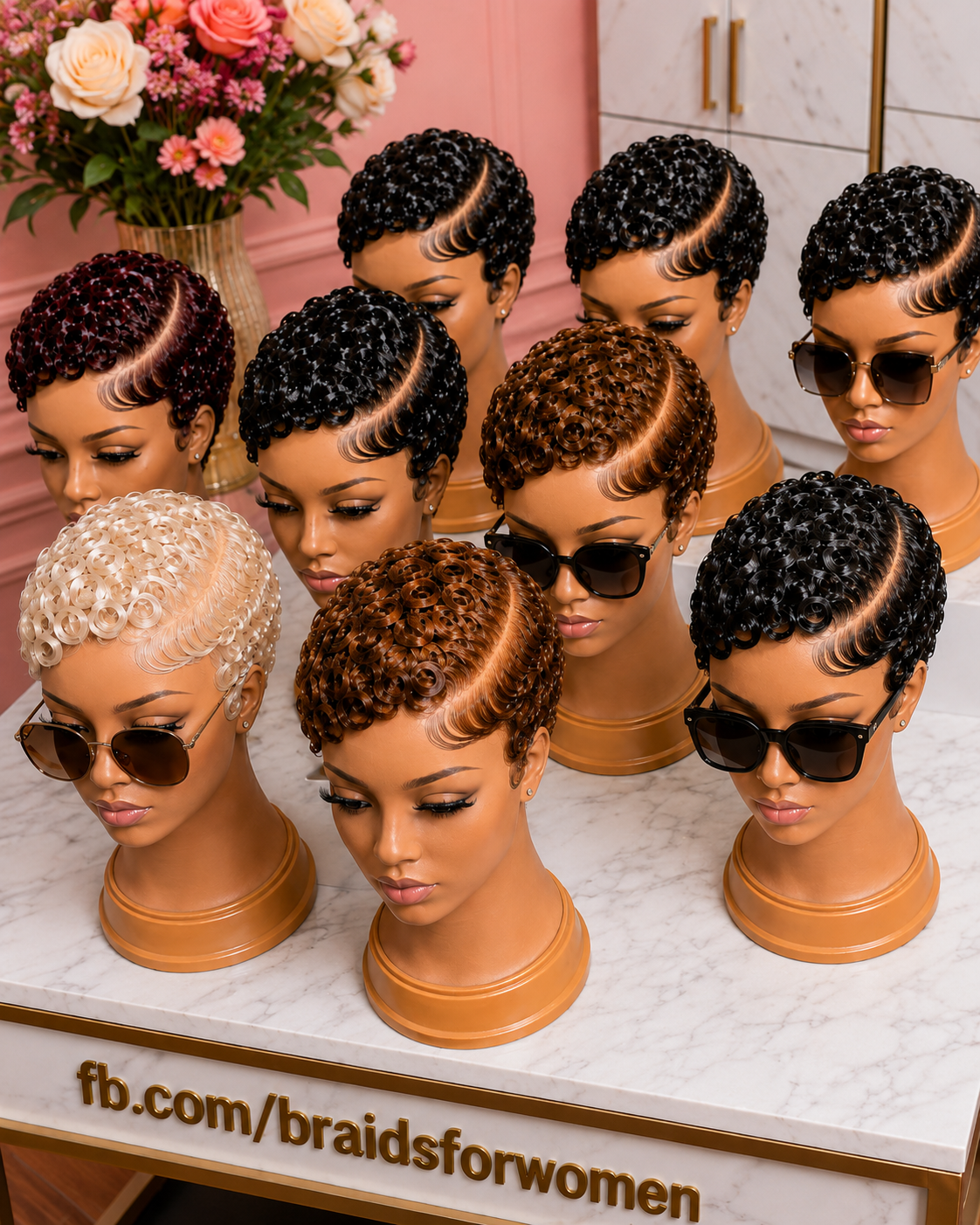
Colour premiums. Black generally requires less colour processing. Burgundy or copper can add roughly $55–$115 in custom human-hair work, while very light blonde or more complex fantasy shades can add $100 or more depending on the starting hair.
Shipping and duty. International delivery, customs charges, and taxes can raise the real purchase cost. Compare the delivered price instead of only the listing amount.
Ongoing costs. Black usually needs the least colour maintenance. Burgundy and copper may need colour-refresh products. Pale blonde can require toning, conditioning, and more careful heat management.
First-year total. Include colour maintenance when comparing two versions of the same wig. A shade that costs only slightly more at checkout may require more products and professional refresh work later.
Cost per wear. The best value is not necessarily the cheapest colour. A shade you wear regularly can produce a lower cost per wear than a dramatic colour that stays on the wig stand most of the year.
What a very low price may signal. With light or highly saturated shades, a very low human-hair price may indicate heavily processed hair, blended fibre, simpler lace, or less careful colour work.
Deposit structure. Custom colour orders may require around 30–50% upfront and the remainder before dispatch. Get the final shade specification in writing because colour disputes are difficult when the order only says something vague like “brown” or “blonde.”
Shipping, Delivery, And What To Expect After Ordering
When the wig arrives, examine the colour in more than one lighting condition before altering it. Warm indoor lighting can make copper richer, black warmer, and blonde more golden than the same unit will look in daylight.
Also compare the crown, parting line, hairline, and side areas. Colour can change how strongly those details appear, so the first impression of “more density” or “better lace” may not tell the whole story.
Do not cut the lace or apply colour products until you have confirmed that the shade, cap construction, and curl pattern match what you ordered.
Black Can Make The Same Curl Pattern Look Denser
Dark hair creates a compact visual mass. When dozens of small black ringlets sit close together, the spaces between them are less obvious because the dark tones visually merge.
That can make a black pixie appear extremely full even when its actual hair density is similar to a lighter version.
This matters when comparing listings. If you look at a black unit and a pale blonde version side by side, you may instinctively describe the black one as thicker. Before accepting that conclusion, check whether the seller has actually changed the density.
Sometimes the difference is construction. Sometimes it is simply what dark colour does to the eye.
Blonde Makes Separation Between Ringlets Easier To See
The pale blonde unit in this collection behaves almost in the opposite way visually. Light colour makes shadows between curls easier to notice, so individual loops and ringlets can become more obvious.
That can make the curl pattern look highly detailed, but it can also make gaps look larger than they would on black hair.
For that reason, do not automatically interpret visible separation on a blonde pixie as low density. Look at the actual scalp coverage and the number of curls rather than judging from contrast alone.
Light colours are less forgiving visually. Small irregularities in the set, uneven ends, or inconsistent curl sizes can attract more attention simply because there is more tonal separation.
Parting Contrast Changes With Hair Colour
All of these units use a strong side-parted pixie silhouette, but the part does not read identically across every colour.
With jet-black hair, the contrast between dark hair and a scalp-like part can be very strong. That can create a crisp, dramatic line, but it can also make poor knot work or the wrong lace tone easier to notice.
With copper or burgundy, the difference between hair and scalp can feel softer depending on the lighting and the wearer’s skin tone. Blonde produces another relationship again because the hair itself reflects more light.
So when comparing parting realism, try not to ask only, “Which part looks best?” Ask whether each part is technically built the same way and whether the colour is changing your perception of it.
Copper And Burgundy Show Curl Dimension Differently
Warm copper and burgundy shades often reveal depth inside a curl because the raised sections catch light while the inner curves remain darker.
That can make sculpted ringlets look more three-dimensional than the same ringlet in solid black. It is one reason warm shades photograph so strongly on small curls.
But stronger visual dimension is not evidence that the copper wig has a better curl pattern. If the underlying set is identical, the colour is simply making the geometry easier to read.
This is a useful distinction when a seller charges different prices for otherwise similar units. Pay extra for real colour work, hair quality, or construction differences—not because one shade photographs with more apparent dimension.
Colour Can Make Hairline Details Look Stronger Or Softer
The sculpted front edges in this collection are highly visible. They curve from the part toward the temple and become part of the entire pixie design.
On black hair, those curves create strong graphic contrast. On blonde, they become lighter and may blend more softly depending on the background and skin tone. Burgundy and copper sit somewhere between those two extremes.
The edge design itself has not necessarily changed. What changes is how aggressively the eye reads it.
This is why ordering a different colour from a reference photograph does not always produce the same visual mood, even when the stylist copies the haircut and curl placement very closely.
Use A Collection Photo As A Controlled Comparison
A collection photograph is most valuable when you use it like a comparison test rather than a catalogue.
Ignore the colour you like for a moment. Look at the same areas on every unit: crown height, curl size, part width, edge placement, temple shape, and overall silhouette.
If those features remain consistent, you are seeing a seller reproduce one design across several colourways. That is useful evidence of repeatability.
If every colour has a noticeably different density, part, curl pattern, or silhouette, then you may not actually be choosing only a colour. You may be choosing between several differently constructed wigs that happen to share the same product name.
Do Not Pay A Construction Premium For A Visual Colour Effect
This is the most important buying lesson from a display like this.
Black may appear fuller. Blonde may show more curl separation. Copper may appear more dimensional. Burgundy may look deeper and more dramatic. None of those visual effects automatically proves that one unit contains better hair, more hair, finer lace, or better ventilation.
If two units have the same cap, same density, same hair grade, same curl set, and same lace construction, then the price difference should mainly reflect the real cost of producing and maintaining the colour.
Ask what physically changed before paying a large premium.
Before You Pay
- Do all colour options use the same density, cap construction, lace type, and curl pattern?
- Can you show the black, blonde, burgundy, and copper versions under the same lighting?
- Is the lighter colour human hair that was lifted, pre-coloured hair, or synthetic fibre?
- Does the price difference come from actual colour processing or from a different wig specification?
- Can I see a close-up of the part and hairline on the exact colour I am ordering?
Trimming The Lace
Do not use the darkest colourway as your only guide when trimming a lighter version. Different hair colours can change how visible the lace edge appears against the surrounding hair.
Place the exact unit you purchased in its final wearing position and inspect the lace in natural light. Trim gradually, following the actual hairline rather than copying the cut from another colour in the collection.
If the lace tone needs adjustment, handle that separately from the hair colour. The goal is for the mesh to work with the wearer’s skin, not simply with the colour of the curls above it.
Search Terms
curly pixie wig color collection · black burgundy blonde copper pixie wigs · sculpted ringlet pixie wig colors · side part curly pixie wig collection · short finger curl pixie wig · platinum blonde curly pixie wig · burgundy ringlet pixie wig · copper curly pixie wig
Final Thoughts
A collection like this gives buyers something a single product photo cannot: the chance to see how one short curly silhouette changes when the colour changes around it. Black can make the design appear denser, blonde can expose more separation, and copper or burgundy can make the contours of individual curls easier to read.
Use those differences intelligently. Choose the colour you actually want, but do not confuse colour contrast with construction quality. The strongest comparison is the one that asks whether the cap, density, lace, parting, and curl pattern remain consistent underneath every shade.