
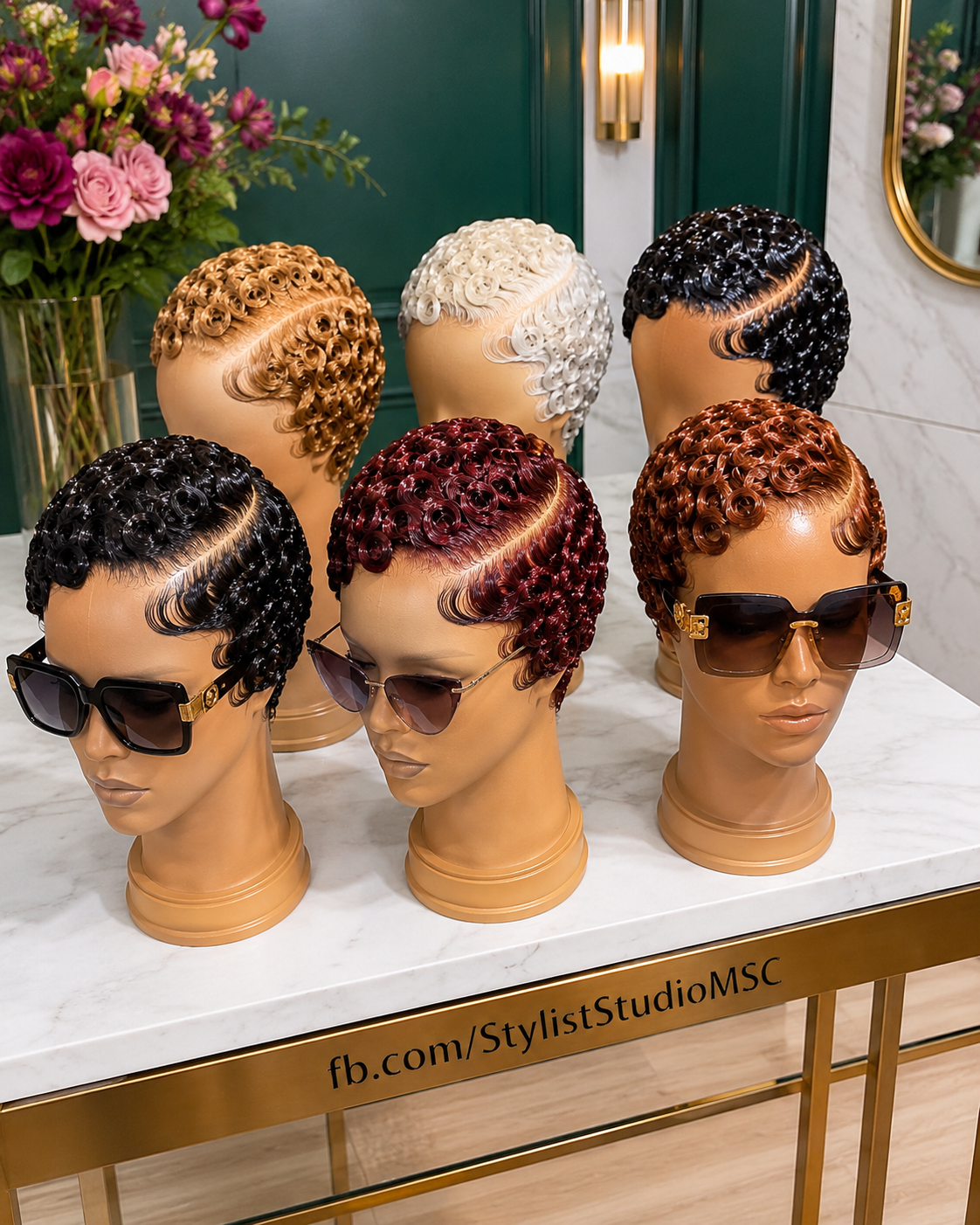
Put a pair of glasses on beside a very short curly pixie and you suddenly test a part of the wig that ordinary product photos rarely show. The arms of the frame have to travel directly through the temple and sideburn area, exactly where this style uses sculpted curls, laid edges, and a very tight perimeter.
This collection makes that interaction unusually easy to see because some of the mannequin heads are wearing large sunglasses while others show the same general side-parted finger-curl silhouette without them. The buying question is not whether sunglasses make the pixie look stylish. It is whether the wig still sits correctly when a real frame has to share the limited space around the temple and ear.
Where To Buy A Glasses-Friendly Curly Pixie Wig
Custom wig makers. If you wear prescription glasses every day, tell the maker before the wig is built. Ask for a side perimeter that leaves enough practical space around the temple and ear without sacrificing the short pixie silhouette.
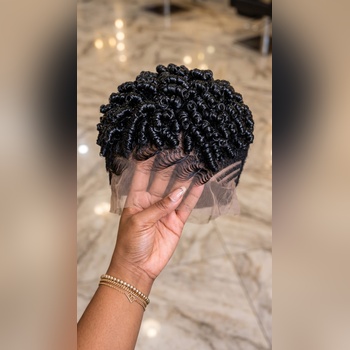
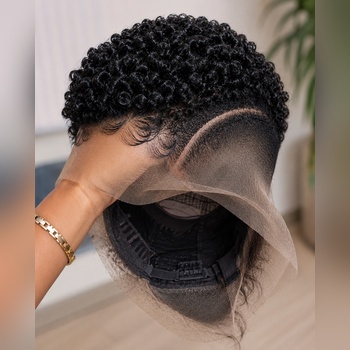
Instagram and TikTok sellers. Ask for a side-profile video with ordinary glasses or sunglasses actually being put on and removed. A finished photo proves very little if the frame was positioned carefully only for the shot.
Etsy. Independent makers can be useful when you need custom cap sizing, softer temple construction, or a specific sideburn length. Mention that you regularly wear eyewear instead of assuming every short unit will behave the same way.
Marketplaces like Amazon, AliExpress, and Temu. Compare customer photographs from the side. Look for whether glasses push the wig upward, disturb the temple curls, or disappear naturally behind the ear area.
Local beauty supply shops and salons. Local shopping gives you the easiest test: bring the glasses you normally wear. Put them on with the wig instead of judging the unit alone. Five seconds with your own frames can tell you more than several polished product photos.
Vendors and wholesalers direct. Ask for cap circumference, ear-tab position, temple density, and sideburn construction. If the seller offers several short pixies, ask which one has the least bulk around the eyewear path.
Regionally. Sellers in Lagos, Accra, Atlanta, London, and major South African hair markets often stock short curly units, but the term “glasses-friendly” may not appear in a listing. Describe the practical issue directly and provide a side-view reference.
Vet the seller. Look for side views, real-head demonstrations, and movement. The strongest evidence is a wig that remains correctly positioned while glasses are put on, worn, and taken off.
Red flags. Be cautious if the temple is extremely bulky, the sideburn curls sit directly over the ear opening, the seller never shows a side profile, or a frame visibly lifts the wig when inserted.
When you order, send. Provide your head circumference, cap size, a photo of your glasses from the side, and an approximate measurement of where the temple arm sits above your ear. That is especially useful for thick or oversized frames.
Contact / order inquiries: WhatsApp [WhatsApp: +XX XXX XXX XX XX]
How Much It Costs
Premium custom human hair. A carefully built short human-hair curly pixie can commonly range from about $220–$430 depending on lace, hair quality, ventilation, cap construction, curl work, and customization.
Standard custom human hair. Around $170–$300 can cover many wearable human-hair pixies. A glasses-friendly temple shape usually should not create a huge premium unless the unit requires substantial custom ventilation or perimeter work.
Basic human hair. Around $150–$230 may buy a simpler cap and more standardized side construction. Check the temple area carefully because generic fit becomes more noticeable on very short styles.
Good synthetic. Around $60–$150 can buy an attractive preset finger-curl pixie. Synthetic curls can keep their shape well, but stiff fibre around the ear may be less forgiving when glasses need to pass underneath or beside it.
Basic synthetic. Around $25–$70 is common for budget units. At that price, expect more standardized cap dimensions and less individual shaping around the temples.
What the price may exclude. Custom sizing, lace tint, bleached knots, adjusted sideburn length, hand ventilation, professional fitting, and later perimeter alterations may be separate charges.
Shipping and duty. International delivery, customs, and local taxes can significantly increase the final cost. Compare the landed price rather than only the product listing.
Ongoing costs. Eyewear itself can create repeated friction against the same temple area. Over time, that may mean more edge refreshing or minor reshaping even if the rest of the wig remains in good condition.
First-year total. Include curl products, edge products, lace care, and possible stylist adjustments if the side area needs to be softened after you begin wearing the wig with glasses.
Cost per wear. If you wear glasses every day, compatibility has real financial value. A slightly cheaper wig that becomes irritating beside your frames may spend far more time unused.
What a very low price may signal. It can indicate generic sizing, bulky side construction, heavier lace, or a perimeter that was designed for appearance rather than repeated real-world use.
Deposit structure. Custom makers commonly request roughly 30–50% upfront and the balance before shipping. Keep your sizing and temple instructions in writing and use a payment method that provides a dispute process.
Shipping, Delivery, And What To Expect After Ordering
Inspect the wig before trimming the lace. First place it in the intended position without glasses and check the front, temples, ear area, and nape.
Then put on the exact glasses you normally use. Do not force the arms underneath the wig. Slide them into their natural wearing position and watch what happens to the temple curls and the side edge.
Repeat the test several times. The problem is often not how the glasses look while stationary, but what happens every time you put them on and take them off.
The arms of most glasses travel from the front of the face across the temple and above or around the ear. On a long hairstyle, that path can disappear underneath loose hair. A short pixie is different.
The exact same zone may contain a sculpted side curl, sideburn detail, lace perimeter, or a deliberately shaped edge. There is very little spare material to move out of the way.
If the wig is too bulky there, the glasses can sit farther away from the head than intended. If the frame arm is thick, it may push against the side of the unit and make that area lift slightly.
Neither problem necessarily means the wig or glasses are poor quality. They may simply be competing for the same small piece of space.
Large Frames Need More Clearance Than Thin Frames
The sunglasses shown on several mannequins in this collection are large, with relatively substantial arms and decorative side hardware. That is a much harder test for a pixie wig than a very thin metal frame.
A narrow frame can often slide beside a compact sideburn without changing much. A thick plastic or embellished arm occupies more space and creates more contact with the hair.
If you regularly wear oversized sunglasses, do not test a wig only with thin reading glasses. Use your largest everyday frame when evaluating the side.
Compatibility is partly about the wig and partly about the eyewear you actually own.
Sculpted Sideburn Curls Can Be Crushed Repeatedly
The front and temple areas in these pixies use carefully shaped curves. Some are tight ringlets while others flatten into smooth swoops close to the face.
A glasses arm passing over the same curl every day can gradually flatten that shape. The first few wears may show no obvious change, but repeated pressure in one exact location creates a small maintenance zone.
For human hair, you can usually wet and reshape that curl. With heat-sensitive synthetic fibre, restoration options may be more limited.
This does not mean you should avoid a sculpted pixie if you wear glasses. It means the side curl should be positioned intelligently rather than directly beneath the most rigid part of your frame.
Laid Edges And Eyewear Create A Friction Point
Laid edges are designed to sit close to the skin. Eyewear introduces movement against that same area.
Every time glasses are pushed backward, removed quickly, or adjusted during the day, the frame can touch edge product and small perimeter hairs. That repeated rubbing may disturb the finish sooner than it would on a wearer who does not use glasses.
The practical fix is not simply more gel. Heavy product can transfer onto the frame and create additional buildup.
A better approach is to keep the actual contact zone relatively light and let the more decorative swoops sit slightly away from the frame path.
Glasses Can Reveal A Wig That Is Already Too Tight
A cap may feel acceptable by itself but uncomfortable once glasses are added. The frame arm becomes another layer pressing between the head and the wig perimeter.
If the cap is already extremely tight, that extra pressure can create soreness around the temples or above the ears. Buyers sometimes blame the glasses even though the underlying problem is an over-tight wig.
A correctly sized cap should leave enough comfort margin for ordinary daily items such as glasses without creating a painful pressure point.
This is one reason cap size and eyewear compatibility should be tested together rather than separately.
Side-Part Placement Can Change How Frames Look
This collection uses a pronounced side part across several colourways. That creates an asymmetrical visual weight: one side has more curl mass while the other side is more sculpted and exposed.
Large glasses add another strong horizontal element across the face. On some pixies, that contrast can look balanced. On others, a very heavy frame may visually compete with the detailed side part and temple curl.
That is not a construction defect; it is a styling interaction. But it is worth considering if the frame is something you wear every day.
A wig can look excellent on its own and still feel different once your normal glasses become part of the silhouette.
Use Sunglasses In Product Photos As A Fit Test
Most buyers see sunglasses in a wig display as decoration. They can actually provide useful information.
Look at where the frame arms disappear beside the wig. Does the side stay flat? Is the temple curl crushed? Does the ear area look crowded? Does the frame appear unusually far away from the mannequin head?
Those small clues can help you judge whether the short perimeter accommodates eyewear naturally.
Of course, a mannequin photo cannot prove comfort. But it can tell you which questions to ask before ordering.
Colour Is Not The Main Decision In This Display
This group includes black, burgundy, pale blonde, warm copper, and golden-brown versions of a very similar short curl silhouette. The colour range is visually strong, but it is not the most useful buying insight here.
The more unusual clue is that the front row demonstrates the same type of pixie with large eyewear attached. That introduces a real-life object into the silhouette and lets you see how little room exists between the frame, sideburn, and temple curls.
When you already know you wear glasses every day, that practical interaction may matter more than whether you choose black, copper, or burgundy.
Before You Pay
- Can you show this pixie being worn with a normal pair of glasses from the side?
- Is there enough space around the temple and ear for a thick frame arm?
- Will the glasses rub directly against the sculpted sideburn curls or laid edges?
- Can the sideburn position be adjusted slightly if I wear glasses every day?
- What cap size should I choose so adding eyewear does not create excessive temple pressure?
Trimming The Lace
Test your glasses before making the final lace cut. Place the wig in its intended position, put the frames on naturally, and confirm that you do not need to pull the unit forward or backward just to make room for them.
Once the position works, trim the lace gradually. Keep an eye on the temple area because that is where the front lace, sideburn detail, and eyewear path come closest together.
If the frame constantly catches a particular small section of hair, ask a stylist whether that section can be redirected instead of repeatedly forcing the glasses through it.
Search Terms
glasses friendly curly pixie wig · sunglasses short curly pixie wig · side part finger curl pixie wig · pixie wig with sculpted sideburns · black curly pixie wig glasses · burgundy finger curl pixie wig · copper short curly pixie wig · blonde side part pixie wig
Final Thoughts
The glasses in this collection are more than display accessories. They reveal a practical question that matters to anyone who wears prescription frames or sunglasses regularly: can the temple, sideburn, and ear area of a short pixie share space with eyewear without being crushed, lifted, or made uncomfortable?
Test that interaction before buying whenever possible. A good short wig should work with the things you actually wear every day, not only look perfect on an empty mannequin head. When the cap fit, temple shape, sideburn placement, and eyewear all cooperate, the pixie becomes much easier to live with.