
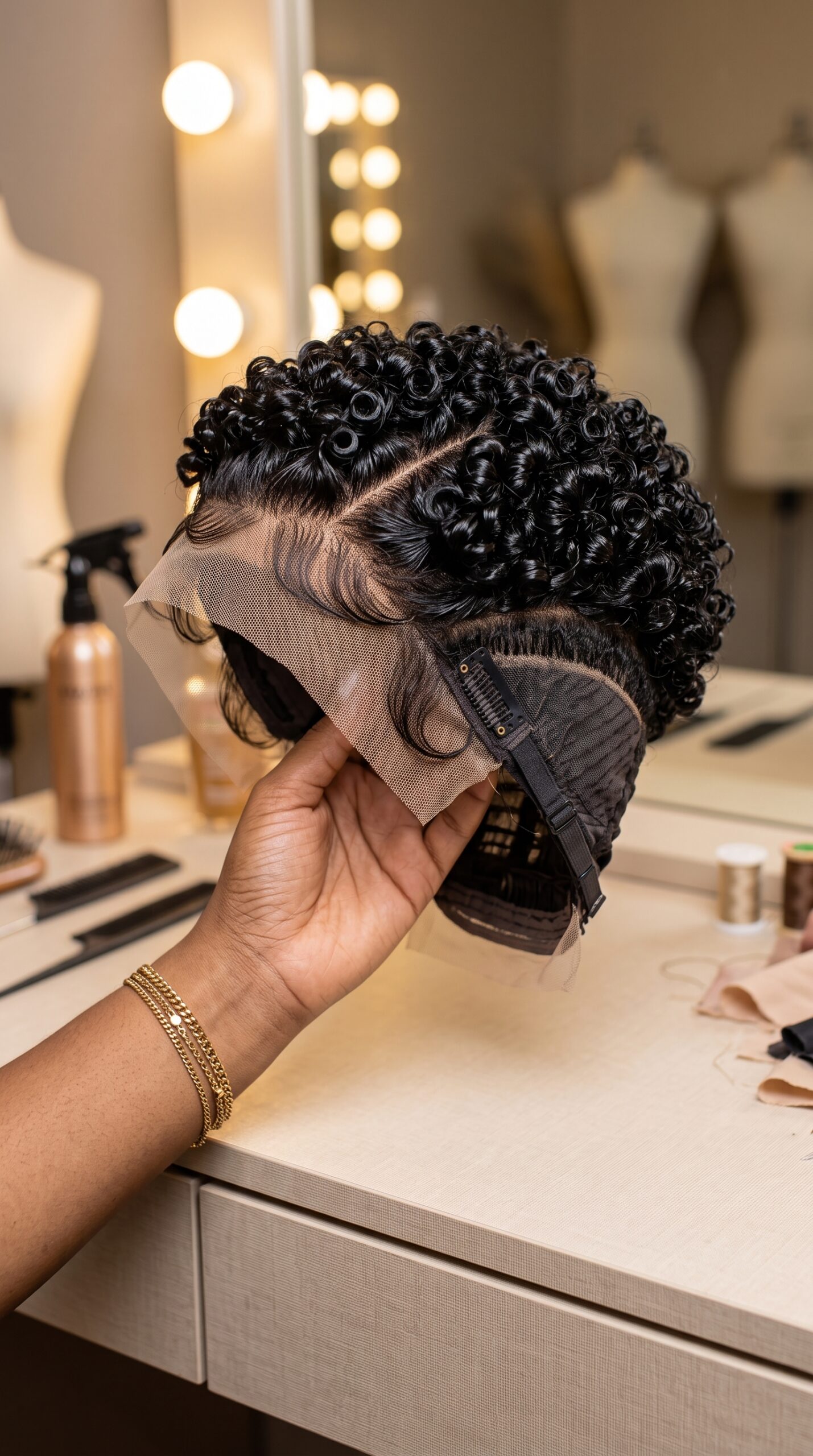
A side part this narrow can reveal more about a short wig than a large section of visible lace. On this jet-black curly pixie, the curls are compact and glossy, but the clean scalp-like line running through the top is what determines whether the style still looks convincing when you move the curls away from their photographed position.
That matters because a part is not simply a styling line. It depends on the construction underneath it. Before paying for a unit like this, you need to know whether the part is ventilated into lace, restricted to a small closure area, or only created by pushing hair away from a fixed section of the cap.
Where To Buy A Side-Part Curly Pixie Wig
Custom wig makers. A custom maker is useful when the exact position and width of the part matter. Ask whether the parting area is hand-ventilated lace and request an inside-cap photo before paying. A finished top view alone cannot show how much usable parting space exists.
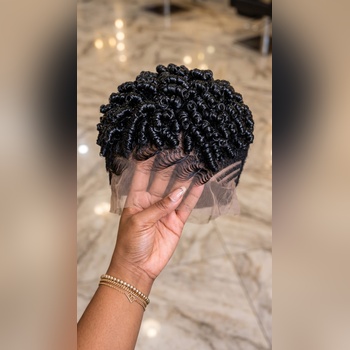
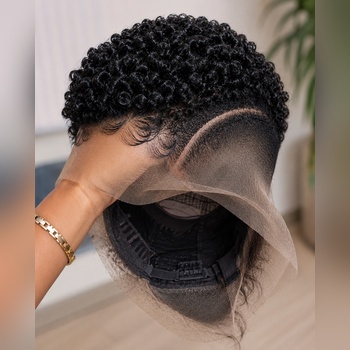
Instagram and TikTok sellers. Short curly units are common on social platforms, but videos should show more than the styled front. Ask the seller to separate the curls along the part with a comb and show the lace underneath in ordinary light.
Etsy. Independent makers can be useful for custom cap measurements, curl placement, and part location. Read the description carefully because “lace wig,” “lace front,” and “closure wig” do not describe the same amount of usable parting space.
Marketplaces like Amazon, AliExpress, and Temu. These can offer lower-cost versions, but compare buyer photos with the listing images. Pay particular attention to the top construction, lace dimensions, cap interior, comb placement, and whether the part shown in promotional photos appears in customer units.
Local beauty supply shops and salons. Buying locally gives you one major advantage: you may be able to inspect the part before leaving with the wig. Place the unit on a mannequin or wig stand and gently move the curls on both sides of the part. The line should look intentional rather than like a gap exposing cap fabric.
Vendors and wholesalers direct. If a vendor supplies multiple sellers, ask for the exact construction specification rather than only the style name. Useful questions include the lace dimensions, closure dimensions, density, fibre type, cap size, and whether the part can be moved.
Regionally. Wig makers and beauty suppliers in Lagos, Accra, Atlanta, London, and major South African cities often carry short curly units or can build them to order. Availability and terminology vary, so use photos plus construction questions instead of relying on the product name alone.
Vet the seller. Look for consistent customer videos, close-ups of actual units, clear return terms, and photographs of the inside cap. A seller willing to show the underside gives you much more useful information than one who only sends heavily styled front views.
Red flags. Be cautious if every photo uses the same angle, the seller refuses to show the cap, the part is digitally smooth-looking, or the description promises unlimited parting without showing a large lace area. A narrow fixed part and a freely movable part are different products.
When you order, send. Provide a reference image, your preferred side for the part, head circumference, desired cap size, human-hair or synthetic preference, and whether you need a glueless fit. If the exact part is important, mark its position on the reference rather than saying only “side part.”
Contact / order inquiries: WhatsApp [WhatsApp: +XX XXX XXX XX XX]
How Much It Costs
Human-hair pricing. A well-made black human-hair curly pixie can commonly fall around $150–$430 depending on hair quality, lace, ventilation, density, customization, and cap construction. A genuinely hand-ventilated parting area can push the price upward because it requires more labor.
Mid-range human hair. Around $180–$280 can be a practical range for a short human-hair unit with decent lace and a usable part, although specifications matter more than the price label.
Basic human hair. Lower-priced human-hair units may use a smaller lace or closure section, heavier knots, simpler machine construction, or more processed hair. That does not automatically make them poor purchases, but the limitations should be clear.
Good synthetic. Roughly $60–$150 can buy a convincing short synthetic unit. Preset curls can hold their shape well, but check whether the scalp line and part look realistic because you may have less freedom to restyle the fibre.
Basic synthetic. Around $25–$70 is common for budget units. At this level, inspect the top carefully: a convincing curl pattern can distract from a visible cap or an artificial-looking part.
What the price may exclude. Custom cap sizing, knot work, lace tinting, bleaching, extra hand ventilation, shipping, duties, and professional fitting can be separate charges.
Shipping and duty. International orders can become significantly more expensive after delivery charges, import fees, or local taxes. Compare the landed cost rather than only the listed wig price.
Ongoing costs. Human hair may need curl products, conditioner, occasional restyling, and lace maintenance. Synthetic hair generally needs fewer styling products but may be harder to repair or reshape once the fibre deteriorates.
First-year total and cost per wear. A $250 unit worn 80 times costs a little over $3 per wear before maintenance. A $70 unit replaced after 15 wears costs nearly $5 per wear. Purchase price alone does not tell you which is cheaper to own.
What a very low price signals. It can indicate simpler lace, lower-cost fibre, machine-heavy construction, limited customization, or a fixed part. Ask what has been simplified to reach the price.
Deposit structure. Custom makers may request roughly 30–50% upfront and the balance before shipment. Use a payment method that provides a dispute process and keep the written specifications and reference photos.
Shipping, Delivery, And What To Expect After Ordering
Ask the seller how long production takes separately from shipping. A ready-made unit can dispatch quickly; a customized cap, ventilated part, altered density, or custom hairline may require additional production time.
When the wig arrives, inspect it before cutting the lace. Photograph the package, front lace, parting area, cap interior, combs, elastic strap, seams, and overall curl pattern. Compare those details with what you ordered while the unit is still in returnable condition.
Do not judge the part only while the curls are freshly arranged. Gently lift the hair on both sides and check what continues underneath. The construction should match the seller’s description.
The Parting Line Is A Construction Test
In this image, the narrow diagonal side part is unusually visible because the hair is deep black and highly reflective. The scalp-like strip creates contrast between two dense sections of small curls.
The useful buying question is not simply, “Does the part look good?” Ask, “What is underneath that line?”
A lace-based part contains individually ventilated hairs around a mesh area, allowing the exposed line to resemble scalp after appropriate tinting. A closure provides a defined lace zone but limits how far the part can move. A machine-made or heavily wefted top can sometimes be styled to imitate a part, yet moving that line may expose tracks or cap material.
That distinction matters on a pixie because there is very little length available to cover construction mistakes.
Fixed Part Versus Free Parting
A fixed part is not automatically inferior. If you want to wear the wig exactly as photographed, a well-made fixed side part can be practical, stable, and less expensive.
The problem begins when a fixed construction is sold as though it offers broad styling freedom.
Ask the seller to move the part one or two centimeters in both directions on video. If a realistic scalp line remains available, the unit has genuine usable parting space. If tracks, dense knots, or fabric immediately appear, treat it as a fixed-part design.
For a short curl like this, decide before buying whether you actually need free parting. Paying for a large lace area that you never use can be unnecessary.
Curl Placement Around The Part Matters
The curls immediately beside the part perform a different job from those at the crown. They need enough density to prevent the part from looking bald, but not so much that the line disappears completely.
Look for gradual distribution. The part should remain visible without becoming an unnaturally wide strip. When the hair is moved, the surrounding curls should fall back toward the line rather than exposing a large empty section.
This is especially important with compact ringlets. Their spring can make a part look narrower or wider depending on how freshly the unit has been set.
Check The Part Before Styling Products Hide It
Gloss, mousse, gel, and curl-setting products can make the top look exceptionally precise in seller photography. They can also hold every curl exactly where the maker wants it.
Ask to see the unit dry and lightly separated. A well-built part should still make sense when the curls are not glued visually into one perfect arrangement.
For human hair, also ask for a washed or minimally styled example when possible. You are checking whether the construction creates the part, rather than whether styling product temporarily creates the photograph.
Glueless Hardware Does Not Create A Better Part
The visible comb and adjustable strap in a unit like this are fit components. They help secure the cap; they do not change the amount or quality of lace available for parting.
A secure glueless fit can keep the part in the intended position, which is useful. But a tight strap cannot turn a machine-made top into a free-part lace area.
Keep the questions separate: first verify cap fit and security, then verify part construction and styling freedom.
Before You Pay
- Is this side part fixed, or can I move it without exposing tracks or cap fabric?
- What are the exact dimensions of the lace or closure used at the top?
- Can you send a video separating the curls along and beside the part?
- Can I see the inside cap directly underneath the visible parting line?
- If the delivered construction differs from the video, what is the return or remake policy?
Trimming The Lace
Do not cut the lace while deciding whether the unit matches the order. Once you are satisfied, place the wig in its intended position and trim gradually rather than cutting a large section in one pass.
Leave enough lace to follow the hairline safely without cutting into ventilated hairs. Around a short pixie, small errors are difficult to hide because there is no long fringe to cover an uneven edge.
If you are uncertain, a wig stylist can trim and tint the lace while preserving the hairline and intended side-part alignment.
Search Terms
jet black side part curly pixie wig · glueless curly pixie lace wig · side part short ringlet wig · lace part curly pixie wig · black short curl closure wig · scalp part pixie lace wig · compact ringlet glueless wig · side part human hair pixie wig
Final Thoughts
The strongest buying clue in this jet-black curly pixie is not simply the glossy curl pattern. It is the narrow, exposed side part and the construction required to make that line look like scalp. A beautiful part in one photograph means little if the cap underneath does not provide the parting freedom the listing promises.
Buy according to how you intend to wear the unit. If the photographed side part is exactly what you want, a stable fixed construction may be perfectly sensible. If you want to move the part, verify the lace area before paying. That one check can separate a genuinely flexible wig from a style that only works in its original position.