
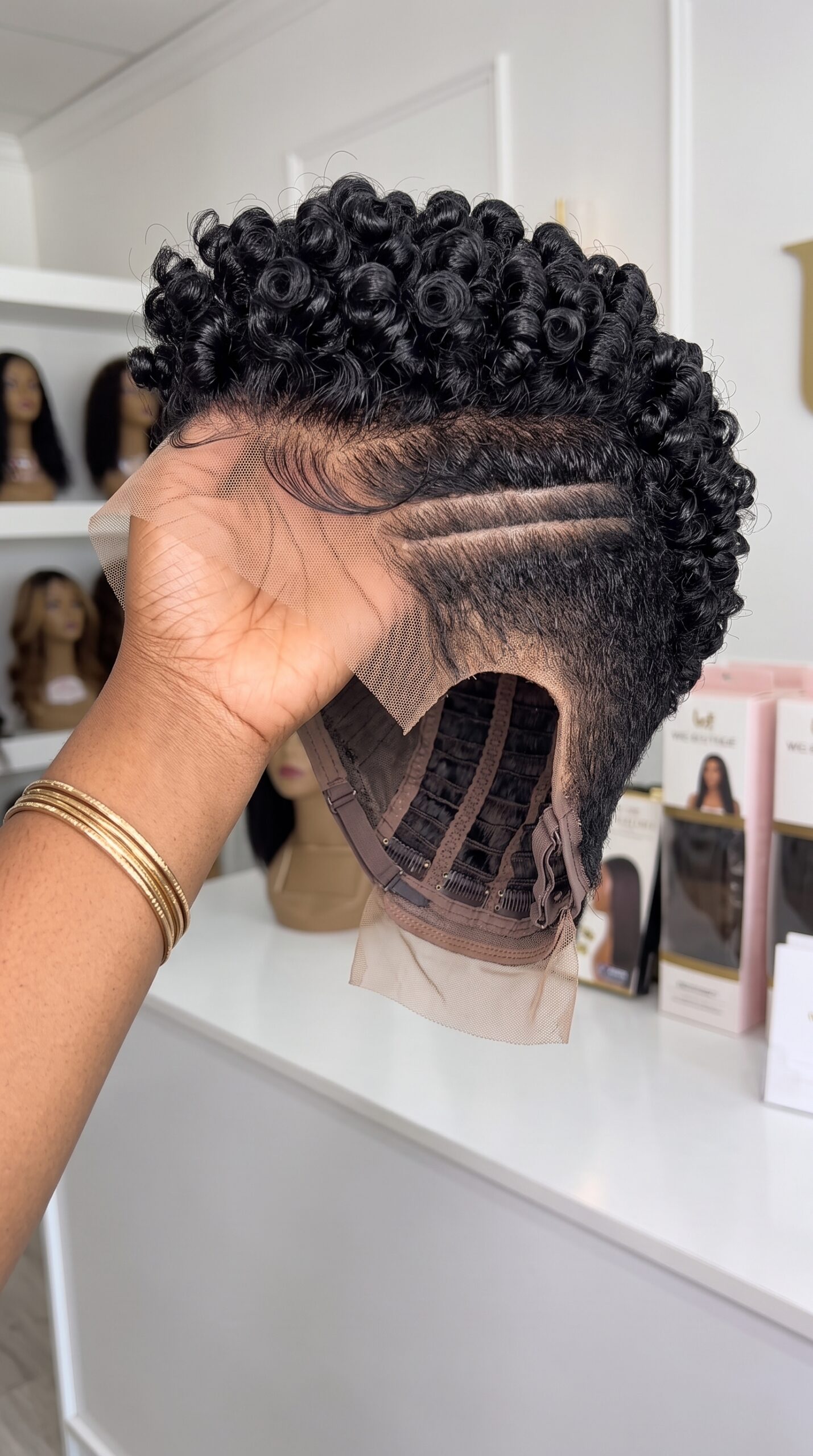
The moment a short pixie wig sits even slightly too high around the ear, the whole illusion changes. On a curly unit like this one, the dense glossy curls and carved side detail may grab attention first, but the real buying test is lower down: how the wig’s perimeter travels from the temple, past the sideburn area, and toward the nape.
That matters because a short wig cannot hide perimeter mistakes the way a longer style can. If the ear area is cut too high, the sideburn zone ends too early, or the fade extension lands in the wrong place, the unit can look like it is floating above the head instead of melting into it. Before paying for a pixie like this, you need to know whether the coverage around the ear and sideburn has been built for realism or only for the photo angle.
Where To Buy A Curly Pixie Wig With Good Ear Coverage
Custom wig makers. A custom maker is often the best option when the perimeter matters. Ask specifically about temple coverage, sideburn length, ear-tab placement, and how the fade or side section is built along the lower edge of the wig.
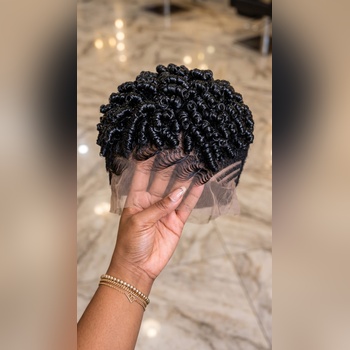
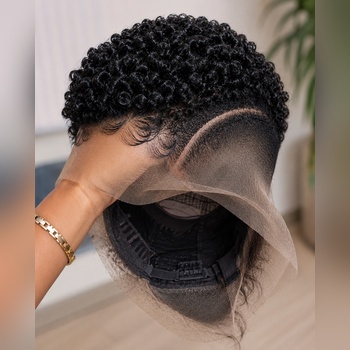
Instagram and TikTok sellers. Social sellers frequently show only the most flattering top angle. Ask for a slow side video that starts at the temple, moves around the ear area, and continues to the nape. That is where good short wigs prove themselves.
Etsy. Independent makers may offer custom perimeter shaping, measured cap sizing, and a better match for how low or high you want the side area to sit. Read closely to see whether the perimeter is hand-ventilated lace or simply machine-finished at the edge.
Marketplaces like Amazon, AliExpress, and Temu. Budget options can look appealing in front-facing photos, but you should compare customer images for the side profile. A wig can have beautiful curls on top and still fail at the ear line.
Local beauty supply shops and salons. Local purchase can be helpful because you may be able to hold the wig up against a mannequin or your own head and judge how the side area would fall. On a short unit, that practical test is extremely valuable.
Vendors and wholesalers direct. If you buy from a direct vendor, ask for exact cap dimensions, lace type, and photos of the full perimeter. Use the phrase “temple-to-nape coverage” rather than only asking whether it is a lace wig.
Regionally. Sellers in Lagos, Accra, Atlanta, London, and major South African hair markets often understand short wig demand well, but terminology differs. Use photos and measurements, not only style names, when discussing a short tapered pixie.
Vet the seller. Favor sellers who show top, side, back, and underside views. A serious seller should be able to show how the perimeter is finished and where the wig is expected to sit around the ear.
Red flags. Be careful if the listing hides the side profile, crops out the lower perimeter, or shows only a mannequin angle where the ear area cannot be judged. A short wig with weak lower-edge design is easy to photograph and much harder to wear convincingly.
When you order, send. Provide your head circumference, preferred cap size, whether you want glueless security, whether the side should sit tightly around the ear, and a reference image showing the exact silhouette you want.
Contact / order inquiries: WhatsApp [WhatsApp: +XX XXX XXX XX XX]
How Much It Costs
Human-hair pricing. A black human-hair curly pixie commonly falls around $150–$430 depending on hair quality, lace, density, hand ventilation, cap fit, and how detailed the perimeter work is.
Mid-range human hair. Around $180–$290 can buy a good short curly human-hair unit, especially if the cap is average-sized and the perimeter design is standard rather than heavily customized.
Basic human hair. Lower-priced units may still look attractive, but the corners are often cut in the finishing details: heavier perimeter knots, less precise shaping around the ear, simpler lace, or a more generic cap that does not hug the side profile cleanly.
Good synthetic. Roughly $60–$150 can buy a visually strong short pixie, particularly if you only need the exact photographed look. But the lower perimeter still needs checking because preset curls on top do not guarantee a believable side silhouette.
Basic synthetic. Around $25–$70 is common for budget units. At this level, sideburn coverage and perimeter realism are often among the first things simplified.
What the price may exclude. Custom cap sizing, lace tinting, extra hand ventilation, perimeter reshaping, professional installation, and shipping may all be separate costs.
Shipping and duty. International orders may rise significantly in final cost after shipping, import fees, and taxes. Compare the total landed price, not just the listing amount.
Ongoing costs. Human hair may need conditioning, curl refreshing, and lace maintenance. Synthetic hair may cost less up front but can be harder to restore once the perimeter or fiber begins to deteriorate.
First-year total. Think in terms of usage. A well-fitting short wig worn frequently may justify a higher upfront cost if it sits correctly every time and needs less corrective styling.
Cost per wear. A cheap unit that always needs adjustment around the ear may cost less to buy but more in frustration, styling time, or early replacement.
What a very low price signals. It may indicate a simpler cap, less refined perimeter, lower lace quality, or a generic fit that was not built for a believable short side silhouette.
Deposit structure. Custom orders often require roughly 30–50% upfront and the balance before dispatch. Use a payment method that allows disputes and keep your written specifications.
Shipping, Delivery, And What To Expect After Ordering
Ask separately about production time and shipping time. A ready-made short wig may ship fast, but customized perimeter shaping or a specific cap size can add build time.
When the wig arrives, inspect it before cutting the lace. Photograph the top, side profile, ear-area perimeter, nape, underside, combs, elastic band, and seams. On a short unit, those construction details matter more than they would on a long hairstyle.
Do not evaluate the wig only from above. Hold it in side profile and check where the lower edge sits. The question is whether the lower perimeter seems designed to follow a real head shape.
The Ear Line Can Make Or Break A Short Wig
This image shows exactly why perimeter design matters. The top is full of compact glossy curls, and the side fade with carved parallel lines looks sharp. But the most informative area is the lower side section extending beneath the curls toward the ear and nape.
A short pixie creates a strong silhouette, so every edge becomes visible. If the wig stops too early near the ear, the head shape can look abruptly cut off. If it drops too low or too bulky, the side may look heavy and unnatural.
On a longer wig, you can often hide those problems with extra hair. On a pixie, you cannot.
Temple Coverage And Sideburn Reach Are Not The Same Thing
Many buyers treat the whole side area as one zone, but it helps to separate it into smaller jobs. The temple area is where the front transitions into the side. The sideburn reach is how far the perimeter continues downward and forward around the face. Then the lower side and nape complete the silhouette.
A wig can perform well in one of those zones and poorly in another. For example, a unit may have a nice temple melt but stop too high near the sideburn area. Or it may extend low enough, but with a bulky, blunt finish that looks less like a fade and more like a flap.
Ask to see the full side in one uninterrupted shot. That tells you more than a close-up of only the front hairline.
Ear-Tab Placement Controls Wearability
The practical reason this matters is comfort and placement. If the perimeter is shaped well but the ear-tab position is wrong, the wig may constantly shift or sit in tension around the ear. That can make even a pretty unit feel unstable.
A good short wig should land where it is meant to land without forcing you to choose between a believable front and a believable side. If you must pull the unit unnaturally forward to improve temple coverage, you may ruin the nape alignment. If you pull it back to improve the side fade, the front may stop looking right.
That is why ear-tab placement is a fit question as much as a beauty question.
Fade Realism Depends On Where It Ends
This wig also shows another useful point: the faded lower side is not just about how gradually the hair thins, but where that section ends around the head.
A technically nice fade can still look wrong if the perimeter reaches the wrong spot. Think of it as architecture rather than decoration. The fade must be built to finish at the correct boundary so the whole short cut keeps a believable head shape.
This is different from simply asking whether the fade is knotted or cut. That question is about how the fade is built. The question here is about where the lower edge and side section sit in relation to the wearer’s ear and jawline.
The Underside Tells You Whether The Shape Is Serious
The inside of the cap is visible in this image, and that is a major buying advantage. The underside helps you judge whether the lower side structure was thoughtfully built or whether the photograph is doing most of the work.
Look for whether the perimeter appears planned, whether the hand-ventilated or faded sections correspond logically to what you see from outside, and whether the cap opening would allow the wig to sit naturally without exposing odd bulk or gaps.
The underside cannot answer every question, but it helps show whether the style depends on real construction or on careful posing.
Before You Pay
- Can you show a full side-profile video from the temple past the ear and down to the nape?
- How far does the sideburn and lower side coverage extend when the wig is worn?
- Where are the ear tabs positioned, and is the cap available in my correct size?
- Does the lower side perimeter sit flat, or is it bulky when worn on a real head?
- If the perimeter shape around the ear does not suit me, what is the remake or return policy?
Trimming The Lace
Do not trim the lace until you are sure the wig sits correctly. With a short pixie, trimming too early can make it harder to judge whether the temple and ear-area perimeter are placed well.
Trim gradually and conservatively. Follow the intended hairline without cutting into ventilated hairs. On a short unit, there is little extra length to disguise an error, so patience matters.
If you are unsure, let a wig stylist handle the lace trimming and first fitting. On styles like this, the placement and edge work are too visible to rush.
Search Terms
curly pixie wig ear coverage · sideburn coverage pixie wig · glueless short curly lace wig · tapered pixie wig side profile · temple to nape pixie wig · short curly wig ear tab fit · black ringlet pixie wig lace front · undercut curly pixie wig
Final Thoughts
The real buying lesson in this wig is that short styles are judged from the edge inward. The curls on top may attract you first, but the lower perimeter around the ear, sideburn, and nape is what determines whether the unit looks integrated or merely styled for one angle.
If you love short pixie wigs, learn to shop for perimeter design as carefully as you shop for curls, lace, or color. A strong top with weak ear-area coverage is still a weak short wig. When the temple, sideburn, and lower edge are all shaped intelligently, a unit like this can look sharp from more than one angle.