
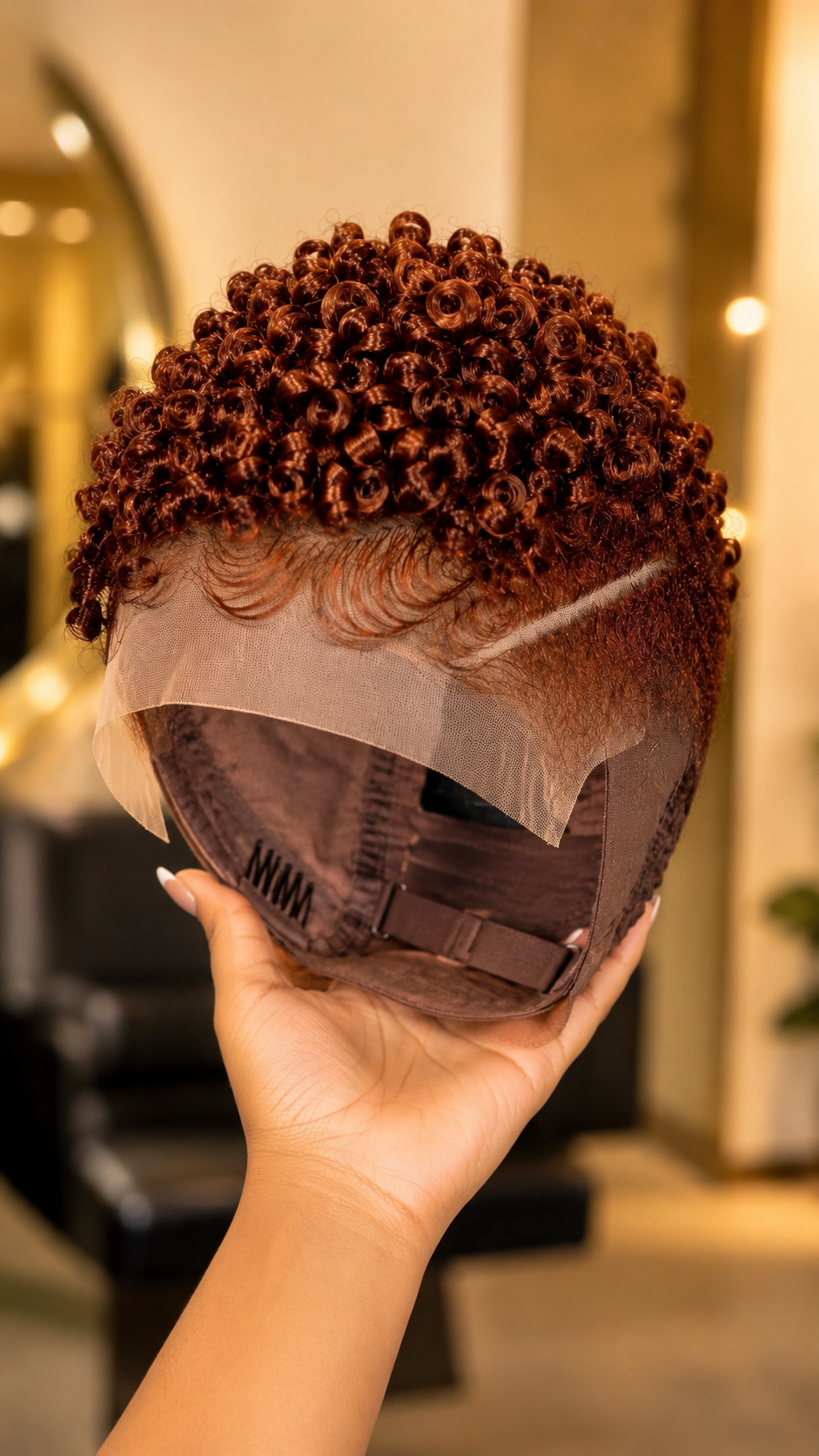
Follow the edge of this unit from the temple down to the nape and notice the shape it cuts. That perimeter, where the hair ends and the neck begins, is a design decision most buyers never think about, and it changes the whole look. A short unit has no length to cover its own edges, so the shape of the nape and sides is fully on show and frames your head and neck directly. Cut one way it slims and elongates; cut another it reads bold and blunt. The curl gets all the attention, but the shape of the perimeter is quietly doing as much to how the unit suits you.
There are a few common nape shapes, and they are not interchangeable. A tapered nape narrows as it falls, coming to a soft point or a close taper at the neck, which lengthens the neck and slims the whole back of the head. A squared or blunt nape ends in a straighter line, which reads stronger and more graphic but can shorten a short neck. A rounded nape sits between them, soft and neutral. On top of that is the perimeter height: a higher nape shows more neck and looks airier, a lower one covers more and feels fuller. Each of these flatters a different neck length and head shape, and the wrong one can make a well-made unit look off on you.
So the nape shape is a feature to choose on purpose, matched to your neck and face, not left to whatever the unit happened to come in. On a curly pixie wig, where the perimeter is impossible to hide, its shape deserves the same thought you give the colour and the curl.
Where To Buy A Curly Pixie Wig With A Nape Shape That Suits You
Custom makers can cut the perimeter to a shape that suits your neck and head, which is worth asking about, because a nape tailored to you flatters in a way a standard cut may not. Ask whether they can taper, square, or round the nape to your preference. A maker who cuts to suit you is selling a shape that fits; one who ships a single shape leaves the framing to chance.
Instagram and TikTok sellers show the unit from the front, so ask for video of the nape and sides to see the perimeter shape. A curly pixie wig lives or dies partly on how its back is cut, and a front-only clip hides exactly that.
Etsy works with makers who show the nape and describe the shape, with real buyer photos from behind. The risk is a listing that shows only the styled front. Read reviews for anyone mentioning how the back sat on the neck.
Marketplaces like Amazon, AliExpress, and Temu ship a fixed perimeter shape with no tailoring, so you take whatever nape the unit comes with. That is fine if the shape happens to suit you, and a limitation if it does not. Judge by photos of the back, not just the front.
Local beauty supply shops and salons let you see the nape shape against your own neck, and a stylist can even re-cut the perimeter to suit you. You pay a premium in-store, but the nape is exactly the part you want to judge on your own head.
Vendors and wholesalers direct ship standard perimeter shapes in bulk, so tailoring is unlikely. For a nape cut to suit your neck, a maker or a stylist re-cut beats stock.
Regionally, makers who shape napes to suit the wearer come strongly out of Lagos, Accra, Atlanta, London, and across South Africa, where you can find stylists who cut short perimeters by hand on video.
Vet the seller on the back: check the account age, look for real buyer photos from behind, time a plain question for a genuine reply, and ask what nape shape the unit has and whether it can be tailored. A seller who only shows the front is not showing you half of what you wear.
Red flags: a unit shown only from the front, no answer on the nape shape, a blunt perimeter on a style that needs a taper, and no option to adjust the cut.
When you order, send your measurements and a note on your neck length and the framing you want, and ask whether the nape can be tapered, squared, or rounded to suit you. That tells the maker the perimeter matters to you as much as the curl.
On payment, thirty to fifty percent down with the balance before shipping is standard for custom work. Use a method you can dispute, and ask for a photo of the finished nape from behind before releasing the last part.
How Much It Costs
The nape shape rarely appears as a price line, yet it decides how a curly pixie wig frames you, so it is worth getting right whether through a custom cut or a stylist afterward.
Human hair, full build with a perimeter cut to suit you, glueless with bleached knots and a fine lace, in this warm auburn: roughly $200 to $430, with the colour adding around $55 to $115 over black. A custom nape shape may add a little for the tailoring, and it is money well spent when the framing flatters you. Human hair, mid build with a standard perimeter: about $150 to $310. Human hair, basic cap: around $70 to $180. Good synthetic: $60 to $140, though synthetic is harder to re-cut cleanly. Basic synthetic: $20 to $55.
The honest point is that a standard perimeter is a gamble on your neck and head, while a shape cut to suit you is a small cost that makes the whole unit look intentional. If a stock nape does not flatter you, a stylist can often re-cut a human unit’s perimeter for a modest fee, which is far cheaper than replacing a unit that simply sits wrong at the back. Budget for that re-cut if you buy standard, since the framing is worth fixing.
Shipping and any customs charge sit outside the price and change with where you live, so plan a realistic band and confirm your own country’s import rate rather than trusting a single quoted figure.
Then the later costs, small here. A stylist re-cut if the stock nape does not suit you, plus the usual curl and colour upkeep. First-year math, honestly: a human unit plus shipping plus any customs plus a possible perimeter re-cut plus upkeep tends to land between a low three-figure total and roughly double the sticker, with the nape shaping being a one-off worth paying for the framing it buys.
Per wear, a unit whose nape suits you looks right from every angle and gets worn with confidence, while one with a mismatched perimeter looks off from behind no matter how good the curls are. A low price on a unit with the wrong nape shape for you is not a saving if it never looks right on your neck.
Deposits follow the custom pattern: thirty to fifty percent to start, balance before shipping, and a photo of the finished nape before the last payment clears.
Shipping, Delivery, And What To Expect After Ordering
A short unit’s nape shape is set by the cut, so it arrives as it will be worn, which makes checking the back on arrival important. Ask that it ship so the perimeter is not crushed out of shape, choose a tracked service for custom work, and confirm your country’s import charge before it lands. When it arrives, put it on and look at the nape in a mirror from behind: a shape that frames your neck cleanly is what you want, and if the perimeter sits wrong, a stylist can re-cut a human unit to suit you. What you unbox is the framing the maker chose, and adjusting it to your neck is the finishing step.
A Tapered Nape Slims, A Squared One Reads Bolder
The single biggest choice in a short perimeter is taper versus square. A tapered nape narrows toward the neck, which lengthens and slims the back of the head and suits most necks softly. A squared nape ends in a stronger, straighter line, which makes a graphic, confident statement but can visually shorten a short neck. Neither is better; they simply frame differently. Choose the taper for a soft, elongating finish and the square for a bold one, based on the effect you want and the neck you have.
Perimeter Height Changes How Much Neck Shows
Beyond the shape, how high the perimeter sits decides how much neck is on display. A higher nape lifts off the neck, showing more skin and looking airy and light, which flatters a longer neck and can lengthen a shorter one. A lower nape covers more and reads fuller and softer. This is a lever you can choose: more neck for a lifted, elongated look, less for a fuller, framed one. On a short unit it is a visible, deliberate part of the style.
The Perimeter Is Fully Exposed On A Short Unit
Unlike a long style that drapes over its own edges, a short unit shows its entire perimeter, so the nape and side shapes are on display all the time. This is why the cut matters so much here: there is nowhere for an unflattering shape to hide. It is also why a short unit rewards a perimeter cut to suit you, because every angle of the shape is seen. Judge the back as carefully as the front, since on a short curl you wear both.
Before You Pay
- What shape is the nape, tapered, squared, or rounded, and does it suit my neck?
- Can the perimeter be cut or adjusted to frame my head and neck?
- How high does the nape sit, and is that the amount of neck I want to show?
- Can I see the unit from behind, since the perimeter is fully exposed?
- If the stock shape does not suit me, can a stylist re-cut it cleanly?
Trimming The Lace
The lace comes off the front the usual way, but on a short unit the perimeter shaping at the sides and nape is its own separate cut, so keep the two in mind together. Trim the front lace in small offset steps and leave a shallow margin rather than cutting flush, and leave any perimeter re-shaping to be judged on your head, where the framing shows. If this is your first short unit, let a stylist handle both the lace and any nape adjustment, since shaping a perimeter to suit your neck takes an eye for the whole head, not just the hairline.
Search Terms
curly pixie wig · short curly pixie unit · tapered nape pixie wig · auburn curl short wig · shaped perimeter pixie · glueless curly pixie lace · nape shape short wig · framed short curl wig
Final Thoughts
This unit will be judged on its curl and its colour, but the shape of its perimeter is doing quiet, powerful work on how it frames you. A short style shows its whole edge, from the temple to the nape, so the way that edge is cut, tapered or squared, high or low, decides how it sits on your neck and suits your head. It is the feature buyers think about least and see most, because there is no length to hide it.
Buy it with the back in mind: check the nape shape, judge it against your own neck, and have it tapered, squared, or rounded to suit you, either by the maker or a stylist afterward. A curly pixie wig with a perimeter cut to frame you looks intentional and flattering from every angle; one with a mismatched nape looks off from behind however good the curls are. The curl is what draws the eye first. The shape of the nape is what frames the whole thing.