
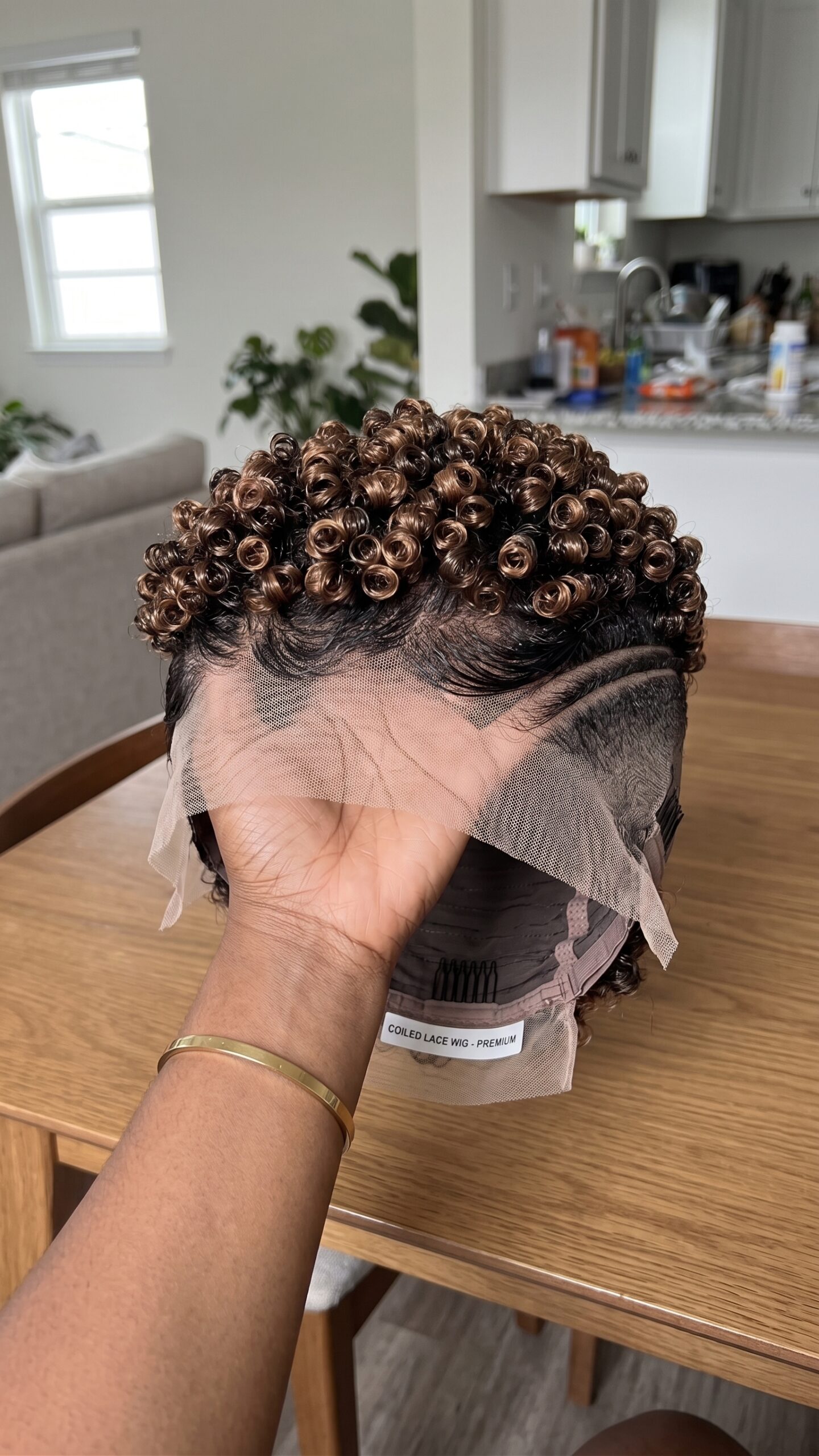
A label reading premium is sewn into this cap, and it guarantees exactly nothing. Someone printed the word, stitched it in, and it now sits next to the combs as if it were a specification. It is not. There is no body that defines premium, no standard a wig must meet to earn the word, and no test behind it. The same is true of coiled lace wig on that tag: it describes the shape, not the quality. So the single most confident-looking thing on this cap, a printed grade, is the one piece of information worth ignoring entirely.
This matters because the whole vocabulary of wig selling works this way. Premium, raw, virgin, double drawn, HD, and letter grades like 10A or 12A sound like measurements and are marketing. No independent authority assigns them; the seller does, on their own product, to their own standard, which is to say no standard at all. A tag that certifies its own hair is the seller grading their own homework. The word costs nothing to print and adds nothing you can verify, and a unit with a premium label can be worse than one with no label at all.
What actually tells you about a curly pixie wig are the things you can see and test, none of which appear on a tag. Turn the unit over, look at the knots and the wefts, press the lace to your skin, ask to see the curl washed. Those checks are real. The label is a word. Judge the wig by what it is, not by what it calls itself.
Where To Buy A Curly Pixie Wig By Its Substance, Not Its Label
Custom makers worth buying from describe what they actually did, not how premium it is. Ask them to explain the knots, the lace grade, and the hair source in plain terms rather than in adjectives. A maker who talks specifics is more trustworthy than one who leans on premium and raw, because specifics can be checked and adjectives cannot.
Instagram and TikTok sellers lean hardest on grade words because they sell. Ignore the caption’s adjectives and ask for video of the underside, the lace on skin, and the washed curl. A curly pixie wig proves itself in those clips, never in the word premium.
Etsy works with makers who describe construction and show real buyer photos. The risk is a listing padded with grade terms and thin on detail. Read reviews for what buyers reported about the actual hair, not for how premium the title sounded.
Marketplaces like Amazon, AliExpress, and Temu are where grade inflation runs wildest, with 10A, 12A, and premium stamped on ordinary units. Treat every such term as zero information and judge by photos of the knots, the lace, and buyer images. The higher the grade number climbs, the less it tends to mean.
Local beauty supply shops and salons let you inspect the unit in person, where a label cannot help or fool you. You pay a premium in-store, ironically the honest kind, for the ability to check the hair with your own hands.
Vendors and wholesalers direct use grade terms loosely too, and consistency matters more than the words on the packaging. For one unit, a sample you can examine beats any printed grade.
Regionally, honestly described units come strongly out of Lagos, Accra, Atlanta, London, and across South Africa, where you can find sellers willing to show substance on video instead of reciting grades.
Vet the seller by how they talk: check the account age, look for real buyer photos, time a plain question for a genuine reply, and ask them to describe the unit without using the words premium, raw, or virgin. A seller who can only sell in adjectives is the one to avoid.
Red flags: heavy reliance on grade words, a premium claim with no underside photo, escalating letter grades, and any tag treated as proof of quality.
When you order, send your measurements and ask for specifics, the knot finish, the lace grade, the hair origin, in plain language. Say you judge by the unit, not the label, so the seller knows adjectives will not close the sale.
On payment, thirty to fifty percent down with the balance before shipping is standard for custom work. Use a method you can dispute, and ask for photos of the verifiable details before releasing the last part, not a photo of the tag.
How Much It Costs
The word premium adds nothing to what a curly pixie wig is worth, so price it by the real things and let the label fall away.
Human hair, full build with genuinely good knots, a fine lace, and a strong curl, whatever the tag says: roughly $200 to $430. Human hair, mid build: about $150 to $310. Human hair, basic cap: around $70 to $180. Good synthetic: $60 to $140. Basic synthetic: $20 to $55. A premium label appears at every one of these prices and changes none of them, because it describes nothing measurable.
The rooted, two-tone colour on this unit is a real cost, since the caramel coils over a dark base are lifted and placed, adding roughly forty to ninety dollars over a plain unit. That is a premium you can see. The word premium on the tag is a premium you cannot. Pay for the colour work and the construction; do not pay a cent extra because a label flatters itself.
Shipping and any customs charge sit outside the price and change with where you live, so plan a realistic band and confirm your own country’s import rate rather than trusting a single quoted figure.
Then the later costs, which the label never covers. A canvas block and pins, curl product, a gloss to keep the caramel from dulling, and the usual upkeep. First-year math, honestly: a human unit plus shipping plus any customs plus a small kit plus maintenance tends to land between a low three-figure total and roughly double the sticker, and the tag contributes nothing to that either. A very low price with a premium label is still a low-price unit; the word does not raise the quality, only the confidence of the listing.
Deposits follow the custom pattern: thirty to fifty percent to start, balance before shipping, and photos of the real details before the last payment clears.
Shipping, Delivery, And What To Expect After Ordering
When the unit arrives, judge it the way you would have judged it without any tag: turn it over, check the knots and wefts, press the lace to your skin, and look at the curl. A premium label in the box changes none of what those checks reveal. Ask that it ship protected, choose a tracked service for custom work, and confirm your country’s import charge before it lands. What you unbox should stand on its construction, and if the only impressive thing about it is the word on the tag, you have your answer.
Grade Words Are Seller-Defined, Not Standardised
The reason premium and 10A tell you nothing is that no outside authority sets them. Each seller decides what their own premium means, so one seller’s premium is another’s basic, and the term carries no fixed content across shops. Letter grades were invented by sellers and inflate every year, which is why they climb without limit. Learn to see these as branding, and they lose all power to sway you.
The Tag Certifies Itself
A label sewn in by the maker making the claim is not independent proof, it is the seller vouching for the seller. Real assurance comes from things outside the seller’s control: your own inspection, buyer photos from strangers, and reviews describing use over time. Trust those, and treat the in-cap tag as decoration.
The Colour Is The Real Premium Here
Setting the label aside, the rooted caramel over a dark base is genuine, skilled work, and it is what actually justifies a higher price on this unit. Judge the colour for how cleanly the caramel is placed and how well it will hold, because that is a premium you can verify with your eyes. Let the visible colour work, not the printed word, be what you pay extra for.
Before You Pay
- Can the seller describe this unit without the words premium, raw, or virgin?
- What are the actual knots, lace grade, and hair source, in plain terms?
- Does an underside and on-skin video back up any quality claim?
- Is the rooted colour cleanly placed, since that is the real premium here?
- Would this unit impress me if the tag were blank?
Trimming The Lace
The lace comes off the front the usual way, and no label affects how you cut it. Trim in small offset steps and leave a shallow margin rather than going flush, working in good light so the rooted colour reads true at the hairline. If this is your first lace unit, let a stylist make the first pass, because a clean hairline is what sells the unit as real, far more than any word stitched into the cap. Cut to your head, not to the grade on the tag.
Search Terms
curly pixie wig · coiled pixie wig · rooted curly pixie · two tone coiled lace wig · caramel curl pixie unit · glueless curly pixie lace · short curly wig construction · bleached knots coiled pixie
Final Thoughts
The most eye-catching detail on this cap is a label calling the unit premium, and it is the detail that deserves the least of your attention. Premium, coiled lace wig, and every grade term like it are words a seller prints, not qualities anyone verified, and a tag that certifies its own hair proves nothing at all. The confidence of a listing is not the quality of a wig.
Buy it by ignoring the adjectives and checking the substance: the knots, the wefts, the lace on your skin, the washed curl, and here, the cleanliness of the rooted caramel colour, which is the one premium you can actually see. A curly pixie wig is worth exactly what those real things make it worth, and not a dollar more for a word. Learn to read past the label, and no seller can charge you for confidence they simply printed.