
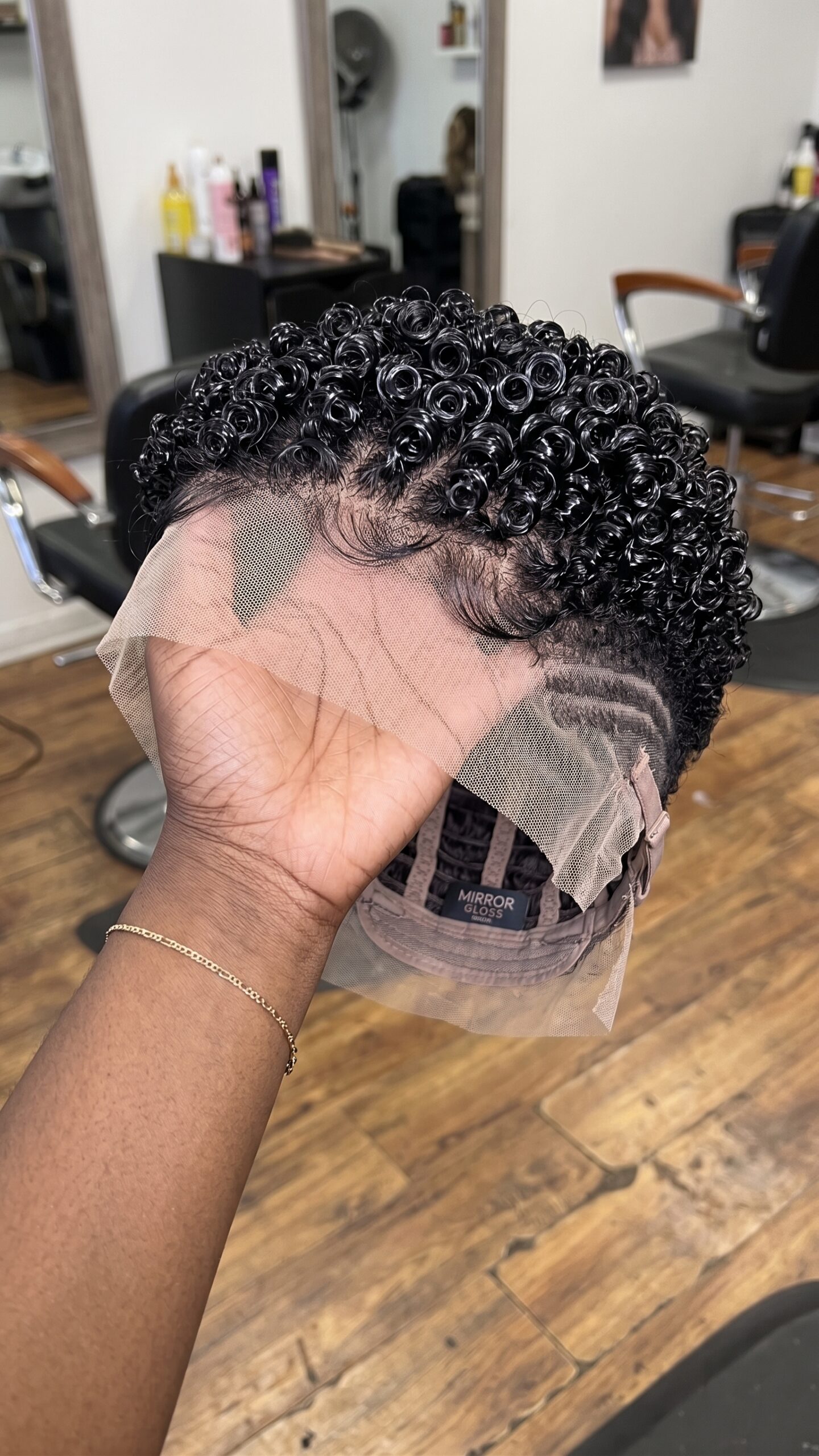
Buyers blame the hair when a short unit will not lie flat, and they are usually wrong. Look into this cap and you see the part that actually decides whether the unit sits right: the dome, the elastic band, the adjustable straps, and the combs. A wig cap is built to a base size, roughly matched to a head circumference, and the straps only fine-tune within an inch or two of that. They do not change the size. So if the base is wrong for your head, no amount of tightening fixes it, and the unit that looked perfect in the photo rocks, lifts, or squeezes the moment it is on. On a curly pixie wig this shows instantly, because there is no length or weight to hide a poor fit.
The two ways it goes wrong are simple. A cap too big for your head sits high, slides back, and lifts at the hairline no matter how hard you pull the straps, because you are cinching fabric that is still too large. A cap too small grips, aches within an hour, and refuses to lie flat because it is stretched past its shape. Either way people reach for glue or blame the lace, when the real problem is a base size that never matched their head. The straps, the combs, and the band are for fine-tuning a correct size, not for rescuing a wrong one.
So the first spec to get right on a short unit is not the hair at all, it is the cap. Measure your head, match the base size, and the hair finally gets to do its job. Skip that, and the best curls in the world will sit wrong.
Where To Buy A Curly Pixie Wig That Fits Your Head
Custom makers are the surest route to a correct fit, because they build to your measurement rather than a standard size. Give them your circumference and ask for a cap made to it. A maker who takes measurements is selling you a fit; one who ships a single size for everyone is hoping it lands close.
Instagram and TikTok sellers usually sell fixed sizes, so ask which base sizes they offer and what circumference each fits before you buy. A curly pixie wig in the wrong base will disappoint you no matter how good the hair looked in the clip, so match the size first.
Etsy works with makers who list cap sizes clearly and offer made-to-measure options. The risk is a one-size listing that assumes an average head. Read reviews for anyone mentioning the unit sat too high, slid, or squeezed, which are fit complaints, not hair complaints.
Marketplaces like Amazon, AliExpress, and Temu mostly ship a single average size with adjustable straps, which suits average heads and frustrates the rest. If your head runs small or large, these are the least likely to fit. Check the stated cap size, not just the hair description.
Local beauty supply shops and salons let you try the cap on and feel whether it sits flat and secure, which no online listing can promise. You pay a premium in-store, but trying a short unit on tells you in seconds what a photo never will.
Vendors and wholesalers direct often stock only standard sizes in bulk, so fit is hit or miss for non-average heads. For a head outside the middle range, a maker who builds to measurement beats stock.
Regionally, makers who build to head measurement come strongly out of Lagos, Accra, Atlanta, London, and across South Africa, where custom-fit short units are easy to find on video.
Vet the seller on fit as well as hair: check the account age, look for real buyer photos, time a plain question for a genuine reply, and ask what circumference their cap fits and whether they offer other sizes. A seller who cannot tell you the cap size is selling hair and hoping about the fit.
Red flags: no stated cap size, one size sold as fitting everyone, no made-to-measure option for unusual heads, and advice to just use glue if it does not fit.
When you order, send your head circumference measured around the hairline, and ask them to confirm the base size matches it. Say you want the cap to fit without heavy tightening, so the straps stay a fine-tune rather than a rescue.
On payment, thirty to fifty percent down with the balance before shipping is standard for custom work. Use a method you can dispute, and confirm the cap size against your measurement before releasing the last part.
How Much It Costs
Cap fit rarely appears as a price line, but it decides whether a curly pixie wig is wearable at all, which makes it the cheapest thing to get right and the most expensive to get wrong.
Human hair, full build in a cap made to your measurement, glueless with bleached knots and a fine lace: roughly $200 to $430. Human hair, mid build in a standard size: about $150 to $310. Human hair, basic cap in one size: around $70 to $180. Good synthetic in a standard cap: $60 to $140. Basic synthetic: $20 to $55. Made-to-measure sometimes adds a small amount over a standard size, and it is the best value on this list, because a unit that fits gets worn and a unit that does not is money gone.
The real cost of fit is hidden in the units people never wear. A wrong base size is not something you can return to fit; it is a total loss if you cannot send it back, since no styling makes a too-big cap sit flat or a too-small one comfortable. Paying a little for the right size, or measuring before you buy a standard one, prevents the most expensive outcome of all, which is a good unit you cannot use.
Shipping and any customs charge sit outside the price and change with where you live, so plan a realistic band and confirm your own country’s import rate rather than trusting a single quoted figure.
Then the later costs, which a good fit keeps low. A canvas block sized near your own head helps the unit hold its shape, plus the usual curl upkeep. A poorly fitting unit adds costs instead, glue and tape to force a hold, and the discomfort that makes you wear it less. First-year math, honestly: a well-fitting human unit plus shipping plus any customs plus a small kit plus upkeep tends to land between a low three-figure total and roughly double the sticker, while a badly fitting one quietly becomes a drawer unit worth nothing.
Per wear, the best value is simply a unit that fits, because it gets worn. A very low price means nothing if the cap does not match your head, so treat cap size as the first filter, before hair, before price.
Deposits follow the custom pattern: thirty to fifty percent to start, balance before shipping, and confirmation of the cap size against your measurement before the last payment clears.
Shipping, Delivery, And What To Expect After Ordering
The first thing to check on arrival is the fit, so put the unit on before you judge anything else, because a cap that does not sit flat makes even great hair look wrong. Ask that it ship boxed so the cap holds its shape, choose a tracked service for custom work, and confirm your country’s import charge before it lands. When it arrives, the band should sit snug at your hairline and the straps should tighten only a little; if you are cinching them to the limit, the base is too big, and if it aches quickly, it is too small. What you unbox should fit near-perfectly out of the box, with the straps as a small adjustment, not a struggle.
Straps Adjust A Range, Not A Size
The adjustable straps and combs inside are designed to fine-tune a cap that is already close, tightening it by an inch or so and holding it in place. They cannot shrink a cap a full size or stretch a small one to fit. Treating the straps as a fix for the wrong base is the mistake that leads to lifting hairlines and sliding units. Buy the size that fits, then let the straps do their small, proper job.
Short Units Punish A Bad Fit Most
A long wig has weight and length that help anchor it and hide a slightly off cap. A short curly unit has neither, so a poor fit shows immediately: the lace will not lie flat, the unit rocks on the crown, and the hairline lifts. This is why cap size matters more on a pixie than on almost any other style, and why a short unit is the worst place to guess your size. Get the fit right here or the whole look falls apart.
Glueless Only Works If The Base Fits
The appeal of a glueless cap is a secure hold with no adhesive, but that only holds true when the base size matches your head. A glueless unit in the wrong size slides or squeezes exactly because there is no glue compensating for the mismatch. So the glueless promise depends entirely on buying the right size first; the straps and combs finish a good fit, they do not create one.
Before You Pay
- What head circumference does this cap fit, and does it match mine?
- Are other base sizes or a made-to-measure option available?
- Will the straps only fine-tune the fit, or am I relying on them to resize it?
- Given short units show misfit most, is this size genuinely right for me?
- If it does not fit, can I return it, since a wrong size cannot be styled to fit?
Trimming The Lace
Fit the unit to your head before you trim a single bit of lace, because a cap that sits in the wrong place puts the hairline in the wrong place, and you will cut the lace to a line that shifts once the fit is corrected. Trim in small offset steps and leave a shallow margin rather than cutting flush, only after the cap is sitting where it will sit. If this is your first lace unit, settle the fit first and let a stylist cut the front to your actual hairline, since lace cut to a misfitted cap never sits right.
Search Terms
curly pixie wig · short curly pixie unit · glueless curly pixie · made to measure pixie wig · cap size curly wig · adjustable cap short wig · custom fit pixie unit · secure fit curly pixie
Final Thoughts
This photo shows the hair everyone looks at and the cap almost no one does, and the cap is what decides whether the unit is wearable. A wig is built to a base size, and the straps only fine-tune it, so a base that does not match your head cannot be tightened or styled into fitting. On a short curly unit, where there is no length to hide a poor fit, the wrong size shows the instant it is on, and the curls take the blame for a problem they never caused.
Buy it by getting the cap right first: measure your head, match the base size or order to measurement, and treat the straps as a small adjustment rather than a rescue. A curly pixie wig that fits sits flat, holds without glue, and lets the hair look the way it did in the photo. One that does not fit becomes a unit you own and never wear, no matter how good the curls are. The hair is what you notice. The cap is what you wear.