
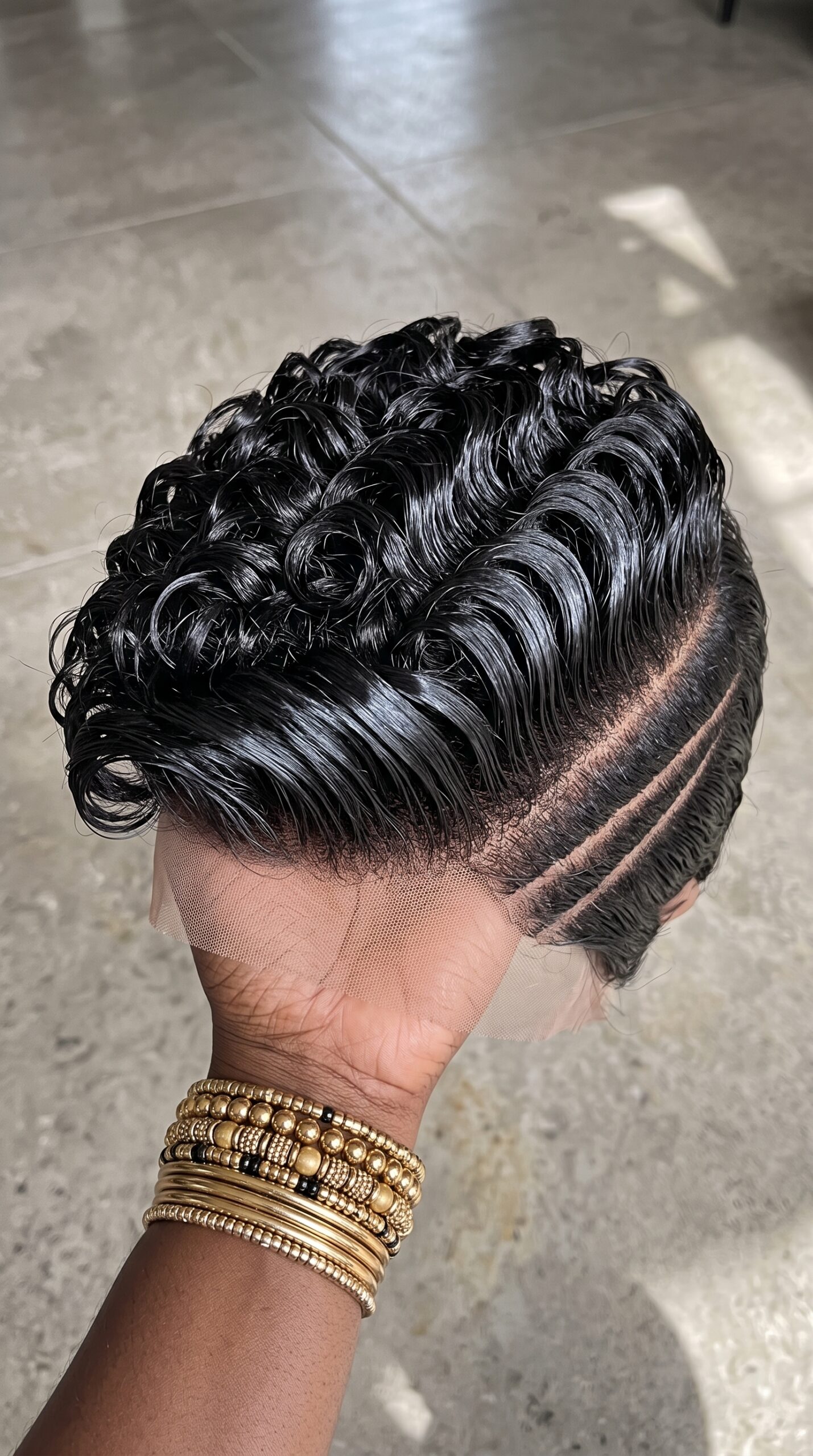
The waves are the last thing to judge on a unit like this. They photograph beautifully, deep and glossy and sculpted along the side, but how they look today tells you almost nothing about how you will live with them. A molded wave finish is set with heat, ironed and shaped into the hair, and the moment those waves relax or a wash flattens them, getting them back means heat again. So the real question, the one that decides whether this unit is a joy or a regret, is whether the fibre can take that heat. Not how the waves look. Whether you can ever make them look that way twice.
This splits sharply by hair type, and it is the split buyers almost never ask about. On synthetic fibre, heat is off the table entirely: the wave you receive is permanent and unchangeable, and once it loses its shape from wear or a bad night’s sleep, you cannot iron it back, because heat melts and ruins the fibre. On human hair you can re-wave as often as you like, but every pass of a hot iron costs the hair some strength and shine, so the style is maintainable but slowly wearing. There is no version where a molded wave stays perfect on its own forever.
So before you fall for the sculpting, ask what the unit is made of and what that means for redoing it. A molded wave pixie wig is not a look you buy once. It is a look you either cannot change or must keep re-setting, and which of those you are signing up for depends entirely on the fibre.
Where To Buy A Molded Wave Pixie Wig You Can Actually Maintain
Custom makers should tell you the fibre and whether the waves can be re-set with heat, and at what temperature. Ask directly: is this human hair I can re-wave, or synthetic I cannot? A maker who styles these will explain how to restore the waves; one who dodges the question is selling you a set you may never recreate.
Instagram and TikTok sellers show molded waves at their freshest, so ask for a clip of the same unit a week in and a plain answer on the fibre. A molded wave pixie wig looks its best for a short window, and the fibre decides whether that window ever reopens.
Etsy works with makers who state the fibre clearly and have reviews mentioning how the waves held or were redone. The risk is a listing that sells the sculpt and stays quiet on whether it survives a wash. Read reviews for anyone describing the waves after a few weeks.
Marketplaces like Amazon, AliExpress, and Temu sell many synthetic molded wave units, which hold their shape well but can never be re-waved with heat. That is fine if you want a permanent set and will treat it gently, and a problem if you expect to restyle. Confirm the fibre before assuming you can iron it.
Local beauty supply shops and salons let you ask the fibre question face to face and even see how the waves respond to handling. You pay a premium in-store, but knowing whether you can re-wave the unit is worth it for this style above all.
Vendors and wholesalers direct make sense across several units with a minimum, and fibre is consistent within a batch. For one unit you intend to restyle, a maker who confirms human hair beats an unlabelled bulk piece.
Regionally, molded wave units in both fibres come strongly out of Lagos, Accra, Atlanta, London, and across South Africa, where stylists who wave short units by hand are easy to find on video.
Vet the seller the usual way plus a heat question: check the account age, look for real buyer photos, time a plain question for a genuine reply, and ask outright whether the unit can be re-waved with heat. A vague answer on fibre is a reason to walk.
Red flags: no clear answer on fibre, waves shown only freshly set, a synthetic sold at a human-hair price, and any claim that the waves last forever with no upkeep.
When you order, send your measurements and a direct question about the fibre and re-waving, and say whether you plan to restyle or keep the set as is. That tells the maker which build suits you.
On payment, thirty to fifty percent down with the balance before shipping is standard for custom work. Use a method you can dispute, and confirm the fibre in writing before releasing the last part.
How Much It Costs
On a molded wave pixie wig, the fibre choice drives both the price and the lifetime cost, because it decides whether you pay a stylist to re-wave or simply replace the unit when the set drops.
Human hair, full build you can re-wave, glueless cap with bleached knots and a fine lace: roughly $200 to $430. Human hair, mid build: about $150 to $310. Human hair, basic cap: around $70 to $180. Good synthetic with a permanent molded wave: $60 to $140, cheaper up front but unchangeable. Basic synthetic: $20 to $55.
The honest trade sits in what happens after the set drops. A human unit costs more but can be re-waved indefinitely, by you with a wave iron or by a stylist; a synthetic costs less but is finished as a wave style the day the shape goes, since you cannot iron it back. So the cheaper synthetic can be the more expensive choice if you wanted a look you could maintain, because maintenance means replacement rather than restyling.
Shipping and any customs charge sit outside the price and change with where you live, so plan a realistic band and confirm your own country’s import rate rather than trusting a single quoted figure.
Then the later costs, which the fibre decides. A human unit needs a wave iron, a heat protectant, setting product, and either your time or a stylist’s to re-wave; a synthetic needs only gentle handling but has no path back once the wave relaxes. First-year math, honestly: a human molded wave unit plus shipping plus any customs plus tools plus re-waving tends to land between a low three-figure total and roughly double the sticker, with re-waving as the recurring effort. A synthetic lands lower but ends as a wave style sooner.
Per wear, a human unit you re-wave yourself is economical over time, while a synthetic is cheap until the day its shape is gone. A very low price on a molded wave unit almost always means synthetic fibre, so read the bargain as the permanent, unchangeable set it usually is.
Deposits follow the custom pattern: thirty to fifty percent to start, balance before shipping, and written confirmation of the fibre before the last payment clears.
Shipping, Delivery, And What To Expect After Ordering
A molded wave unit can arrive with its waves crisp and set, and how you keep them depends entirely on the fibre you confirmed. Ask that it ship so the waves are not crushed, choose a tracked service for custom work, and check your country’s import charge before it lands. When it arrives, a human unit lets you re-wave any waves flattened in transit; a synthetic must be handled gently because a crushed wave cannot be ironed back. What you unbox is the wave at its best, and the fibre determines whether a flattened wave is a quick fix or a permanent loss.
Synthetic Waves Are Permanent And Unfixable
The appeal of a synthetic molded wave is that it holds its shape with no effort, and the catch is the same fact from the other side: when the shape finally goes, from friction, humidity, or sleep, there is no heat you can safely use to bring it back. The style has a fixed life and no restoration. If you choose synthetic, choose it knowing the wave you receive is the best it will ever be and cannot be renewed.
Human Waves Can Be Redone But Heat Wears The Hair
A human unit hands you the opposite deal: you can re-wave it whenever the set drops, but each pass of a hot iron dries and weakens the hair a little, so a heavily re-waved unit ages faster than a curl left alone. Use a heat protectant, wave at the lowest temperature that holds, and space out the re-sets. The freedom to restyle is real, but it is not free, and the hair keeps a tally.
The Wet-Look Gloss Is Product, And It Builds Up
The lacquered shine on these waves comes from heavy gel, not the hair, and product that heavy leaves residue. Over time gel builds up, crusts at the roots, attracts dust, and can clog the lace if it is not washed out properly. Clarify the unit regularly so build-up does not dull the hair or shorten the lace’s life. The gloss is part of the look, but it is a coat you reapply and wash away, not a permanent finish.
Before You Pay
- Is this human hair I can re-wave with heat, or synthetic I cannot?
- If synthetic, do I accept that the wave cannot be restored once it drops?
- If human, what temperature re-waves it without frying the hair?
- Can the maker show the waves a week in, not just freshly set?
- Am I paying a human-hair price for a synthetic permanent wave?
Trimming The Lace
The lace at the front comes off the usual way, but cut it while the waves are freshly set so you shape the hairline to the real style, not a relaxed one. Trim in small offset steps and leave a shallow margin rather than cutting flush, and keep the blade clear of any product-heavy waves so gel does not gum the scissors. If this is your first lace unit, let a stylist cut the front while the set is fresh, since a clean hairline reads best against sharp waves and is harder to judge once they soften.
Search Terms
molded wave pixie wig · wave pixie wig · short wave pixie unit · pin curl wave wig · synthetic wave pixie wig · human hair wave pixie · glueless wave pixie lace · sculpted wave short wig
Final Thoughts
This unit sells itself on the sculpted waves, and the waves are the part you should think hardest about, just not the way most buyers do. How they look today is a set, and whether you can ever recreate it comes down to a single fact almost no listing volunteers: what the fibre is and whether it takes heat. Synthetic gives you a permanent wave you cannot change or restore. Human hair gives you a wave you can redo forever, at a slow cost to the hair each time.
Buy it by asking the heat question first and judging the waves second. Decide whether you want a fixed look you treat gently or a maintainable one you will re-wave and slowly wear down, and match the fibre to that choice. A molded wave pixie wig is a beautiful thing to own when the fibre fits your plan for it, and a frustrating one when it does not, because the waves you fell for are either unchangeable or a set you did not know you would be repeating. Ask what it is made of. The waves depend on the answer.