
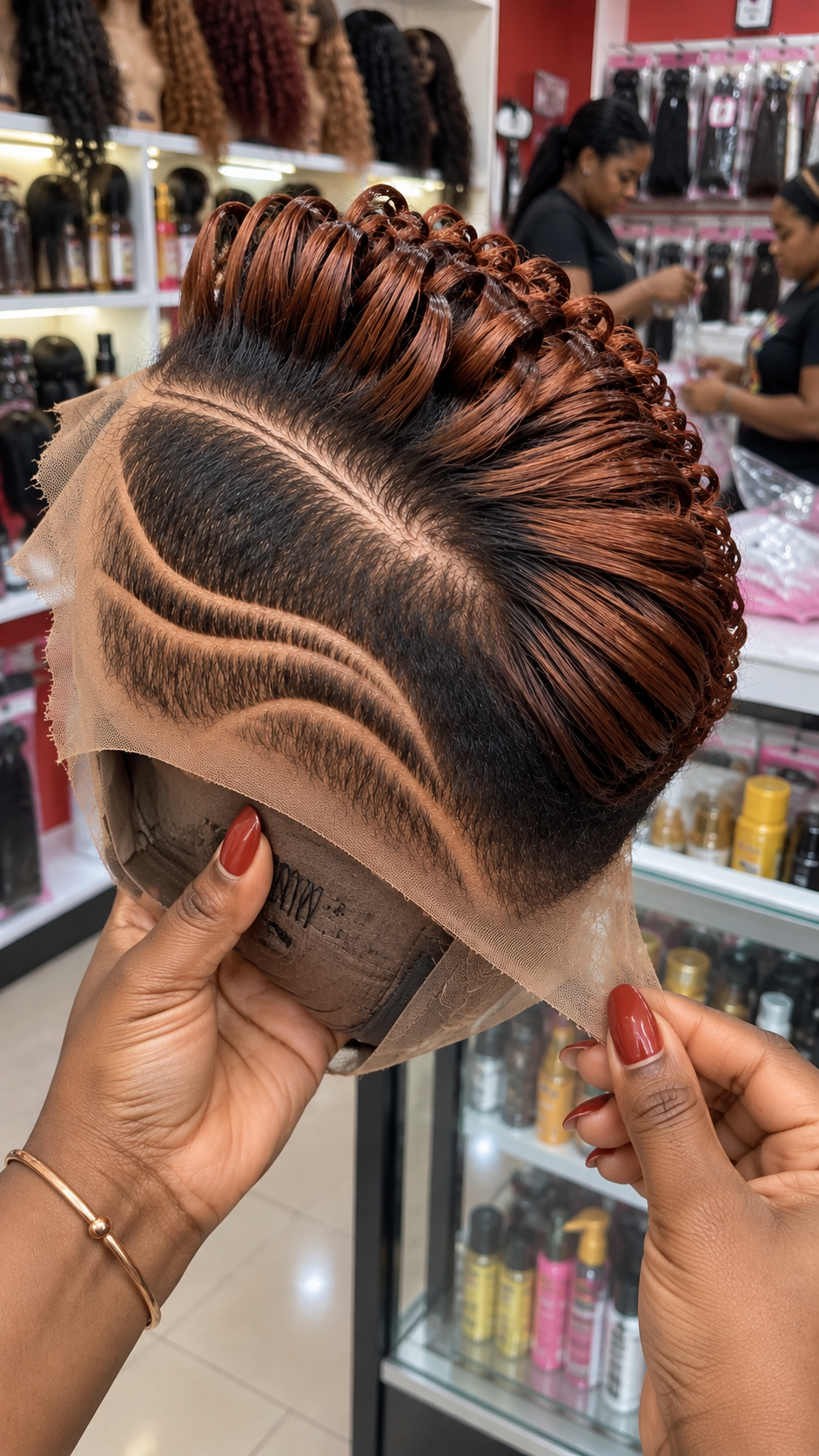
This striking pixie wig pairs a deep espresso-black foundation with rich burnished copper lengths, creating a dramatic two-tone effect across a highly sculpted crown. The upper hair is arranged into large polished loops that rise from the darker root area before bending backward into a fuller curled section at the rear.
The side construction gives the wig an especially distinctive identity. Instead of relying only on color, the stylist has created a very close side section with two long sweeping curved separations. The upper line travels beneath the crown while the lower line follows a wider arc toward the back, producing a layered graphic effect without overwhelming the hairstyle.
The photograph also shows the wig before installation. The lace remains untrimmed, the interior cap is partially visible, and the unit is being held from underneath. This makes it possible to examine details that would normally disappear once the wig is fitted.
Burnished Copper Dominates the Sculpted Crown
The most noticeable color is a warm copper-brown with reddish undertones. It is richer and deeper than a bright orange copper, giving the hair a polished appearance under the salon lighting.
Rather than appearing as occasional highlights, copper covers most of the longer upper strands. The darker espresso shade remains concentrated at the roots and throughout the close side section.
This creates a strong transition from dark to warm without looking like a conventional ombré. The change follows the physical construction of the hairstyle: dark hair anchors the base while copper becomes dominant as the strands rise into the crown.
For someone ordering a similar piece, a useful color description would be espresso-black roots transitioning into burnished copper through the sculpted upper sections.
Large Crown Loops Create the Signature Shape
The front and upper crown are constructed from broad loops rather than small ringlets. Individual sections rise almost vertically from the root before folding backward.
The loops gradually change direction as they move toward the rear. Those closest to the front are taller and more upright, while subsequent sections become increasingly swept back.
This progression creates height without forming a rounded dome. The crown instead has a directional silhouette that visually moves from front to back.
The glossy copper strands also make the construction easier to see. Light reflects along the outer surface of each loop, separating neighboring sections and emphasizing their curvature.
The Rear Transitions Into Smaller Curls
Behind the larger loops, the hairstyle becomes more intricate. Smaller curled sections are concentrated around the rear, creating a transition between the structured crown and the back edge of the wig.
The photograph is primarily a side view, so the complete center-back arrangement cannot be confirmed. However, the visible portion shows that the stylist did not simply sweep all of the longer hair straight backward.
Instead, the larger loops gradually meet a denser collection of smaller curls. This gives the rear additional volume while keeping the front construction visually dominant.
Two Sweeping Lines Shape the Close Side
The side design is one of the most recognizable elements in this particular unit. Two exposed curved separations travel across the close section beneath the crown.
The upper sweep begins near the front and follows the lower boundary of the longer hair. Beneath it, a second curved line creates another narrow band of close hair before widening slightly toward the rear.
The two curves are not perfectly parallel. Their changing distance from one another gives the design a more organic appearance than two identical straight lines would provide.
The lower sweep also bends more dramatically as it approaches the back, creating a pointed transition between the surrounding sections.
When commissioning this design, reference photographs will be more reliable than simply requesting “two lines.” Specify that they should be long, curved and directional rather than straight parallel barber lines.
Very Close Side Hair Makes the Pattern Visible
The hair between and around the sweeping separations remains extremely close to the base. Individual tiny strands are visible, preserving a realistic hair-like appearance rather than creating large completely bare areas.
The espresso-black shade is particularly effective here because it creates strong contrast against the scalp-toned lines.
This dark side also visually anchors the brighter copper crown. If the entire side were copper, the exposed design would have considerably less contrast.
The Color Placement Supports the Hair Architecture
The relationship between color and shape is especially important in this wig. Copper does not appear randomly throughout the entire unit.
It becomes strongest exactly where the hairstyle gains height and movement. The darker base remains visible underneath, allowing every raised copper section to stand out individually.
At the rear, copper strands continue through the swept sections and smaller curls, connecting the front and back without eliminating the dark foundation.
A custom recreation should therefore treat color placement and styling direction as one combined design rather than two separate choices.
The Lace Is Still Untrimmed
A substantial lace perimeter is visible around the front and side of the wig. Because the unit has not yet been installed, the lace extends beyond the intended finished hairline.
This should not be confused with how the wig would appear after fitting. During installation, excess material would normally be trimmed according to the construction of the unit and the wearer’s preferred placement.
The image shows fine mesh, but photography alone cannot reliably establish whether the material is HD lace, transparent lace or another specific commercial lace type.
Before purchasing, ask the seller to confirm the exact lace material, lace shade and coverage area.
What the Interior Cap Reveals
Part of the brown interior cap is visible beneath the lace. The photograph also shows internal construction around the lower section, but it does not expose every component of the cap.
For that reason, features such as comb placement, clips or a removable elastic band should not be assumed from this photograph alone.
If a secure glueless installation is important, request photographs of the complete interior and ask the seller specifically whether the unit is designed for glueless wear.
Why Accurate Measurements Matter
Cap sizing becomes particularly important with a design that places visible lines along one side. A poorly fitted unit may rotate or sit too high, moving those lines away from the intended temple area.
A correctly sized cap helps maintain the relationship between the lace hairline, close side section and elevated crown.
Use the measurement method supplied by the wig maker rather than relying only on general small, medium or large sizing. Custom makers may request circumference, ear-to-ear and front-to-nape measurements before beginning production.
The Finish Is Highly Reflective
The upper hair has a deliberately polished appearance. The intended visual quality is mirror-like glossy hair, silky reflective finish, healthy wet-look shine, individually visible strands and ultra-defined hair texture.
That shine is especially noticeable on the copper sections because each curved strand catches the salon lighting differently. The outer surfaces become bright copper while recessed areas appear deeper reddish brown.
This means the color may look different under daylight or neutral indoor lighting. Buyers trying to match the shade precisely should request additional photographs under less directional light.
Who Can Make a Similar Wig?
This design is better suited to a custom pixie wig maker or stylist experienced with sculpted lace units than a general retailer selling standard factory-cut wigs.
The stylist needs to handle several techniques together: close side construction, controlled curved separations, elevated loop styling, copper coloring and detailed rear curling.
When reviewing a stylist’s portfolio, look for previous examples of precision pixie units rather than only long lace-front wigs. Photographs showing the sides of their work are particularly useful.
Useful local searches include custom copper pixie wig stylist near me, sculpted pixie wig maker, two tone pixie wig salon and custom lace pixie wig stylist.
Ordering This Copper And Espresso Combination
Send the wig maker clear reference photographs showing both the crown and the exposed side. Explain that the darker color should remain concentrated around the roots and close side while copper dominates the longer upper sections.
For the crown, request large raised loops flowing backward into smaller rear curls. This distinction is important because ordinary finger curls would create a substantially different silhouette.
For the side, request two sweeping curved separations with very close hair surrounding them. Mention that the lower line should bend toward the rear rather than remaining perfectly parallel to the upper line.
Before production begins, confirm whether the quoted price includes coloring, cutting, sculpting and final styling.
Finding Similar Ready-Made Wigs
Ready-made alternatives may be easier to locate by combining the visible color and construction details in search queries.
Search phrases such as copper sculpted pixie wig, espresso root copper pixie wig, copper loop crown lace wig and copper pixie wig with curved side lines are more specific than simply searching for a copper wig.
Compare the crown height and side treatment carefully when evaluating listings. Two wigs can use nearly identical colors while having completely different cuts and styling.
Also determine whether the photographs represent the actual product. Some sellers use styled reference images while shipping a base wig that requires additional work after delivery.
Booking a Wig Styling Appointment
If you already own a suitable pixie unit, a wig stylist may be able to recreate parts of this look without making an entirely new wig.
When booking, send photographs before the appointment and explain that you need crown sculpting and precision side work. Ask whether the stylist works with wigs specifically, because shaping a removable unit can require a different approach from cutting natural hair directly on a client.
If color changes are required, identify the wig fiber before booking. Human hair and synthetic fibers require different coloring methods, and many synthetic units cannot be conventionally dyed.
Human Hair Versus Synthetic Construction
The photograph does not provide enough evidence to determine whether this particular unit uses human hair or synthetic fiber.
A human hair version can offer flexibility for future reshaping and recoloring, although a heavily sculpted crown may require professional resetting after washing.
A quality synthetic version may retain a preset shape effectively, but heat resistance varies substantially between fibers. Never assume that a synthetic wig can tolerate hot tools simply because it has been styled into loops.
Confirm the material and manufacturer’s heat recommendations before making adjustments.
How Much It Costs
The photograph does not contain pricing information, and the exact cost of this specific wig cannot be determined visually. The combination of custom coloring, close side detailing and extensive crown styling can make a finished version more expensive than a basic pixie unit.
| Wig Category | Typical Estimated Price Range |
|---|---|
| Premium Custom | $350–$800+ |
| Standard Custom | $175–$425 |
| Basic Human Hair | $100–$275 |
| Premium Synthetic | $60–$160 |
| Basic Synthetic | $30–$90 |
These are broad estimates rather than a valuation of the photographed unit. Final pricing can vary according to hair type, cap construction, lace choice, coloring complexity, stylist location and the amount of hand finishing required.
When requesting a quote, ask whether the price covers the complete finished appearance or only the base wig.
Protecting the Sculpted Crown Between Wears
The large upper loops should be protected from compression during storage. A wig stand with enough clearance around the crown can help prevent the elevated sections from being flattened.
Avoid repeatedly brushing through the sculpted loops. These sections depend on controlled strand placement, and conventional brushing can quickly change their shape.
For cleaning, follow the instructions appropriate to the confirmed fiber. If the unit is human hair and has been professionally colored, use products recommended for color-treated hair.
After washing, the crown may require reshaping. Owners who want to preserve the original arrangement as closely as possible may prefer professional maintenance rather than completely restyling the unit at home.
A Pixie Wig Built Around Direction And Contrast
The appeal of this design comes from several coordinated elements rather than color alone. Burnished copper loops rise from deep espresso roots, travel backward across the crown and eventually meet smaller curled sections at the rear.
Below them, two sweeping side lines create movement in the same direction as the upper styling. The close dark side provides contrast while keeping attention on the brighter crown.
For a faithful recreation, preserve the major characteristics together: espresso-dark roots, dominant copper upper lengths, elevated crown loops, smaller rear curls, a very close side and two long curved separations.
Search Terms
Burnished Copper Pixie Wig · Espresso Root Copper Pixie Wig · Copper Loop Crown Lace Wig · Copper Pixie Wig With Double Side Lines · Espresso And Copper Sculpted Pixie Wig · Copper Crown Wig With Sweeping Side Design · Two Tone Copper Pixie Lace Wig · Copper Sculpted Crown Pixie Wig