
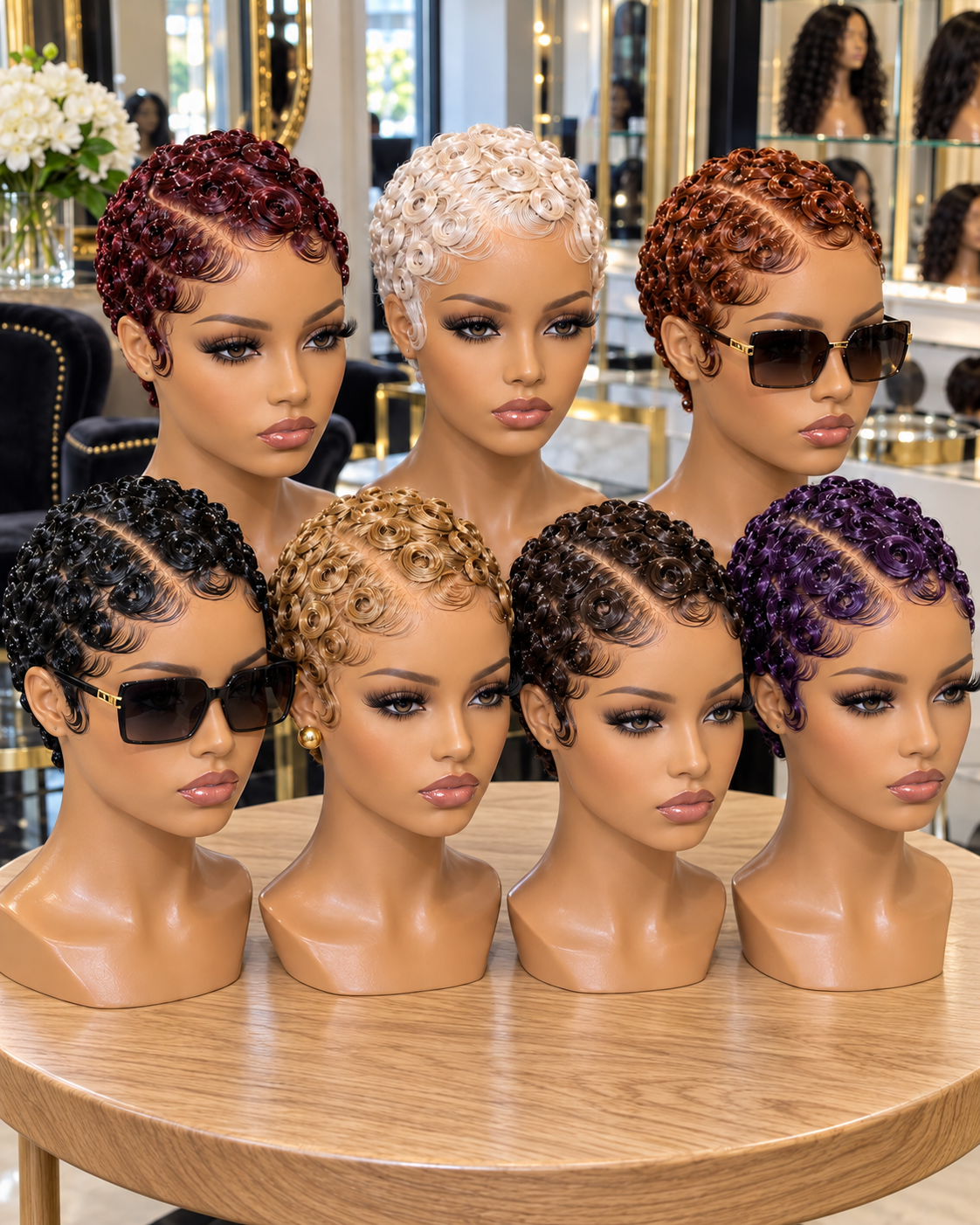
These pin curl pixie wigs are arranged on mannequin heads, making the relationship between the crown, front, and sides easy to compare. Small rolled curls cover the top without creating a tall silhouette. Visible side parts introduce direction, while flatter waves follow the forehead and temples. The ears remain largely exposed, reinforcing the short cut. For someone considering a similar wig, the most useful starting point is deciding which combination of color and curl arrangement feels wearable, then checking the construction and fit behind the finished appearance.
One Short Cut With Seven Different Moods
The burgundy wig at the upper left has a deep red appearance that becomes more noticeable where light catches the curls. It offers a color change while keeping a darker overall impression. The pale platinum wig beside it makes the circular pattern especially prominent because the bright strands contrast with the darker spaces inside each loop. At the upper right, copper brings a warmer appearance, with orange-brown reflections tracing the rolled sections. Although the three wigs share a similar shape, the color changes where the eye settles first.


Across the front row, black gives the cut a strong, cohesive appearance, while honey blonde emphasizes the individual curves through lighter golden tones. The deep brown version offers another dark option with warmer reflections. Purple creates the boldest departure from the natural-looking shades in the display. It still carries the same side-parted direction and small curl arrangement, which helps separate a preference for the cut from a preference for the color. You may love the purple version’s shape while choosing that shape in brown or black for your own order.
The display is also a reminder that mannequin styling is a presentation reference rather than a guarantee of personal fit. The same wig can sit differently on another head shape, particularly around the temples and ears. Before purchasing, look beyond the most appealing color and study the outline you want to preserve. Decide whether the close sides, the low crown, or the forehead waves matter most to you. Those priorities will make your discussion with a seller or stylist much more productive than simply requesting “the same pixie.”
Understanding the Circular Curl Pattern
The curls in these wigs form small, open-centered loops. They sit close together across the crown and follow the head rather than falling in long spirals. This gives the surface a rosette-like appearance, although sellers may use several names for comparable work. You might find similar styles described as pin curl pixies, sculpted curl wigs, or short rolled curl wigs. Search terms can help locate candidates, but the photographs should determine whether a listing actually matches the look you want.
Not every short curly wig will create this effect without additional styling. A unit with loose ringlets may have enough length to be reshaped, but its existing cut, density, fiber, and construction will influence what a stylist can achieve. A tightly curled cropped wig might also produce a different result because the individual sections do not naturally form these open loops. If matching the image is your priority, send the reference before buying a base unit. Ask the person doing the setting whether that particular wig is suitable.
The front sections deserve equal attention. Each wig combines raised circular curls with flatter curved strands near the hairline. Those lower waves help connect the top to the forehead and temple areas. Removing them entirely would change the balance of the style, while making them much longer could dominate the face. Ask for a front arrangement that suits your preferred placement and daily routine. A stylist can discuss a subtler version or a more pronounced wave without changing the entire haircut.
Choosing Color Beyond the Display
Start with how often you expect to wear the wig. If it will become part of a regular work or everyday rotation, consider which shade coordinates easily with the clothes and accessories you already use. Black and deep brown may offer a familiar starting point, while burgundy can provide a noticeable change with a dark overall appearance. Honey blonde, copper, and pale platinum make a stronger color statement. Purple suits someone who specifically wants that visible color rather than a close match to their natural hair.
Lighting matters when comparing shades. A copper wig can appear redder under one light and browner under another, while a pale blonde can look warmer or cooler depending on its surroundings. Request photographs or a short video in ordinary daylight before selecting a color remotely. Ask whether the seller uses a named color code or a custom mixture, and keep that information with your order. Descriptions such as “blonde” or “brown” are too broad when you are trying to reproduce a particular shade.
Root color is another detail to settle explicitly. The wigs in the image appear largely consistent in color, but a photograph cannot establish every strand or hidden section. If you want a single shade throughout, say so. If you prefer darker roots, request examples showing the depth and length of the root area. Do not leave that decision to an assumption based on the word “natural.” A dark-rooted platinum wig and an all-over pale platinum wig can create quite different effects even when their curls are arranged similarly.
A useful way to narrow the choice is to select two finalists for different reasons. One might be the shade you expect to wear most often; the other might be the shade that makes the cut feel exciting. Compare those two in daylight images and ask yourself which you would actually reach for. This keeps the decision connected to use instead of the appeal of the whole display. You are choosing an individual wig, so it should work independently of the surrounding colors and accessories.
How To Order This Style
Look for wig makers and boutiques whose portfolios include short pin curl styling, closely shaped pixies, and molded front waves. A seller with several finished examples can show whether they consistently achieve this kind of compact outline. Check for side views and back views as well as front portraits. The crown may look attractive from one angle while the nape remains bulky or uneven. A short wig needs to hold its shape around the entire head, especially if you intend to wear it without frequent salon adjustments.
When contacting a supplier, identify the exact version in the reference. For example, explain that you want the honey blonde color, circular curls across the crown, a side part, and a close outline around the ears. Then separate confirmed requirements from flexible preferences. You may insist on the color and overall shape while allowing the stylist to adjust the smallest front waves for your fit. This gives the maker a clear brief and reduces the chance of receiving a generic curly pixie with only a similar shade.
Ask whether the listing includes a completed wig or only a styling service. Some businesses sell the hair unit, cut, and set together; others expect you to supply the base. Confirm the fiber, cap size, available parting area, color, included preparation, and delivery condition. If the wig is made to order, request an estimated completion window and an explanation of any review stage before dispatch. If it is ready-made, ask to see the actual unit rather than relying entirely on a display photograph.
For online purchases, read the return and alteration conditions before cutting lace or changing the style. Keep the written description and the seller’s answers together so you can check the delivered item against them. For an in-person purchase, try the unit on where that service is available and inspect it from several angles. The goal is to understand what you are receiving and what work remains. A lower advertised price may still be useful, provided you know whether fitting, trimming, or resetting will cost extra.
The Cap Determines How the Pixie Sits
The photograph shows the styled exterior, so it does not verify the interior construction of these wigs. Ask for an inside-cap image and a clear description. Depending on the product, a seller may offer a wefted cap, a lace-front construction, a lace area around the part, or another design. These options affect where hair can be separated and how the front can be customized. Choose according to the placement you need rather than assuming that a more elaborate construction will automatically improve this particular short style.
If you want the side part to remain in the position shown, confirm that the unit supports it. A fixed-part wig may suit someone who wants a consistent look, while another construction may allow more adjustment. Ask how much freedom there is before ordering. Moving a part is not always a simple surface change, especially when the surrounding curls have been deliberately set. The maker should explain whether a different part requires restyling, a different base, or only a minor adjustment.
Measure using the supplier’s instructions instead of choosing a cap size by guesswork. Circumference is a useful starting point, and the maker may also request measurements from front to nape or across the head. With a short pixie, fit problems can be particularly visible near the ears and lower edges. A cap that sits too far forward may crowd the forehead waves, while one that shifts backward may expose areas you intended to cover. Adjustable components help only within the limits of the cap’s design.
A Realistic Five-Tier Price Plan
The following table provides illustrative budget bands in US dollars for planning a purchase. These are not current market quotations or verified prices for the pictured wigs. A real offer depends on the unit’s documented materials, construction, customization, styling, and included services. Use the table to organize questions and compare complete proposals. A price tier by itself does not establish hair quality, lace quality, durability, or how closely a seller can reproduce the curl pattern.
| Price Tier | Illustrative Budget | Option to Investigate | What to Confirm |
|---|---|---|---|
| Basic Purchase | Under $75 | A stock cropped wig or an entry-level unit for occasional styling | Whether the circular curl arrangement is included and what fiber is supplied |
| Ready-Styled Purchase | $75–$150 | A completed short wig offered in a standard color and cap size | The actual finished appearance, cap measurements, and care instructions |
| Personalized Styling | $150–$300 | A suitable base wig with a separate or included cutting and setting service | How the total is divided between the unit, color work, and styling |
| Custom Order | $300–$500 | A project with more individual input on fit, color, part placement, and shaping | The agreed specifications, review process, and included alterations |
| Extended Custom Service | Above $500 | A bespoke unit or a package with additional fitting and salon appointments | The specific materials, workmanship, appointments, and aftercare covered |
Compare the amount required to achieve a wearable result. One seller may include the finished set and fitting, while another may quote for an unstyled unit. Shipping, taxes, color adjustments, lace preparation, and installation can change the final total. Ask for a written breakdown if several services are involved. This makes it easier to decide where to spend and where to simplify. For this look, a suitable fit and convincing curl arrangement usually deserve attention before optional accessories or presentation packaging.
Include future care in your personal budget as well. If you cannot recreate the circular curls yourself, find out whether the seller or a local stylist offers resetting. Ask what cleaning involves and whether a wash is likely to change the finished arrangement. The answer will depend on the verified fiber and the styling method used. A wig that fits your initial budget may still be inconvenient if maintaining its appearance requires services you cannot easily access.
Booking a Salon for the Same Finish
Search for a wig stylist who can show short molded styles, pin curls, or finger-wave work. Send the image before the appointment and explain whether you want a new wig or a restyle of an existing one. If you already own the base, provide its fiber information and photographs of its current cut. The stylist needs enough detail to judge what is feasible. Booking a generic curl service without discussing the reference may leave too little time for the shaping and setting this style requires.
During the consultation, discuss the crown height, ear area, forehead placement, and nape together. These sections create the short silhouette as a whole. Ask whether the stylist recommends a fit check before completing the curl set. If you wear glasses, bring them so the arms can be considered around the temples. The display includes sunglasses on two mannequins, but that does not establish comfort on an individual wearer. A fitting provides information that a styled mannequin cannot.
Clarify the appointment scope before the day arrives. Cutting, coloring, lace customization, securing, and setting may be separate services. Ask what preparation is expected and whether the wig needs to be left at the salon. Also discuss your preferred front detail: the small swoops in the reference can be a central feature or a quieter finishing touch. Showing exactly which sections you like gives the stylist a stronger starting point than asking for an unspecified “neat front.”
Glueless Wear and Other Securing Options
If daily removal is important to you, ask whether a suitable glueless version is available and how its fit is achieved. The term should come with an explanation of the cap, band, straps, or other securing components. It cannot be confirmed from this exterior display. Try the unit on where possible and check how it behaves when you turn your head or look downward. A finished hairstyle should remain comfortable during ordinary movement, without relying on an excessively tight adjustment.
If you prefer a secured installation, discuss the method with your wig stylist and follow the relevant product directions. Explain that you want the front waves and crown loops preserved during fitting. The styling should be checked after the cap is positioned because moving the unit can alter how the front sits. Ask for removal instructions appropriate to the chosen method. Knowing how to take the wig off without pulling at its delicate front sections is part of preserving the finished work.
Care That Respects the Set
Treat these arranged curls differently from a loose curly wig that you routinely separate with your fingers. Brushing through the loops can dismantle the pattern that gives the style its character. Support the cap when lifting the wig and avoid repeatedly pulling at individual curl centers. Ask the stylist to demonstrate a simple correction for a displaced section. A small touch-up may be manageable at home, while a flattened crown or disrupted front may need a more complete reset.
Before washing, establish what creates the curl pattern. A manufactured fiber shape and a temporary salon set may respond differently to cleaning. Follow the directions for the specific unit, including appropriate products, water temperature, and drying method. Do not assume that the circular arrangement will return unchanged after shampooing. If professional resetting is needed, arrange it as part of your care routine. This is especially useful for someone buying the wig for its precise styling rather than for a flexible everyday curl pattern.
The glossy appearance in the image does not mean that more shine product is always helpful. Repeated applications can leave residue or make carefully separated strands sit differently. Ask what was used to finish the wig and which product, if any, is recommended between services. Use a restrained approach to touch-ups and avoid mixing several products simply because they are marketed for curls. The appropriate routine should support the verified fiber and the existing set, rather than adding unnecessary layers.
Store the wig where the crown and sides will not be crushed. A suitable stand should support the cap without stretching it, and the curls should have space around them. For travel, choose a protective container that does not press directly on the top. Keep the unit away from damp storage conditions and allow it to dry according to its care instructions before enclosing it. These practical habits protect the shape between wears and reduce the amount of correction needed before the next outing.
Making the Pixie Feel Personal
Accessories can change the presentation without requiring another hairstyle. The close sides leave room for visible earrings, while the compact crown can work with understated clothing or a more dressed-up outfit. Select accessories after checking comfort around the ears and temples. Large frames or earrings should not push the wig out of position. You can also personalize the style through the degree of front-wave detail, provided the maker understands your preference before completing the set.
If you plan to own more than one color, use the first successful wig as a fit reference. Keep its measurements, cap information, part placement, and care notes so a later order can be specified more accurately. Color changes should still be reviewed individually because different materials or processing can affect the available options. Ask the supplier to explain any difference between the first unit and a new shade. Consistent-looking photographs do not establish that every version uses an identical base.
The strongest choice is the one you can picture wearing independently of the display. Study the circular curls, the close outline, and the forehead waves, then choose the shade that makes those details work for you. Confirm the cap and fiber, agree on the styling, and understand the care before purchasing. That combination turns an appealing reference into a practical order: a short pin curl wig with a clear shape, a considered color, and a finish suited to your own routine.
Search Terms
pin curl pixie wigs · short rosette curl wigs · side part curly pixie · burgundy pin curl wig · platinum cropped wig · copper curl pixie · honey blonde pin curls · finger wave pixie wigs