
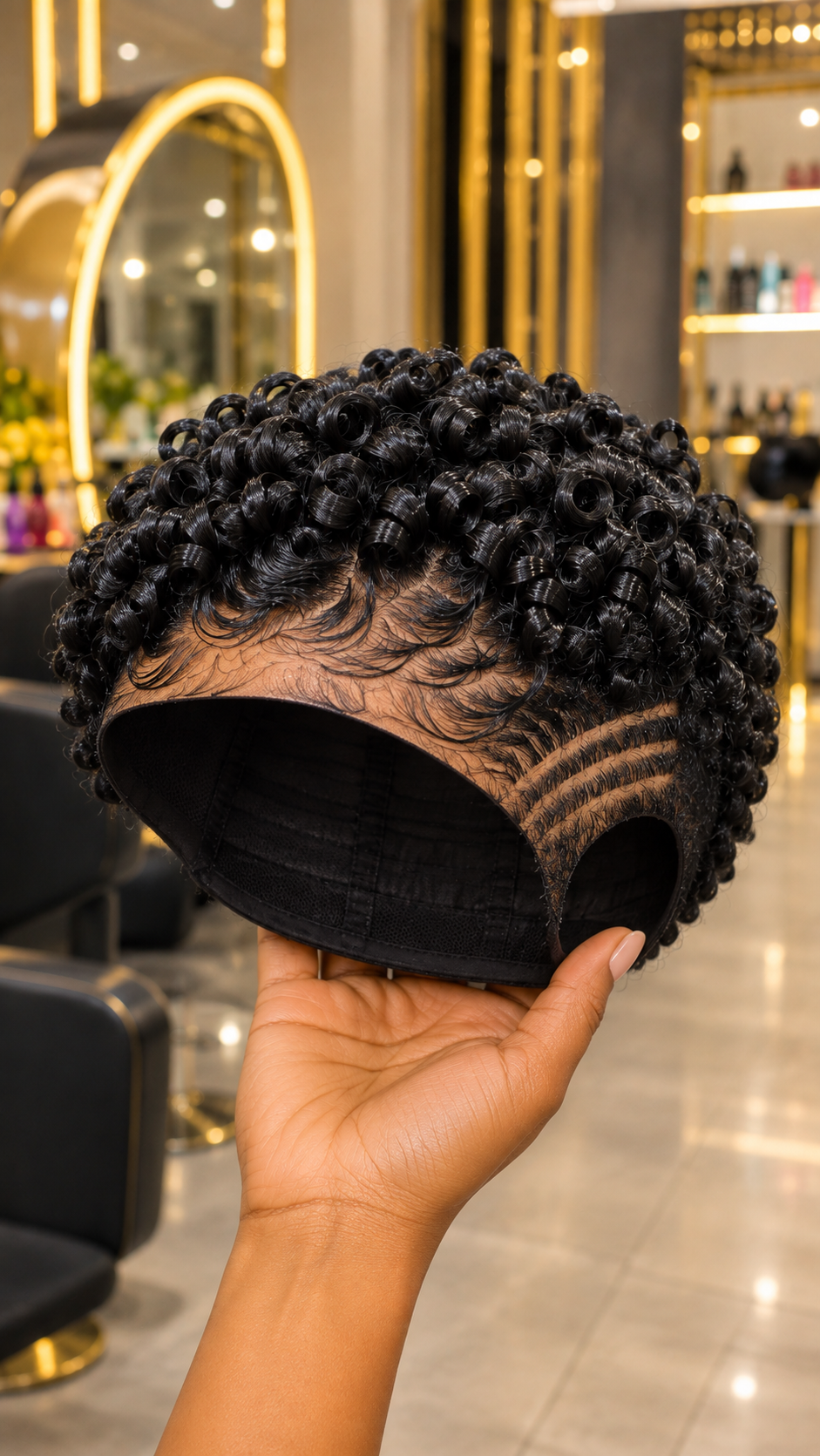
A compact pixie hairstyle can make an impressive statement when its smallest details are arranged with precision. The wig in this photograph brings together hundreds of glossy black corkscrew curls, delicate sweeping strands across the forehead, and three closely spaced curved lines along the visible temple. The result is a distinctive sculpted hairstyle that combines the fullness of tightly rolled ringlets with the sharper appearance of barber-inspired side detailing.
Presented in one hand inside an elegant salon with warm golden lighting, the wig has a rounded crown covered in small, hollow-centered curls. The front section transitions into fine, feather-like waves that follow the hairline, while the visible temple contains three curved separations. These lines sit beneath the curly upper section and follow the contour of the side, creating a noticeable decorative pattern without introducing contrasting hair colors.
The hair appears consistently deep jet black. Light reflects along the curved surfaces of the miniature ringlets, making their cylindrical structure particularly apparent. Some curls face outward with clearly visible openings, while others tilt sideways and overlap neighboring coils. The hairstyle remains close to the head despite its dense upper coverage.


Another important aspect is the visible underside. The wig is held with its dark interior cap facing the camera, revealing black fabric and mesh construction along the opening. Unlike photographs that show a fully installed wig, this image allows buyers to consider the intended silhouette and some of the foundation before ordering or booking an installation.
Although the photograph provides valuable visual information, it does not establish whether the fibers are human hair, synthetic, or blended. The exact lace specification, manufacturer, and complete attachment system are also unknown. Those details should be confirmed with a supplier rather than inferred from the styling.
Three Temple Arcs Give the Side Its Personality
The most recognizable design element is the group of three curved channels positioned along the visible side. The lines sit close to one another, following a similar direction while gradually bending toward the lower temple.
They are not perfectly straight barber stripes. Their curvature follows the rounded shape of the wig, allowing the pattern to sit naturally beneath the upper curls.
The hair between the channels remains dark and closely arranged, creating narrow bands that make each separation noticeable. The exposed paths appear lighter than the surrounding hair, producing a striking contrast.
The uppermost channel begins near the transition from the forehead waves to the shorter side. Beneath it, the additional arcs follow a related direction, creating a layered design.
This arrangement distinguishes the wig from a plain curly pixie. However, the image cannot establish whether the channels were created by cutting hair, adjusting its placement, or combining several construction techniques.
Why the Number and Spacing of the Lines Matter
A double-line temple design would not reproduce the same visual effect as the three arcs shown here. The third separation gives the lower side additional detail and makes the pattern more prominent.
Spacing is equally important. If the lines are positioned too closely together, the dark hair between them may become difficult to recognize. If they are placed too far apart, the design may occupy too much of the side.
Customers requesting a custom reproduction should provide a close-up reference showing all three curves.
Ask the wig maker to explain how the channels will be incorporated and whether the proposed cap construction provides enough hair coverage around them.
Creating additional lines with scissors or clippers after purchase may permanently damage the wig or expose unwanted foundation material.
The Miniature Corkscrew Curls Form a Dense Crown
The upper section contains a large collection of tightly arranged cylindrical curls. Most have narrow circular openings, while others form compact rounded loops that overlap their neighbors.
These curls differ from broad rose-shaped coils because their individual cylinders are generally smaller and more tightly grouped. This gives the crown a lively, intricate appearance.
Several coils near the front face forward, making their hollow centers easy to recognize. Around the upper middle, the curls become more densely layered, producing a rounded silhouette.
Smaller formations continue toward the sides and visible rear, preventing abrupt gaps between the raised crown and lower sections.
The curls reflect the warm salon lighting along their outer surfaces. Darker areas appear between overlapping strands, emphasizing the depth of the arrangement.
The Difference Between Tight Corkscrews and Loose Ringlets
Not every curly pixie wig will reproduce this crown. Loose ringlets may hang downward or extend outward, while larger circular coils create a more open appearance.
The photographed style contains tightly grouped, hollow-centered curls that remain relatively close to the head.
When shopping, request actual close-up photographs rather than relying on a general description such as curly pixie.
Ask whether the curls retain their cylindrical shape after washing and whether professional resetting is needed.
A photograph from directly above would also help establish how the coils are distributed across the entire crown. The reference does not reveal every section of the rear or opposite side.
The Hairline Uses Delicate Sweeping Strands
The front has a softer appearance than the densely curled crown. Fine black strands are arranged into elongated curves that extend across the forehead area.
These strands form a series of sweeping ridges rather than large circular baby-hair loops.
Several of the curves begin beneath the front curls and follow a gentle downward direction. Others bend toward the temple, where they visually connect with the three curved side channels.
The hairline remains relatively close to the underlying foundation, creating a contrast with the raised corkscrew coils.
This transition is important because it allows the intricate crown to remain prominent while giving the front a carefully arranged appearance.
Preserving the Fine Forehead Arrangement
The narrow front strands should not be treated like ordinary loose curls. Their visual effect depends on coordinated direction and spacing.
Heavy brushing may disturb the pattern, while excessive product application can cause neighboring strands to merge.
During installation, the stylist should examine the front arrangement before attempting any trimming or restyling.
If a buyer wants the original appearance, large additional baby-hair spirals should not be introduced without discussing the change first.
The safest approach is to preserve the visible pattern and adjust it only after the wig has been positioned correctly.
Jet Black Coloring Keeps the Focus on the Hairstyle
The visible hair appears consistently deep black, with glossy reflections created by the salon lighting.
There are no clearly distinguishable blonde, burgundy, copper, silver, or other colored sections.
The miniature curls gain visual depth through shadow and reflection rather than deliberate contrasting highlights.
Light catches the rounded surfaces of individual coils, producing bright curved lines. Their central openings remain darker, making the cylindrical forms more noticeable.
The forehead waves reflect light along longer paths, emphasizing the difference between the upper curls and the flatter front styling.
However, shine alone cannot establish the fiber composition or whether a particular finishing product has been applied.
Choosing the Right Black Shade
Suppliers may advertise similar colors as natural black, raven black, soft black, or jet black.
The photographed wig appears closest to deep jet black, although the golden salon lighting may influence its appearance.
For an accurate comparison, request photographs under neutral daylight.
Some natural black shades contain subtle brown undertones, while jet black options may appear more uniform.
Customers should select the shade according to their preference rather than assuming the photograph establishes a precise manufacturer color code.
The Rounded Silhouette Balances Curl Density and Side Detail
The hairstyle has a relatively compact shape despite the numerous curls covering the crown.
The upper section appears fuller and more rounded, while the sides become closely fitted beneath the curls.
This contrast allows the three temple arcs to remain visible without competing with excessive side volume.
The closely arranged lower hair also creates a clear foundation for the decorative channels.
Unlike wigs with long curls extending below the ears, this design concentrates most of its volume near the upper head.
The result is a compact pixie that emphasizes detailed styling rather than length.
Choosing Crown Density and Finished Length
The photograph cannot provide exact measurements of hair density or strand length.
Because the curls are tightly wound, their visible height may be substantially shorter than their length when extended.
For custom orders, ask the supplier about the finished crown height, curl size, and available density options.
Excessive density may conceal the individual cylindrical openings. Insufficient density may create noticeable gaps between curls.
The goal should be to preserve a full, rounded crown while keeping the individual corkscrew formations recognizable.
The Visible Cap Shows a Broad Dark Interior
The wig is photographed with its interior opening facing the camera. Black fabric panels and a mesh-like foundation are visible across the underside.
The opening appears broad, and the lower edge follows a curved shape.
However, the photograph does not clearly establish the full fastening system. The presence, number, and position of internal combs, adjustable straps, clips, or other security components cannot be verified from this angle.
Buyers should request a complete underside photograph before purchasing.
It is also important not to assume that the wig is suitable for adhesive-free installation merely because the interior is visible.
Understanding Cap Measurements
Correct cap sizing helps the hairstyle sit at the intended angle.
The three temple arcs should align with the side of the wearer’s head, while the front waves should follow the forehead naturally.
A cap that is too large may shift during wear, changing the position of these details.
A cap that is too small may create uncomfortable tension and distort the intended silhouette.
Provide the measurements requested by the supplier, including head circumference and any additional dimensions needed for the selected construction.
If glueless wear is preferred, obtain explicit confirmation that the complete cap and fastening system support that method.
The Hairline and Lace Construction Need Verification
The front styling extends toward the cap’s perimeter, but the photograph does not provide enough information to identify a specific lace grade or complete lace construction.
Some areas appear to contain fine mesh beneath the decorative strands, although the exact specifications are not established.
Buyers should request clear close-up photographs of the front perimeter and ask the supplier to identify the lace material.
Do not assume that a fine-looking hairline automatically means the wig uses HD lace.
If excess lace is present on the delivered unit, it should be trimmed only after the wig has been positioned correctly.
The decorative forehead waves and temple design should be considered during fitting to avoid damaging fine strands near the edge.
Where To Find a Similar Triple-Arc Pixie Wig
The photograph does not establish a verified manufacturer or current product listing. However, the visible hairstyle provides a useful reference for contacting specialist wig makers and beauty retailers.
Look for suppliers experienced in compact corkscrew curls, sculpted pixie wigs, and decorative temple patterns.
A general listing for a black curly wig may provide the correct color but lack the triple-arc design.
Independent wig makers may offer greater control over the position of the side channels and curl distribution.
Local wig boutiques can allow customers to inspect construction details and compare different cap options in person.
Online sellers may offer broader selections, but actual photographs of the proposed product should take priority over generic promotional images.
Questions to Ask a Wig Maker
Ask whether the maker can reproduce the three curved temple channels with their intended spacing.
Request examples of previous work involving miniature cylindrical curls.
Confirm the material, cap measurements, lace specifications, and fastening components.
Ask whether the wig arrives with its curls and forehead waves fully arranged.
For a custom order, establish the production timeline, approval process, revision policy, and shipping charges before payment.
Ready-Made Alternatives Versus Individual Production
A ready-made curly pixie may be suitable for buyers primarily interested in the compact jet black silhouette.
However, standard units may contain larger curls, simpler hairlines, or plain sides without decorative arcs.
Custom production may allow the wig maker to plan the crown and temple design together.
This can be valuable because the exposed channels require sufficient surrounding hair coverage.
Attempting to create three curved lines on an unsuitable finished wig may expose the cap or damage the side arrangement.
Ask the maker to identify which details can be reproduced accurately and which may vary.
Illustrative Pricing for Triple-Arc Corkscrew Pixie Wigs
The following USD figures are illustrative planning ranges, not verified live retail prices or quotations for the photographed wig. Actual costs depend on fiber, construction, styling labor, and supplier.
| Wig Category | Illustrative USD Range | Potential Cost Considerations |
|---|---|---|
| Premium Custom | $350–$850+ | Individual cap sizing, dense miniature corkscrew curls, precision triple-arc side design, and detailed hairline styling. |
| Standard Custom | $190–$450 | Selected cap options with coordinated crown curls and personalized temple channels. |
| Basic Human Hair | $110–$290 | A human-hair starting unit that may require curl setting, side design work, and professional fitting. |
| Premium Synthetic | $85–$215 | A manufactured black curly pixie with preformed ringlets and possible decorative side detailing. |
| Basic Synthetic | $35–$100 | A budget curly pixie that may not reproduce the miniature curls or triple temple arcs accurately. |
The dense corkscrew arrangement may increase labor costs when individual curls require careful setting.
The triple-arc temple design also introduces precision work, particularly if the maker must preserve sufficient hair coverage between the channels.
Cap construction, lace specifications, hair density, and professional finishing may influence the final quotation.
Installation, shipping, taxes, and later restyling services may be charged separately.
Ask whether the quoted price includes a fully finished hairstyle or only the base wig.
Planning a Professional Installation Appointment
The first appointment should begin with checking the cap fit and confirming the intended front hairline position.
The stylist should examine whether the temple arcs sit correctly relative to the wearer’s head.
Any lace adjustments should follow the fitting assessment rather than being completed in advance.
The compact curls should be handled carefully to avoid compression or accidental separation.
If the hairstyle has shifted during shipping, restoration should follow the manufacturer’s instructions for the confirmed material.
Heat styling should not be applied automatically when the fiber composition is unknown.
Maintaining the Miniature Corkscrew Curls
The upper hairstyle depends on preserving numerous small cylindrical formations.
Repeated brushing may stretch the curls and reduce their recognizable circular openings.
Handle the wig gently, supporting the cap rather than pulling directly on individual ringlets.
If the unit contains human hair, professional resetting may be possible using suitable techniques.
If it contains synthetic fibers, conventional heated tools may be unsuitable. Follow the manufacturer’s recommendations before attempting reshaping.
Heavy styling products can accumulate between closely grouped curls and reduce their individual appearance.
Protecting the Temple Arcs
The three decorative channels require careful maintenance because surrounding strands may move across the exposed areas.
If the design becomes less visible, determine whether the hair simply needs repositioning.
Do not deepen the lines with clippers or scissors without consulting a wig specialist.
Removing additional hair may permanently expose the underlying foundation.
Professional maintenance may be helpful when the side pattern requires significant restoration.
Storage and Travel for a Compact Curly Wig
Use an appropriately sized wig stand to support the cap between wears.
Avoid placing pressure on the crown because compressing the curls may alter their cylindrical shapes.
For travel, select protective packaging with sufficient space around the hairstyle.
Keep the front perimeter away from rough surfaces that could snag fine strands or lace.
Before wearing the wig again, inspect the temple pattern and crown curls rather than brushing the entire hairstyle automatically.
Everyday Wear and Practical Considerations
The compact silhouette may appeal to wearers who prefer shorter hairstyles without loose hair extending toward the shoulders.
The densely curled crown provides fullness, while the close-fitting side creates a structured contrast.
The three temple arcs introduce a distinctive decorative element that can be particularly noticeable in profile photographs.
However, the hairstyle may require more careful maintenance than an ordinary loose curly pixie.
Cap comfort, installation security, and the ability to restore the miniature curls should be considered before choosing it for frequent wear.
What Makes This Pixie Worth Considering?
The defining quality of this hairstyle is the combination of tightly grouped corkscrew curls and three elegantly curved temple separations.
The feathered forehead waves connect these elements, creating a cohesive arrangement rather than a collection of unrelated decorative details.
Before purchasing, verify the fiber composition, cap dimensions, lace specifications, fastening system, and expected maintenance requirements.
Request additional photographs of the complete rear, opposite side, crown, and interior construction to establish details not visible in the reference.
A successful reproduction should preserve the deep black color, miniature cylindrical curls, compact rounded silhouette, sweeping forehead strands, and triple temple arcs. Those characteristics are the most reliable reference points for comparing ready-made alternatives or commissioning a custom wig.
Search Terms
Jet black corkscrew pixie crown · Triple curved temple arc wig · Miniature black cylindrical ringlets · Black three line temple hairstyle · Sweeping feathered forehead curls · Dense black spring coil pixie · Compact black ringlet cap wig · Sculpted triple arc curly pixie