
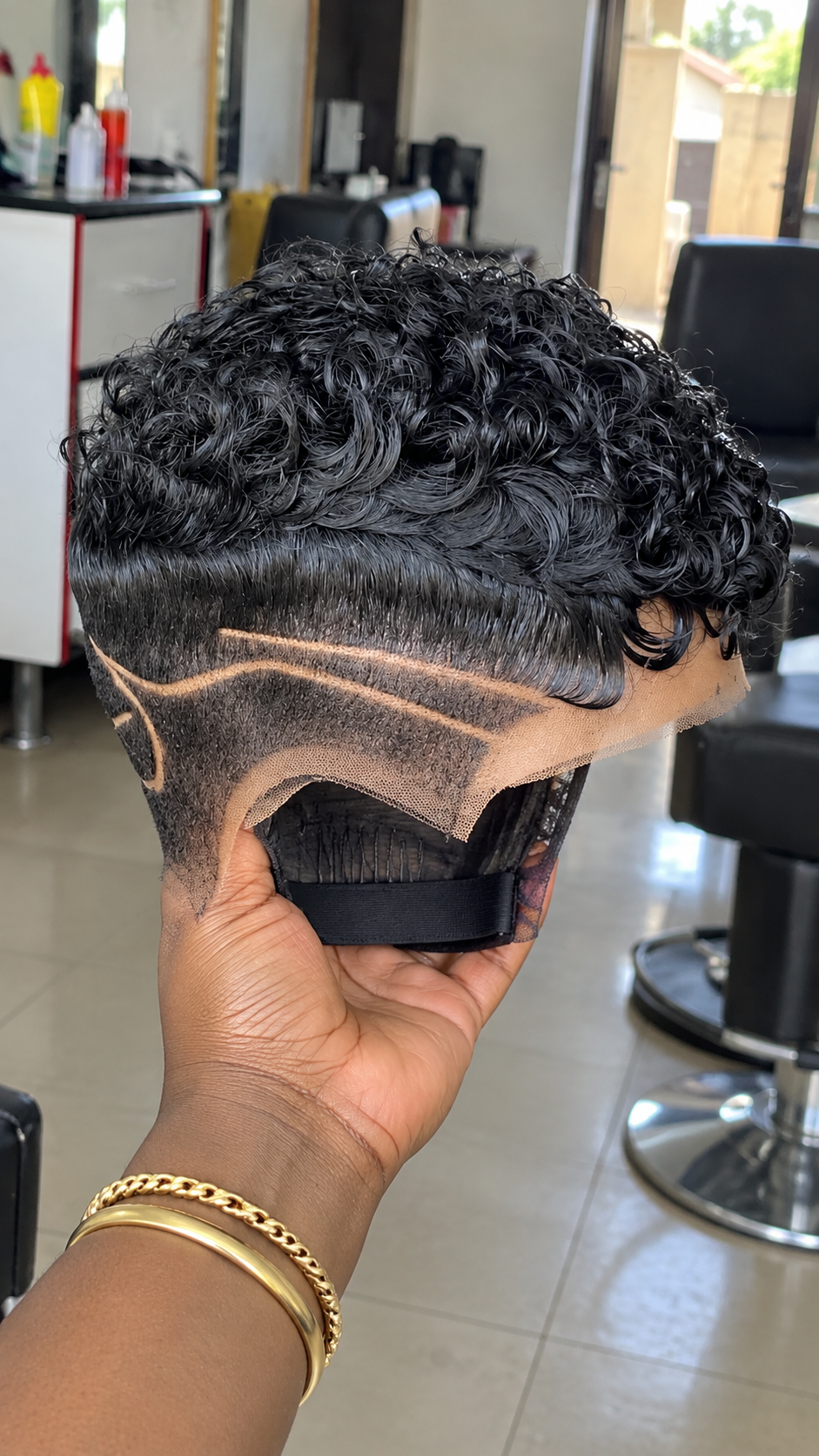
A decorative pixie wig does not need an elaborate color treatment to stand apart. In this photograph, the most compelling detail is the way a soft-looking crown of irregular black coils meets a closely cropped side containing a long, undulating exposed line. The contrast is unusually pronounced: the upper hair forms a rounded, loosely interlocking curl arrangement, while the lower section resembles a precise barber-style taper with a deliberate geometric accent.
The wig is displayed in one hand inside a working hair salon, with its untrimmed lace extending across the visible side and a black interior cap exposed beneath the lower edge. Unlike a photograph of an installed wig, this view allows potential buyers to study the side pattern, curl distribution, lace placement, and part of the attachment construction before considering a purchase.
The hair appears predominantly natural black or jet black, with charcoal reflections created by the lighting. The crown contains numerous compact spirals and irregularly curved strands rather than large, uniform circular rings. Beneath it, a broad band of closely directed hair separates the upper curls from a darker, lower taper. One prominent wavy channel travels across the side, accompanied by a smaller angular detail near the rear-visible edge.


This hairstyle is particularly relevant to customers interested in tapered pixie wigs, coily crowns, decorative barber-inspired side patterns, and compact lace hairpieces. Its successful reproduction depends less on color selection than on accurate curl formation, proportional side density, and careful positioning of the exposed channels.
The Crown Has an Organic Coil Arrangement Rather Than Perfect Rings
The upper hairstyle is filled with small, irregularly arranged curls that overlap across a rounded crown. Several sections form loose spirals, while others bend into incomplete loops or curl back toward the surrounding hair.
This gives the crown a more organic appearance than wigs constructed from identical circular ringlets. The curls vary in direction and apparent diameter, creating movement without relying on excessive length.
Some strands appear more elongated near the front, while the upper and rear-visible sections contain denser overlapping coils. The arrangement creates a continuous silhouette that follows the head’s rounded shape.
The photograph does not establish whether these curls were produced using finger-coiling, setting tools, or another technique. Their appearance can be described as compact spiral coils, but the exact styling process requires confirmation from the maker.
Why Irregular Curl Direction Matters
A customer commissioning this hairstyle should avoid requesting perfectly identical ringlets across the entire crown. The photographed curls have a more varied arrangement, with some spirals facing upward and others turning toward the side.
This variation contributes to the hairstyle’s natural-looking movement.
Ask the wig maker to preserve a rounded crown with individually recognizable coils rather than creating a rigid collection of uniform circles.
A close-up photograph from above can help establish whether the curl density and direction resemble the reference.
The finished crown should remain proportionate to the compact sides. Excessive height could change the hairstyle into a more dramatic pompadour-like shape.
The Long Wavy Side Channel Creates the Main Decorative Accent
The visible side contains a prominent exposed channel that travels across the closely cropped-looking hair. Unlike a straight razor line, this channel follows an undulating path, rising and falling gently as it moves toward the rear-visible section.
The line is relatively narrow and reveals a scalp-toned surface beneath the surrounding dark strands.
Above it, the hair is arranged into a compact band that follows the contour of the head. Below it, the hair becomes shorter in appearance and gradually narrows toward the lower edge.
The result resembles a decorative barber-style taper, although the photograph shows a removable wig rather than hair growing directly from a person’s scalp.
The exact construction method cannot be established visually. The channel may have been produced through deliberate hair placement, cutting, or another specialist technique.
Understanding the Smaller Rear-Side Accent
Near the left rear-visible portion of the side, a smaller angular separation appears beneath the main wavy channel.
This detail is more compact than the primary line and does not extend across the entire temple.
Its position adds a secondary geometric accent without overwhelming the broader side pattern.
Customers should identify this smaller detail separately when placing a custom order. Asking for multiple full-length parallel lines would produce a different appearance.
The reference relies on one dominant wavy channel and a limited secondary accent.
The Tapered Side Is Not Completely Bare
The lower side contains numerous fine dark strands arranged close to the underlying surface. This creates the appearance of a closely graduated taper rather than a completely shaved skin fade.
The hair becomes progressively shorter toward the lower edge, contributing to the compact silhouette.
Because visible hair remains present throughout much of the side, the decorative channel stands out against a dark foundation.
A wig maker attempting to reproduce the style should preserve enough hair density to maintain this contrast.
Removing too much hair could expose unwanted cap materials, while leaving the side excessively full might obscure the wavy channel.
The ideal result depends on careful graduation rather than maximum thinning.
Jet Black Color Keeps the Focus on Shape
The wig appears predominantly black, with subtle charcoal reflections across the curls and closely arranged side hair.
There are no clearly distinguishable blonde, copper, burgundy, or silver highlights in the photographed unit.
The monochrome palette places greater emphasis on curl direction, the wavy side channel, and the transition between crown and taper.
Some strands appear lighter where daylight strikes their curved surfaces, but these reflections do not establish a separate color treatment.
Customers seeking a faithful reproduction should prioritize a consistent dark shade rather than introducing additional highlights.
Choosing Between Natural Black and Jet Black
Wig suppliers may offer several dark shades, including natural black, jet black, and off-black.
These colors can appear similar in photographs, especially under mixed salon lighting.
The reference shows a very dark appearance with subtle cool reflections, but it does not establish a manufacturer’s exact color code.
Ask the seller for daylight photographs of the proposed shade before approving a custom order.
A color sample may be useful when the buyer wants a precise match to existing hair or a particular wardrobe preference.
The Frontal Transition Connects the Coils to the Taper
Between the upper curls and the exposed side channel, the hair forms a closely arranged transitional band.
The strands in this area follow a more horizontal direction than the irregular spirals above.
This creates a visual boundary that helps separate the rounded crown from the decorative lower side.
The band is not a broad finger-wave panel containing numerous sculpted ridges. Its primary role is to guide the hair toward the side while maintaining a compact profile.
Customers should preserve this transitional area when commissioning a similar wig because it contributes to the hairstyle’s proportions.
Allowing the crown curls to extend directly over the exposed channel could obscure the side design.
What the Untrimmed Lace Reveals
The photograph shows beige lace extending beyond the visible frontal and side hairline. The mesh hangs loosely beneath the closely arranged hair, indicating that it has not yet been trimmed to fit an individual wearer.
The lace appears relatively fine, but its exact grade cannot be confirmed visually.
It should not automatically be identified as HD lace without reliable manufacturer information.
Likewise, the presence of lace does not establish whether the wig is designed for adhesive-free installation.
The appropriate attachment method depends on cap construction, fit, and the intended wearing conditions.
Why Lace Placement Matters for the Side Pattern
The wavy channel and compact taper sit close to the lace boundary. If the wig is positioned incorrectly, the decorative line may appear misplaced relative to the wearer’s temple.
A professional installer should begin by checking the cap fit and positioning the hairline.
Only after confirming the alignment should the excess lace be trimmed.
The lace color should also be evaluated against the wearer’s complexion under suitable lighting.
Removing too much mesh can compromise the hairline and may be difficult to correct.
The Visible Black Cap and Elastic Fastening
The lower opening reveals part of the black interior cap. A broad elastic fastening section is visible across the opening, together with stitched fabric and structural components.
These details suggest that the wig includes attachment-related construction, but the photograph does not reveal the complete underside.
The exact cap circumference, number of combs, and full adjustment system remain unverified.
Buyers should request a complete underside photograph before purchasing.
This can help identify any adjustable straps, combs, elastic sections, and other fastening components.
Cap measurements should be compared with the wearer’s actual head measurements rather than relying exclusively on generic size labels.
Finding a Wig Maker for Coily Pixie Taper Designs
Customers searching for this hairstyle should look for wig makers experienced in compact spiral crowns, tapered pixie construction, and decorative side channels.
Independent wig studios, specialist lace wig salons, and custom hairpiece makers may offer suitable services.
When reviewing previous work, look for examples of irregular coil arrangements and carefully graduated sides.
A stylist experienced only with ordinary curly wigs may not necessarily be able to reproduce the wavy side channel and compact taper.
Send the reference photograph and explain that the desired hairstyle contains a jet-black coily crown, a broad transitional band, one dominant wavy side channel, and a smaller rear-side accent.
Preparing a Custom Order
Before paying a deposit, confirm the proposed fiber type and whether it can maintain the intended compact coils.
Ask whether the wavy side channel will be incorporated during construction or created through additional styling.
Request the cap measurements, lace specifications, attachment details, and expected production timeline.
Establish whether the quoted price includes the completed crown styling and decorative taper work.
For a custom commission, request photographs from the front, side, above, and rear before shipping.
These views can help confirm that the finished wig resembles the reference beyond the single angle shown in the original photograph.
Ready-Made Versus Custom: Consider the Side Construction
A ready-made black curly pixie wig may provide a similar color and crown shape but lack the decorative wavy channel.
Some products contain ordinary spirals or uniformly cropped sides without the distinctive taper arrangement.
Custom production may offer greater control over curl density, side graduation, channel placement, and cap fit.
Before purchasing a basic wig for later customization, consult a specialist to determine whether its density and construction can support the intended result.
Creating exposed channels in an unsuitable wig may reveal underlying materials or produce unwanted gaps.
Illustrative Prices for Black Coily Pixie Wigs with Decorative Tapers
The cost of this hairstyle may depend on the compact coil styling, tapered side construction, wavy decorative channel, and lace preparation.
Because the design does not require visible multi-color processing, some custom orders may involve less color-related labor than highlighted alternatives.
However, precise side shaping and curl arrangement may still require specialist work.
The following USD figures are illustrative planning ranges, not verified current retail prices or quotations for the photographed wig.
| Wig Category | Illustrative USD Range | Potential Purchasing Considerations |
|---|---|---|
| Premium Custom | $290–$690+ | Individually arranged black coils, graduated temple construction, decorative wavy channel, and possible lace customization. |
| Standard Custom | $155–$355 | Customized coily crown and tapered side styling with selected cap and hairline adjustments. |
| Basic Human Hair | $90–$230 | A possible human-hair foundation that may require separate coil styling and specialist taper work. |
| Premium Synthetic | $65–$165 | A potential pre-styled alternative if the manufacturer offers comparable compact coils and decorative side detailing. |
| Basic Synthetic | $25–$85 | Budget alternatives may resemble the black curly pixie silhouette without reproducing the wavy channel and graduated taper. |
These categories describe possible purchasing options rather than the confirmed material of the photographed wig. The image does not establish whether its strands are human hair, synthetic fiber, or a blend.
Before accepting a quotation, confirm whether the price includes the completed coils, side styling, lace preparation, and cap adjustments.
Shipping, professional installation, and future maintenance may be charged separately.
For this hairstyle, the accuracy of the wavy side channel and the quality of the tapered construction may contribute significantly to the final cost.
Installation Should Protect the Decorative Channel
The installer should begin by checking the cap fit and positioning the frontal hairline correctly.
The wavy side channel and smaller rear-side accent should be evaluated before trimming the excess lace.
Once the wig is properly aligned, the mesh can be adjusted conservatively according to the wearer’s hairline.
The coily crown should be handled carefully during fitting. Pulling on the spirals may disturb their arrangement or alter the overall volume.
Any corrections to the taper should be discussed before cutting or thinning begins. The exposed channel depends on precise placement, and unnecessary alterations may change its appearance permanently.
After installation, photographs from the front and visible side can help confirm that the crown remains proportional and the decorative channel is clearly recognizable.
Maintaining the Compact Coils and Tapered Side
The upper curls depend on their spiral formations remaining recognizable. Repeated brushing, pulling, or compression may disturb the arrangement and reduce the separation between individual coils.
Customers should avoid manipulating the curls unnecessarily.
Before washing or applying styling products, confirm the fiber type and obtain appropriate care instructions from the seller.
If the wig is synthetic, heat styling should only be attempted when the manufacturer confirms suitable temperature limits.
If it contains human hair, previous styling treatments may influence its response to further heat or chemical processing.
Keeping the Wavy Channel Visible
The decorative side pattern depends on closely directed strands surrounding the exposed separation.
Excessive product buildup or aggressive manipulation may interfere with the clarity of the wavy line.
Ask the original stylist which products and maintenance techniques are appropriate for the tapered side.
Avoid attempting to deepen or widen the channel without professional guidance. Removing hair from a wig can be irreversible and may expose the underlying construction.
When storing the unit, support the cap without compressing the coily crown or stretching the frontal lace.
A Black Pixie Wig That Balances Organic Coils and Precise Side Geometry
This hairpiece combines a rounded crown of irregular jet-black coils with a compact tapered side containing one prominent wavy channel and a smaller rear-side accent.
The transitional band beneath the curls helps connect the two styling zones, creating a coordinated silhouette without relying on additional color.
For buyers seeking a similar result, accurate curl density, taper graduation, and channel placement should take priority over generic black curly wig descriptions.
Request actual product photographs, confirm the cap and lace specifications, and discuss the proposed styling method before commissioning custom work.
The strongest reproduction will preserve the jet-black coily crown, compact side profile, wavy decorative channel, and restrained secondary accent without introducing unnecessary additional details.
With suitable construction and careful fitting, this hairstyle offers a distinctive example of decorative pixie wig styling in which natural-looking spiral movement and precise barber-inspired side geometry create a recognizable appearance.
Search Terms
Jet black tousled coil pixie lace wig · Wavy razor line tapered side hairpiece · Compact black spiral crown wig · Single undulating temple channel pixie · Beige untrimmed lace coily wig · Black graduated side curly hairpiece · Small angular rear temple accent wig · Natural black irregular coil crown