
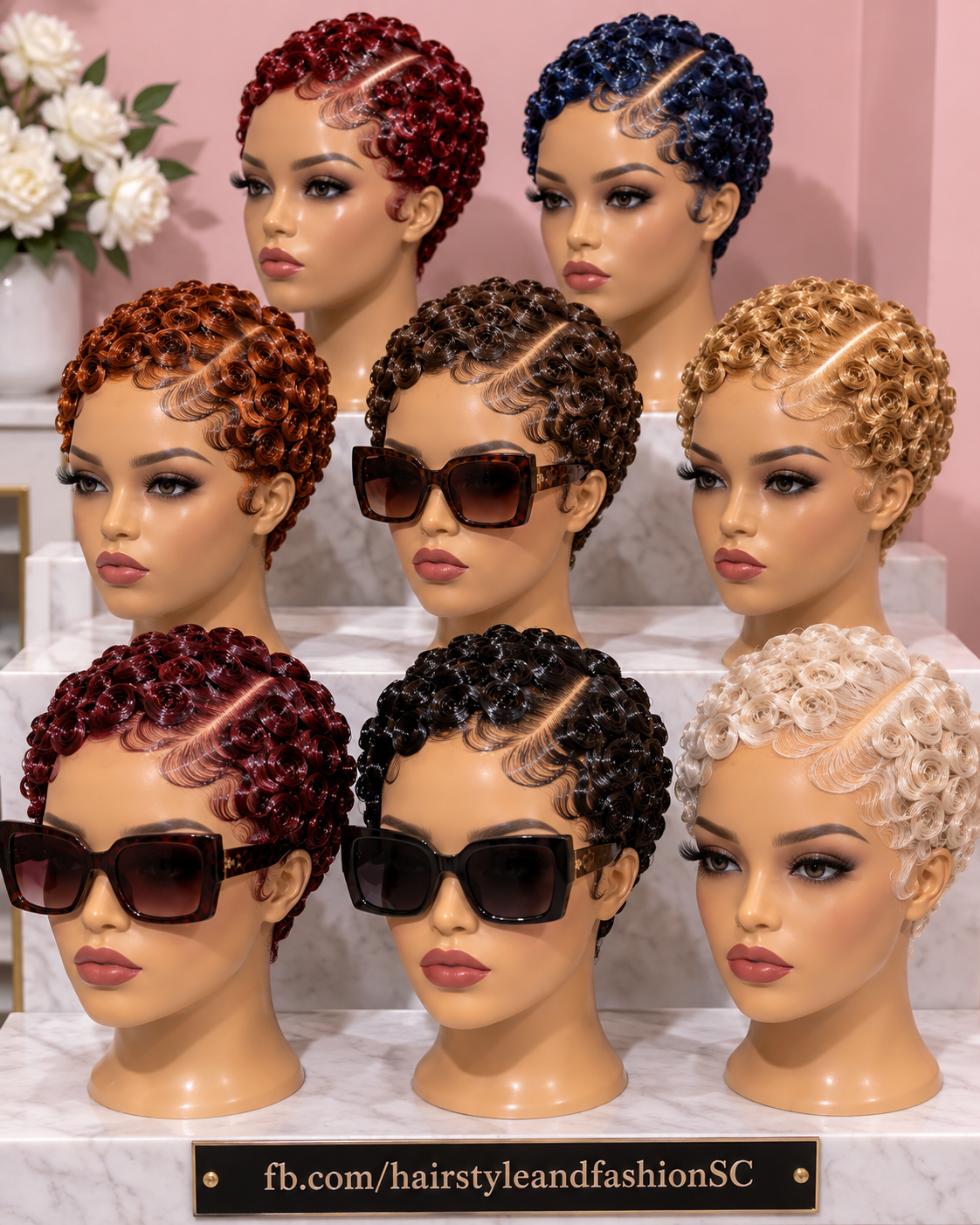
Color is often the first thing a customer notices in a wig display, but this nine-piece collection offers a more interesting way to compare hairstyles. Every mannequin wears a compact pixie covered in small, carefully arranged pin curls, with a diagonal parting cutting through the upper hair and delicate finger-wave styling near the forehead. What changes from one mannequin to another is the color, the visibility of the circular curls, and the impression created by the contrast between the hair and its exposed parting.
The collection is arranged in three rows on pale marble-effect display tiers against a pink salon background. The upper row contains a wine-red wig and a deep navy-blue version. The middle row presents copper orange, dark chocolate brown, and golden blonde. The lower row completes the selection with burgundy, glossy black, and pale champagne-platinum curls. Although there are nine mannequin heads in total, the visible colors include two different red-family interpretations, giving customers an opportunity to compare closely related shades.
Four mannequins wear oversized sunglasses, while the others display their full facial styling. The sunglasses are presentation accessories rather than part of the hairstyles. All nine mannequin heads have cosmetic facial detailing, including prominent lashes, shaped eyebrows, and lipstick.


The wigs share a recognizable construction concept: numerous small circular pin curls arranged across the crown, a diagonal exposed parting, and carefully directed strands around the front hairline. The photograph does not reveal the underside of the wigs, so their fiber composition, cap construction, and lace specifications cannot be verified.
Why This Collection Is Useful for Comparing Wig Colors
A coordinated display allows buyers to evaluate color without being distracted by completely different hairstyles. Here, the compact curl arrangement remains broadly consistent, making the differences between navy, burgundy, copper, brown, blonde, and black easier to appreciate.
The darker wigs emphasize shadow and reflection. Their circular curls appear especially glossy where light strikes the outer strands, while the openings inside the curls remain dark.
The lighter wigs reveal more of the individual strand arrangement. Golden blonde and pale platinum make the small pin curls particularly visible because the lighter hair contrasts with the spaces between neighboring loops.
Warm colors such as copper and burgundy introduce another effect. Their reflective surfaces create depth through variations in red, orange, and brown rather than relying entirely on dark shadows.
Customers should still inspect the actual wig they intend to purchase. Similar styling across a collection does not guarantee identical curl sizes, parting placement, or construction.
Wine-Red Pin Curls in the Upper Left
The upper-left mannequin wears a rich wine-red pixie with compact circular curls. The shade contains deep red and burgundy reflections, creating a jewel-like appearance under the salon lighting.
The upper hair is closely arranged, with numerous small spiral openings visible near the crown. A diagonal parting travels from the upper front toward the side, separating neighboring curl sections.
Near the forehead, fine strands form a sequence of curved finger waves. These waves follow the direction of the parting before joining the circular curls around the temple.
The overall silhouette remains compact, with little hair extending below the ear area.
This version may appeal to customers who enjoy dark red hair but prefer a richer shade rather than bright cherry red.
Distinguishing Wine Red From Ruby Burgundy
Wine-red hair generally has a darker appearance, with deeper burgundy or purple-red undertones. Brighter ruby shades may appear more intensely red under the same lighting.
The photograph includes another red-family wig in the lower row, making this distinction particularly relevant.
Customers should request actual photographs of both shades before choosing. Color names are not standardized across all wig suppliers.
The upper-right mannequin introduces a dark navy-blue pixie. Its compact circular curls display blue reflections against a nearly black foundation.
The color appears particularly deep around the roots and within the curl openings. Brighter navy reflections become visible along the outer surfaces of the loops.
A diagonal parting crosses the upper front, and several fine finger-wave sections follow the hairline.
The result offers a cool-toned alternative to the warm red, copper, and brown wigs elsewhere in the collection.
Customers seeking this appearance should distinguish navy blue from electric blue or bright royal blue. The displayed shade is relatively dark, with a subtle blue-black character.
When ordering, describe the desired shade as deep navy blue with a dark foundation.
Ask the seller whether the color appears blue under ordinary daylight or primarily under bright indoor lighting.
The photograph does not establish whether the blue tone was achieved through dyeing, pre-colored fiber, or another method.
The selected material and coloring process should be confirmed before purchase.
Copper-Orange Pin Curls in the Middle Row
The middle-left mannequin wears a vivid copper-orange pixie with numerous circular curls.
The color is considerably warmer and brighter than the burgundy wigs. Orange-copper reflections appear across the upper hair, particularly around the outward-facing spiral openings.
A diagonal parting creates a visible division through the crown. The front hairline contains closely arranged waves that curve toward the temple.
The compact silhouette allows the copper color to become prominent without requiring long hair.
Buyers seeking this version should specify a bright copper-orange shade rather than a darker auburn brown.
Dark Chocolate Brown for a Restrained Appearance
The center mannequin wears a deep chocolate-brown pixie with small, tightly arranged pin curls.
The crown contains numerous circular loops with warm brown reflections, while darker strands remain visible near the roots and inside the curls.
The diagonal parting is clearly visible against the surrounding hair. Curved front strands follow the hairline, creating a carefully arranged transition toward the temple.
This version is paired with oversized tortoiseshell-style sunglasses, but the hair itself remains the primary focus.
Chocolate brown can appeal to customers who want warmth without the intensity of copper or burgundy.
Chocolate Brown Versus Natural Black
Chocolate brown reflects warmer tones than natural black. Under bright lighting, these differences become particularly noticeable around circular curls.
The center wig displays brown reflections, while the black wig in the lower row appears darker and more neutral.
Customers comparing these shades should request photographs under similar lighting conditions.
The exact commercial color codes cannot be determined from the image.
Golden Blonde Pin Curls on the Middle Right
The middle-right mannequin displays a golden blonde pixie with a dense collection of small circular curls.
The color contains warm honey-gold reflections, producing a brighter appearance than the darker wigs.
The upper hair includes numerous recognizable spiral openings. Near the front, the curls transition into fine finger waves arranged along the forehead and temple.
A diagonal parting divides the upper hair, helping organize the curl direction.
This version is particularly useful for customers who want a warm blonde shade without moving toward pale platinum.
Why Golden Blonde Reveals Curl Placement
Lighter hair can make individual curl shapes easier to distinguish, particularly when the curls contain visible circular openings.
The golden strands contrast with the darker spaces between neighboring loops, creating a detailed surface.
However, the appearance can change under different lighting. A seller should provide daylight photographs before a customer commits to a particular shade.
Burgundy Pin Curls With Oversized Sunglasses
The lower-left mannequin wears another deep red-family hairstyle. This version appears burgundy with rich reddish-brown reflections.
The curls are closely packed, with small circular openings visible across the upper head.
The diagonal parting follows a similar general direction to those on the other wigs, while the front strands form carefully arranged curves.
Oversized tortoiseshell-style sunglasses partially cover the mannequin’s face but do not obscure the crown.
This wig provides an alternative for customers comparing wine-red and burgundy shades.
Although the two red wigs are similar, the photograph shows slightly different reflections and curl arrangements. Buyers should not assume they are identical products in different positions.
Glossy Black Pin Curls in the Lower Center
The lower-center mannequin displays a deep black pixie with compact circular curls.
The upper hair appears glossy, with reflections along the outer strands and dark openings inside the curls.
A diagonal parting creates a visible separation through the upper front, while sculpted finger waves follow the hairline.
The mannequin wears oversized black sunglasses, giving the display a fashion-oriented appearance.
This version may appeal to customers who prefer a versatile dark shade without additional color processing.
Black Hair Emphasizes Shape Rather Than Color Contrast
The black wig relies on curl arrangement, light reflection, and the exposed parting to create visual interest.
Its circular curls remain recognizable despite the consistent dark coloring.
Customers seeking a similar hairstyle should prioritize curl size and hairline arrangement rather than requesting unnecessary highlights.
The photograph does not establish whether the black hair is human hair or synthetic fiber.
Pale Champagne Platinum Completes the Collection
The lower-right mannequin wears a very light champagne-platinum pixie with compact circular curls.
The shade appears creamy and pale, with subtle warm undertones rather than a strongly yellow-gold appearance.
The upper curls are closely arranged, while the diagonal parting remains clearly visible.
Fine finger waves curve across the front hairline and toward the temple.
This version offers a lighter alternative to the golden blonde wig in the middle row.
Champagne Platinum Versus Golden Blonde
Golden blonde contains stronger warm gold reflections, while champagne platinum appears lighter and more neutral.
The two shades can create noticeably different impressions even when the curl arrangement is similar.
Customers should compare actual samples under daylight because warm indoor lighting may make platinum shades appear more golden.
The photograph does not establish the coloring history or exact fiber composition of either wig.
Across the nine wigs, a diagonal exposed parting separates sections of the upper curls.
The partings vary slightly in angle and visible length, but they create a recognizable styling relationship throughout the collection.
Hair on either side follows different directions, allowing the circular curls to form compact arrangements around the separation.
The exposed foundation contrasts with the surrounding strands, making the parting particularly noticeable on darker colors.
On lighter wigs, the parting remains visible through differences in strand direction and the spacing between curls.
A custom maker should consider the position of the parting before arranging the curls.
Front Finger Waves Add Precision to the Hairline
The front hairlines contain carefully arranged strands that curve across the forehead and toward the temple.
These waves create a transition between the compact circular curls and the lower hairline.
Their shapes vary slightly between the wigs, but the general styling approach remains consistent.
Some waves form broad curves, while others appear as smaller repeated arcs.
The photograph does not reveal the exact construction method used to create these hairlines.
Customers should ask whether the wig will arrive with the front waves already styled or whether additional salon work will be required.
What the Mannequin Display Cannot Confirm
The photograph provides a detailed view of color, curl arrangement, parting direction, and front hairline styling.
However, the underside of the wigs is not visible.
The mannequin heads do not establish the cap construction, fiber composition, lace grade, or attachment hardware of the wigs placed on them.
Buyers should request photographs of the actual wig removed from its mannequin before purchasing.
A complete underside photograph can help establish the cap design, while a close-up of the hairline may reveal whether lace is present and how it has been prepared.
No wig in the display should be advertised as HD lace or glueless solely on the basis of this photograph.
Finding a Seller for Compact Pin Curl Pixie Wigs
Specialist wig salons, independent wig makers, and online businesses offering custom pixie styling are appropriate places to begin.
Look for portfolios containing small circular pin curls, diagonal partings, and carefully arranged front waves.
A general curly wig seller may offer similar colors without demonstrating the ability to reproduce the compact circular curl arrangement.
When contacting a potential maker, send the reference photograph and identify the preferred wig by its position and color.
Ask whether the seller can reproduce the curl size, parting direction, and front-wave styling.
Preparing a Clear Order Request
Confirm the desired color, crown height, curl density, and parting orientation.
Ask whether the wig will arrive fully styled or require additional salon work after delivery.
Request photographs of the actual unit rather than relying exclusively on a mannequin display.
The seller should also provide information about the hair material, cap construction, measurements, and available installation options.
For online orders, obtain written confirmation of the agreed design, production time, shipping arrangements, and revision policy.
Illustrative Pricing for Jewel-Toned Pin Curl Pixie Wigs
The potential cost of these hairstyles depends on the selected hair material, cap construction, color processing, compact curl styling, and front hairline customization.
The following USD amounts are illustrative planning ranges only. They are not verified live retail prices or quotations for the displayed wigs.
| Wig Category | Illustrative USD Range | Relevant Cost Considerations |
|---|---|---|
| Premium Custom | $370–$880+ | Individual pin curl placement, custom jewel-tone coloring, diagonal parting construction, sculpted front waves, and personalized cap fitting. |
| Standard Custom | $185–$440 | Customized compact curls and front-wave styling on a suitable prepared wig foundation. |
| Basic Human Hair | $105–$280 | A possible starting unit requiring additional coloring, curl setting, and hairline customization. |
| Premium Synthetic | $75–$205 | May offer a pre-styled colorful pixie alternative if the fiber and construction support the intended curl arrangement. |
| Basic Synthetic | $30–$100 | A lower-budget option for similar colors and silhouettes, potentially without the precise pin curl and hairline details. |
The photograph does not establish whether the displayed wigs contain human hair, synthetic fiber, or blends. These categories describe possible purchasing options rather than verified characteristics of the products.
Additional charges may include coloring, cap adjustment, professional installation, shipping, and future styling restoration.
When comparing quotations, ask whether the completed pin curl arrangement and sculpted front waves are included in the price.
Maintaining Small Circular Pin Curls
The upper curls depend on retaining their compact circular shapes. Repeated brushing could disturb their arrangement and reduce the visible spiral openings.
Customers should avoid pulling the curls apart simply to increase volume.
Ask the wig maker whether the curls can be refreshed at home or whether professional restyling is recommended after washing.
If the wig contains human hair, cleansing should account for any coloring and setting products used during preparation.
If synthetic fiber is used, follow the manufacturer’s instructions and confirm heat tolerance before attempting to restyle the hair.
Color-Specific Care Considerations
Bright colors such as copper, navy blue, burgundy, and platinum may require particular attention if the hair has been chemically processed.
The photograph does not establish the coloring history of any displayed wig.
For human-hair units, ask the seller whether the color has been processed and which care products are appropriate.
For synthetic alternatives, follow the manufacturer’s instructions rather than attempting conventional hair dyeing.
The goal is to preserve both the selected shade and the compact curl arrangement.
Protecting the Diagonal Partings and Front Waves
The exposed partings depend on neighboring strands remaining aligned. Repeated rubbing or combing across the channels may reduce their visibility.
The front waves also require careful handling because their appearance depends on maintaining specific directional paths.
A stylist should explain how to refresh these sections without disturbing the upper curls.
Any cutting or permanent adjustment should be performed cautiously because the parting and hairline arrangement are important parts of the hairstyle.
Choosing a Color From the Nine-Piece Collection
This display demonstrates how a compact pin curl pixie can be interpreted through several distinctive colors.
Wine red and burgundy provide deep red alternatives, while copper orange introduces greater warmth and brightness.
Navy blue offers a cooler jewel-toned option, and chocolate brown and black provide more restrained dark shades.
Golden blonde and champagne platinum create lighter appearances with different undertones.
The individual wigs also differ slightly in curl placement and parting orientation, making it important to evaluate the preferred unit rather than selecting color alone.
For customers planning a purchase, the best approach is to identify the desired shade, compare the curl arrangement, and confirm that the seller can reproduce the sculpted front hairline.
When these details are considered together, a compact pin curl pixie can offer a distinctive combination of circular styling