
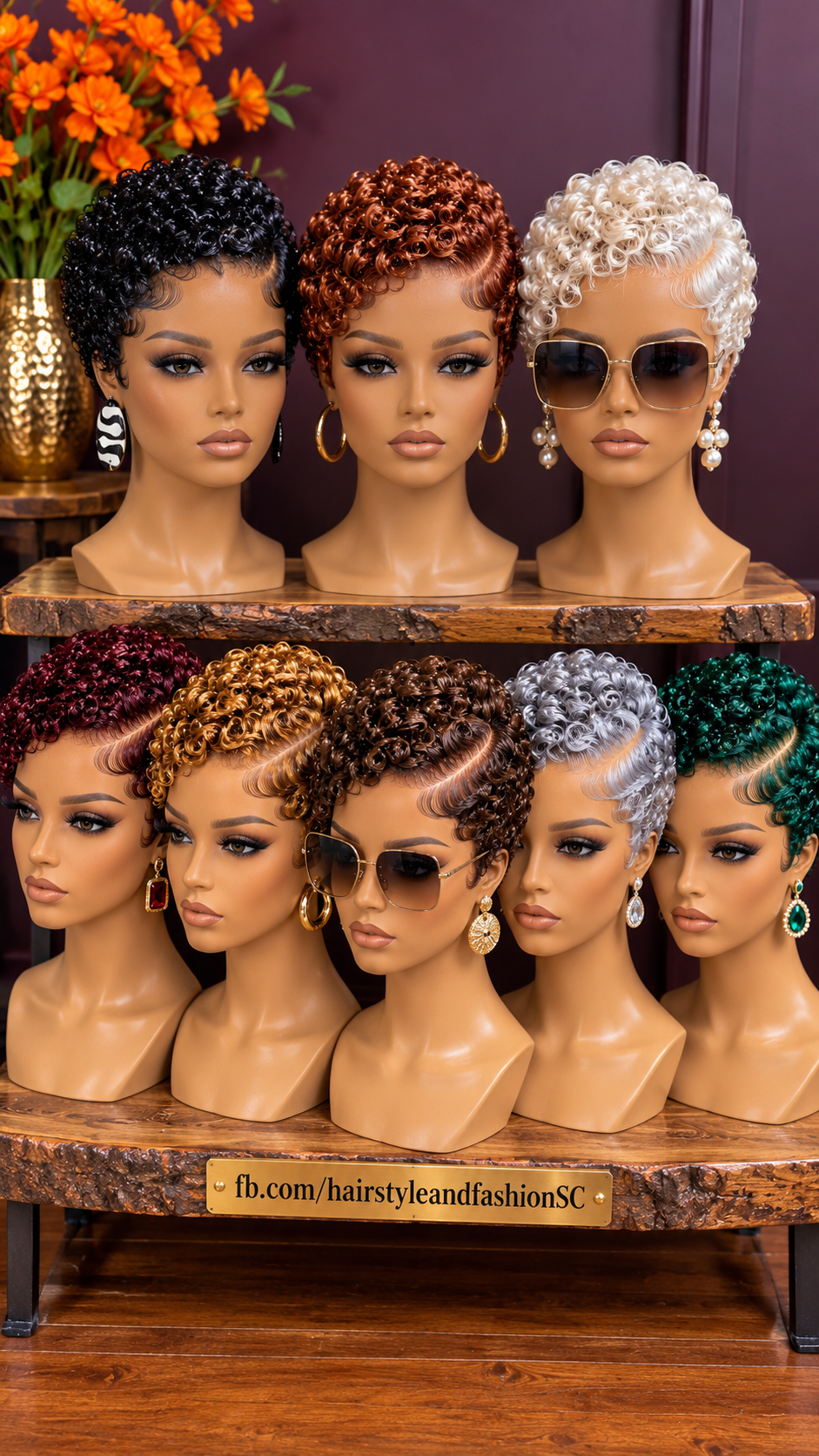
Color can completely change the personality of a pixie wig, even when the underlying hairstyle remains similar. This eight-piece salon collection demonstrates that beautifully through compact spiral curls, carefully arranged frontal waves, and a remarkable range of colors extending from natural black to emerald green. Presented across two rustic wooden shelves, the wigs offer a direct comparison of how different shades influence the appearance of sculpted finger-coil styling.
The display contains eight mannequin heads arranged in two rows, with three positioned above and five below. Each mannequin wears a compact curly pixie hairstyle featuring closely grouped circular coils and decorative hairline styling. Several wigs include a clearly visible diagonal parting, while others emphasize sweeping finger waves near the temples. The overall collection maintains a recognizable styling family without making every individual wig appear completely identical.
The upper row presents glossy black, copper auburn, and platinum blonde. The lower row introduces burgundy, golden honey blonde, chocolate brown, silver gray, and deep emerald green. These variations provide a broad selection for women interested in expressive colors without sacrificing the compact proportions of a pixie hairstyle.


The wooden display includes a gold-colored plaque bearing the address fb.com/hairstyleandfashionSC. This is visible display branding rather than proof of a particular manufacturer, verified seller, or available inventory. The mannequin presentation also does not establish the hair material, cap construction, or lace specifications of the individual wigs.
Eight Wigs, Two Shelves, and Distinct Color Personalities
The arrangement is especially useful because it places different shades within the same visual environment. Buyers can compare colors under similar lighting while observing how the circular curls interact with darker roots, exposed partings, and sculpted frontal strands.
The upper shelf contains three mannequin heads. The left mannequin wears a glossy black curly pixie, the center displays warm copper auburn, and the right presents a pale platinum-blonde variation.
The lower shelf contains five mannequins wearing deep burgundy, golden honey blonde, dark chocolate brown, silver gray, and emerald green wigs.
Although the collection shares compact curly crowns and decorative side styling, the exact placement of the partings and finger waves differs slightly among the mannequins. Customers should therefore evaluate each wig individually rather than assuming that all eight are identical products in different colors.
Natural Black: The Version That Places Curl Geometry First
The upper-left mannequin displays a predominantly black pixie wig with numerous small, glossy curls arranged across the crown. The curls form a rounded silhouette that sits relatively close to the head, while the frontal strands follow a curved direction toward the temple.
Because the hair is dark throughout, the individual curl formations become visible primarily through reflected light. Some sections appear almost charcoal under the display lighting, but there is no clearly distinguishable contrasting highlight color.
This variation may appeal to customers who prefer the sculpted appearance without introducing a dramatic color treatment.
The frontal styling contains carefully arranged curved strands that complement the compact upper curls. For a custom order, the buyer should request a similar balance between crown density and hairline detail.
Natural black and jet black are not always identical manufacturer shades. Customers should confirm the actual color designation before purchasing.
Copper Auburn: Warm Color Across the Spiral Crown
The upper-center wig displays a rich copper auburn shade with reddish-brown and orange-copper reflections. Its curls are closely arranged across the crown, creating a compact but visually lively surface.
A diagonal parting is visible near the frontal side, with darker copper strands arranged into a sweeping finger-wave formation beneath it.
The copper color emphasizes the individual curls because the light travels across their rounded surfaces. Some sections appear brighter than others, producing depth within the warm palette.
This shade differs from bright scarlet red or deep burgundy. Its appearance is more closely associated with warm copper brown and auburn.
Customers seeking a similar wig should request daylight photographs because indoor lighting may intensify the orange reflections.
Platinum Blonde: Pale Curls with a Sculpted Hairline
The upper-right mannequin wears a very light platinum-blonde pixie with compact circular curls and a pale finger-wave arrangement around the frontal hairline.
The shade appears close to ivory platinum, with subtle cream reflections rather than a strongly golden blonde appearance.
A diagonal separation remains visible beneath the crown, helping distinguish the curls from the frontal styling.
The light color changes how the hairstyle is perceived. Instead of relying on dark reflections, the curls gain depth through the shadows inside their openings and the spacing between individual strands.
The mannequin also wears large sunglasses, but these accessories are separate from the wig and should not be treated as part of the hairstyle.
Buyers interested in this pale shade should confirm whether the material is supplied in its final color or requires additional processing. The photograph alone cannot establish how the platinum appearance was achieved.
Burgundy: A Deep Wine-Red Interpretation
The lower-left mannequin displays a compact burgundy pixie with tightly arranged circular curls. The color appears deep wine red, with darker plum and reddish-brown reflections across the upper hair.
The frontal area contains a sweeping wave arrangement that follows the temple, contributing to the hairstyle’s sculpted appearance.
The burgundy shade is noticeably darker than the copper variation above. It provides a richer red appearance without the brighter orange tones associated with copper.
This distinction matters when ordering because burgundy, cherry red, and auburn are not interchangeable color descriptions.
Customers should request a color sample or daylight photograph to establish whether the shade leans toward red, purple, or brown.
Golden Honey Blonde: Brightness with Warm Brown Depth
The second mannequin on the lower shelf wears a golden honey-blonde pixie with numerous rounded curls and a prominent diagonal parting.
The upper hair displays warm gold, caramel, and honey-brown reflections. Some curls appear lighter along their outer surfaces, while deeper golden-brown strands remain visible between the openings.
The frontal wave arrangement follows the parting and curves toward the temple.
This variation offers a warmer alternative to the platinum-blonde wig above. Its golden undertones are considerably more pronounced, creating a different visual impression despite the similar compact curl arrangement.
Buyers should avoid confusing honey blonde with pale platinum or ash blonde. A supplier’s color name should be supported by actual product photographs.
Chocolate Brown: A Rich Alternative to Natural Black
The center mannequin on the lower shelf displays a deep chocolate-brown curly pixie. Its crown contains numerous circular coils with warm brown reflections, while the frontal area is arranged into a prominent sweeping wave beneath a diagonal separation.
The hair appears darker than the honey-blonde and copper variations but warmer than the natural-black wig.
This makes the chocolate shade particularly interesting for customers who want subtle color variation without choosing a bright fashion color.
The mannequin wears dark sunglasses, which partly conceal the face but do not obscure the visible crown and frontal styling.
Customers commissioning this version should specify a deep chocolate or espresso-brown appearance rather than a uniformly light brown shade.
Silver Gray: A Cool-Toned Pixie with Pale Spiral Curls
The fourth mannequin on the lower shelf wears a silver-gray pixie with compact circular curls and a pale sculpted frontal arrangement.
The color contains cool silver, ash-gray, and lighter metallic reflections. The upper curls remain closely grouped, creating a rounded silhouette.
A diagonal parting separates the crown from the frontal waves, maintaining the recognizable styling concept of the collection.
This version differs from the platinum-blonde wig because its appearance is more distinctly gray and metallic rather than ivory blonde.
Buyers seeking silver hair should confirm whether the proposed shade is pearl silver, ash gray, smoky silver, or another manufacturer color.
Color-care requirements depend on the actual material and processing history, which cannot be determined from the mannequin display.
Emerald Green: The Most Unusual Color in the Collection
The lower-right mannequin displays a deep emerald-green pixie with compact spiral curls and decorative frontal waves.
The shade appears saturated and jewel-like, with darker green shadows between the curls and brighter green reflections across their surfaces.
A diagonal parting remains visible near the frontal side, while the surrounding strands follow a sculpted direction toward the temple.
This variation demonstrates how a compact pixie can accommodate an expressive fashion color without requiring additional length.
Customers interested in emerald green should verify the fiber type before considering any future recoloring. Conventional hair dyes may be unsuitable for synthetic materials.
The photographed shade should not automatically be described as teal or blue-green. Its dominant appearance is a rich emerald green.
Across the collection, the most recognizable styling elements are the compact curly crowns and carefully arranged frontal hair.
The upper sections contain numerous small circular curls that remain close to the head. Their arrangement produces rounded pixie silhouettes rather than long hanging spirals.
Several wigs display clearly visible diagonal partings that separate the crown from the frontal finger-wave sections.
The waves follow the hairline and curve toward the temples, creating a decorative boundary beneath the curls.
Although these elements are shared, the individual wigs differ slightly in curl placement, parting angle, and wave arrangement.
A buyer should therefore choose a specific mannequin as the reference for a custom order rather than requesting an unspecified version of the entire collection.
Why Curl Diameter Matters More Than Maximum Volume
The compact appearance depends on the curls remaining proportionate to the mannequin heads.
Oversized curls could increase the crown height and change the hairstyle’s silhouette. Extremely small coils might create a denser appearance with fewer recognizable circular openings.
Customers should specify the preferred curl diameter and overall crown shape when commissioning a wig.
Photographs from the front, side, and above can help establish whether the finished unit resembles the selected reference.
The image does not establish the original setting techniques or the long-term durability of the curls.
Understanding the Diagonal Partings and Finger-Wave Placement
The diagonal partings create an asymmetrical division between the upper curls and the frontal hairline styling.
These exposed channels resemble scalp-toned separations, but the photograph does not reveal the exact construction beneath them.
The finger waves follow a controlled direction, creating curved ridges that contrast with the circular coils above.
Customers should distinguish these decorative waves from ordinary side-swept hair. Simply brushing the frontal strands diagonally may not reproduce the same arrangement.
A wig maker experienced in sculpted pixie styling should be able to explain how the waves will be created and maintained.
Any cutting or thinning around exposed partings should be approached cautiously because alterations to a wig may be irreversible.
What the Mannequins Cannot Confirm About the Wigs
The collection is displayed on mannequin heads, so the interior cap construction is not visible.
The photograph does not establish whether the wigs contain human hair, synthetic fiber, or blended materials.
It also does not confirm lace-front construction, lace grade, cap circumference, attachment combs, or adjustable straps.
The outward appearance of a wig cannot reliably establish its fiber composition or installation requirements.
Buyers should request separate photographs showing the actual product’s underside and hairline before purchasing.
Questions to Ask About Cap Construction
Ask the seller for the cap circumference and any additional measurements required for a comfortable fit.
Request photographs showing the interior seams, adjustment components, and attachment hardware.
If the wig includes lace, confirm its dimensions, color, and manufacturer specifications.
Do not assume that a wig is suitable for adhesive-free installation simply because it is displayed as a ready-to-wear hairstyle.
Similarly, HD lace should only be described as such when reliable product information confirms that construction.
Where to Find Similar Sculpted Pixie Wigs
Customers can begin by searching specialist wig boutiques, custom hairpiece makers, and salons experienced in decorative pixie styling.
Look for suppliers who can demonstrate compact circular curls, diagonal partings, and carefully arranged frontal finger waves.
When contacting a seller, identify the preferred color and send a photograph of the specific mannequin.
Ask whether the unit is ready-made or requires custom production.
For online orders, request actual photographs of the product being shipped rather than relying entirely on promotional images.
Customers should also confirm the seller’s return policy, production timeline, and available customization options.
Choosing Between Ready-Made and Custom Production
A ready-made wig may be convenient when the preferred color and styling are already available.
However, some products may contain different curl diameters, frontal wave patterns, or cap constructions.
Custom production may offer greater control over color, crown density, parting placement, and fitting.
Before purchasing a basic wig for later customization, consult a specialist to determine whether its material and construction can support the intended result.
Extensive restyling may not be suitable for every wig, particularly when the curls were manufactured into the fibers.
Illustrative Price Guide for Colorful Sculpted Pixie Wigs
The cost of these hairstyles may depend on the material, cap construction, circular curl preparation, frontal finger-wave styling, and any additional color processing.
Some colors may require more production work than others, but the photograph does not establish the actual manufacturing methods or retail prices.
The following USD figures are illustrative planning ranges rather than verified current prices or confirmed supplier quotations.
| Wig Category | Illustrative USD Range | Potential Purchasing Considerations |
|---|---|---|
| Premium Custom | $310–$760+ | Individually arranged spiral curls, personalized color selection, sculpted frontal waves, and possible custom cap construction. |
| Standard Custom | $165–$390 | Customized pixie styling with selected adjustments to curl diameter, parting placement, and color distribution. |
| Basic Human Hair | $95–$255 | A possible human-hair foundation requiring additional curl setting, color work, or finger-wave styling. |
| Premium Synthetic | $70–$190 | A potential pre-styled alternative with compact curls and decorative frontal waves. |
| Basic Synthetic | $25–$95 | Budget options may resemble the general colorful pixie silhouette without reproducing the intricate styling. |
These categories describe possible purchasing options rather than the confirmed material of the displayed wigs.
Before accepting a quotation, confirm whether the price includes completed styling, color work, cap adjustments, and any lace preparation.
Shipping, professional installation, and future maintenance may be charged separately.
Customers should compare the actual quality of the curls and frontal waves rather than selecting a wig solely because it belongs to a higher price category.
Installation and Personalization After Purchase
Once a wig has been purchased, the installer should begin by checking its fit and examining the existing styling.
If the unit contains lace, the frontal mesh should be positioned correctly before trimming.
The diagonal parting and finger waves should align naturally with the wearer’s face.
Any adjustments to the circular curls should be performed carefully because excessive brushing or pulling may disturb their arrangement.
Customers should discuss significant changes with a specialist before cutting, thinning, or restyling the wig.
For custom units, photographs taken after fitting can help establish whether the final result resembles the selected mannequin reference.
Maintaining Eight Different Colors Without Damaging the Curls
The compact spiral curls depend on their individual formations remaining recognizable. Repeated brushing, compression, or unnecessary manipulation may disturb the arrangement.
Maintenance requirements depend on the confirmed fiber type and the original styling method.
For synthetic wigs, heat styling should only be attempted when the manufacturer confirms suitable temperature limits.
For human-hair wigs, previous coloring and processing may influence how the strands respond to heat or chemical treatments.
The platinum, silver, copper, burgundy, and emerald variations may require different color-care approaches depending on how their shades were produced.
Customers should obtain specific instructions from the seller rather than applying the same routine to every wig in the collection.
Protecting the Frontal Finger Waves
The sculpted waves may lose their original direction if the strands are repeatedly separated or coated with excessive product.
Ask the original stylist which products and techniques are appropriate for maintaining the wave ridges.
When storing the wig, avoid compressing the crown or stretching any frontal lace.
A suitably sized wig stand may help preserve the overall silhouette, provided it does not place excessive tension on the cap.
If the waves lose their shape, professional restyling may be preferable to extensive home adjustments.
Making a Color Choice That Preserves the Sculpted Pixie Identity
This eight-wig collection demonstrates how a compact spiral-coil pixie can take on very different personalities through color while retaining a recognizable combination of circular curls, diagonal partings, and frontal finger waves.
Natural black and chocolate brown emphasize the shape of the hairstyle. Copper auburn and honey blonde introduce warmth, while burgundy and emerald green provide deeper fashion colors. Platinum and silver offer pale alternatives with distinctive reflective qualities.
For buyers, the best approach is