
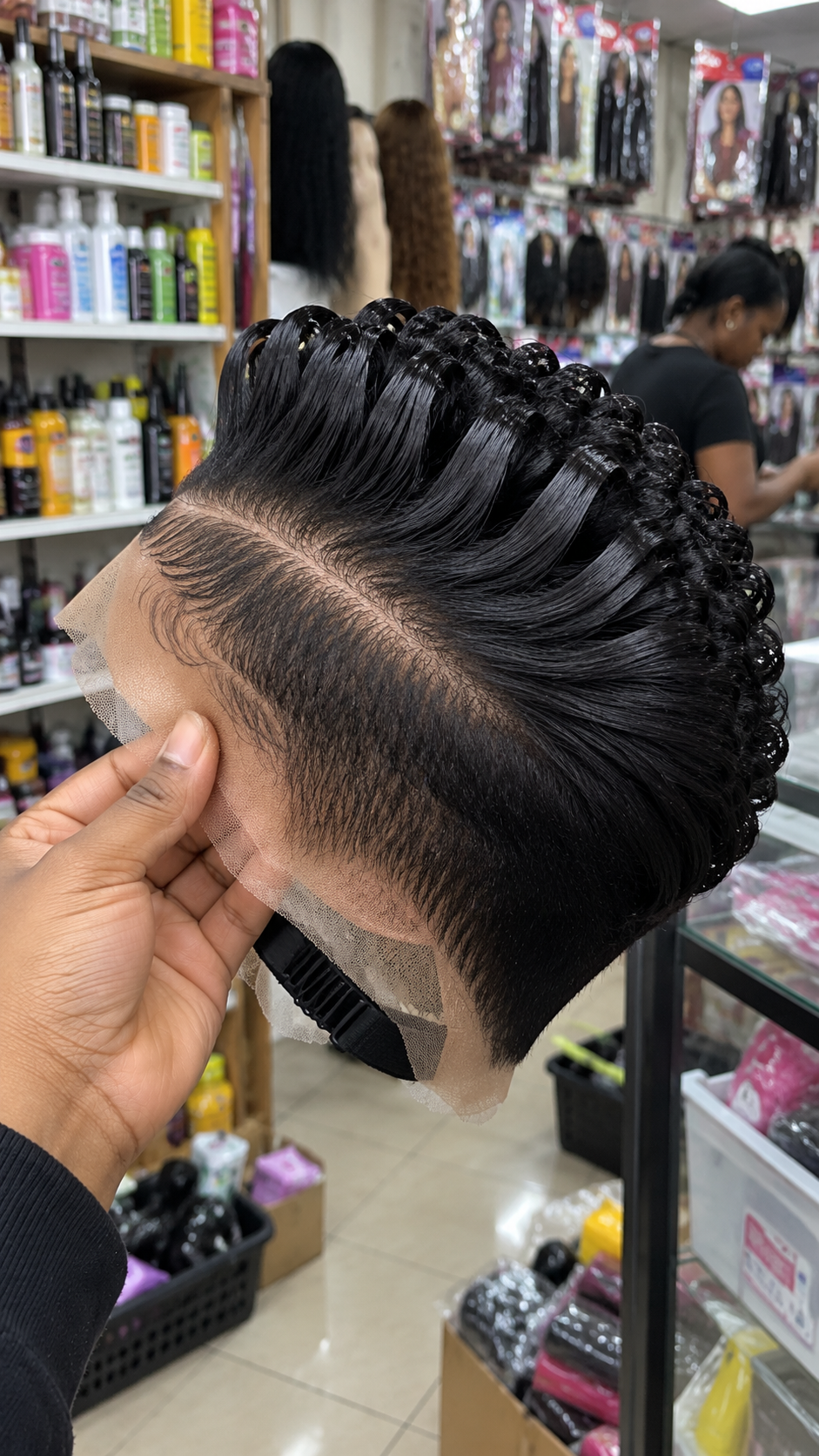
A pixie wig can make a powerful impression without bright colors, elaborate shaved patterns, or an oversized crown. This jet black hairstyle demonstrates how carefully directed ribbon curls and a closely fitted side can create a distinctive silhouette. Broad, glossy strands rise from the front, fold backward into sculpted loops, and gradually transition into smaller curls toward the rear. Beneath them, the side remains compact, with finely arranged dark hair following the natural curve of the head.
Photographed inside a busy beauty supply store, the wig is held in one hand before installation. The upper section contains several prominent ribbon-like loops, each formed from closely aligned strands. Their curved surfaces catch the overhead lighting, producing narrow reflections that emphasize the direction of the styling. The lower section appears much flatter, creating a strong contrast between the raised crown and the tapered side.
A pale beige lace perimeter extends beyond the front and temple area. Part of a black fastening component is visible beneath the opening, but the complete interior construction remains concealed. The photograph does not establish the fiber composition, exact lace grade, manufacturer, or whether the unit is suitable for adhesive-free wear.
One important distinction separates this hairstyle from many previously popular sculpted pixies: the visible side does not contain decorative razor stripes. Instead, its appearance depends on carefully controlled hair density, an uninterrupted dark side, and the sweeping direction of the upper curls.
The Beauty of an Uninterrupted Tapered Side
The lower section is the visual foundation of this hairstyle. Fine black strands lie close to the cap, creating a tapered appearance beneath the fuller crown.
Near the upper side, the hair follows a curved direction toward the rear. As it approaches the lower perimeter, the strands become shorter-looking and more compact.
This gradual reduction in visible volume gives the hairstyle a balanced profile. The crown remains elevated, but the lower hair does not extend outward or compete with the upper curls.
The photograph shows no clearly carved diagonal stripes, intersecting lines, or decorative temple channels. The side should therefore be described as plain and closely tapered rather than as a patterned fade.
That simplicity is an important part of the design. Adding shaved lines could change the overall appearance and shift attention away from the ribbon curls.
Why Side Density Matters
A closely fitted wig side must maintain enough coverage to conceal its underlying foundation while preserving a compact silhouette.
If the density is excessive, the side may appear bulky and reduce the contrast with the raised crown.
If too much hair is removed, the foundation may become visible, especially around the lower temple.
For custom production, ask the wig maker how the tapered effect will be achieved. The maker should be able to explain whether the side relies on strand placement, cutting, or another construction method.
Do not assume that a regular curly wig can be converted into this style simply by shaving the sides. Removing strands from an unsuitable cap may cause permanent damage.
Broad Ribbon Loops Shape the Upper Crown
The crown is built around wide sections of hair that rise upward before curling backward. These loops have an elongated, folded appearance rather than the small circular openings associated with tightly packed finger coils.
At the front, several ribbon formations stand prominently above the hairline. Their strands remain closely aligned, creating continuous reflective surfaces.
Farther toward the middle of the crown, the loops overlap and begin to curve more strongly toward the rear.
Smaller curled formations appear along the back edge of the visible upper section, creating a gradual progression from the broad front loops to a denser rear arrangement.
This transition prevents the hairstyle from looking flat or uniformly curled.
Understanding the Direction of the Ribbon Curls
The ribbon curls are not arranged randomly. Most visible sections follow an upward-and-backward direction, producing the impression of hair being swept away from the forehead.
The front loops are relatively tall, while the lower rear curls sit closer to the head.
This creates a directional silhouette that differs from a pixie with curls distributed evenly across the entire crown.
When requesting a similar wig, emphasize the backward movement of the upper strands.
A supplier offering ordinary spiral curls may not reproduce the same shape, even if the wig is black and has a tapered side.
Request photographs from above and from the opposite profile to confirm how the curls travel across the crown.
Jet Black Coloring Highlights the Sculpted Shape
The hairstyle appears predominantly deep black. Bright silver-gray reflections run along the glossy strands under the store lighting, but these do not establish intentionally colored highlights.
No clearly separate blonde, copper, burgundy, or brown sections are visible.
The dark coloring allows the shape of the ribbon curls to become the central point of interest.
Light reflects differently across the raised upper loops and the flatter side. The crown produces long, curved highlights, while the lower section appears more restrained.
This contrast makes the individual sections easier to distinguish despite their shared color.
Natural Black or Jet Black?
Suppliers often offer several dark shades, including natural black, jet black, and very dark brown.
These colors can appear similar in photographs, especially under strong artificial lighting.
The reference shows a deep black appearance, but it does not establish the manufacturer’s color code.
Ask for photographs taken under neutral daylight before choosing a shade.
If the buyer wants the darkest available black, that preference should be confirmed directly with the supplier.
The Front Hairline Supports the Upward Styling
At the front, the longer upper strands emerge from a closely arranged hairline and rise into the first ribbon loops.
The transition is gradual rather than interrupted by a heavy fringe.
Fine strands follow the front perimeter, creating a restrained edge beneath the elevated crown.
Unlike pixies decorated with large circular baby-hair loops, this hairstyle keeps the front relatively simple.
The absence of elaborate forehead curls allows the sweeping upper sections to remain visually dominant.
When commissioning a reproduction, ask the stylist to preserve the upward direction of the front strands rather than introducing oversized decorative waves.
The Visible Lace Shows the Wig Before Fitting
A broad beige lace section extends beyond the front and side hairline. The excess mesh remains untrimmed, leaving additional material for positioning and customization.
The lace is visible along the forehead area and continues toward the lower temple.
However, the photograph cannot establish the exact lace grade, mesh thickness, or complete construction.
Fine-looking lace should not automatically be advertised as HD lace.
Before purchasing, ask the supplier to confirm the lace material, dimensions, and available shades.
The appropriate lace shade will depend on the intended wearer and installation method.
Why Lace Positioning Comes Before Trimming
The hairstyle’s silhouette depends on the correct relationship between the raised crown and lower side.
If the wig is positioned too far forward, the upper curls may sit unnaturally over the forehead.
If it is positioned too far backward, the hairline may appear misplaced.
A stylist should establish the final wearing position before trimming excess lace.
Because lace cutting is generally irreversible, unnecessary removal should be avoided.
The fine strands near the perimeter should also be protected during customization.
What Can Be Seen Inside the Cap?
The photograph provides a limited view beneath the wig. A black fastening or adjustment component is visible near the lower opening.
However, the complete interior structure cannot be examined from this angle.
The number and placement of combs, clips, elastic straps, or other securing elements remain unknown.
The image also does not confirm whether the wig is designed for glueless installation.
Buyers should request an underside photograph showing the cap fully opened.
Ask the supplier to explain the fastening system and whether additional installation products are required.
Cap Measurements for a Balanced Pixie Fit
Correct sizing is especially important for a hairstyle with a raised upper section and close-fitting lower sides.
A cap that is too large may shift during wear, changing the position of the front loops.
A cap that is too small may create discomfort or distort the intended silhouette.
Provide the measurements requested by the maker, including head circumference and any additional dimensions needed for the selected construction.
For custom production, discuss where the crown should sit in relation to the forehead and ears.
These details can influence how the finished hairstyle appears when worn.
Where to Find This Sculpted Black Pixie
Customers can look for similar hairstyles through local wig boutiques, specialist wig makers, and online hair retailers.
However, an ordinary black curly pixie may not reproduce the same wide ribbon formations or closely fitted side.
Searching for sculpted ribbon curl pixies may produce more relevant results than searching for general curly wigs.
Local shops can offer the advantage of inspecting the actual unit before purchasing.
Independent wig makers may provide greater control over the crown direction and side density.
The photograph does not identify a verified seller or establish current product availability.
Questions to Ask Before Ordering
Ask whether the wig arrives with its ribbon curls fully styled.
Confirm the fiber composition, cap measurements, lace specifications, and fastening components.
Request photographs of the front, both sides, rear, crown, and interior cap.
Ask whether the closely fitted side is part of the original construction or requires additional cutting.
For a custom unit, specify the upward-and-backward curl direction and the absence of decorative temple stripes.
Before paying, establish the production schedule, revision policy, shipping charges, and whether photographs of the finished unit will be provided.
Ready-Made Wigs Versus Custom Sculpted Styling
A ready-made wig may be suitable if its upper curls and tapered side already resemble the reference.
However, many manufactured curly pixies use small finger coils or loose spirals rather than broad ribbon loops.
Others have fuller sides, reducing the contrast between the crown and lower hair.
Custom production may allow the maker to coordinate the curl placement and side density during construction.
This can be useful when the buyer wants a particularly close reproduction of the reference.
Ask whether the proposed fiber is suitable for maintaining the raised loops and whether professional resetting will be necessary after washing.
Illustrative Prices for Sculpted Black Ribbon Pixies
The following USD figures are illustrative planning ranges, not verified live prices for the photographed wig. Actual costs depend on fiber, cap construction, styling labor, and supplier.
| Wig Category | Illustrative USD Range | Potential Cost Considerations |
|---|---|---|
| Premium Custom | $340–$820+ | Individual cap sizing, detailed ribbon curl placement, tapered side construction, and professional hairline finishing. |
| Standard Custom | $185–$445 | Selected cap options with personalized crown loops and compact lower-side styling. |
| Basic Human Hair | $110–$295 | A human-hair starting unit that may require curl setting, cutting, and professional fitting. |
| Premium Synthetic | $80–$215 | A manufactured black pixie with preformed sculpted curls and varying cap options. |
| Basic Synthetic | $30–$105 | A lower-cost curly pixie that may not reproduce the raised ribbon loops accurately. |
The broad ribbon formations may require substantial styling work, especially if they are individually arranged.
Creating a closely fitted side without exposing the underlying foundation may also influence the final quotation.
Cap measurements, lace options, hair density, and professional finishing can affect the price.
Installation, shipping, taxes, and future restyling may be charged separately.
Ask whether the quoted amount includes a fully finished hairstyle or only the base wig.
Preparing for the First Installation
When the unit arrives, inspect the crown loops, lace perimeter, and side density before making permanent changes.
The stylist should begin by checking cap fit and establishing the intended wearing position.
The front ribbon curls should rise naturally from the forehead without excessive forward overhang.
The closely fitted side should sit comfortably around the temple and ear.
Only after the fitting is complete should unnecessary lace be trimmed.
If the curls have shifted during shipping, restoration should follow the manufacturer’s recommendations for the confirmed fiber.
Heat styling should not be used automatically when the material is unknown.
Maintaining the Sculpted Ribbon Curls
The broad loops depend on preserving the direction and grouping of their strands.
Repeated brushing can stretch the curls and reduce their raised appearance.
Handle the wig by supporting the cap rather than pulling directly on individual loops.
If the unit contains human hair, professional resetting may be possible using appropriate techniques.
If it contains synthetic fibers, follow the manufacturer’s instructions before applying heat or attempting reshaping.
Heavy styling products may accumulate between the loops and reduce the distinction between neighboring sections.
Keeping the Tapered Side Neat
The lower section should retain its closely fitted appearance.
If strands become displaced, consult a wig stylist before attempting additional cutting.
Removing too much hair can expose the foundation and permanently change the silhouette.
The hairstyle does not require decorative shaved lines, so adding them is unnecessary for an accurate reproduction.
Maintenance should focus on preserving the existing coverage and the transition into the raised crown.
Storage and Travel Considerations
Use an appropriately sized wig stand to support the hairstyle between wears.
Avoid compressing the upper loops beneath heavy objects or other wigs.
For travel, choose protective packaging with enough space around the crown.
Keep the lace away from rough surfaces that could snag the mesh.
Before wearing the wig again, inspect the upper curls, front hairline, and tapered side.
The compact length may appeal to women who prefer shorter hairstyles without long loose curls.
However, the raised ribbon formations may require more careful handling than an ordinary curly pixie.
A Practical Choice for Women Who Prefer Sculpted Pixies
The strongest quality of this hairstyle is its carefully balanced silhouette. The broad black ribbon curls create fullness above the forehead, while the closely fitted side keeps the lower profile compact.
The uninterrupted dark coloring allows the arrangement of the strands to remain the main attraction.
For a close reproduction, prioritize the size and backward direction of the loops, the gradual transition toward the rear, and the restrained tapered side.
Before purchasing, verify the fiber composition, lace specifications, cap measurements, fastening system, and maintenance requirements.
Additional photographs of the opposite side, complete rear, and interior construction will help establish details not visible in the reference.
A well-chosen unit should preserve the hairstyle’s balance of raised ribbon curls and compact lower styling while providing comfortable wear and realistic maintenance requirements.
Search Terms
Jet black sculpted ribbon pixie · Wide backward loop crown wig · Black tapered side curly hairstyle · Glossy raised ribbon curl wig · Plain temple black pixie design · Deep black swept crown loops · Beige lace tapered pixie wig · Compact black ribbon curl hairstyle