
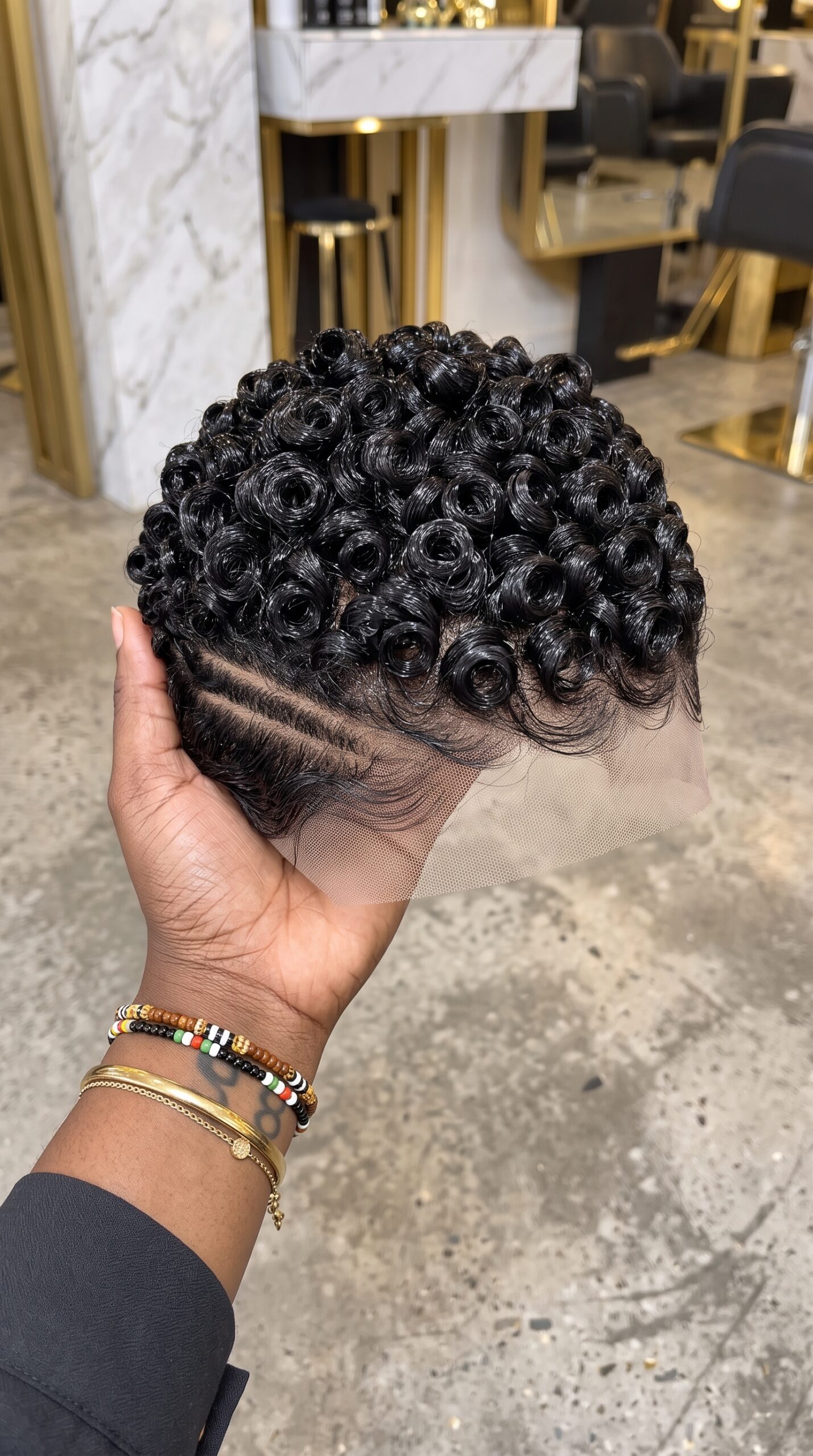
This jet black ringlet pixie wig brings together a densely curled crown, glossy sculpted spirals, a close-cut side foundation and two parallel line details near the temple. The overall shape stays compact and rounded, while the lace-front construction gives the perimeter enough flexibility for a carefully fitted installation.
The strongest visual feature is the concentration of small circular curls across the crown. Instead of loose waves or large curls, the hair is formed into numerous tight ringlets that sit individually across the surface. Their reflective jet-black finish creates depth even though the wig uses a single dark color.
Mirror-like glossy hair, silky reflective finish, healthy wet-look shine, individually visible strands, ultra-defined texture.
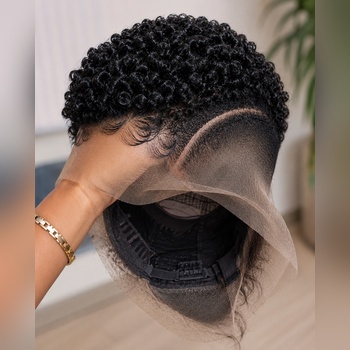
Glossy Jet Black Gives the Curls More Dimension
The entire hairstyle stays within a rich jet black color. Light reflecting from the curved strands creates subtle variations between deep black and softer charcoal highlights, helping every ringlet remain visible.
This is particularly effective on a compact pixie because the color does not compete with the curl formation. Instead, the eye is drawn toward the circular pattern and the contrast between the fuller crown and the closely shaped side.
When ordering a similar unit, specify a deep neutral or blue-based jet black if you want to preserve this rich appearance rather than a warmer natural-black shade.
Small Circular Ringlets Cover the Crown
The crown consists of dozens of small, individually shaped ringlets. Many form almost complete circles, while others have slightly elongated spiral shapes that help fill the spaces between curls.
The curl diameter remains relatively consistent across the upper section. This consistency gives the crown its carefully arranged appearance without making it look flat or repetitive.
A custom wig maker can recreate this effect by setting smaller sections individually rather than curling large sections of hair together.
The Crown Has a Rounded Pixie Silhouette
The curls create a softly rounded upper profile that stays relatively close to the head. There is enough height to showcase the ringlets, but the crown does not become oversized.
The highest concentration of curls appears through the center and upper portion of the unit. Toward the perimeter, the curls gradually become lower and transition into finer strands.
This proportion is important when requesting the style because excessive crown height would change the compact pixie character.
The Front Ringlets Sit Close to the Hairline
Several curls are positioned close to the frontal area instead of being swept entirely backward. This creates a fuller front and makes the ringlet pattern visible from a frontal or three-quarter viewing angle.
Fine strands underneath the curls are shaped toward the lace, creating a gradual transition rather than an abrupt edge between the crown and frontal construction.
During installation, these front curls should be handled carefully so they are not flattened while the lace is being positioned.
Swooped Edge Work Softens the Frontal Area
The frontal perimeter includes delicate swooped strands that follow the contour of the lace. These sections are much finer than the ringlets above and provide a softer finish around the forehead and temple.
The edge work is intentionally subtle. It supports the overall design without covering too much of the lace or competing with the compact curls.
A stylist recreating the look can use lightweight styling product to shape these strands while keeping them flexible.
The Side Is Kept Close Beneath the Curls
Under the ringlet crown, the side becomes significantly lower. The hair sits close against the lace and creates a tapered visual effect.
This reduced side volume is essential because it separates the upper curls from the decorative line pattern. If the side were left too long, the lines would become difficult to see.
The transition between these two sections should remain gradual so the upper curls do not appear disconnected from the lower foundation.
Two Parallel Lines Shape the Temple Area
The visible side includes two narrow parallel line details running beneath the crown. They follow a slightly curved horizontal direction and remain close together.
The upper line is longer and visually stronger, while the second follows beneath it to create a layered barber-inspired pattern.
Keeping both channels narrow preserves the balance between the decorative side and the dense curls above.
The Side Lines Follow the Head Shape
Rather than appearing completely straight, the lines subtly follow the contour of the side foundation. This makes them look integrated into the overall pixie construction.
Their placement begins toward the frontal side and continues backward underneath the ringlet crown.
For a custom order, provide a clear side-view reference because the exact angle and spacing of these channels can be difficult to communicate through a frontal photograph alone.
The Lower Side Remains Minimal
Below the double-line pattern, the hair stays extremely close and uncomplicated. This open area provides visual separation and makes the lines easier to recognize.
The contrast between the simple lower section and highly detailed crown is one of the reasons the design remains balanced.
Additional patterns are unnecessary if the goal is to recreate the same look.
Fine Lace Surrounds the Front and Temple
The unit is shown before the excess lace has been trimmed. A generous lace perimeter extends across the frontal and temple area, giving the installer room to position the wig correctly before cutting.
This is useful for a pixie design because the perimeter remains highly visible after installation. Correct placement is especially important around the side where the double-line detail needs to sit naturally above the ear and temple.
Ask the seller about lace type, lace shade and knot size before purchasing.
Why Lace Quality Matters With This Style
Longer hairstyles can partially cover the frontal area, but this compact pixie exposes much more of the perimeter. For that reason, lace quality can have a noticeable effect on the finished appearance.
Fine lace with carefully ventilated strands can provide a more convincing transition around the forehead and temple.
The installer should avoid unnecessarily heavy product around the perimeter because buildup can make the lace more noticeable.
Cap Measurements Should Be Accurate
Accurate sizing helps keep the crown, frontal curls and side lines in their intended positions. A unit that is too large may shift, while a cap that is too tight can distort the lace perimeter.
Custom wig makers may request measurements including circumference, ear-to-ear distance and front-to-nape length.
Providing these measurements is particularly worthwhile when ordering a customized pixie with permanent side detailing.
Human Hair Offers Greater Restyling Control
A human-hair ringlet pixie wig can be a practical option for someone who wants to refresh individual curls over time. Small ringlets can be reset individually without completely restyling the entire unit.
Human hair also provides more flexibility if the wearer later wants to adjust the shine, curl direction or frontal swoops.
Heat should still be used carefully because repeated high temperatures can reduce the lifespan of the hair.
Premium Synthetic Fiber Can Preserve the Curl Pattern
For buyers who prefer minimal restyling, a premium synthetic version may provide good curl retention. Factory-set ringlets can maintain their circular form for extended periods when the wig is stored properly.
However, synthetic fibers vary considerably in heat tolerance and appearance.
Always check whether a synthetic unit is heat-friendly before attempting to reshape individual curls.
Glueless Wear May Be Possible With the Right Cap
A properly sized unit with adjustable straps, internal elastic and secure construction may be suitable for glueless wear. This can be convenient for a compact pixie that is removed regularly.
Glueless wear also makes it easier to place the wig on a stand overnight, helping protect the ringlets from being crushed during sleep.
Confirm the cap construction with the seller because visible frontal lace alone does not guarantee that a unit is designed for adhesive-free installation.
Where to Get This Style Made
Search for a custom pixie wig maker, lace wig specialist or barber-inspired wig stylist with experience in sculpted curl work. Their portfolio should show close-cut units as well as precise side detailing.
The ringlets and side pattern require different styling skills, so it is useful to choose someone comfortable working with both.
If a local wig stylist does not create barber-style details, ask whether they collaborate with a barber or another specialist for the finishing work.
How to Book an Appointment
When contacting a stylist, describe the unit as a jet-black lace pixie with a compact crown of small glossy ringlets, close tapered sides and two parallel temple lines.
Send clear photographs showing both the crown and side construction. Ask whether the service price includes the wig itself, customization, curl setting, lace preparation and installation.
If you already own a base unit, confirm whether the stylist accepts customer-supplied wigs before booking.
Where to Buy a Similar Wig
Look for independent wig boutiques and custom sellers specializing in curly pixie lace wigs. Search results for generic pixie wigs may include many loose-curled designs that do not have the same compact circular ringlets.
Product photographs should ideally include front, side and crown views. A side photograph is particularly important because it lets you check the taper and double-line placement.
For custom orders, ask the seller to confirm the finished design before shipping.
How to Order the Closest Version
Specify a jet-black color with a glossy finish and numerous small circular ringlets covering the crown. Request a compact rounded silhouette rather than a tall curly top.
The side should be closely tapered with two narrow parallel line details. Ask for fine swooped strands around the frontal perimeter and a lace shade suitable for your complexion.
Also confirm cap size, hair type, density, lace construction and whether the wig can be worn glueless.
How Much It Costs
| Wig Type | Estimated Price | Typical Details |
|---|---|---|
| Premium Custom | $450–$875+ | Premium human hair, fine lace, individually formed ringlets, custom cap and precision double-line side work |
| Standard Custom | $260–$500 | Human hair, customized frontal, compact ringlet crown and close side detailing |
| Basic Human Hair | $145–$300 | Human-hair pixie base with basic lace and simplified hand-set curls |
| Premium Synthetic | $75–$165 | Higher-grade fiber, preset circular curls, lace front and basic side pattern |
| Basic Synthetic | $35–$85 | Factory-made curly pixie with standard lace and limited customization |
Prices can vary significantly according to hair quality, lace construction, cap customization and the amount of hand styling involved. Individually setting numerous small ringlets and creating precise side details generally increases the labor required for a custom unit.
Maintaining the Circular Ringlets
Finger styling is preferable to brushing because a brush can separate the curls and reduce their circular structure. Handle one ringlet at a time when repositioning the crown.
Use only a small amount of lightweight styling product when needed. Too much product can cause neighboring curls to stick together.
If the wig is human hair, individual ringlets can be reset when necessary rather than disturbing the entire crown.
Preserving the Reflective Black Finish
The glossy surface plays an important role in showing the curl pattern. Gentle cleansing and proper conditioning can help maintain that reflective quality.
Avoid excessive oils that leave the strands heavy or greasy. The goal is to preserve visible separation between the curls while maintaining a healthy sheen.
Allow the unit to dry thoroughly before placing it into storage.
Protecting the Double-Line Detail
Keep heavy gels and creams away from the closely shaped side. Product buildup can push fine strands across the narrow channels and make the pattern appear less precise.
Use a small edge tool or fingertips to reposition stray hairs gently.
When the side eventually requires refinement, having it serviced by a wig stylist or barber familiar with lace units can help protect the surrounding construction.
Proper Storage Helps the Crown Last Longer
Store the wig upright on a suitable stand so the ringlets remain unsupported by hard surfaces. Avoid stacking other wigs or clothing on top of the crown.
If the unit is transported, use enough space around the curls to prevent compression.
Protect the excess or trimmed lace as well, since repeated folding can weaken delicate frontal material.
A Strong Choice for Ringlet Pixie Lovers
The combination of a jet-black circular ringlet crown, close side foundation, double parallel lines and delicate frontal swoops gives this wig a distinctive appearance without relying on multiple colors.
The design works because each section has a clear role: the crown provides volume and shine, the tapered side creates contrast, and the double lines introduce a precise barber-inspired accent. Keeping these proportions consistent is the key to recreating the same overall look.
Search Terms
jet black glossy ringlet pixie wig · black pixie wig with double side lines · small spiral curl lace pixie wig · jet black circular curl pixie wig · glueless ringlet pixie wig with tapered sides · black lace pixie with parallel temple lines · compact glossy curl pixie lace wig · jet black ringlet wig with swooped hairline