
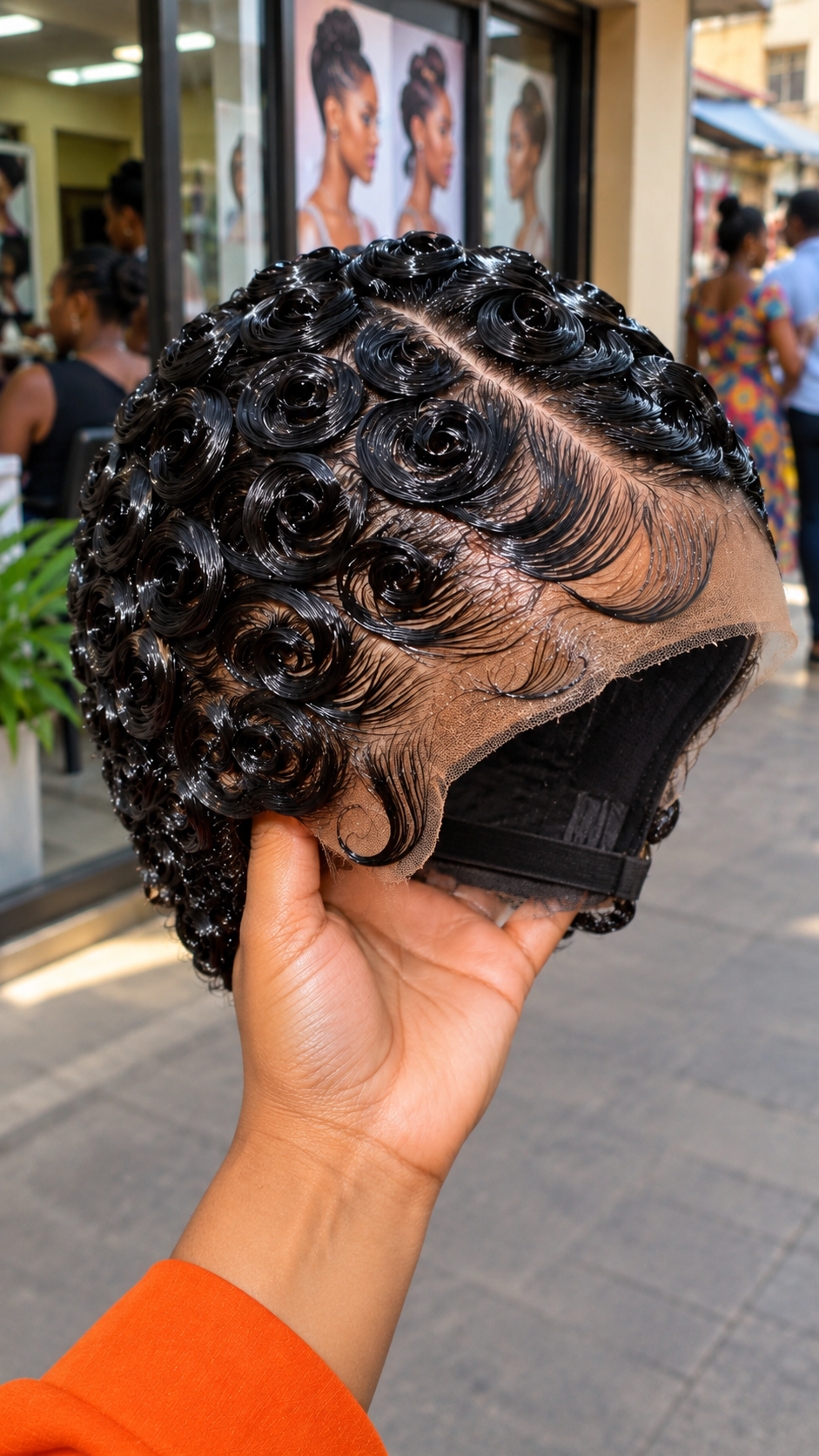
A dramatic curl does not always need height. In this black wig, much of the beauty sits close to the underlying shape: wide circular spirals turn inward, flatter sections sweep beneath them, and a diagonal part gives the arrangement a clear direction. The curls resemble small rosettes, but their centers and outer turns vary enough to keep the surface interesting. Along the visible temple, the hair leaves those circular shapes and moves into longer, overlapping waves.
The most eye-catching detail is the transition between those two kinds of movement. A large spiral near the upper front leads into a broad curved section, followed by finer sweeps that travel toward the perimeter. Lower down, a separate hooked curl finishes the visible temple area. That progression gives the wig more character than a simple all-over ringlet set.
For anyone looking to buy this hairstyle, the photograph provides a useful exterior reference and a partial view inside. Brown-toned excess lace extends beyond the styled perimeter, while a black foundation and horizontal band are visible through the opening. These details show a unit before final preparation. They also create practical questions about fit, construction, styling, and the services included in a purchase.
The Temple Waves Deserve First Place in the Order Brief
Start by looking beneath the diagonal part. Fine black strands curve downward and then turn back toward the surrounding hair, creating a broad wave panel. Several sections overlap visually, with the upper wave larger and the lower strands arranged into narrower sweeps. This area is not simply loose hair brushed forward; it has a deliberate shape that connects the part to the front edge.


Farther down the visible side, a longer section curves into a hooked finish. That small detail matters because it extends the styling beyond the forehead and gives the temple its own ending. A supplier who replaces it with a blunt edge or a row of tiny curls would change the appearance, even if the upper rosettes were similar.
When sending the reference to a maker, identify this wave panel as a priority. Ask how much of it will remain visible once the unit is fitted and how its position relates to the wearer’s temple. A hand-held photograph exposes the area clearly, but the final relationship depends on the cap and its placement.
The image does not show razor stripes or a shaved side pattern. The pale spaces here belong to the visible separation and areas between styled strands. There is no reason to add carved lines to recreate this reference. Concentrate on the flowing hair arrangement that is actually present.
Spiral Rosettes Create a Close, Rounded Surface
The upper and side curls form broad circular spirals, with strands turning toward open centers. Several are relatively flat against the wig’s rounded form rather than standing upright as tall loops. Their layered turns give the surface depth without creating a high crest.
This distinction is important when comparing listings. A product described as a spiral wig might contain dangling corkscrew curls, tiny finger coils, or loose ringlets. Those patterns are different from the close circular formations shown here. Ask to see the actual curl arrangement instead of relying on the word “spiral.”
The visible rosettes are not all the same size. Larger circles appear through the upper-front area, with smaller groupings continuing toward the lower visible side. That variation helps the pattern follow the rounded shape. A recreation using one repeated curl size could look more mechanical than the reference.
Ask the maker whether the arrangement is created as a temporary set or supplied as a pattern that largely remains after care. The answer affects the ongoing styling commitment. It also helps establish whether the quoted product is a finished recreation or a base wig that needs additional salon work.
A Diagonal Part Organizes the Entire Front
The pale part travels diagonally through the upper section toward the visible front. It separates a narrower area of closely arranged curls and waves from the larger rosette field. This gives the hairstyle an asymmetrical direction without introducing a long fringe.
Its position should be discussed before ordering. Moving the part can change how much of the wave panel appears near the forehead and how the larger curls frame the face. A center-parted version would be another interpretation, not a faithful recreation of the photographed arrangement.
The part looks scalp-like, but that appearance does not verify a specific foundation or lace technology. The underlying support and lighting can affect how it reads. Ask the seller to show the corresponding interior area and identify the construction in writing.
If you want to change the part direction, discuss feasibility before commissioning the unit. Some products allow more styling flexibility than others. A supplier should explain the options for the actual base rather than assume that any visible part can be moved freely.
Read the Black Shade Without Adding Imaginary Highlights
The hair appears deep black throughout, with bright reflections following the circular strands. Those reflections are especially strong on the outer turns of the larger curls. They do not establish silver highlights, brown tips, or a separate color treatment.
The contrast between black hair and the pale visible part makes the front geometry easy to follow. Darker spaces inside the rosettes give them depth, while the fine temple strands remain individually visible against the lace. That combination is central to the photograph’s appeal.
Before purchasing, request footage in neutral daylight as well as ordinary indoor light. Ask the seller to turn the wig slowly so you can assess the shade across the top and lower sections. This is more useful than deciding from a single brightly lit image.
If you prefer a softer black or a deep brown version, make that a separate color decision. Do not assume the reference contains brown simply because warm light reflects on some strands. The written order should state the agreed shade clearly.
Get The Details On This Wig
The photograph shows brown-toned mesh extending beyond the styled front and side perimeter. Its edge remains untrimmed, which is consistent with a unit awaiting final fitting. The visible mesh does not establish a premium lace grade or confirm how well its color will suit a particular wearer.
Inside the opening, a black foundation and horizontal band can be seen. Other dark sections overlap in the interior, but the angle does not reveal a complete securing system. Ask for a full underside view before assuming particular combs, straps, or adjustment components are included.
The presence of a band does not independently confirm adhesive-free suitability. Fit, construction, and the intended wearing method need to be assessed together. Ask the supplier how this exact unit is designed to be secured and what preparation it requires.
The material of the hair also remains unverified. Reflective black strands and a detailed curl set cannot reliably distinguish human hair from synthetic fiber. Obtain the written product description before discussing heat, coloring, washing products, or resetting methods.
The complete rear and nape are not shown straight on. Although curls continue toward the lower visible area, the photograph cannot establish the back length or full outline. Request those missing views before approving the entire haircut.
Choose a Supplier Who Can Reproduce the Front Panel
Look for wig makers and stylists with examples of circular curl setting and elaborate temple waves. A portfolio containing only long installations may not demonstrate the skills this piece needs. The most useful examples show close front details and side views, not just finished portraits from a distance.
During an initial conversation, ask the professional to explain how they would approach the reference. Their response should address the spiral scale, diagonal part, broad wave panel, and hooked temple ending. Specific observations provide a better basis for confidence than a general promise to make any style.
Potential sources include dedicated wig boutiques, custom makers, and salons that sell and style cropped units. Confirm which services each business provides. A shop may supply the base but outsource setting, while a stylist may work only with customer-owned wigs.
For a local search, combine your city with terms such as “spiral rosette wig stylist,” “cropped lace wig setting,” or “temple wave wig salon.” Treat the results as candidates to investigate. Search wording does not verify stock or establish that a particular business has created this exact look.
The salon entrance in the photograph does not identify a verified seller, city, country, or ordering destination. No confirmed purchasing route is supplied by the image itself. Ask any business offering this unit for separate product evidence and clear location or dispatch information.
Budgeting for the Wig and Its Detailed Set
The table below gives illustrative USD planning allowances, not verified current product offers. The categories do not identify the material or value of the photographed wig. Use them to organize quotations and ask what each supplier includes for the specification you are considering.
| Purchase Category | Illustrative USD Allowance | Details Worth Comparing |
|---|---|---|
| Premium Custom | $525–$1,150+ | Individual sizing, selected foundation, detailed spiral placement, extended temple wave work, and fitting or revision support. |
| Standard Custom | $285–$585 | Available base choices, reference-based shaping, part placement, front coverage, and styling completed before delivery. |
| Basic Human Hair | $150–$345 | Written material description, processing history, construction details, and separate cutting or setting charges. |
| Premium Synthetic | $90–$225 | Fiber instructions, supplied curl arrangement, available dimensions, and permitted methods for resetting. |
| Basic Synthetic | $35–$100 | Actual unit photographs, fit limitations, perimeter appearance, styling restrictions, and return eligibility before changes. |
The distinctive labor in this hairstyle is concentrated at the front and visible side. Arranging large circular curls is one task; connecting them to fine, elongated temple waves is another. A quotation should explain whether both are included or whether the displayed set costs extra.
Request a breakdown for the unit, cutting, initial set, fitting, lace preparation, installation if needed, and delivery. If a separate local stylist will finish the wig, include that appointment in the total. Comparing complete routes gives a clearer picture than comparing starting prices alone.
Ask about future resetting as well. If the first wash removes the detailed arrangement, restoring it may require another service. That ongoing cost matters when deciding whether the wig suits your routine.
For overseas orders, clarify which delivery charges are included and whether import-related costs could be collected separately. Also establish who handles alterations if the fit needs attention. A complete quotation should make the path to a wearable piece understandable.
Stock Purchase, Custom Recreation, or Restyling
A stock unit can be a practical choice if the seller demonstrates the exact wig available and its dimensions suit you. Ask whether the photograph represents that item or a styling example. A similar replacement may differ in curl placement and forehead coverage.
For a custom recreation, rank the visible priorities. The broad rosettes, diagonal part, layered temple waves, and hooked side finish make a focused brief. Add your fit requirements and agreed shade, then ask the maker to summarize the order in writing.
If you already own a wig, a restyling consultation may establish whether it can support this arrangement. The stylist needs to inspect usable length, density, foundation, and material. A base cut too closely around the temple may not provide enough hair for the longer sweeps.
Do not buy an unstyled base solely because its general length sounds appropriate. Send the proposed product details to the stylist first. The relationship between hair placement and foundation can affect whether the visible part and side panel are achievable.
Whichever route you choose, establish the condition in which the unit will arrive. “Styled” should be explained through actual photographs and a service description. Ask what preparation remains before the first wear and who is expected to complete it.
Use the Fitting to Position the Longest Sweeps
The temple panel needs enough room to sit as intended without being pushed into an uncomfortable position. During fitting, assess the cap placement, front edge, and side coverage together. The longest sweeps should be evaluated on the wearer rather than measured from a hand-held photograph.
Follow the chosen maker’s measurement instructions before ordering. Provide the requested dimensions and explain any preference about ear clearance or temple coverage. A size label used by another brand may not correspond to the same shape.
If the front feels heavy, ask whether position or styling can address it before requesting a cut. Length used to create a broad wave may be necessary even when the finished section appears compact. Removing it can limit later resetting options.
Settle the fit before trimming excess lace. The mesh visible in the image is part of an unfinished perimeter, not an indication of where the final edge should sit. A stylist should explain the intended preparation for the selected construction and wearing method.
Bring your everyday glasses if you wear them. Check whether their arms disturb the side arrangement or create pressure near the temple. This small practical test can help make the finished wig easier to wear regularly.
Approve the Back Before Calling the Haircut Complete
The rounded visible side gives only part of the silhouette. A straight rear view is needed to understand how the curls continue toward the nape and where the hair ends. A longer back could change the balance significantly.
Ask for both profiles, because the diagonal part may create different coverage on each side. The opposite side should not be assumed to repeat the visible wave panel exactly. A clear order should state whether asymmetry is intentional.
A supported top view is also useful. It shows how the larger rosettes connect and whether spaces between them change when the cap is placed on a head. This can clarify density questions that the hand-held angle cannot answer.
For a custom commission, request these views before dispatch. It is easier to discuss an unexpected back shape while the maker still has the unit than after it has been shipped and prepared by another stylist.
Understand the Reset Before the First Cleaning
Ask what the hairstyle will look like after washing and drying according to the supplier’s instructions. The rosettes and fine wave panel may not behave in the same way. One area may retain more of its shape while another needs detailed rearrangement.
Request a demonstration or an example showing the same product after care. This gives a more realistic understanding than a general claim that maintenance is easy. The key issue is whether you can restore the appearance yourself or need a professional appointment.
For confirmed synthetic fiber, obtain the specific instructions before using heated tools or chemical products. For confirmed human hair, ask about processing history and the recommended setting approach. The photograph does not provide a temperature limit or establish product compatibility.
Ask which minor corrections are appropriate between full resets. A single displaced rosette is a different problem from an entire temple panel losing its shape. Targeted instructions can prevent a small adjustment from becoming a complete restyling task.
Protect the Fine Strands That Give the Front Its Detail
The thin, sweeping strands are visually important because they create the layered movement beneath the larger curls. Repeated handling can disturb their direction. Avoid treating the panel as loose hair that can be brushed repeatedly without changing the arrangement.
Ask the stylist to demonstrate how to put on and remove the unit without gripping the styled front. Use the handling method recommended for the foundation. The broad wave sections should not become handles simply because they are easy to reach.
Follow the supplied product instructions rather than adding heavy layers to hold every strand in place. Buildup may make the fine sections clump and reduce the clarity of the part. If the panel repeatedly moves, investigate fit and handling as well as the set itself.
Store the wig on suitable support that does not stretch the base or press the rosettes flat. Keep the hooked temple section from being bent against a hard surface. Ask the maker how to protect that area during travel.
If packaging compresses the style, seek material-appropriate instructions before brushing through it. A few moved curls may require only a limited correction. The supplier should explain any normal preparation expected after delivery.
Arrange Delivery Around Inspection and Fitting
Confirm production time and shipping time separately. If the wig is intended for an event, allow room for inspection and a fitting appointment after it arrives. Delivery alone does not guarantee that the piece is ready for its first wear.
For custom work, agree on the final approval stage. Request a video showing the front, visible temple panel, opposite side, back, top, and interior. Compare it with the written brief before dispatch.
On receipt, inspect the unit before washing, trimming, coloring, or applying products. Check the material description and included components, and read the alteration or return conditions. Document concerns clearly while the wig remains unmodified.
Keep the agreed photographs and order summary together. If the delivered product differs, a specific comparison is more useful than a broad statement of disappointment. Identify the color, curl scale, front coverage, or construction detail that needs attention.
Let the Front Detail Lead the Purchase
This wig’s character comes from the way its black spirals lead into cascading temple waves. The diagonal part provides direction, the large circular curls give the surface depth, and the hooked side section completes the visible outline. Those relationships deserve more attention than a generic curly-wig label.
Choose a supplier who can explain how the arrangement will be created and supported by the actual product. Confirm the material, dimensions, complete quotation, and resetting requirements. Then use the fitting to settle the perimeter and temple position before permanent changes.
With a clear brief and an understood care routine, the reference becomes a practical plan for a distinctive black wig. The aim is to preserve the graceful front movement while making the piece comfortable to wear and realistic to maintain.
Search Terms
jet black flat spiral wig · diagonal part rosette curl unit · cascading temple wave hairstyle · hooked side curl lace wig · large circular black pin curls · brown mesh perimeter wig · layered forehead swoop curls · rounded spiral crown hairstyle