
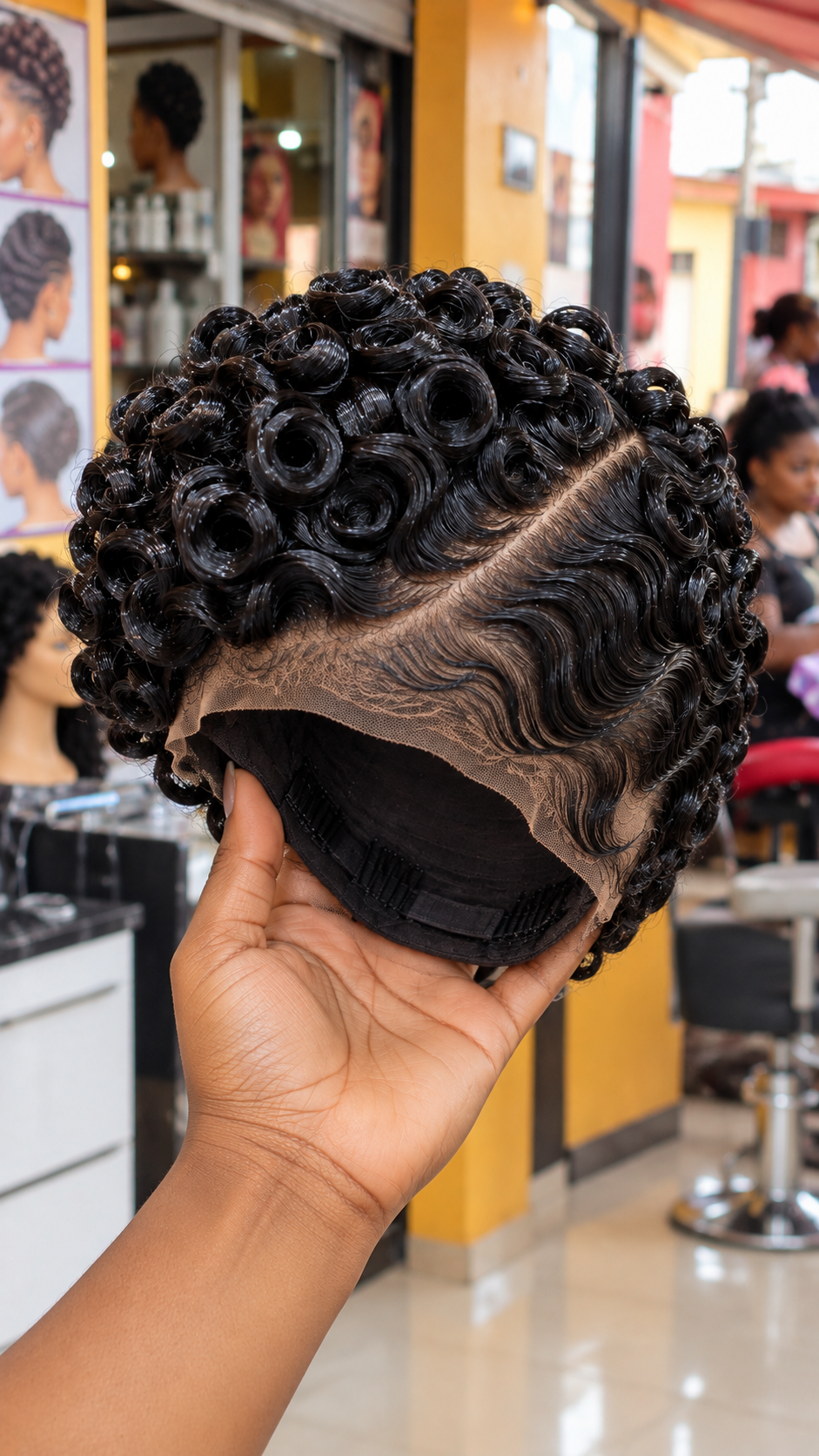
Large, open barrel curls give this black wig a distinctive presence, but the broad finger-wave panel makes the design especially memorable. The upper curls rise in rounded sections, while the hair below the curved part follows a series of connected S-shaped movements. Together, these two arrangements create a hairstyle with contrast, direction, and a rounded silhouette that remains visually interesting from the front-side angle.
The wig is photographed in one hand at a salon entrance, with its opening tilted toward the camera. That position reveals an untrimmed tan lace perimeter and part of the black interior. It also exposes details that a photograph on a wearer might hide: the relationship between the part and wave panel, the size of the upper curls, and the amount of lace extending beyond the styled hairline.
For a buyer, this reference is most useful as a description of a particular arrangement rather than a generic curly wig. The barrel-like openings, curved separation, and broad side waves should all be considered when comparing products. A unit can be black, curled, and close-fitting yet still look quite different if one of those elements is missing.
Begin With the Silhouette You Want to Receive
The wig has a rounded outer shape, with more lift across the upper section than along the waved side. Its curls do not hang in long lengths. Instead, they sit around the cap in overlapping arrangements that create fullness without extending into a shoulder-length silhouette. The overall impression is compact, although its precise dimensions cannot be established from a hand-held photograph.


The upper curls vary in diameter and orientation. Several face the camera directly, revealing dark circular openings, while others lie partly on their sides. This variation prevents the top from appearing like a repeated grid. When discussing a reproduction, explain that you want a rounded arrangement with different curl orientations rather than perfectly identical rings placed in straight rows.
The visible outer edge also contains smaller curls that connect the upper section with the lower perimeter. Those details help the hairstyle feel continuous. However, the entire rear and nape are not shown, so their final treatment remains unconfirmed. Ask the seller for a rear view before assuming the same curl density continues around the complete unit.
It is helpful to decide whether you want the photographed amount of fullness or a slightly lower version. A maker can assess a specific request about height more easily than a vague instruction to make the wig “less big.” Ask for measurements or a comparison on a mannequin photographed from a consistent distance if scale is important to your decision.
Read the Barrel Curls as Three-Dimensional Shapes
The large upper curls are not simply flat spirals resting against the cap. Many form rolled sections with visible depth. Their strands travel around an open center, creating a barrel-like appearance. Some curls stack near one another, while others overlap the edges of adjacent sections. That construction of the visible hairstyle contributes to its fuller upper outline.
When searching for a similar product, terms such as “barrel curl wig,” “open curl pixie wig,” and “sculpted curl lace wig” may help communicate the idea. Product naming varies between sellers, so use the photograph alongside those words. A listing described as pin curls could show much flatter circles, while a listing described as curls might show loose hanging lengths.
The black shade makes the openings between sections appear particularly deep. Reflections along the outer strands reveal the direction of each roll. The photograph does not establish a second intentional color, despite some warmer-looking highlights caused by illumination. If you want a uniform black result, state that preference and request neutral-light footage of the actual unit.
The reflective surface also cannot identify the fiber. Products, lighting, processing, and material can all influence shine. Judge the visible curl arrangement from the photograph, but obtain composition and care information directly from the supplier. A glossy appearance should never substitute for a written product specification.
The Curved Part Controls the Change in Direction
A pale-looking channel travels diagonally through the visible upper-side area. It separates the rolled curls above from the flatter waved section below. Rather than acting as a decorative line added afterward, it organizes the direction of the surrounding hair and gives the hairstyle a clear division between its two main surfaces.
The part is curved rather than sharply straight from front to back. Its apparent width also changes along the visible section, partly because the wig is angled and the surrounding strands overlap it differently. A close photograph taken from above would help clarify the exact path if a maker intends to reproduce it closely.
This channel should not be described as a shaved line on a wearer. The image shows a detached wig, and the underlying method used to create the separation is not visible. Ask whether the part is fixed, whether it can be relocated, and what construction supports the exposed area.
If you prefer the part on a particular side, confirm the intended wearer’s side in writing. Reference photographs can be mirrored, and the orientation of a detached unit can be confusing. A front view with the maker identifying the side is more reliable than relying only on the direction shown in a close crop.
Broad S-Waves Give the Side Its Identity
Below the part, the hair follows several large connected curves. Fine strands lie together through each bend, making the wave direction easy to see. The panel sits closer to the foundation than the upper curls, so the contrast is not only between shapes but also between heights.
The lowest visible wave turns toward the perimeter, while the upper curves travel along the part and forehead area. This is a substantial section of the hairstyle, not a narrow strip of small edge curls. Preserving its width and movement is important if you want the finished unit to resemble the reference.
Ask a custom maker to show previous work with broad finger waves, preferably on wigs. Someone who produces attractive barrel curls may not automatically have experience arranging this kind of side panel. The two techniques contribute differently to the final appearance and should be evaluated separately.
During fitting, the panel may need to be positioned in relation to your forehead and temple. That is different from redesigning it. Explain whether the broad curves are essential and ask the stylist to discuss any proposed changes before shortening, separating, or resetting the sections.
Get The Details On This Wig
The tan lace is visible along the front and side perimeter, extending beyond the styled hair. Its mesh edge remains untrimmed in the photograph. This confirms exposed lace, but it does not establish a particular grade, an exact coverage area, or how it will appear against an individual wearer’s skin.
The black interior is visible through the opening. A stitched, gathered-looking section runs near the lower edge, but the photograph does not reveal the complete cap or fastening system. It would be inaccurate to promise adjustable sizing, particular attachment hardware, or adhesive-free security from this view alone.
Request a clear underside photograph showing the entire cap. Ask the seller to identify the material, size, fastening components, and any area intended for adhesive. If the listing uses a construction term, request a plain explanation of what that means for fitting and daily use.
The hair composition remains unconfirmed. Human hair, synthetic fiber, and blends should be treated as possible purchase categories rather than established facts about the photographed piece. Written specifications should accompany the actual unit being sold, along with instructions appropriate to that material.
Find a Supplier Who Can Deliver the Whole Arrangement
Start with wig boutiques or independent makers whose portfolios include both rolled curls and finger-wave styling. Send the reference before visiting or requesting a quote. Explain that the broad waved side, curved part, and raised upper curls are all important. This helps the supplier assess whether an existing unit is suitable or custom work is required.
A local wig studio can be useful when you want fitting and styling handled together. Ask whether it sells completed units, makes custom wigs, or only customizes pieces purchased elsewhere. The answer determines what the quote should include and who is responsible if the base is unsuitable.
For online purchases, clarify whether the seller is offering the photographed unit or using the image as inspiration. An existing item should be available for current footage. A commission should include measurements, material choices, production timing, approval stages, and a description of acceptable variation.
The salon background does not identify a verified shop or current stock source. No confirmed address or seller can be established from this image alone. Obtain the business location, delivery coverage, collection arrangements, and order terms directly before paying or travelling.
Useful local searches include “barrel curl wig maker” or “finger wave wig customization,” followed by your city. Review complete examples rather than only close-ups. A full view of the front, sides, and rear is necessary to assess whether a supplier consistently creates balanced units.
Budgeting for Barrel Curls and a Waved Side Panel
The USD amounts below are illustrative planning ranges, not verified current prices for this photographed wig. They compare possible shopping routes. The final quote should identify the actual fiber, cap, styling services, and fitting arrangements. Categories can overlap because detailed labor may influence the price as much as the base material.
| Purchase Category | Illustrative USD Range | What the Quote Should Explain |
|---|---|---|
| Premium Custom | $470–$1,020+ | Individually specified construction, barrel-curl placement, curved part, broad finger-wave panel, and fitting support. |
| Standard Custom | $225–$485 | An existing base adapted toward the reference, with clear limits on cap changes and styling revisions. |
| Basic Human Hair | $120–$285 | Verified composition, available processing information, lace coverage, and whether the completed set is included. |
| Premium Synthetic | $70–$180 | Fiber specifications, preset curl quality, side-panel arrangement, sizing options, and maintenance restrictions. |
| Basic Synthetic | $30–$85 | Actual product photographs, perimeter coverage, fit information, and the degree of resemblance to the reference. |
Ask whether the price covers a finished hairstyle or only the underlying wig. Creating the upper rolls and arranging the side waves are separate elements of styling work. A low starting price may exclude both. If another salon will complete the look, request its estimate before purchasing the base.
Include delivery, applicable taxes, fitting, and any necessary lace preparation in the total. A supplier offering a completed custom piece may include services that a basic listing does not. Conversely, an existing unit may offer better value if it already has the desired shape and requires little adjustment.
Future resetting is another relevant expense. Ask what happens to the arrangement after washing, whether it can be restored at home, and what a professional reset would involve. The most useful budget covers the wearable result and its upkeep rather than the initial checkout amount alone.
Approve the Unit Through a Complete Video
Before dispatch, request a slow continuous turn showing the front, both sides, back, top, and underside. The camera should first show the whole silhouette, then move closer to the part and wave panel. This prevents a detailed crop from concealing an unexpected overall shape.
Look at how the larger curls progress toward the rear. The photograph demonstrates the near side well, but it does not establish the full nape arrangement. Ask the maker to explain how the unseen areas have been completed and whether that treatment matches the order brief.
For the lace, request a view without fingers covering the edge. The seller should show enough of the perimeter to explain its coverage and any preparation still needed. The inside footage should likewise reveal the fastening system rather than only a small black section through the opening.
If the video uses bright directional light, ask for another view under ordinary indoor illumination. This can help you assess the black shade and the visible base around the part. It also provides a less dramatic comparison for how the unit may appear during regular wear.
Use the First Appointment to Establish Position
The first fitting should determine where the cap sits comfortably before any irreversible work begins. The front waves, part, and upper fullness need to be assessed together. Moving the unit to improve one detail can change the position of another, so check the complete outline.
Ask the fitter to distinguish between placement, sizing, and styling concerns. A wave sitting too low may not require cutting if the cap is positioned incorrectly. Similarly, excess material should not automatically be hidden by rearranging the curls if the underlying size is unsuitable.
If lace trimming is needed, it should follow that assessment. The visible extension in the reference is untrimmed, but the appropriate amount to remove depends on the actual construction and attachment plan. Discuss the method before cutting, particularly around the broad side panel.
Bring the material specifications and care instructions to the appointment. If they are missing, obtain them before authorizing heat or chemical work. A stylist should not have to infer fiber compatibility from the photograph or the reflective appearance of the hair.
Keep the Rolls Open Without Pulling Them Apart
The open centers are part of the visual appeal, but they should not be used as grips. Support the cap when lifting or moving the wig rather than inserting fingers through the curls. Repeated pulling can change the shape of an individual roll and disturb neighboring sections.
Ask the maker to demonstrate how a displaced curl should be corrected. Some arrangements may allow a small local adjustment, while others need a more complete reset. Follow the method recommended for the actual unit instead of assuming all sculpted curls behave alike.
The waved side may require different handling from the upper rolls. Its strands need to retain their connected direction, so brushing through it casually could dismantle the panel. Ask whether it should remain untouched between wears or be refreshed using a particular technique.
Avoid adding heavy products without guidance. The reference already shows substantial reflection across the hair, but the photograph does not identify which products created that effect. Ask what was used and which products, if any, are appropriate for ongoing maintenance.
Plan Washing Before the First Wear
Find out whether washing is expected to remove the set. This is an important question for a hairstyle built from deliberate rolls and waves. A unit may need professional restyling afterward, or the seller may provide a suitable home-care process. The answer depends on the actual product.
Follow cleansing and drying instructions specific to the verified fiber. Do not apply hot tools to unidentified material. Even when human hair is confirmed, previous processing and the setting method can affect which approach is appropriate. A generic care routine is not enough for every unit.
If professional resetting is recommended, locate a stylist who can reproduce both the upper curls and the waved panel. Ask about service cost and scheduling before purchase, especially if the original maker is far away. Accessible aftercare makes the hairstyle more practical to maintain.
Keep neutral-light photographs of the approved set for future appointments. Include the front, side panel, top, and back. Those images provide a clearer maintenance reference than a single dramatic close-up and help a stylist understand which proportions you want preserved.
Store the Wig With Space Around the Shape
The raised upper curls need clearance during storage. Choose an arrangement that supports the cap without pressing the rolls against a lid or shelf. Avoid forcing the unit onto a support that stretches its base simply to keep it upright.
The front lace and side waves should not be repeatedly folded together. Ask the fitter how the customized perimeter should rest between wears. The finished edge may need different handling from the untrimmed extension shown in the photograph.
For travel, request packing instructions for the particular unit. Ask what preparation may be needed after unpacking and whether a professional reset should be expected. A compact silhouette does not automatically mean the style can withstand tight packing without changing.
If the wig is intended for an event, test placement and handling in advance. Allow time for delivery, inspection, fitting, and any agreed correction. Learning the routine before the occasion makes the hairstyle easier to enjoy when you actually want to wear it.
Choose the Version That Preserves the Contrast
This design succeeds through the contrast between raised barrel curls and a flatter wave panel. A proposed alternative should be compared against both elements. Attractive black curls alone will not reproduce the same effect if the curved part or broad side arrangement is missing.
Before committing, bring the important details into one written agreement: selected shape, confirmed material, cap measurements, lace coverage, part orientation, total cost, production timing, and aftercare terms. Clear specifications give the photograph a practical foundation.
The right supplier should be able to explain what will arrive, what remains to be customized, and how the hairstyle will be maintained. With that information and a careful fitting, the bold upper rolls and sculpted side waves can remain the focus of the finished look.
Search Terms
jet black barrel curl lace wig · curved part sculpted wig · broad S wave side panel · open rolled curls with finger waves · untrimmed tan mesh wig front · rounded black barrel curl hairstyle · diagonal part waved pixie unit · raised crown curls with laid side waves