
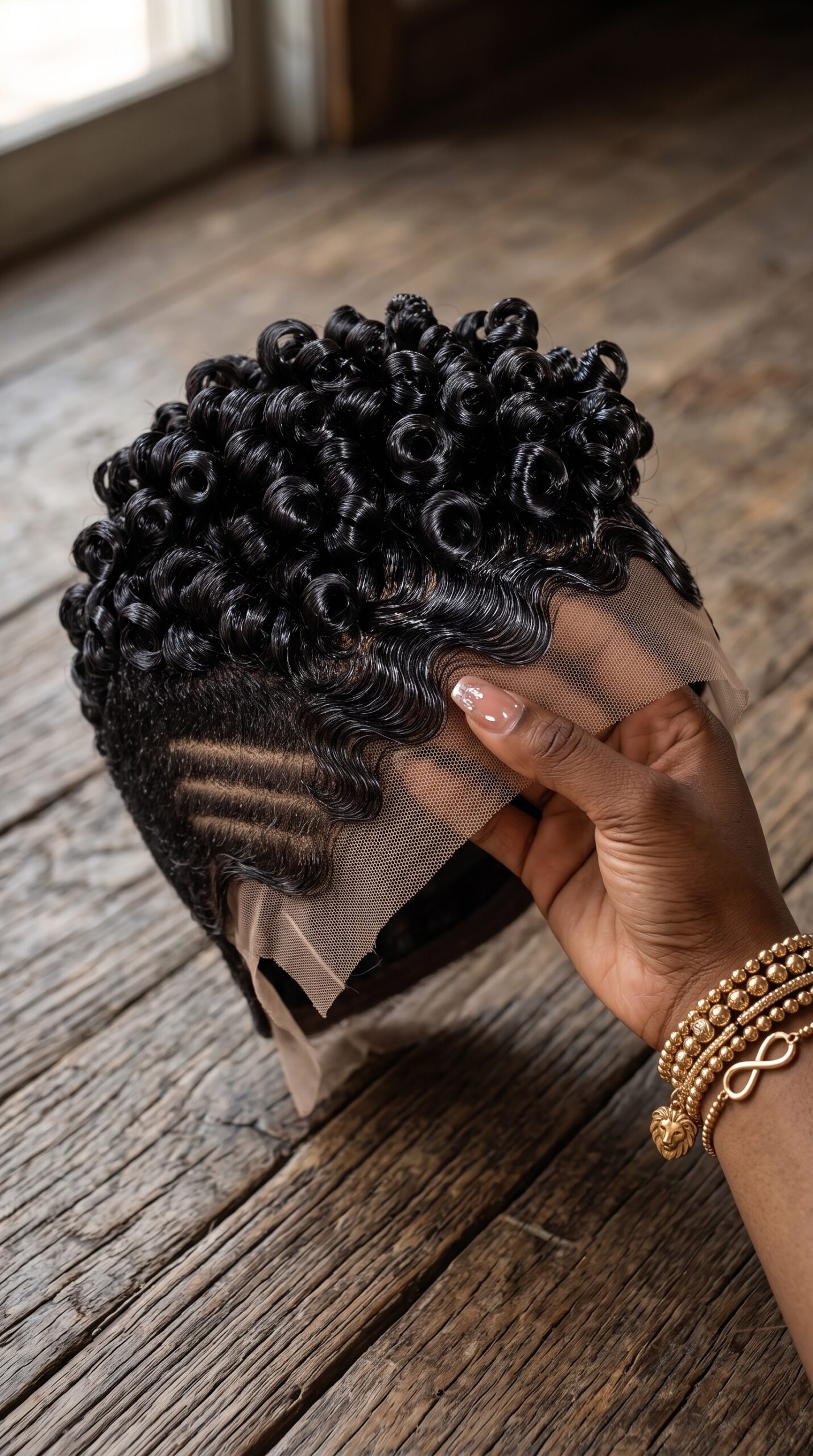
A curly pixie wig can have beautiful ringlets and a good lace frontal yet still feel visually unbalanced because of one small proportion: the width of the flat finger-wave section sitting between the hairline and the raised crown.
On this black pixie, the upper section is packed with rounded ringlets, while the frontal and temple area use a flatter wave pattern. That wave section acts like a border. It separates the lace edge from the fuller crown and creates a gradual change from hair sitting close to the head to hair rising above it.
The important question is not simply whether the wig has finger waves. It is how much space those waves occupy before the ringlet crown begins. A very wide wave border changes the entire silhouette. A very narrow one changes it again.


Where To Buy A Curly Pixie Wig With A Balanced Wave Border
Custom wig makers. A custom maker is usually the best choice when you care about the exact proportions. Send a side-profile and front reference showing where you want the ringlet crown to begin. Do not request only “finger waves with curls,” because that leaves the width of the lower wave section open to interpretation.
Instagram and TikTok sellers. Ask for a true side video. A front photograph does not show the vertical depth of the wave band clearly. The side tells you how far the flat section travels upward before the raised curls begin.
Etsy. Independent wig makers may offer control over crown length, wave placement, lace size, cap dimensions, curl scale, and perimeter proportions. Ask whether the front wave zone can be made narrower or broader.
Amazon, AliExpress, and Temu. Factory units may use one preset pattern for every cap size. Look at customer photos because the same wave border can occupy a different visual percentage of a small head than it does on a larger one.
Local beauty supply shops and salons. In-person shopping is useful for this feature. Put the wig on a mannequin or hold it at head height and compare the amount of flat wave area with the amount of raised curl area.
Direct vendors and wholesalers. If you are buying multiple units, ask whether the ringlet starting line remains consistent across the batch. A small production variation can make one wig appear much more wave-heavy than another.
Regional sellers. Wig makers in Lagos, Accra, Atlanta, London, and major South African hair markets may call this styling molded waves, finger waves, laid waves, sculpted perimeter, or wave-and-curl pixie. A reference image is more reliable than terminology.
Vet the seller. Ask for front, side, and upper three-quarter views. These three angles together reveal how large the wave border is relative to the crown.
Red flags. Be cautious if the waves extend very far into the crown but the listing still promises a full ringlet pixie, or if the raised curls begin at noticeably different heights on the two sides without an intentional asymmetric design.
When you order, send. Provide your cap size, crown-height reference, wave-width reference, desired curl size, lace preference, and photographs showing the exact front-to-crown proportion you like.
Contact / order inquiries: WhatsApp [WhatsApp: +XX XXX XXX XX XX]
How Much It Costs
Premium custom human hair. A short human-hair unit with detailed ringlets, a hand-shaped wave perimeter, lace construction, and customized proportions can commonly range around $240–$460 depending on the hair, cap, and styling labour.
Standard custom human hair. Around $180–$320 can cover many good short units. At this level, ask whether the wave section is specifically shaped for the requested style or reproduced from one standard template.
Basic human hair. Around $150–$240 may buy a simpler unit with a more generic wave-to-curl proportion, heavier lace, or less customization around the temple.
Good synthetic. Around $60–$150 can provide a strong preset wave-and-ringlet silhouette. Synthetic fibre can hold a sculpted border well, although later changes to the proportions may be more difficult.
Basic synthetic. Around $25–$70 is common for budget pieces. Inspect whether the lower waves actually consist of hair or whether the appearance is excessively molded and rigid.
What the price may exclude. Lace tinting, cap customization, side carving, hairline work, wave resetting, ringlet resetting, and professional fitting may all be separate charges.
Shipping and duty. International shipping, customs charges, and local taxes can significantly change the final cost. Compare the complete delivered price rather than only the product listing.
Ongoing costs. Human-hair versions may need mousse or setting product to maintain the wave band and separate curl products for the ringlet crown.
First-year total. Include lace care, curl products, wave-setting products, and occasional professional reshaping if the boundary between the two zones begins moving after repeated washing.
The Wave Border Controls Where The Crown Visually Begins
Look at the hairstyle as two major zones.
The first zone sits close to the head. It begins at the lace edge and follows the forehead and temple with sculpted waves.
The second zone rises into full ringlets.
The exact point where one zone becomes the other determines where the viewer thinks the crown begins.
Move that boundary upward and the flat section becomes larger. Move it downward and the ringlet crown becomes visually larger.
A Wide Wave Border Makes The Crown Look Smaller
This happens even if no curls are removed.
When more of the front and side are occupied by low-profile waves, less visible surface area remains for raised curls.
The crown may therefore appear more compact.
For someone who wants a highly sculpted wave-and-curl combination, that may be desirable.
For someone expecting a very curly pixie, the same proportion may feel like too much wave and not enough curl.
A Narrow Border Makes The Ringlets More Dominant
Reduce the wave area and the curls begin closer to the frontal.
This gives the crown more visual territory and makes the ringlet pattern the main feature of the style.
The tradeoff is that the transition has less space.
If the change from flat hair to raised curls happens too quickly, the crown can look as though it was placed directly on top of the frontal instead of growing out of the same haircut.
The Best Width Depends On The Curl Height
A low ringlet crown may work with a relatively narrow wave border because the height difference between the two zones is small.
A highly raised crown creates a stronger contrast.
In that case, a slightly broader transition zone can help the eye move from the flat frontal into the fuller top.
Wave width therefore should not be chosen independently from crown height.
The Border Should Change Around The Head
The wave band does not need to remain exactly the same width from the center forehead to the temple.
Head geometry changes.
A slightly narrower area may work near the central hairline while the temple needs more length for the wave to curve naturally into the side.
What matters is that the change appears intentional rather than irregular.
A Perfectly Uniform Border Can Look Mechanical
If the ringlet crown starts along one mathematically straight line across the entire frontal, the hairstyle may begin looking manufactured.
Natural short cuts usually contain subtle differences in length and direction around the perimeter.
A controlled curve or gradual rise toward the side can make the transition less rigid.
The boundary should be organized without looking stamped onto the cap.
The Temple Usually Needs More Transition Space
The center forehead and temple are not geometrically identical.
At the temple, the hairstyle has to move from frontal lace toward the short side while also turning around the head.
A slightly extended wave section can help connect those areas.
If ringlets begin too abruptly at that point, the temple may appear crowded and the short side can lose visibility.
Wave Width Changes How Much Lace Is Visually Covered
Flat sculpted hairs lie across part of the frontal mesh.
A broader wave band therefore places more hair over the lace area.
This can make the frontal appear less exposed in photographs.
But that should not be used to hide poor lace underneath.
A strong wig should still have an acceptable hairline when the waves are gently moved away.
The Wave Band Can Affect Forehead Framing
Large downward curves occupy more visible forehead space than a ringlet crown beginning immediately at the hairline.
This can create a lower-looking frontal without changing where the lace actually sits.
People who prefer an open forehead may want less wave coverage.
Those who enjoy stronger sculpted framing may prefer a deeper wave zone.
This is a styling preference, not a universal quality rule.
Side Carving Makes The Proportion More Important
This style also uses parallel carved lines through the short side.
That design needs visible space.
If the wave border becomes too deep around the temple, it can begin competing with or covering the upper portion of the carved section.
That creates three visual layers fighting for limited space: ringlets, waves, and carved lines.
Good proportion allows each one to remain readable.
A Wave Border Can Make Dense Ringlets Feel Less Heavy
A crown filled completely with compact black ringlets can carry substantial visual weight.
The flatter perimeter provides contrast.
It gives the eye an area of lower volume before reaching the dense upper section.
This can make the ringlets feel more intentional rather than simply filling every possible area of the wig.
The wave band is therefore not only decorative. It can provide visual breathing room.
But Too Much Flat Area Can Make The Wig Feel Top-Heavy
This sounds contradictory, but both things can happen.
A moderate flat border can balance a dense crown.
Make it excessively broad and the raised ringlets become concentrated into a smaller upper area.
The contrast becomes stronger, and the crown can begin looking like a compact mass sitting above a broad flat base.
Proportion is what separates balance from exaggeration.
The Boundary Should Follow The Head Shape
The point where the curls begin should not ignore the roundness of the head.
From the front, the line may appear nearly horizontal.
As it moves toward the side, however, it usually needs to curve with the skull.
A boundary that stays completely straight while the head turns away can make the crown look disconnected from the cap underneath.
Curl Density Near The Boundary Matters
Even with the ideal wave width, the transition can look wrong if the first row of ringlets is packed too densely.
A heavy wall of curls immediately above the wave section creates a hard break.
A slightly lighter first row allows the crown to build upward more gradually.
The transition therefore depends on both geometry and density.
The First Ringlets Should Not Crush The Waves
Ringlets sitting directly above the border can fall forward after wear, shipping, or washing.
If they drop onto the flat wave area, part of the border disappears.
The wig then appears to have a narrower wave zone than the seller originally showed.
Before cutting anything, redirect those curls and see whether the original proportion returns.
Heavy Product Can Visually Widen The Border
Strong gel can spread the wave section flatter and farther across the frontal.
That may make the band appear broader than it does when the hair is freshly washed.
Product can also pull nearby transitional hairs into the wave pattern, temporarily changing where the curls seem to begin.
This is another reason seller photos should not be the only reference.
The First Wash May Move The Boundary
On human hair, washing removes the original set.
The ringlets may loosen, the waves may relax, and several hairs near the boundary may no longer clearly belong to one zone or the other.
This does not necessarily mean the wig was badly made.
It means the visible border was partly a styling decision.
Take detailed photographs before the first wash if you want to rebuild the same proportions.
Reset The Border Before Rebuilding The Crown
When restyling, establish where the flat section should end first.
Shape the frontal and temple waves, then identify the hair remaining above them for the ringlet crown.
If you rebuild random curls first, you may accidentally pull too much hair into the upper section and leave too little available for the border.
Work from the perimeter inward.
Do Not Keep Adding Hair To The Wave Zone
If a wave loses its crisp shape, the solution is not automatically to borrow more hair from the crown.
Doing this repeatedly makes the wave band wider every time the wig is restyled.
Eventually the ringlet section becomes smaller and the original proportions disappear.
Use the existing wave hairs whenever possible and preserve the intended boundary.
Human Hair Lets You Change The Proportion Later
One advantage of a human-hair unit is flexibility.
A stylist may be able to narrow the wave zone by redirecting selected hairs into curls or widen it by laying a little more perimeter hair.
There are limits, especially once lengths have been cut specifically for each zone, but moderate adjustment is often possible.
This makes custom human hair useful if you like changing the balance slightly over time.
Synthetic Units Usually Keep The Original Border Longer
A quality synthetic pixie can preserve the factory relationship between flat waves and raised curls for many wears.
That reduces the need to rebuild the perimeter after every wash.
The disadvantage is customization.
A preset synthetic wave border can be difficult to narrow or reshape significantly without risking fibre damage.
Judge The Wig From Normal Distance
Close-up photos are useful for lace and hair detail, but proportion is easier to judge from farther away.
Step back mentally from the individual strands and look at the overall division between the flat lower section and raised crown.
Does the wave area feel like a frame?
Or does it dominate the hairstyle?
That broader visual judgment is often more useful than measuring the band millimeter by millimeter.
Before You Pay
- Can you show the wig from a true side profile so I can judge how wide the flat wave section is?
- Where does the ringlet crown begin relative to the frontal and temple?
- Does the wave border stay approximately balanced on both sides?
- What happens to this wave-to-curl proportion after the first full wash?
- Can the wave border be made slightly narrower or wider on a custom order?
Trimming The Lace
Do not use the bottom curve of the finger wave as the lace-cut line.
The hair may extend over the mesh beyond the actual ventilated hairline.
Place the wig correctly first, identify the true frontal boundary beneath the styling, and check the temples and side position.
Trim the excess lace gradually while protecting the fine hairs used to create the perimeter waves.
After the cap is fitted correctly, restyle the wave border if necessary. Do not reposition the whole wig simply to change how wide the wave section appears.
Search Terms
finger wave border curly pixie wig · wave and ringlet pixie wig · sculpted wave lace pixie · black curly pixie finger waves · wave perimeter pixie wig · ringlet crown finger wave wig · shaved side wave pixie wig · curly lace pixie wave border
Final Thoughts
The flat finger-wave section on a curly pixie is not just decorative edging. Its width determines where the raised crown appears to begin, how much forehead the hairstyle frames, how visible the lace and carved side remain, and how dominant the ringlets look.
A narrow border gives more visual space to the curls but creates a quicker transition. A wider border provides more sculpted framing but can make the curly crown look smaller if it occupies too much of the head.
The strongest result is proportional. The wave area should be large enough to perform its job without taking over the haircut.
When ordering a wig like this, do not say only “finger waves with curls.” Show the seller where you want the waves to stop and the ringlets to begin. That boundary may be only a small part of the wig, but it changes the shape of everything above it.