
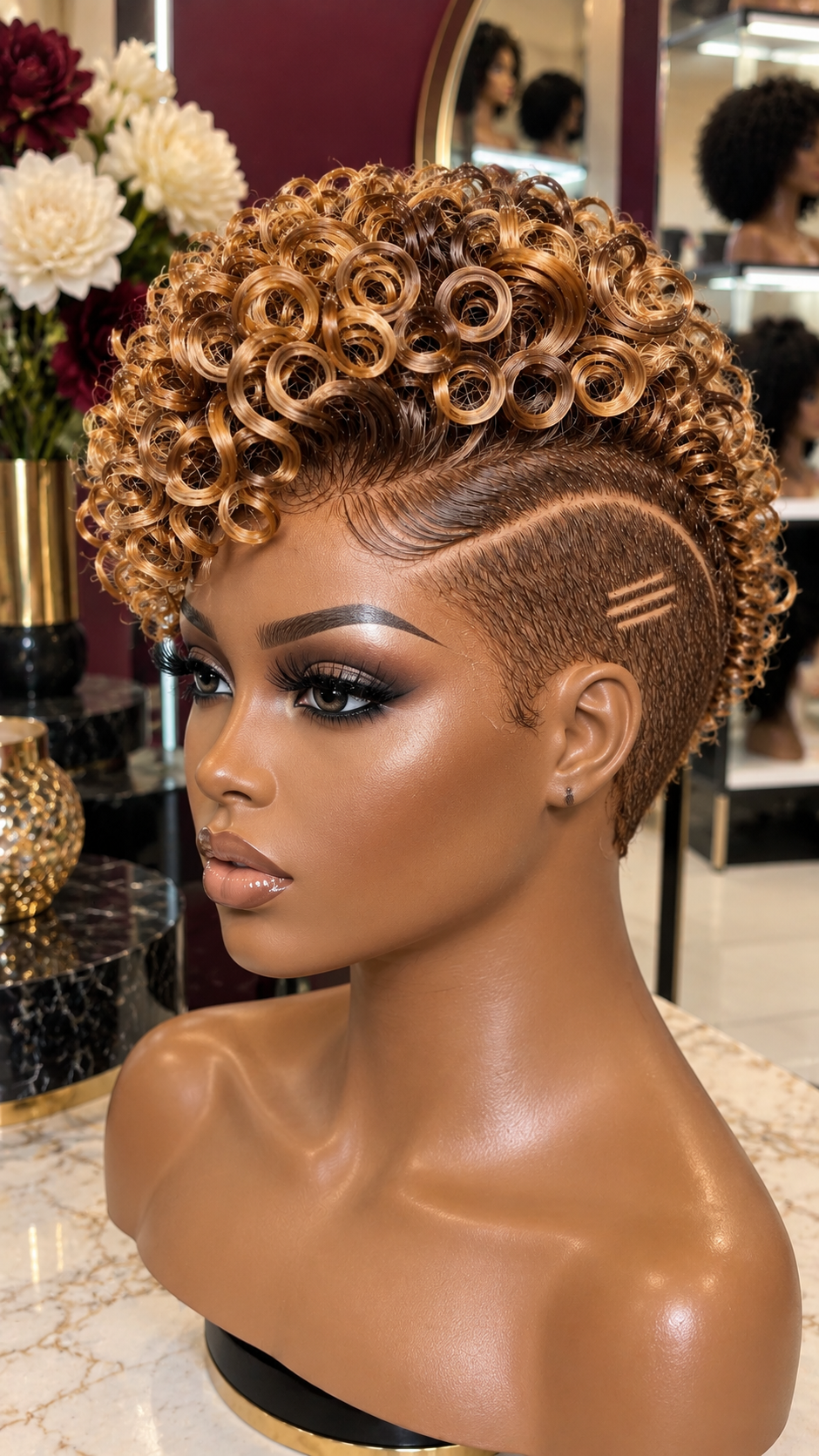
This honey-copper pixie wig stands out because the color, curl placement and side profile have been planned as one complete composition. The upper section is covered with tightly arranged circular ring curls in a warm honey-copper shade, while a deeper brown foundation remains visible underneath. Instead of relying on an ordinary side part, the style uses a broad curved separation that travels from the front temple toward the area above the ear. Three small parallel line accents sit inside the closely cropped side section, giving the profile an additional graphic detail without competing with the curls.
The photograph also reveals an important difference between this design and many pixie wigs sold online. The crown is not made from loose spirals or fluffy curls. Each curl has been shaped into a visible loop, with the circular openings creating a pattern across the entire upper surface. The front curls are slightly larger and more prominent, while smaller loops fill the surrounding areas. This gives the crown a full appearance without hiding the individual curl shapes.
For someone who wants to buy or commission a similar wig, the most useful approach is to describe the visible construction rather than simply asking for a “honey blonde pixie.” The recognizable details are the honey-copper ring curl crown, deeper brown roots, sweeping side separation, closely cropped side panel, three parallel accents and sculpted front wave. These are the features that should appear in a custom-order brief.
The Honey-Copper Shade Has More Depth Than a Flat Blonde
The color is one of the first things that attracts attention, but it is not a uniform pale blonde. The curls carry warm golden-brown and copper tones that become brighter wherever the salon lighting hits their curved surfaces. Deeper brown appears between the loops and closer to the base, giving the upper section much more dimension than a single light color would provide.
This type of color placement is particularly effective with circular curls because every ring catches light differently. The outer edge can appear golden or amber, while the interior of the same curl looks several shades deeper. As a result, the crown can appear highly dimensional even when only a limited palette is used.
When ordering, avoid relying exclusively on names such as “honey blonde,” “caramel” or “copper brown.” Color terminology varies considerably between wig vendors. Send the reference photograph and ask the maker to show the actual shade they intend to use. If possible, request a photograph in neutral daylight before approving the color.
Why the Circular Curl Pattern Needs Careful Construction
The crown is built from dozens of individual rings positioned closely beside one another. Some face forward, some upward and others sit at a slight diagonal. This directional variation keeps the hairstyle from looking like rows of identical circles.
The rings around the front are especially important. They form a bright halo above the forehead and connect visually with the sweeping wave below. Toward the sides, the curls become more compact so that the crown can transition into the lower profile without creating excessive width.
If a wig maker substitutes ordinary spiral curls, the result will have a different silhouette. Spirals generally create hanging movement, whereas these ring curls create controlled height. For a closer recreation, specify compact circular loops with visible centers and provide both front and side reference photographs.
A Darker Foundation Gives the Light Curls More Impact
Underneath the honey-copper crown, the hair becomes substantially darker. This deeper foundation creates a visual boundary between the bright upper area and the mannequin’s skin tone. It also makes the side artwork easier to read.
The darker base is particularly noticeable around the temple and above the ear. Instead of coloring every strand honey copper, the stylist has allowed the deeper shade to become an intentional part of the design. That decision gives the wig more contrast and prevents the light crown from appearing disconnected from the side.
Someone commissioning this look can ask for a dark espresso or natural dark-brown foundation beneath the warmer rings. The exact base shade should be selected alongside the crown color so the transition feels deliberate rather than accidental.
The Large Side Curve Is the Signature Profile Detail
The most recognizable element from the side is the broad curved separation. It begins close to the front wave and travels backward in a graceful arc above the ear. The line creates a clear border between the upper styling and the closely cropped panel beneath it.
This is not the same as requesting a straight side line. The curve follows the shape of the head and visually echoes the circular movement of the crown. Because the hairstyle contains so many rings, using another curved element on the side helps connect the two sections.
When sending instructions to a stylist, describe this as one sweeping curved side division positioned above the ear. Include a close side photograph because verbal descriptions alone can easily produce a different placement.
Three Small Accents Add Detail Without Overcrowding the Side
Inside the darker side panel are three compact parallel marks. They are positioned toward the rear portion of the exposed section and remain much smaller than the primary curved division. Their limited size is important: they provide a secondary detail rather than becoming the dominant feature.
A recreation with too many lines would change the balance of the style. The reference keeps most of the side visually open, allowing the broad curve and cropped area to remain easy to see. If these accents are important to your order, specify the number and approximate position instead of requesting generic side lines.
For a custom wig, ask the maker how these details are created and whether they can be refreshed later. The technique and durability can vary according to the construction of the unit.
The Front Wave Connects the Crown to the Hairline
Between the circular crown and the curved side division is a broad sculpted wave. The hair follows a sweeping direction across the temple before turning toward the side. This section provides a transition between two very different visual elements: the elevated rings above and the closely cropped panel below.
The wave also helps frame the forehead. Rather than allowing the ring curls to begin abruptly at the perimeter, the design introduces a flatter directional section first. This creates a more elaborate front profile and gives the crown additional visual height.
When discussing the style with a wig specialist, ask whether the front wave will arrive pre-styled. If it does, the installer should preserve its original direction when positioning the unit.
The Crown Proportion Matters as Much as Curl Size
Although the curls are plentiful, the silhouette remains relatively compact. Most of the volume is concentrated above the crown rather than extending far outward around the sides. This creates height while keeping the profile close to the head.
The front portion appears slightly fuller, which gives the hairstyle a subtle forward emphasis. Moving toward the rear, the rings follow the rounded contour of the head. This distribution prevents the wig from becoming top-heavy.
If you prefer the exact proportion shown, tell the stylist that you want a rounded crown with concentrated height rather than an oversized curly dome. Density should be sufficient to hide obvious gaps while still allowing individual loops to remain visible.
What the Photograph Does and Does Not Confirm
The image clearly shows the finished hairstyle positioned on a mannequin, including the curl structure, side pattern, color distribution and perimeter styling. These visible characteristics can be used confidently when describing the design.
However, the photograph does not provide enough evidence to identify the exact hair material, cap dimensions or commercial lace grade. Those specifications should not be assumed. In particular, a buyer should not advertise or order the piece as HD lace unless the manufacturer confirms that specification.
Ask the seller directly about hair or fiber type, lace material, cap construction, adjustment options and recommended installation method. These technical details can substantially affect both price and maintenance.
Who Should You Search for to Recreate This Wig?
A general wig installer may be able to fit the finished unit, but recreating it from the beginning requires a more specialized skill set. Look for professionals whose portfolios include sculpted pixie wigs, molded curls, finger-wave work and customized side patterns.
Search locally for terms such as custom pixie wig stylist, ring curl wig maker, finger wave wig specialist or custom copper wig salon. Add your city or neighborhood to narrow the results. Social media portfolios can be particularly useful because side-profile photographs reveal much more about this kind of work than a standard frontal beauty shot.
Before booking, send the reference image and ask whether the stylist has created circular ring curls before. A professional who specializes primarily in long straight units may not necessarily use the same techniques required for a compact sculpted crown.
Questions to Ask Before Paying a Custom Wig Deposit
Start by confirming whether the stylist can reproduce the ring size and overall crown height. Then discuss the color. Ask whether the honey-copper shade will be created from one color or blended from several related tones. Request a sample photograph whenever possible.
Next, discuss the side profile separately. Confirm the large curved division, the three smaller line accents and the darker cropped panel. These details should be included in the written order description so there is less room for misunderstanding.
Finally, confirm the practical terms: measurements, production time, payment schedule, shipping method, alteration policy and whether customized units are eligible for returns. Keep screenshots of the agreed specifications until the order has been completed.
Premium Custom, Standard Custom and Other Price Levels
| Category | Typical Planning Range | What to Confirm Before Ordering |
|---|---|---|
| Premium Custom | $450–$900+ | Personal measurements, advanced color placement, individually formed ring curls, side artwork and full perimeter styling |
| Standard Custom | $275–$475 | Custom color, crown styling, side curve, line accents and fitting adjustments |
| Basic Human Hair | $160–$325 | Hair quality, density, coloring fees, cap construction and amount of styling included |
| Premium Synthetic | $90–$190 | Fiber grade, heat tolerance, curl retention, color availability and cap features |
| Basic Synthetic | $45–$110 | Pre-set curl pattern, fiber quality, sizing options and styling limitations |
These figures are general budgeting ranges rather than the price of the exact wig shown. Custom labor, location, materials, coloring and construction can move a quote considerably higher or lower.
How to Approve the Wig Before It Is Shipped
Request photographs from several angles before accepting a custom order as complete. A straight-on image should show the front curl distribution and wave placement. A side photograph should clearly reveal the sweeping curve and three smaller accents. An overhead photograph can show whether the circular curls cover the crown consistently.
Also ask for a photograph of the opposite side and rear. Even when one profile contains the primary artwork, the entire silhouette should remain balanced. This is especially important for a crown built from individually arranged curls because uneven density can be difficult to notice from one camera angle.
If anything differs from the original agreement, raise the issue before shipping. Adjustments are usually easier for the maker to perform while the wig is still in the salon.
Preserving the Ring Formation at Home
The circular loops should be treated as styled shapes rather than ordinary loose curls. Avoid brushing through the crown because a brush can open the rings and merge neighboring sections. Excessive finger separation can have the same effect.
When the wig is not being worn, place it on a suitable stand or head form with enough clearance around the crown. Do not allow clothing, storage bags or other wigs to press against the rings. Compression can flatten the upper surface and distort the circular openings.
If several rings lose their form, take the piece back to a stylist who understands sculpted curl work. Attempting to rebuild the entire crown without knowing the original technique can alter its proportion.
Color Care for Honey and Copper Tones
Warm shades often appear most attractive when the strands remain reflective and free from heavy residue. Product buildup can make the copper areas appear darker and reduce the contrast between neighboring curls.
Care products should be selected according to the actual material of the wig. Human hair and synthetic fiber require different routines, so obtain washing and product recommendations from the seller. Do not assume that products used on another wig are appropriate for this one.
If the unit is made from color-treated human hair, ask the stylist about maintaining the honey-copper tone between appointments. If it is synthetic, ask whether the color is integral to the fiber and what products should be avoided.
Booking the Installation Without Losing the Side Placement
When booking an installation appointment, send the stylist this side-profile reference in advance. Explain that the large curve needs to sit naturally above the ear and that the three line accents must remain visible. The unit should be positioned and checked before any irreversible perimeter work is performed.
Look at the wig from multiple angles during the fitting. The ring crown should remain centered, the front wave should follow the intended direction and the side panel should not sit unnaturally high or low.
If you want a removable installation rather than longer wear, discuss that preference before the appointment. The appropriate method depends on the cap and construction supplied by the wig maker.
Search Terms
Honey Copper Ring Curl Pixie Wig · Golden Copper Circle Curl Wig · Honey Brown Sculpted Pixie Wig · Curved Side Design Pixie Wig · Copper Ringlet Crown Wig · Honey Copper Finger Wave Wig · Three Line Side Pixie Wig · Golden Brown Circular Curl Wig
Ordering the Look Without Turning It Into a Generic Pixie
The safest way to reproduce this hairstyle is to divide the reference into separate specifications. For the crown, request densely arranged honey-copper rings with visible circular centers. For the foundation, preserve a deeper brown shade. For the side, request one large sweeping curve with three compact parallel accents. Around the temple, preserve the broad directional wave that connects the upper and lower sections.
Do not allow color alone to become the order description. Two wigs can use almost identical honey-copper shades and still look completely unrelated if their curl size, crown height or side work differs. The construction is what gives this piece its identity.
Before placing the order, compare the stylist’s previous work with the reference and discuss every visible feature that matters to you. Confirm technical specifications separately rather than assuming them from the photograph. Once the piece is completed, review front, side, top and rear photographs before approving shipment.
The finished result should preserve the visual rhythm seen here: bright circular curls concentrated across the crown, deeper hair underneath, a sweeping curved side division, three compact line accents and a sculpted wave framing the temple. Those elements work together to create a pixie wig that looks deliberately designed from every angle rather than relying on color alone.