
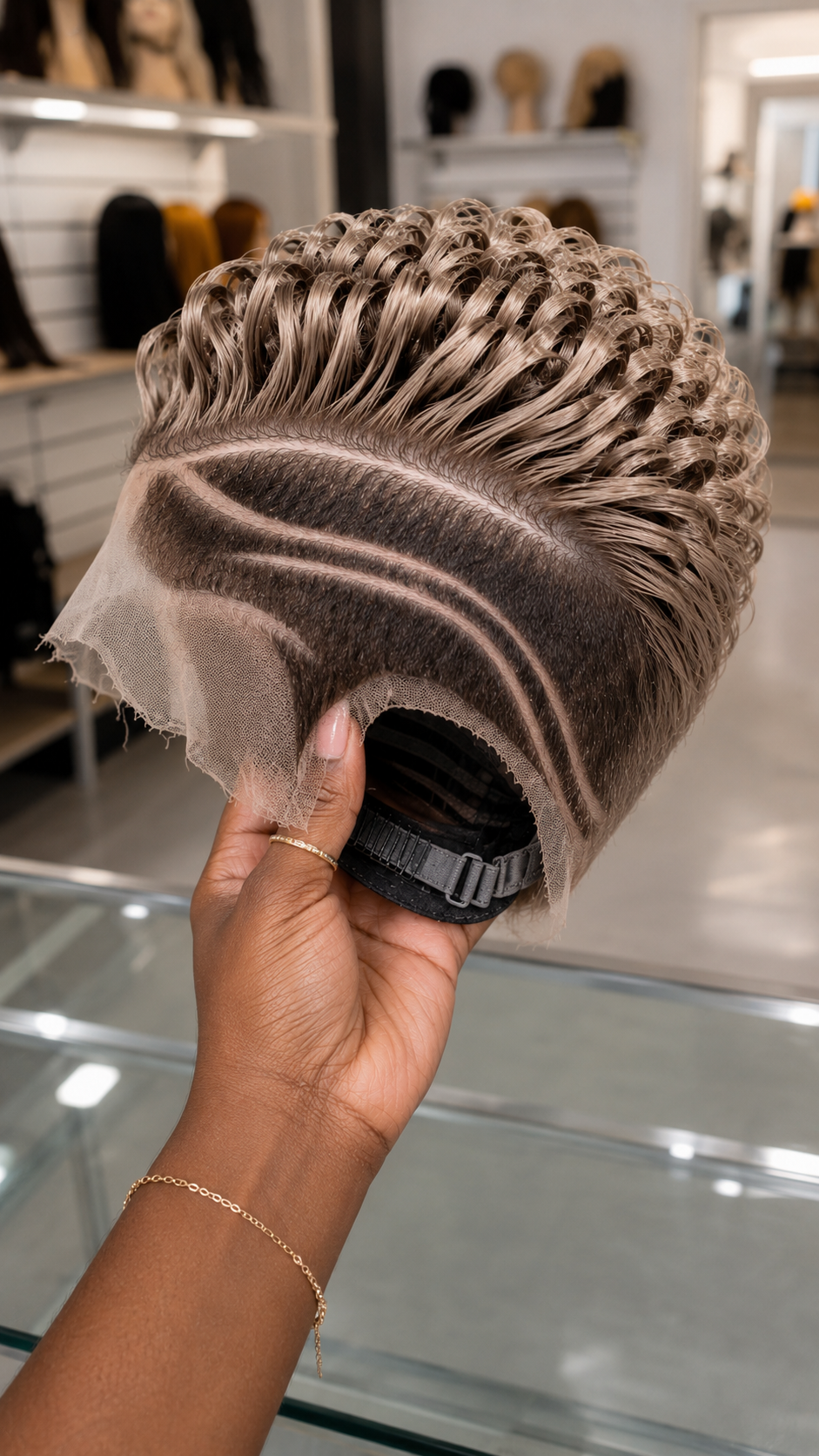
A light curly pixie wig does not necessarily need to be pale from the scalp to the ends. In fact, one of the easiest ways to give a short blonde, silver, ash-beige, or champagne-colored crown more depth is to preserve a darker root beneath it.
This short pixie shows why that detail matters. The elongated light loops create the main crown, but they rise from a noticeably darker foundation. The cropped side remains dark as well, so the shadow root acts as a bridge between the pale upper section and the close-cut lower area.
If the light color begins directly at the base of every strand, the crown can look flatter and much brighter. If the dark root extends too far into the curls, the wig may appear mostly black with light ends rather than like a light-colored pixie.
The important question is therefore not simply which blonde or silver shade to choose. It is how much dark root should remain visible before the lighter color begins.
Where To Buy A Dark-Root Light Curly Pixie Wig
Custom wig makers. Custom work gives you the best control over root depth. Send a side-view reference and specify whether you want a narrow shadow root, a medium dark-root transition, or a more dramatic black-to-light effect.
Local wig boutiques. Inspect the wig from the side and from slightly above. The darker root may be difficult to judge from a frontal photograph because the pale curls can cover much of the transition.
Instagram and TikTok wig sellers. Ask for an unfiltered rotation video of the actual unit. Request close footage of the roots rather than only a beauty shot of the finished loops.
Etsy wig makers. Independent sellers may allow you to choose the crown shade, root color, root depth, curl size, cap measurements, lace type, and short-side design.
Online wig retailers. Useful searches include dark-root silver pixie wig, rooted blonde curly pixie wig, ash-blonde pixie wig, champagne curly wig, shadow-root short wig, and glueless pixie wig.
Amazon, AliExpress, and Temu. Ready-made rooted colors can be more affordable, but customer photos are important because the root area may be much wider or narrower than the listing images suggest.
Professional wig salons. A colorist may be able to add a shadow root to an existing light human-hair pixie or soften a root that appears too abrupt.
Wholesale vendors. If you purchase multiple units, confirm that root depth is part of the production specification. The same color combination can look very different when the dark section varies between units.
Order inquiries: WhatsApp [WhatsApp: +XX XXX XXX XX XX]
How Much Does A Rooted Light Pixie Wig Cost?
Premium Custom Human Hair: approximately $300–$600+. This may include high-quality human hair, professional lightening, custom shadow-root coloring, HD or Swiss lace, cap measurements, hand-set curls, and detailed side work.
Standard Custom Human Hair: approximately $200–$400. This range can provide good human hair, professional two-zone color work, and customized styling with fewer premium construction options.
Basic Human Hair: approximately $140–$270. These units may require additional toning, root correction, or curl resetting after purchase.
Premium Synthetic: approximately $70–$180. Factory-rooted synthetic fibre can provide excellent color consistency and strong curl retention.
Basic Synthetic: approximately $30–$90. Budget units can reproduce the general dark-root effect, although the transition may appear more abrupt or printed-looking.
Shipping, taxes, custom coloring, lace customization, cap alterations, professional installation, and additional styling can increase the final price.
What Is A Shadow Root?
A shadow root is a deliberately darker section left or created near the base of the hair before the lighter color becomes dominant.
It can be jet black, natural black, espresso brown, dark ash brown, or another deeper shade.
On a short pixie, the root area may be relatively small in physical length, but it occupies an important visual position because it sits directly beneath the crown.
The darker color creates depth before the eye reaches the pale loops above it.
A Narrow Root Creates A Brighter Crown
If the dark section is kept very short, most of each visible curl appears light.
This makes the entire pixie read more strongly as blonde, silver, beige, or champagne.
The root still provides a little contrast, but it does not dominate the crown.
This approach works well when the wearer wants the light color to be the obvious main feature.
A Medium Root Creates More Dimension
Allowing the dark base to travel slightly farther into the upper strands produces a stronger gradient.
The viewer sees dark hair at the base, a transitional section through the loop, and the lightest color farther out.
Because the loops repeatedly turn back toward the head, different portions of the root may appear between pale sections.
This creates considerable depth without adding highlights or several separate colors.
A Very Deep Root Changes The Entire Color Balance
If the dark section extends too far, the wig may stop reading as a light pixie with dark roots.
Instead, it can look like a black pixie with pale tips.
That may still be an attractive design, but it is a different result.
Before ordering, decide which color you want viewers to notice first.
If the answer is the pale crown, keep the dark root controlled.
Root Depth Is Especially Important On Short Hair
A long wig has many inches available for color transitions.
A pixie does not.
A relatively small change in root length can therefore alter a large percentage of the visible strand.
On a three-inch curl, one inch of dark root represents a significant portion of the total hair.
This is why vague instructions such as “dark roots” are not always enough for a custom order.
The Curl Pattern Changes How Much Root You See
The physical root length and the visible root length are not necessarily the same.
A loop bends away from the scalp and then returns.
Parts of its dark base can therefore appear next to lighter portions of the same strand.
A straight strand with a one-inch root looks very different from a compact loop with the same one-inch root.
Color placement should be planned around the final curl shape.
Elongated Loops Show More Transition
This type of pixie uses extended loops rather than tiny closed ringlets.
That gives the eye more strand length to follow.
The transition from dark base into pale beige or silver therefore becomes an obvious part of the hairstyle.
A good root blend can make each loop look richer and more three-dimensional.
Dark Roots Help Separate Individual Curls
Very pale curls placed directly beside one another can visually merge, especially under strong lighting.
A darker base creates small areas of contrast between them.
This makes the shape of the loops easier to see.
The crown can appear more detailed even when the actual curl density remains unchanged.
Dark Roots Can Make A Pale Crown Look Fuller
Depth at the base creates stronger shadows underneath the light loops.
Those shadows give the impression that more layers of hair sit beneath the visible surface.
A completely pale crown can sometimes look flatter because there is less tonal contrast between the upper and lower portions.
This is an optical effect rather than an increase in actual density.
The Root Should Connect With The Short Side
The cropped side of this style remains dark.
If the crown immediately became pale directly at the division line, the two sections could look visually disconnected.
A dark root gives them a common color.
The short side flows into a dark crown base, and only then does the lighter color appear.
This can make a high-contrast pixie feel more coherent.
The Parting Line Looks Stronger Against A Dark Root
The boundary between the crown and cropped side is visually important.
Dark hair around this line creates a strong frame.
If very pale hair begins directly at the division, the contrast around the part may become much sharper and more graphic.
Keeping dark root around the base can soften that jump while preserving the structure of the haircut.
The Side Design Should Stay Separate From The Light Color
Decorative carved lines are easier to read when they remain within a darker area.
If pale color travels too low into the cropped side, it can compete with those lines.
Keeping the short foundation dark gives the side design its own visual space while the light loops remain the focal point above it.
Root Color Does Not Have To Be Jet Black
Jet black creates the strongest possible contrast.
But it is not the only option.
Natural black produces a slightly softer result.
Espresso brown can connect beautifully with beige-blonde or champagne tones.
Dark ash brown can work particularly well with cool silver-beige crowns.
The best choice depends on how dramatic you want the contrast to be.
Cool Crown Colors Need Compatible Roots
A cool ash or silver crown can look less harmonious if the root contains strong red or orange warmth.
The two colors do not always need to match in temperature, but the relationship should be intentional.
For a muted silver-beige crown, natural black, charcoal brown, or dark ash brown can create a controlled transition.
Send your colorist a full reference rather than choosing the root and crown shades independently.
Warm Roots Can Work With Champagne Blonde
If the light crown is warmer, a deep chocolate or espresso root can produce a softer effect than blue-black.
This is useful when the wearer wants noticeable depth without extremely sharp contrast.
Color names vary between sellers, so visual references remain more reliable than terminology alone.
Ask Whether The Root Is A Hard Line Or A Blend
Two wigs can use exactly the same dark root length but look completely different.
One may transition abruptly from black to pale blonde at a single point.
Another may gradually soften through intermediate shades.
A diffused root normally appears less banded.
When ordering custom, specify whether you prefer a crisp color block or a blended shadow-root effect.
A Hard Root Line Can Become Obvious On Loops
If every strand changes color at exactly the same distance from the scalp, the transition may create a visible band through the crown.
Curled hair can disguise some of that line, but not always.
A slightly irregular or feathered transition can make the change feel more natural.
Neighboring strands do not necessarily need to become light at precisely the same point.
Root Smudging Can Soften The Transition
On human hair, a colorist may use a root-smudge technique to create a less abrupt boundary.
The darker tone is blended into the lighter section instead of ending sharply.
This can be particularly effective on ash, beige, champagne, and silver pixies.
The exact method should depend on the starting hair and the final color goal.
Do Not Darken The Root Afterward Without Planning
Adding a root later may sound simple, but short curly hair offers very little room for mistakes.
If dark pigment travels too far down the strand, much of the light color can disappear.
If it transfers onto neighboring curls unevenly, the crown can become patchy.
For an expensive human-hair unit, professional correction is safer than experimenting directly on the finished pixie.
Human Hair Allows More Root Customization
Human hair gives a professional colorist greater flexibility to create, deepen, soften, or refresh a shadow root.
However, the pale portion may already have undergone substantial chemical processing.
Any additional coloring needs to account for the condition and porosity of the hair.
A beautiful root effect should not come at the expense of curl quality.
Synthetic Rooted Colors Can Be Very Consistent
Synthetic fibre can be manufactured with a dark-root pattern already built into the color.
This can provide excellent repeatability across a product line.
The limitation is flexibility.
If the root is too long or too short for your preference, changing it later may be difficult.
Inspect the exact factory color layout carefully before ordering.
Lighting Changes The Apparent Root Depth
Under bright light, pale loops become much more reflective and can visually overpower the dark root.
In lower light, the darker base may appear more dominant.
This means the same wig can look like it has a narrow root in one photograph and a much deeper root in another.
Ask for both daylight and normal indoor footage.
Flash Can Make The Transition Look Sharper
Phone flash reflects strongly from pale hair while dark roots absorb more light.
This exaggerates the contrast.
If you plan to use the wig heavily for social media photography, a flash test can be useful before final approval.
Make sure you still like the root depth when the contrast is at its strongest.
Filters Can Alter Root Color
A warm filter can turn dark ash brown into chocolate and pale beige into gold.
A cool filter can push the crown toward silver and the roots toward blue-black.
For color approval, request an unfiltered video.
Do not rely only on heavily edited social media photographs.
Check The Root From The Back Too
The frontal and side naturally receive the most attention.
But the color transition should also continue convincingly around the rear crown.
A common inconsistency is a beautifully blended front with much larger dark sections at the back.
Request a complete rotation before paying for a custom wig.
Check Both Sides
The dark-root transition does not have to be mechanically identical on both sides.
But one side should not appear almost fully light while the other contains several inches of dark root unless asymmetry was deliberately requested.
Compare the relationship between the root, outer loops, and cropped foundation on both sides.
Root Depth Can Change As The Curls Are Restyled
If human-hair loops are reset tighter, more of the root may become visible because the strand contracts closer to the scalp.
If the curls are stretched into larger loops, the pale section may become visually more dominant.
This means the apparent color balance is connected to styling.
When refreshing the wig, try to preserve a curl scale similar to the original set if you want the same root effect.
How To Find A Stylist For This Color
Search for a shadow-root wig colorist, blonde wig specialist, pixie wig stylist, short human-hair wig salon, or custom wig maker.
Look for portfolios showing short rooted colors rather than only long balayage wigs.
Short wigs require more precise placement because the color transition has far less length available.
Send the reference before booking and specify the crown color, root color, and approximate amount of dark base you want to remain visible.
Appointments can usually be arranged by phone, WhatsApp, Instagram DM, Facebook, or the salon’s booking page.
What To Tell The Wig Maker
Explain that you want a light ash-beige, silver, champagne, or similar crown with a controlled dark root connecting it to the cropped side.
Specify whether the dark area should be narrow, medium, or pronounced.
Ask for a blended transition rather than a hard band if that is your preference.
Send a true side-profile reference because root depth is much easier to evaluate from the side than from a frontal image.
Before You Pay
- What color is the dark root?
- What exact shade is used through the light crown?
- How far does the dark root extend into the curls?
- Is the transition blended or a hard line?
- Does the same root depth continue around the back?
- Can you show both sides under neutral lighting?
- Can you provide an unfiltered daylight video?
- Is the unit human hair or synthetic?
- Can the root be adjusted before shipping?
- If human hair, how should the root color be refreshed later?
- Can I approve the finished color before shipment?
Maintaining The Shadow Root
Human-hair color can change gradually with washing and styling.
The pale crown and dark root may fade at different rates.
Use products intended for color-treated hair and avoid unnecessary high heat.
If the root begins fading, consult a colorist before applying dark pigment across the entire base.
Short hair makes accidental over-application particularly noticeable.
Keep Heavy Products Away From The Root
Oils and heavy styling creams can make a dark root appear even darker and reduce the visible transition into the pale section.
Use lightweight products and apply only what the curls need.
If the crown starts looking much darker at the base after styling, product buildup may be contributing to the effect.
Search Terms
dark root curly pixie wig · shadow root pixie wig · ash blonde pixie wig with dark roots · silver pixie wig for black women · rooted blonde curly wig · champagne pixie wig · beige blonde short wig · glueless rooted pixie wig · dark root silver wig · short curly wig with black roots · ash beige pixie wig · custom shadow root wig · short human hair pixie wig · rooted loop curl wig
Final Thoughts
A dark root can do much more than make a light pixie easier to maintain. It creates depth, separates the curls, connects the crown to the cropped foundation, and changes how bright the entire hairstyle appears.
The key is controlling its depth.
A narrow root keeps the wig predominantly light. A medium root creates stronger dimension. A deep root shifts the balance toward black or dark brown with pale ends.
When ordering a similar unit, specify the root color, approximate depth, and whether you want the transition blended or sharply blocked. Request side and back views of the actual finished wig under neutral lighting.
On a short pixie, even a small change in root length affects a large percentage of each visible curl. Getting that proportion right is what allows the dark foundation and pale crown to look like one intentional hairstyle rather than two unrelated colors.