
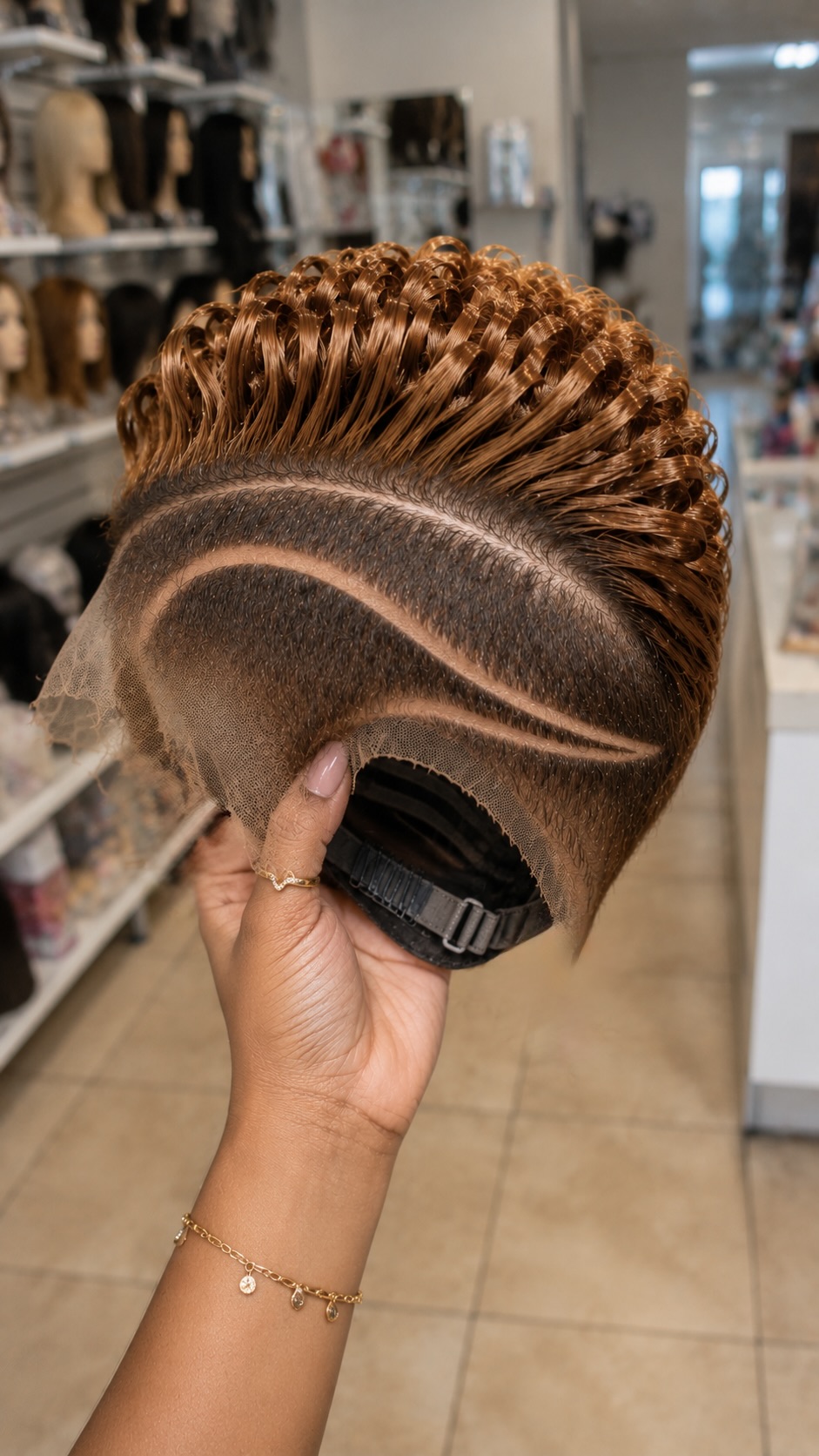
A short curly pixie wig can have a beautiful crown and still look noticeably different from the reference because of something as small as the spacing between two carved side lines.
On this copper curly pixie, the upper section is filled with glossy elongated loops while the lower side stays very short. Two curved lines travel through that cropped area. They follow a similar direction, but they are separated by enough short hair to remain readable as two independent details.
That spacing is important.
If the two lines sit too close together, they can visually merge and look like one unusually thick carved section. If they are placed too far apart, they divide too much of the side panel and begin competing with the crown above them.
For anyone ordering a similar wig, the question should therefore be more specific than simply asking for “two side lines.” You need to consider line thickness, distance between the lines, curve direction, and the amount of short hair left around them.
Where To Buy A Curly Pixie Wig With Double Side Lines
Custom wig makers. Custom work gives you the most control over the side design. Send a true side reference and explain that you want two separate curved lines with visible short hair between them.
Local wig boutiques. When inspecting a unit in person, view the side from normal conversational distance. Tiny differences that look insignificant at close range can completely change how the design reads from several feet away.
Instagram and TikTok wig sellers. Ask for a slow side video of the exact wig. Do not rely only on a heavily angled photograph because perspective can make the space between two lines appear narrower or wider.
Etsy wig makers. Independent sellers may offer custom crown color, side length, line placement, cap measurements, lace type, and curl shape.
Online wig stores. Useful searches include short curly pixie wig, pixie wig with shaved lines, curly pixie wig with side design, copper pixie wig, tapered curly pixie, and glueless short curly wig.
Amazon, AliExpress, and Temu. Similar styles can be available at lower prices, but customer images are important. Factory side designs may vary even when the main crown is consistent.
Professional wig salons. A stylist experienced with very short wig work may be able to refine the side of an existing unit, although structural side changes should be approached carefully.
Wholesale suppliers. If you buy several units for resale, specify the number of lines and approximate spacing. Hand-finished side designs can vary significantly between pieces.
Order inquiries: WhatsApp [WhatsApp: +XX XXX XXX XX XX]
How Much Does A Curly Pixie Wig With Side Detailing Cost?
Premium Custom Human Hair: approximately $280–$550+. This may include premium human hair, custom coloring, HD or Swiss lace, cap measurements, hand-set curls, short-side work, and individually finished carved details.
Standard Custom Human Hair: approximately $190–$380. This range can provide good human hair and custom styling with somewhat simpler construction.
Basic Human Hair: approximately $130–$260. Additional shaping or professional side refinement may be necessary after delivery.
Premium Synthetic: approximately $70–$170. Quality synthetic fibre can maintain a compact crown extremely well, although side customization options may be more limited.
Basic Synthetic: approximately $30–$90. Budget units can reproduce the overall silhouette but may show more variation in carved-line placement.
Shipping, custom coloring, professional fitting, lace work, side detailing, and additional salon styling can increase the final price.
Two Lines Need To Read As Two Lines
This sounds obvious, but it is the first test.
When you look at the side from normal distance, you should immediately understand that there are two separate carved paths.
If the remaining strip of short hair between them is extremely narrow, that strip can disappear visually.
The result may look like one wide shaved area rather than two controlled lines.
A successful double-line design preserves enough contrast between the line, the hair strip, and the second line.
Line Thickness Changes The Required Spacing
A very fine line can sit closer to another fine line.
Two wider lines need more space.
Otherwise the amount of remaining hair between them becomes too small.
When discussing a custom wig, do not specify spacing without also specifying whether you want delicate narrow lines or stronger, more visible carved channels.
Those two decisions affect each other.
Thin Lines Create A More Detailed Effect
Fine carved lines usually look more intricate.
They allow the stylist to include two or even three details without removing too much of the cropped side.
They also preserve more dark hair around the design.
The disadvantage is that extremely fine lines can become harder to see from a distance, especially when the surrounding hair and scalp-like base are similar in tone.
Wide Lines Create Stronger Contrast
A wider carved channel is easier to see.
It creates a stronger graphic element on the side of the pixie.
However, wide lines consume more of the available side panel.
Using two very broad lines can make the entire lower section feel dominated by the design.
This is why the most visible option is not always the most balanced option.
The Hair Strip Between The Lines Is Part Of The Design
The short hair remaining between two carved lines should not be treated as leftover material.
It is an intentional third visual element.
You have the upper line, the strip of short hair, and the lower line.
If that middle strip has consistent width, the two lines feel connected while remaining clearly separate.
If it becomes extremely thin in one section and very wide in another, the design can look accidental.
Perfectly Equal Spacing Is Not Always Necessary
The head curves.
A carved design also usually curves.
Because of that, the space between two lines does not need to measure exactly the same at every point.
A small amount of variation can actually make the design feel more natural and hand-shaped.
The important thing is that the two lines continue to feel related rather than gradually drifting away from each other.
Parallel Does Not Mean Mathematically Identical
A good double-line design may look parallel without being geometrically perfect.
The upper curve can be slightly broader.
The lower line may taper sooner.
Both can still travel in the same visual direction.
Trying to make them look like computer-generated duplicates can sometimes create an overly rigid result.
The goal is controlled similarity.
The Lines Should Follow The Shape Of The Head
A curved side design normally looks stronger when it responds to the skull rather than cutting across it randomly.
As the head rounds toward the back, the lines can gradually follow that movement.
This makes them appear integrated into the haircut.
A completely straight design placed across a strongly curved side can look pasted onto the wig rather than built into it.
The Upper Line Needs Enough Distance From The Crown
The upper carved line should not sit directly underneath the long crown.
If it is too high, the outer curls may cover it.
Even when the curls do not physically touch the line, a very narrow strip of short hair between the crown and carved detail can make the entire area feel crowded.
Leaving a visible short-hair band above the first line helps the design breathe.
The Lower Line Needs Enough Hair Beneath It
The opposite side needs space too.
If the second line sits too close to the lower perimeter, very little short hair remains underneath it.
The side can then look unfinished or structurally weak.
A good placement leaves the lower line clearly visible while preserving enough cropped hair below it to complete the tapered panel.
Double Lines Can Visually Change Side Height
Two horizontal or curved details divide the side into several bands.
That can make a tall short-side panel appear shorter.
This optical effect is useful when you want the design to break up a large dark section.
But on an already shallow side, too many lines can make the available area feel cramped.
Always consider the total side height before deciding how many carved elements to use.
Crown Size Should Influence The Side Design
A very large crown already contains substantial visual information.
Adding large, widely spaced carved lines underneath can make the wig feel busy.
A more compact side detail may balance a fuller crown better.
On a smaller crown, stronger side work can sometimes become more prominent without overwhelming the hairstyle.
The crown and side should be planned as one composition.
Color Changes How Wide The Lines Appear
Contrast influences perception.
On a dark side, a pale scalp-like carved line stands out strongly and can appear wider than it physically is.
On blonde or very light sides, the same line may blend more easily into the surrounding hair.
Therefore, a line specification that works perfectly on black hair may not read the same way on another color.
Judge the finished design visually, not only by measurement.
Copper Crown And Dark Side Create Strong Separation
This style uses a warm copper crown over a much darker short foundation.
That already creates a clear upper and lower division.
The carved lines therefore do not need to be extremely aggressive to attract attention.
The strong color change performs part of the visual work.
When multiple design elements already exist, restraint can produce a cleaner result.
Avoid Letting The Copper Travel Into The Carved Area Randomly
If a few bright copper strands extend inconsistently into the dark side, they can interrupt the clarity of the double lines.
A deliberate color transition is different.
If the side is meant to remain dark, keep the carved area predominantly within that darker foundation.
This allows the line geometry to remain easy to read.
The Front End Of The Lines Matters
Look carefully at where the two curves begin near the front.
They should not create a heavy block of exposed scalp-like space immediately beside the frontal.
A tapered beginning usually looks more controlled.
The line can start narrow and become slightly stronger as it travels backward.
That prevents the front of the side panel from appearing abruptly cut.
The Rear End Should Finish Deliberately
The same rule applies at the opposite end.
A line that simply stops without tapering can appear unfinished.
Many effective designs gradually narrow or curve into the surrounding short hair.
Ask for rear-three-quarter photographs because the end of a side design is often hidden in standard frontal images.
Both Lines Should Not Necessarily End At The Same Point
Allowing one line to finish slightly before the other can create movement.
If both terminate at exactly the same vertical point, the design may feel more rigid.
A staggered finish can work well as long as the difference is intentional.
The reference image should guide the exact relationship.
Check The Design From Normal Distance
Close-up photos are excellent for inspecting craftsmanship.
But they are not enough.
Move back mentally and ask how the design will look in an ordinary selfie or when someone sees the wearer from across a room.
Extremely fine details may disappear.
Overly wide details may dominate.
The strongest side design works at more than one viewing distance.
Ask For A True Side View
A three-quarter photograph can compress the apparent space between the two lines.
A direct side view gives you a much more reliable impression.
Request one where the camera is level with the side rather than looking down from above.
This makes line spacing, side height, and crown relationship easier to judge.
Check The Opposite Side Too
Some pixie wigs use carved detailing on only one side.
Others repeat it.
If your order is supposed to include similar details on both sides, request images of both.
Handmade line spacing may vary.
Decide whether you want mirrored designs, related designs, or intentionally different sides before production.
Do Not Add More Lines Simply Because There Is Space
Three or four carved lines may fit physically.
That does not mean they improve the style.
Every additional line reduces the amount of uninterrupted short hair.
On a compact pixie, two carefully positioned lines can communicate more clearly than several crowded ones.
Use the number of lines that supports the haircut rather than filling every available area.
Side Designs Need Maintenance On Human Hair
If the short section is made with human hair, growth-like texture can become less crisp after repeated washing and restyling.
Individual short hairs may move across the carved channels.
A stylist can carefully redirect the surrounding hair to make the lines easier to see again.
Avoid repeatedly cutting deeper into the same channel without evaluating how much hair remains around it.
Heavy Product Can Blur Fine Lines
Gel, mousse, oils, and shine products can cause very short hairs to clump.
Those clumps may partially cover narrow carved areas.
Use product lightly around the side design.
If the lines disappear after styling, the issue may be product placement rather than the original carving.
Flash Can Make Lines Look Wider
Direct flash brightens exposed lace or scalp-toned material while making dark short hair appear deeper.
That increases contrast.
A carved line can therefore look stronger and wider in flash photography than it does under ordinary light.
If the wig is mainly intended for social media, ask for a flash photo as part of the approval process.
Natural Light Is A Better General Test
Daylight gives you a more balanced view of the actual proportion.
You can evaluate the line thickness without extreme warm salon lighting or strong phone flash.
Ask for a short daylight clip whenever possible, especially for expensive custom work.
Cap Fit Can Distort The Curves
A side design may look perfect while the wig is being held and change slightly when stretched over a head.
If the cap is too small, tension can lengthen the curves.
If the cap is too large, the side can bunch and make the spacing appear uneven.
Always evaluate the carved design after confirming correct cap fit.
Human Hair Allows More Side Refinement
A professional stylist can sometimes improve a human-hair side by redirecting short hairs, refining the surrounding taper, or carefully cleaning up the carved channels.
This makes human hair useful for buyers who expect long-term customization.
However, the amount of material on the side is limited.
Repeated aggressive modification can eventually make the panel too sparse.
Synthetic Side Designs May Be Harder To Alter
Synthetic short hair can hold a factory shape extremely well.
That is helpful when the original design is already correct.
Major modifications can be more difficult because very short synthetic fibres may react differently to cutting and heat.
Inspect the exact side design carefully before purchasing a synthetic unit.
How To Find A Stylist For This Look
Search for a pixie wig specialist, short wig stylist, custom wig maker, barber-style wig detailing, or short human-hair wig salon.
Look for portfolios that show side profiles.
Many stylists post beautiful crown photographs but very little close short-side work.
Send the reference image before booking and explain that the relationship between the two carved lines is an important part of the style.
Appointments can usually be arranged through phone, WhatsApp, Instagram DM, Facebook, or the salon’s booking page.
What To Tell The Wig Maker
Do not simply ask for “two lines.”
Explain that you want two curved, visually separate carved channels with a controlled strip of short hair remaining between them.
Specify whether you want fine or bold lines.
Ask for the two curves to travel in a related direction while leaving enough short hair above the first line and below the second line.
Send a true side-view reference because frontal photographs do not communicate spacing accurately.
Before You Pay
- How thick will each carved line be?
- How much short hair will remain between the two lines?
- Will the lines follow approximately the same curve?
- Will they taper at the front and back?
- Can you show a direct side view?
- Will the crown cover any part of the upper line?
- How much short hair remains below the lower line?
- Is the side design handmade?
- Can the spacing vary between units?
- Can you show the exact finished wig before shipping?
- Is the short side human hair or synthetic?
- Can the line design be adjusted before shipment?
Search Terms
double line pixie wig · curly pixie wig with side lines · short curly wig with shaved design · copper curly pixie wig · pixie wig for black women · carved side pixie wig · tapered curly pixie wig · glueless short pixie wig · short human hair pixie wig · pixie wig with double side design · curly wig with shaved sides · copper loop curl pixie wig · custom pixie wig · short lace pixie wig
Final Thoughts
Double carved lines work because of the hair left between them.
If they are too close, the middle strip disappears and the design becomes one broad channel. If they are too far apart, the two lines stop feeling related and can divide too much of the short side.
The right balance depends on line thickness, side height, crown size, color contrast, and the natural curve of the head.
When ordering a custom pixie, show the maker a direct side reference and discuss the two lines as a complete design rather than two separate cuts.
Ask how much short hair will remain above, between, and below them. Request a side photograph of the finished unit before shipment.
On a compact pixie, those proportions matter. Two simple carved lines can look incredibly precise when the spacing is right, while only a small change in distance can make the entire side feel crowded or disconnected.