
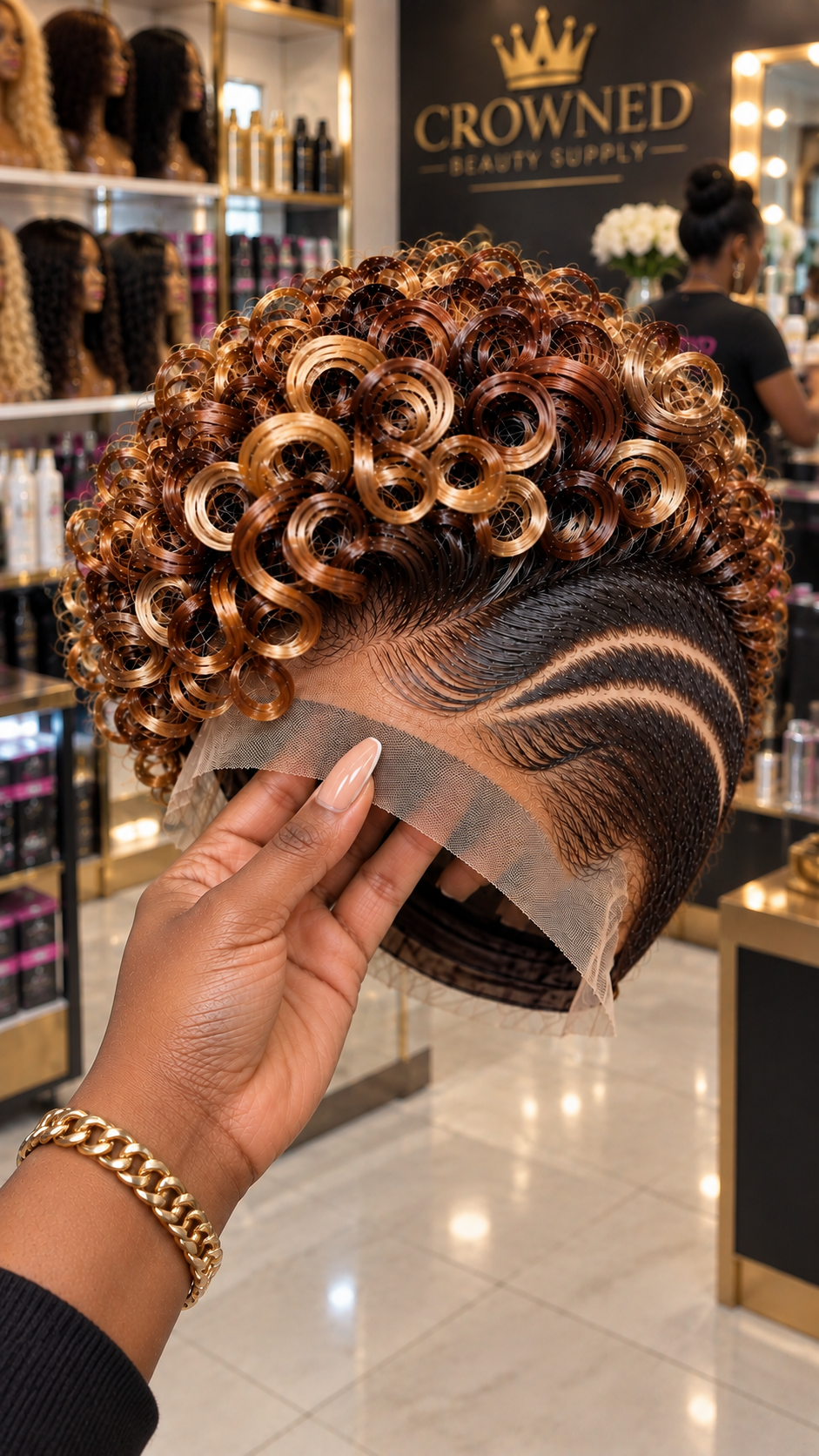
A striking wig does not always need dramatic length to create a memorable appearance. Sometimes the strongest design comes from the precise relationship between its curls, color, and hair direction. This honey bronze pixie wig illustrates that approach through a dense collection of circular rosette curls above two sweeping temple channels. The upper hair glows with caramel, bronze, and golden-brown reflections, while the lower side remains dark and closely arranged, creating a distinctive contrast.
The wig is photographed before installation, held in one hand inside a beauty supply salon. Its beige lace extends beyond the front hairline, and part of the dark interior cap is visible beneath the mesh. The image provides a useful opportunity to examine the styling without the visual distractions of a completed installation.
What makes this particular hairpiece interesting is the precision of its upper curl arrangement. Many loops form nearly complete circles with visible openings, while others overlap in small rosette-like clusters. The curls are not distributed randomly. Their positioning creates a compact, rounded upper silhouette that contrasts with the directional hair beneath them.


The visible temple introduces another distinctive element: two pronounced curved separation channels arranged in a flowing pattern. These divisions create a layered appearance across the dark side without requiring a completely shaved section. For buyers considering a comparable wig, the accuracy of these curves may be just as important as the copper-brown color.
The Rosette Arrangement Creates a Distinctive Upper Profile
The upper hairstyle contains numerous glossy circular loops, many positioned with their openings facing outward. These curls resemble small rosettes, with strands circling around dark centers and overlapping neighboring sections.
Several larger loops occupy the front and central upper area. Their openings are particularly noticeable because the outer strands reflect golden-brown light while the inner sections remain darker.
Smaller curls fill the spaces between the larger formations and continue toward the visible rearward portion. This mixture of curl sizes creates a layered appearance without producing excessive height.
The loops are not arranged in identical rows. Some face forward, others turn diagonally, and several overlap at different angles. This variation contributes to the hairstyle’s visual depth.
The upper silhouette remains relatively compact. Although the curls create fullness, they do not extend into a tall afro shape or long hanging spirals.
For a custom reproduction, preserving this relationship between larger central rosettes and smaller surrounding loops is essential. A wig with uniformly sized curls may have similar volume but a noticeably different appearance.
Why Circular Openings Matter More Than Additional Hair
The most recognizable characteristic of the upper hairstyle is the visibility of individual circular openings. These spaces allow the viewer to distinguish one loop from another.
Adding excessive density could obscure the openings and cause the curls to merge into a continuous surface. Conversely, reducing the number of curls too much could create large gaps and weaken the rounded silhouette.
A skilled wig maker should consider curl diameter, spacing, and orientation together. The objective is not simply to create more curls but to arrange them so their individual shapes remain visible.
When ordering, request a photograph from slightly above the wig. This angle can reveal whether the rosette arrangement resembles the reference.
Honey Bronze Reflections Over a Dark Foundation
The upper curls display warm honey bronze, caramel, copper-brown, and deeper chestnut tones. Some loops appear almost golden where their outer surfaces catch the salon lighting.
Other curls show richer reddish-brown reflections, particularly where strands overlap or curve away from the brightest light.
The underlying hair remains considerably darker, approaching espresso brown or black in certain areas. This contrast gives the upper rosettes greater visual prominence.
The photographed color should not be interpreted as proof of a particular dye formula. Warm indoor lighting, reflective styling products, and natural differences between strands may all influence the recorded appearance.
Buyers should request photographs under neutral daylight before choosing a final shade. This can help determine whether the wig appears more golden, copper, or chestnut outside the salon environment.
Choosing a Color That Preserves the Contrast
A uniformly golden wig would not necessarily reproduce the same visual effect. The darker foundation plays an important role in separating the circular loops and connecting them to the lower temple section.
For a custom order, describe the desired color as a warm honey bronze upper hairstyle with deeper brown roots and dark side hair.
Ask whether the supplier can provide actual color samples or photographs of completed wigs in comparable shades.
If the selected material is human hair, any coloring service should account for previous processing. If synthetic fibers are used, the desired color may need to be selected from available manufactured shades.
The photograph does not establish the material, so neither coloring method should be assumed suitable for the pictured unit.
Two Sweeping Temple Channels Give the Side Its Identity
The visible temple contains two prominent curved separation channels. They travel across the dark side in a flowing arrangement, creating distinct sections of closely styled hair.
The upper channel follows a broad curve beneath the raised rosette curls. Below it, a second channel creates another sweeping division through the lower side.
The channels are not perfectly straight or uniformly spaced. Their paths bend with the contour of the hairstyle, producing a layered S-like appearance.
Between the channels, dark strands remain visible and closely arranged. These hair panels provide the contrast necessary for the pale separations to stand out.
The photograph does not establish whether the channels were created through parting, cutting, or another styling technique. They should not automatically be described as shaved razor lines.
For an accurate reproduction, the stylist should preserve the two visible curves without introducing additional decorative stripes.
The Middle Side Panel Is a Critical Design Element
The dark hair between the curved channels forms a substantial middle panel. Its strands follow the direction of the surrounding curves, creating a close-fitting appearance beneath the upper curls.
This panel is important because it determines the spacing between the two pale separations.
If the panel becomes too narrow, the curves may appear crowded. If it becomes too wide, the design may lose its compact layered character.
The photographed side retains visible hair coverage rather than exposing bare skin. The strands appear directed downward and backward, following the shape of the wig.
Customers comparing ready-made products should examine this area carefully. Two wigs may have similar curved partings but different panel widths, producing noticeably different results.
A close side photograph is therefore one of the most useful images to request before purchasing.
Dark Finger Waves Connect the Upper Curls to the Hairline
Near the front, the dark hair is arranged into a sweeping finger-wave pattern. Fine strands follow a curved direction from the hairline toward the upper hairstyle.
This section appears flatter than the circular curls above it, creating a gradual transition between the raised rosettes and the closely styled temple.
The wave bends toward the visible side, visually connecting the upper curl arrangement with the curved separation channels.
Several small curls extend forward above this area, creating a decorative border near the forehead.
The photograph shows the wig before installation, so the final position of these strands against a wearer’s skin cannot be confirmed.
Cap fit, lace preparation, and any additional customization will influence how the front hairline appears once worn.
Examining the Untrimmed Beige Lace
A broad section of beige-toned lace extends beyond the front and visible temple. The mesh remains untrimmed and hangs freely beneath the styled hairline.
The lace provides material for fitting, but its appearance does not establish a specific commercial classification.
The photograph does not confirm whether the wig uses HD lace, Swiss lace, transparent lace, or another type. Those details require reliable seller information.
Part of the dark interior cap can be seen beneath the lace, but the complete construction remains hidden.
The image does not establish the total number of comb attachments, the presence of adjustable straps, or whether the wig is designed for adhesive-free installation.
Before purchasing, request a complete underside photograph and written specifications for the cap and lace.
Why the Temple Pattern Must Be Checked During Fitting
The curved channels sit close to the temple, so their position can change visually when the wig is placed on a head.
If the cap sits too far forward, the lower curve may extend into an unintended area near the face. If it sits too far backward, the decorative pattern may become less prominent.
A professional stylist should first position the wig and evaluate the relationship between the front hairline, upper curls, and temple channels.
Only after confirming the fit should excess lace be trimmed where necessary.
Cutting too much lace prematurely can reduce adjustment flexibility and may permanently affect the front edge.
Finding a Wig Maker With Rosette Curl Experience
This hairstyle requires more specific expertise than an ordinary curly pixie wig. Its appearance depends on circular loop placement, a compact upper silhouette, warm color distribution, and precise temple geometry.
When searching for a supplier, consider specialized wig boutiques, custom lace wig makers, and salons experienced in sculpted curl designs.
Useful search descriptions include honey bronze rosette wig, circular coil pixie lace wig, sculpted spiral curl hairpiece, and finger-wave pixie with double curved parting.
Ask prospective suppliers to provide examples of previous work featuring carefully arranged circular loops.
A portfolio containing only loose curls may not demonstrate the expertise required for this design.
For ready-made products, request photographs of the actual unit available for shipment rather than relying solely on catalog images.
Preparing a Custom Order That Prioritizes Accuracy
Begin by identifying the upper rosette arrangement as the principal styling requirement. Explain that the hairstyle should contain visible circular openings with varied loop diameters.
Next, specify the warm honey bronze appearance and darker foundation. Provide the reference photograph so the maker can evaluate the relationship between the upper curls and lower side.
Identify the two curved temple channels and the dark finger-wave section near the front.
Ask the maker not to add extra decorative lines, increase the crown height excessively, or replace the circular loops with ordinary loose curls.
Finally, confirm the cap measurements, lace specifications, hair material, and intended installation method.
If possible, request a progress photograph before final styling is completed. This can help identify significant differences while adjustments may still be feasible.
Ready-Made Convenience Versus Custom Precision
A ready-made wig may be suitable if the buyer finds a unit with comparable curls, color distribution, and cap dimensions.
However, exact reproduction may be challenging because the reference combines several specific characteristics.
A generic caramel curly pixie may have the correct approximate color but lack the open rosette loops. Another wig may reproduce the curls while using a different temple arrangement.
Custom production offers more control over curl placement, color depth, and the position of the curved channels.
The trade-off may involve higher cost and additional production time.
Before choosing either route, determine which details are essential and which minor variations would be acceptable.
Booking a Stylist for Installation and Curl Care
After receiving the wig, inspect the curls, lace, and cap before making any adjustments.
When booking a salon appointment, explain that the hairstyle contains carefully arranged circular rosettes and two curved temple channels.
Ask whether the stylist has experience installing sculpted pixie wigs without disturbing the upper curls.
At the appointment, the cap should be positioned and checked for comfort before any lace trimming.
If the side requires adjustment, the stylist should inspect the underlying construction before using cutting tools.
For future maintenance, ask whether the salon can restore individual loops if they lose their circular shape during wear or washing.
Illustrative Pricing for a Honey Bronze Rosette Wig
The cost of reproducing this hairstyle may depend on hair material, cap construction, lace coverage, color requirements, and the labor involved in arranging the circular curls.
The photograph does not establish the actual manufacturer, fiber composition, or selling price.
The following US dollar figures are illustrative planning estimates rather than verified current product prices.
| Wig Category | Illustrative USD Range | Potential Cost Considerations |
|---|---|---|
| Premium Custom | $345–$795+ | Personalized cap measurements, detailed rosette curl setting, honey bronze color work, and precision temple styling. |
| Standard Custom | $185–$415 | Selected adjustments to curl placement, color distribution, cap sizing, and double-channel temple styling. |
| Basic Human Hair | $110–$280 | A human-hair base unit that may require additional coloring and professional rosette setting. |
| Premium Synthetic | $75–$205 | A higher-grade synthetic option with potentially prearranged circular curls and blended warm coloring. |
| Basic Synthetic | $30–$110 | A budget alternative where exact loop placement and temple geometry may vary. |
These categories describe possible purchasing approaches and do not identify the material of the photographed wig.
Installation, shipping, lace preparation, and future curl restoration may be charged separately.
Ask for an itemized quotation and confirm which services are included before paying.
Maintaining the Circular Rosettes and Side Channels
The upper rosettes are the most visually delicate part of the hairstyle. Their appearance depends on individual loops retaining their rounded shape and remaining separated enough for their openings to be visible.
Brushing through the curls could disturb their arrangement. Before attempting maintenance, ask the supplier how the loops were formed and which products are appropriate for the material.
If the wig contains synthetic fibers, heat tools should only be used within manufacturer-confirmed limits.
If the unit contains human hair, professional curl resetting may be possible, but the appropriate method depends on previous processing and the original styling technique.
The honey bronze color may also require attention. For confirmed color-treated human hair, repeated washing, excessive heat, and sunlight can influence color longevity.
For synthetic fibers, conventional hair dye should not be assumed suitable.
The dark temple section should be maintained without excessive manipulation, particularly near the two curved separation channels.
Additional Views Worth Requesting Before Purchase
The reference provides a strong view of the upper curls and one temple, but it does not reveal the complete rear or opposite side.
A direct front photograph would help establish how the circular rosettes frame the forehead.
An opposite-side view would show whether the curved temple channels are repeated or whether the other side has a different arrangement.
A rear photograph would reveal how the curls continue toward the nape.
A complete underside image would help verify the cap construction and attachment components.
A brief video under neutral lighting would also provide a more reliable impression of the honey bronze color and overall proportions.
Choosing a Rosette Wig for Its Distinctive Structure
This wig combines warm honey bronze circular curls with a dark foundation and two sweeping temple channels. The upper rosettes create a lively arrangement of overlapping circles, while the closely styled side keeps the silhouette compact.
The untrimmed lace and partially visible interior provide useful information, but they do not establish the complete construction or fiber composition.
For buyers seeking a sculpted pixie hairstyle, the strongest purchasing strategy is to evaluate curl shape, color distribution, temple geometry, and cap fit as connected considerations.
A successful reproduction should preserve the circular openings and warm bronze depth without introducing additional decorative side lines or changing the hairstyle into ordinary loose curls.
With accurate supplier communication, appropriate fitting, and maintenance suited to the confirmed hair material, this design can offer a distinctive alternative to conventional curly pixie wigs.
Search Terms
Honey bronze circular rosette pixie wig · Caramel chestnut spiral coil hairpiece · Double S curve temple parting wig · Dark finger wave bronze lace wig · Golden copper hollow curl crown · Beige untrimmed lace rosette wig · Two sweeping side channels pixie · Warm brown sculpted loop hairstyle